
Son of immigrant pioneers changed consumer culture amid Great Depression, Dust Bowl and looming world war
One of the world’s greatest conveniences was conceived amid its greatest hardships.
Sylvan Goldman, son of immigrant pioneers, invented the shopping cart.
His brilliantly simple idea was born in Oklahoma during global economic calamity and as the Great Plains were recovering from ecological disaster.
“The simplest inventions are always the most fascinating,” Larry O’Dell, the state historian for the Oklahoma Historical Society, told Fox News Digital.
“You wonder, ‘How was this not done before?’ It’s brilliant.”
The shopping cart is the ultimate symbol of American bounty and the richness of its consumer culture.
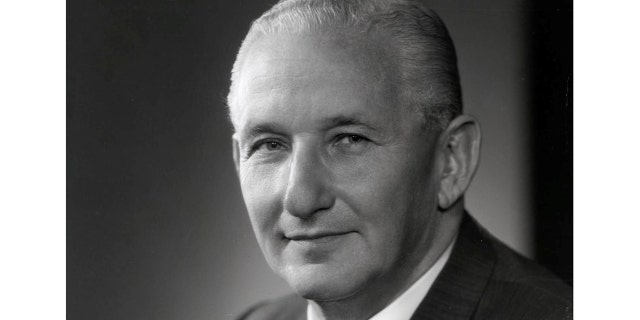
Oklahoma grocery store magnate Sylvan Goldman invented the shopping cart in 1936 — and went on to become a shopping-cart manufacturer and benefactor of many Oklahoma charities and institutions. (State Museum Collection, Sam Flood Collection, Oklahoma Historical Society)
Yet the shopping cart’s creator was born to a hardscrabble family of boomer Sooners in 19th-century Indian Territory — Oklahoma before it was Oklahoma.
Goldman introduced his ingenious innovation at his chain of Humpty Dumpty grocery stores across the state in 1937.
His “invention of the shopping cart revolutionized merchandising and changed the face of America,” The Oklahoman newspaper wrote in tribute to the beloved native son the day after his death in 1984.
The mid-1930s seem a most unlikely time to revolutionize global consumer culture.
The world was suffering through the Great Depression, imperial Japan was waging war in Asia and Hitler was about to unleash his frightening new blitzkrieg warfare upon Europe.
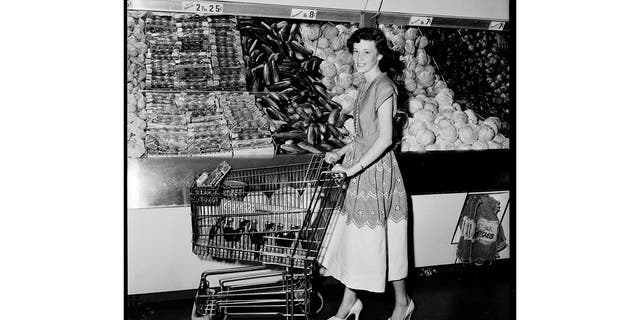
Woman using a Sylvan Goldman shopping cart in use at a Humpty Dumpty grocery store. (Meyers/Barney Hillerman Photographic Collection, Oklahoma Historical Society)
Goldman’s innovation before global conflict came in the immediate aftermath of another disaster.
The infamous Dust Bowl, caused by years of drought and government land mismanagement, turned the rich topsoil of the Great Plains into arid desert sand in the 1930s.
“To the red country and part of the gray country of Oklahoma, the last rains came gently, and they did not cut the scarred earth,” John Steinbeck famously wrote in “The Grapes of Wrath,” his 1939 fictional American epic of hardened Okies escaping the Dust Bowl for California.
The world could not have appeared more ominous than it did in 1937.
Yet hard times breed innovation, to quote a popular entrepreneurial aphorism.
Perhaps it was the history of hardship that inspired Goldman, buoyed by his family’s pioneering spirit, to look at the world in a new, more optimistic way.
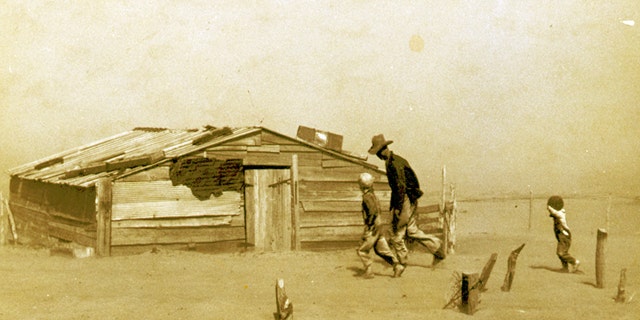
Farmer and sons walking in the face of a dust storm in Cimarron County, Oklahoma in the 1930s. (Universal History Archive/UIG via Getty images)
“Goldman’s invention, the grocery shopping cart, made him a multi-millionaire and became the most used item on four wheels for public use, second only to the automobile,” croons the Oklahoma Hall of Fame.
Born of Sooner spirit
Sylvan Nathan “Syl” Goldman was born to an immigrant pioneer family on Nov. 15, 1898, in what was then the Chickasaw Nation.
His birthplace is now part of Ardmore, Oklahoma, about 100 miles south of Oklahoma City.
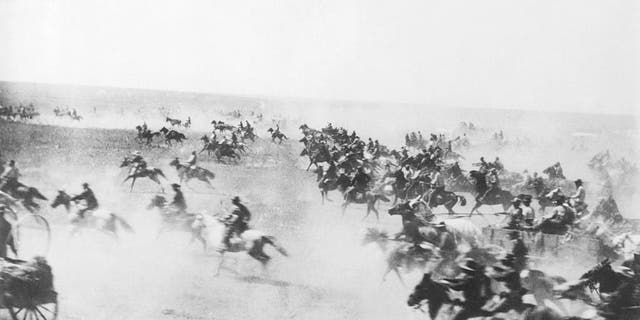
The start of the Oklahoma Land Run at high noon as settlers rush to claim the Unassigned Lands, Oklahoma, April 22, 1889. (Barney Hillerman/Underwood Archives/Getty Images)
His father, Michael Goldman, was born in Latvia. His mother, Hortense (Dreyfus) Goldman, hailed from Alsace-Lorraine, a war-torn wedge of Europe at various times part of Germany or France, depending upon the outcome of the most recent conflict.
“His father, Michael Goldman, earlier had demonstrated initiative and ambition,” historian Terry P. Wilson wrote in his 1978 biography, “The Cart That Changed the World: The Career of Sylvan N. Goldman.”
The elder Goldman arrived in Baltimore, Maryland, in 1880 and obtained work in a dry goods store, establishing the family’s grocery-store trajectory.
He moved west and in 1889 joined the famous land rush on what’s now Oklahoma.
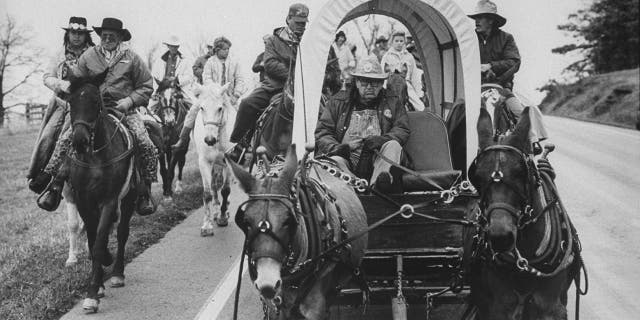
Trekkers in horse-drawn covered wagon and on horseback reenacting the Trail of Tears, 1,000-mile journey that Cherokees traveled 150 years ago. No location. (Ed Lallo/Getty Images)
Goldman’s dad was among America’s most iconic pioneers: an original Sooner.
The future supermarket magnate was a Latvian-French Jew, born and raised on land settled by the Five Tribes, the native peoples of the American southeast, at the end of the Trail of Tears.
“The Trail of Tears was hard on the Five Tribes,” O’Dell, the Oklahoma historian said.
“It was even harder on their slaves.”
The native tribes on the Trail of Tears — Cherokee, Chickasaw, Choctaw, Creek, Seminole — owned Black slaves of African descent.
It’s a poignant statement of the complexity of race and culture in the American melting pot that refutes simplistic contemporary pop-culture binary narratives.
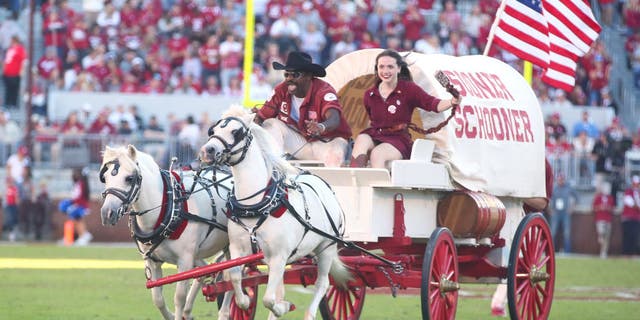
The University of Oklahoma recreates the Land Run of 1889 with the Sooner Schooner rushing the field before football games and after the Sooners score. (David Stacy/Icon Sportswire via Getty Images)
People of global heritage and race settled the Indian Territory together. The natives and Africans were followed by the Boomer Sooners — primarily European-Americans and recent European immigrants.
Goldman grew up a rare Jew in a multiracial but overwhelmingly Christian society. He attended school only through the eighth grade.
“He learned the retail store business from working in the family dry goods store in Ardmore, Oklahoma,” reports the website of Oklahoma City, where Goldman spent most of his life.
Goldman soon answered the call of Uncle Sam, enlisting in the U.S. Army with his boyhood pals on April 25, 1917 — just 19 days after the nation declared war on Germany.
The patriot Goldman, then only 18, lied about his birthday to meet the then-21 age of enlistment.
Goldman’s knowledge of the food industry earned him a job as a mess cook.
“Sergeant Goldie” in the summer and fall of 1918 fed doughboys on the front lines of Saint-Mihiel and in the decisive American-led campaign on the Argonne Forest that earned the Allies victory in World War I.
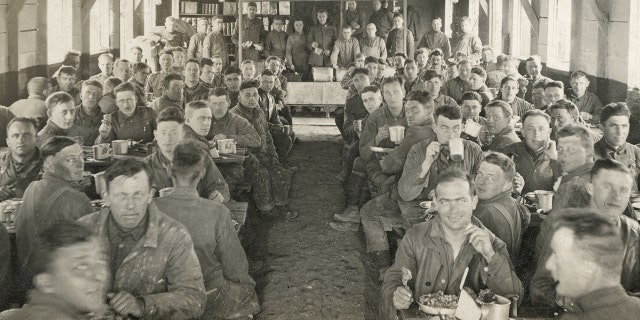
World War I, Interior of an American barracks at Lux (Côte-d’Or, France). In 1918. (adoc-photos/Getty Images)
His work securing supplies from local sources was enhanced by the French he learned from his mother.
“Goldman tackled the myriad tasks of preparing food for 200 men under all kinds of conditions with the good humor and determination that characterized his later business activities,” Wilson wrote in his Goldman biography.
Goldman entered the grocery store business in Texas with his brother Alfred immediately after the war.
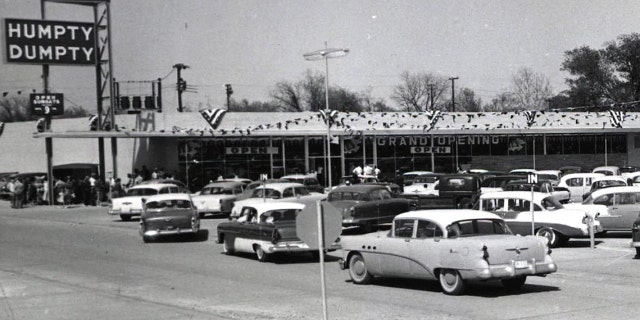
Humpty Dumpty Grocery Store grand opening in Ardmore, Oklahoma, circa 1950s. Sylvan Goldman purchased the faltering grocery chain in the 1930s and turned it into a success with inventions such as the shopping cart. (Oklahoma Historical Society)
The Goldman boys enjoyed various degrees of success in Texas, California and Oklahoma before purchasing the struggling Humpty Dumpty chain of grocery stores in 1934. Alfred Goldman died in 1937.
The lone Goldman brother changed the fortunes not only of Humpty Dumpty, but of consumer culture around the world with the shopping cart.
He conceived of the idea in 1937, tooling around with it in his carpentry shop.
His original shopping cart was slightly different than the all-in-one model we know today.
His “combination basket and carriage,” as he called it in the patent application, was a two-part unit.
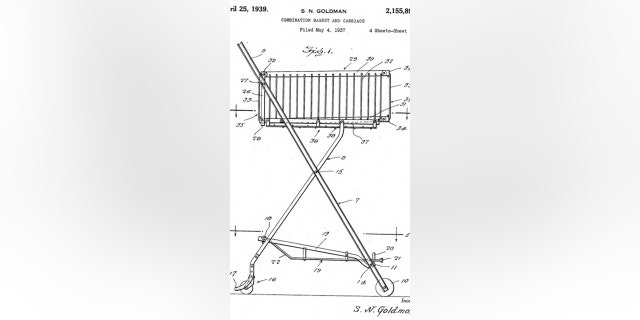
Sylvan Goldman invented the shopping cart in 1937. He received the patent for his invention in 1939. (U.S. Patent and Trademark Office/Public Domain)
It featured the typical wire shopping basket that could now be placed on his visionary addition, a collapsible frame with wheels.
Goldman himself must have been giddy with the thought.
He referred to his shopping basket and carriage as “ingenious” and a “broad inventive concept” in the patent application.
It measured 24 inches long, 18 inches wide and 36 inches tall.
“The baskets had to be removed when the cart was folded, but they were designed so they could be stacked and took up very little space. Goldman added a baby seat to his design a year later,” reports the National Center for Agricultural Literacy, which offers lesson plans to teach Goldman’s story to rural schoolchildren.
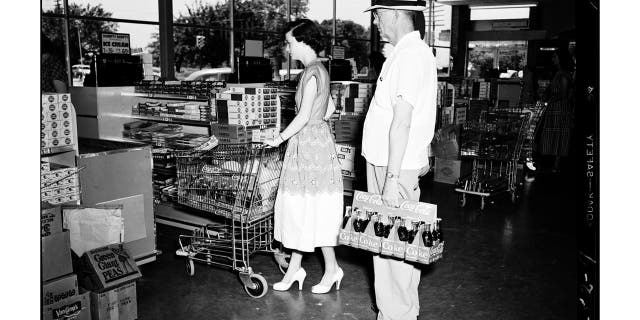
A woman with her shopping cart checking out of an Oklahoma Humpty Dumpty store in 1951. Said O’Dell, the Oklahoma historian, of the shopping cart, “It’s hard to believe nobody thought of it before.” (Oklahoma Historical Society)
“The fact the shopping cart wasn’t invented until the mid-1930s just floored me,” said O’Dell, the Oklahoma historian.
“It’s hard to believe nobody thought of it before.”
Shopping carts rolled into Humpty Dumpty markets across Oklahoma on June 4, 1937.
The public — naturally — hated the idea.
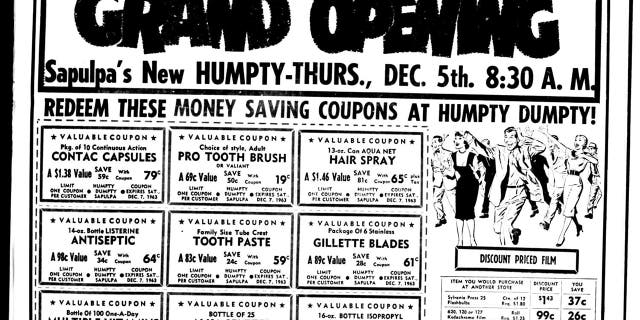
Advertisement promoting the opening of a new Humpty Dumpty grocery store in Sapulpa, Oklahoma, from the Sapulpa Daily Herald, Dec. 5, 1963. (Oklahoma Historical Society)
“I’ve pushed my last baby buggy,” women reportedly retorted, according to an oft-cited quote.
Men also resisted “because pushing a cart didn’t feel ‘manly enough,’” The Oklahoman reported in a 2018 retrospective on the Sooner State creation.
“I thought it would be an immediate success. I was so enthused about the cart and the advertising we had put around the cart being put on the market,” Goldman told CBS television reporter Charles Kuralt in a 1977 interview.
“I went down to the store the next morning about 10 o’clock expecting to see people standing in line outside the store trying to get in.”
He was met not by crowds but by utter disappointment.
“When I got there, there was ample room for me to get in. There were people shopping and not a one was using the cart.”
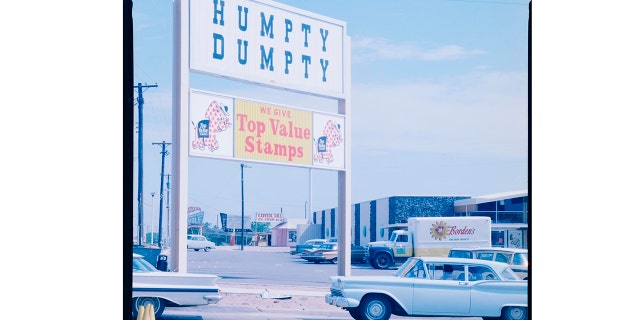
Sign outside a Humpty Dumpty grocery store in Oklahoma in 1964. (Oklahoma Historical Society)
Undaunted, Goldman turned to some classic marketing magic. He hired women of various ages to walk around near the entrance of each store, pretending to be shopping with their carts.
“Shills!” cracked Kuralt.
“That’s right. Exactly what it was,” Goldman replied, smiling broadly and nodding his head. “When they’d seen the ones that were walking around using them, they started using them. And immediately it became a huge success.”
Sylvan Goldman died on Nov. 25, 1984 in Oklahoma City.
His wife of 53 years, Margaret Katz Goldman, died only a week earlier.
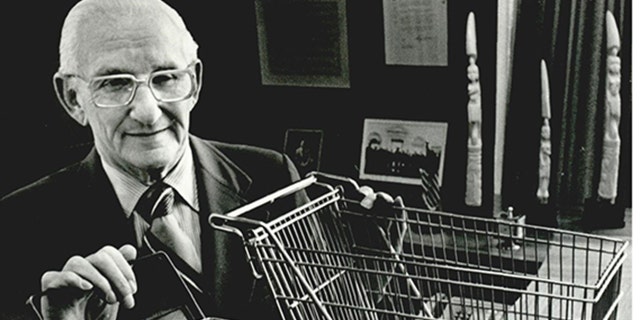
Sylvan Goldman, Oklahoma City supermarket magnate, pictured in 1976. Goldman invented the supermarket shopping cart in 1936. (Don Tullous, courtesy Oklahoma Historical Society)
“Goldman’s shopping cart invention has been described by his biographer and others as the greatest development in the history of merchandising,” The Oklahoman wrote in its obituary the following day.
“Goldman used the fortune he amassed from the cart and from a retail food chain to launch a vast business empire that includes savings and loan, banking, insurance and real estate development shopping centers, office buildings, hotels and thousands of acres of property across the United States.”
The Oklahoma Country Historical Society has an award named in his honor.
He gifted the Oklahoma Blood Institute $1.5 million, which honors him with their lifesaving work today at the Sylvan N. Goldman Center.

In this photo illustration, an Amazon logo is seen displayed on a smartphone along with a shopping cart. (Rafael Henrique/SOPA Images/LightRocket via Getty Images)
Oklahoma City honors the businessman with Syl Goldman Park, located between South Independence Avenue and Interstate 44 near Will Rogers World Airport.
“With his wife Margaret, the Goldmans donated large buildings and small statues and provided major support for education, the Oklahoma Blood Institute, and the arts and humanities,” the city website proclaims.
His legacy is most notable in his prized shopping carts, so ubiquitous we hardly notice them today and really can’t imagine a world without them.
Industry estimates vary, but several sources say that about 100,000 grocery stores and supermarkets across the United States carry an average of about 200 to 250 shopping carts — a total of up to 25 million shopping carts.
At any given time, 15 million shopping carts are rolling across the aisles of American markets, according to several estimates, while millions more are used daily around the world.
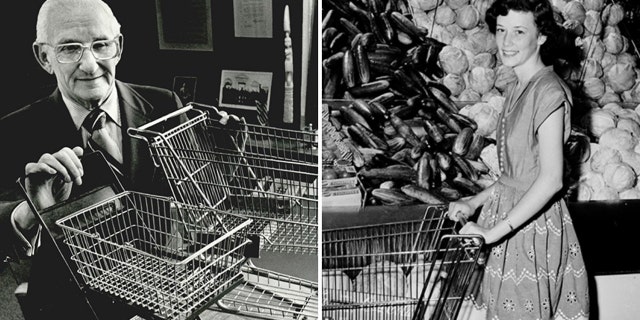
Sylvan Goldman, left, invented the shopping cart in 1937; shown on the right is a shopper at one of his Humpty Dumpty stores in Oklahoma in the 1950s. (Courtesy Oklahoma Historical Society)
The digital consumer industry has even adopted the term first applied to Goldman’s wire and wheel invention.
Global consumers place items in their Amazon or other online shopping cart by the hundreds of millions each day.
“If there were no shopping carts, nothing to roll our children and our Campbell’s soup around the store in, what would become of us?” Kuralt asked viewers in his 1977 interview with Goldman.
“There might never have been a supermarket. There might never have been a giant economy-sized Kellogg’s Rice Krispies. It boggles the mind.”
“Goldman,” The Oklahoman wrote in its obituary, “was the epitome of the immigrant’s son who worked hard and risked much to build a business.”
Kerry J. Byrne is a lifestyle reporter with Fox News Digital.










 Michael Bradley - Time Traveler