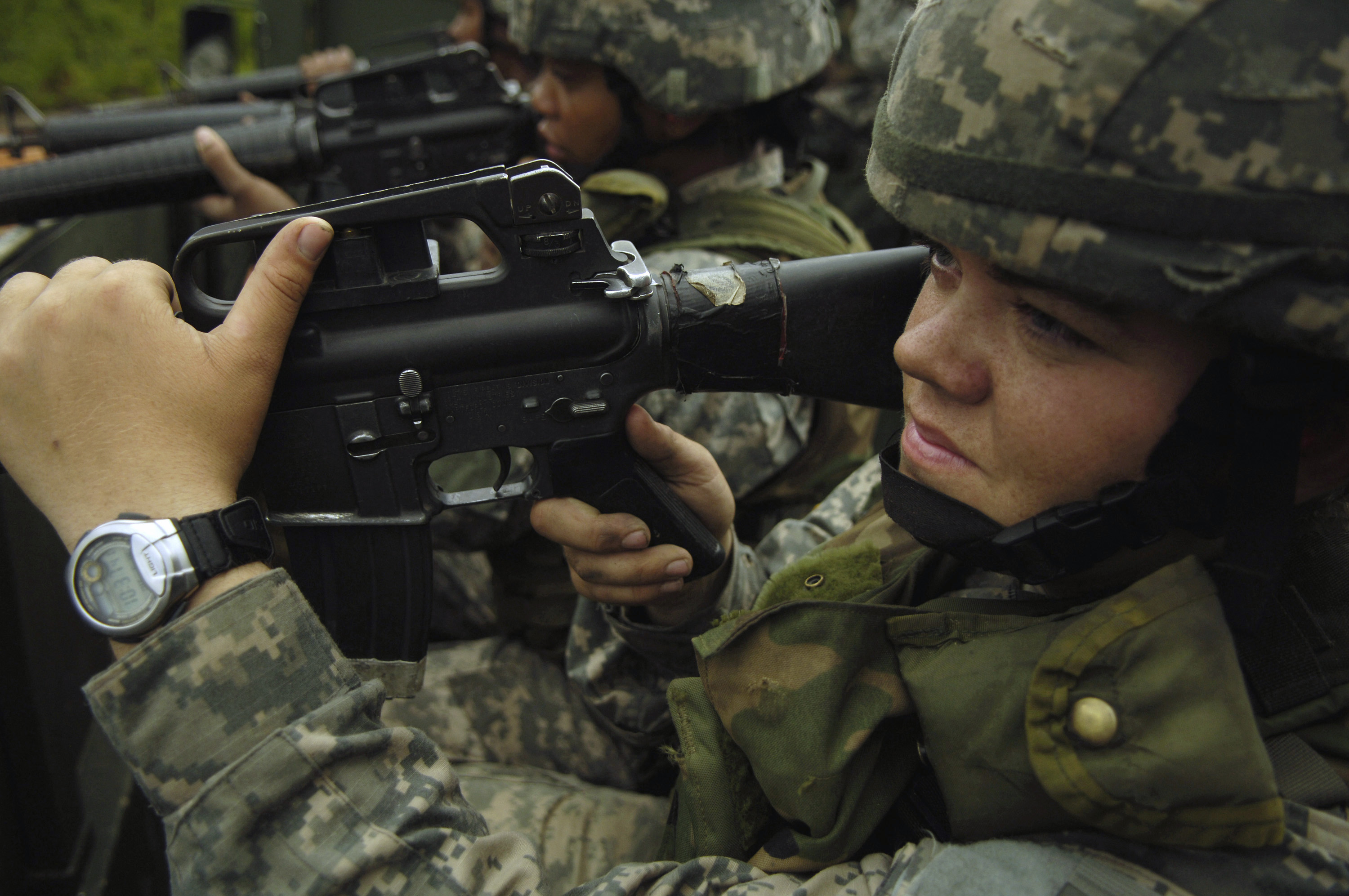
Oddly enough, none of the debaters on the issue of women in the military seem to have any real clue as to why women were excluded from combat in the first place. It was never because women cannot fight well, nor that they cannot fight alongside men. The fact is that historically, people went to war over women, to get women. Women were the most valuable commodity after clean water, food and shelter. The ancient Trojan War was fought because Troy kept taking women from the Greeks in order to have more women for their city. The final straw was when one of the kings had his wife taken. They launched the famous thousand ships because they could tolerate losing their women no more.
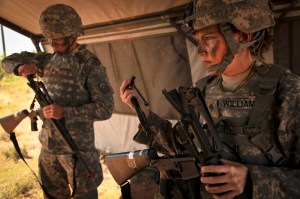
The Roman Empire started as a feud between the Romans, a small band, and the Iceni, over women. If you had women, you could breed and grow as a nation, without them you died off. Men could be replaced, but not child bearers. Crudely speaking, one man can keep ten women pregnant, but not the other way around. Women were simply too valuable to lose in battle. Still, there is a long history of women fighting anyway. Queen Boudicea was the Celtic Brittanic Queen who nearly defeated the Romans in England after they were stupid enough to rape her sisters to intimidate her. The woad women were especially fierce.
That is why I find both sides of the “controversy” to have such strange arguments. First, one argues women cannot do the same job, or men cannot fight clear headed with them alongside. This ignores thousands of years of history, and contemporary history of such places as the Soviet Union in World War 2, or modern day Israel where everyone spends two years in the military. The other side claims women are just like men. No they are not. Yes, they can fight, but in a volunteer force, not as many women are as drawn to the military as a career. If they are fine, if not, don’t force them to go under some equality crusade.
Men and women should have equal rights, pay, privileges and opportunities, but they are not the same. Women tend to be smaller which is great for flying fighter jets and crawling inside tanks. It is not so great for carrying a 75 mm mortar, base mount or extra rounds. Some women are stronger and bigger than some men and can do just fine. I believe women should be allowed to any job in the military they qualify for, the same as a man. I am a disabled veteran myself. I could never have become a Navy seal or an Army ranger. I am simply not strong enough physically. We can keep our standards based on each position and men and women will both fill jobs as they can.
My only concern is what happened on somewhat second line units. In the Navy, on vessels in the Gulf Conflicts, the pregnancy rate skyrocketed. Men and women on the ships commingled and created progeny. This by itself is not a problem, other than those women are sent back for nine months out of harm’s way, and their units receive men to replace them that are not part of the team. Working with a team through drills, exercises and combats creates the most efficient units. If women are intermixed with men, then birth control needs to be used so as to not disadvantage men with having to stay in the lines, while women return home. I know it takes two to tango, but statistically, the Navy was ashamed at the sudden burst of pregnancies when the combat started.
Women in the military – YES! Everyone who wants to serve their country should be able to do so. Every person should have to qualify for what they do, just as I had to in my field. Only people who could easily life 90 pounds over their head dead lift were allowed into my specialty (among other requirements). I worked on classified electronics. So, I also had to have good depth perception, no problems with color blindness (for reading electric wire colors – kind of important black vs. red), be able to run a mile in 7 minutes with a 60 lb pack, and other objective tasks. My gender was really irrelevant. Several women served in my unit, though as a volunteer force, my particular specialty did not attract a lot of women. Those that did work there did everything as good or bad as the men.
What do you think? Before you answer, here is a brief summary of women in combat in the United States:
Highlights in the History of Military Women
American Revolution (1775-1783): Women serve on the battlefield as nurses, water bearers, cooks, laundresses and saboteurs.
War of 1812: Mary Marshall and Mary Allen nurse aboard Commodore Stephen Decatur’s ship United States.
Mexican War (1846-1848): Elizabeth Newcom enlists in Company D of the Missouri Volunteer Infantry as Bill Newcom. She marches 600 miles from Missouri to winter camp at Pueblo, Colorado, before she is discovered to be a woman and discharged.
Civil War (1861-1865): Women provide casualty care and nursing to Union and Confederate troops at field hospitals and on the Union Hospital Ship Red Rover. Women soldiers on both sides disguise themselves as men in order to serve. In 1866, Dr. Mary Walker receives the Medal of Honor. She is the only woman to receive the nation’s highest military honor.
Spanish-American War (1898): Thousands of US soldiers sick with typhoid, malaria and yellow fever, overwhelm the capabilities of the Army Medical Department. Dr. Anita Newcomb McGee suggests to the Army Surgeon General that the Daughters of the American Revolution (DAR) be appointed to select professionally qualified nurses to serve under contract to the US Army. Before the war ends, 1,500 civilian contract nurses are assigned to Army hospitals in the US, Hawaii, Cuba, Puerto Rico, Guam and the Philippines, as well as to the Hospital Ship Relief. Twenty nurses die. The Army appoints Dr. McGee Acting Assistant Surgeon General, making her the first woman ever to hold the position. The Army is impressed by the performance of its contract nurses and asks Dr. McGee to write legislation creating a permanent corps of nurses.
1901: Army Nurse Corps is established.
1908: Navy Nurse Corps is established.
World War I (1917-1918): During the course of the war, 21,480 Army nurses serve in military hospitals in the United States and overseas. Eighteen African-American Army nurses serve stateside caring for German prisoners of war (POWs) and African-American soldiers. The Army recruits and trains 233 bilingual telephone operators to work at switchboards near the front in France and sends 50 skilled stenographers to France to work with the Quartermaster Corps. The Navy enlists 11,880 women as Yeomen (F) to serve stateside in shore billets and release sailors for sea duty. More than 1,476 Navy nurses serve in military hospitals stateside and overseas. The Marine Corps enlists 305 Marine Reservists (F) to “free men to fight” by filling positions such as clerks and telephone operators on the home front. Two women serve with the Coast Guard. More than 400 military nurses die in the line of duty during World War I. The vast majority of these women die from a highly contagious form of influenza known as the “Spanish Flu,” which sweeps through crowded military camps and hospitals and ports of embarkation.
Army Reorganization Act (1920): A provision of the Army Reorganization Act grants military nurses the status of officers with “relative rank” from second lieutenant to major (but not full rights and privileges).
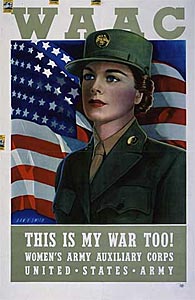
World War II (1941-1945): More than 60,000 Army nurses serve stateside and overseas during World War II. Sixty-seven Army nurses are captured by the Japanese in the Philippines in 1942 and are held as POWs for over two and a half years. The Army establishes the Women’s Army Auxiliary Corps (WAAC) in 1942, which is converted to the Women’s Army Corps (WAC) in 1943. More than 150,000 women serve as WACs during the war; thousands are sent to the European and Pacific theaters. The Women Airforce Service Pilots (WASP) are organized and fly as civil service pilots. WASPs fly stateside missions as ferriers, test pilots and anti-aircraft artillery trainers. More than 14,000 Navy nurses serve stateside, overseas on hospital ships and as flight nurses during the war. Five Navy nurses are captured by the Japanese on the island of Guam and held as POWs for five months before being exchanged. A second group of eleven Navy nurses are captured in the Philippines and held for 37 months. The Navy recruits women into its Navy Women’s Reserve, called Women Accepted for Volunteer Emergency Service (WAVES), starting in 1942. Before the war is over, more than 80,000 WAVES fill shore billets in a large variety of jobs in communications, intelligence, supply, medicine and administration. The Marine Corps creates the Marine Corps Women’s Reserve in 1943. Marine women serve stateside as clerks, cooks, mechanics, drivers, and in a variety of other positions. The Coast Guard establishes their Women’s Reserve known as the SPARs (after the motto Semper Paratus – Always Ready) in 1942. SPARs are assigned stateside and serve as storekeepers, clerks, photographers, pharmacist’s mates, cooks and in numerous other jobs. In 1943, the US Public Health Service establishes the Cadet Nurse Corps which trains some 125,000 women for possible military service. More than 400,000 American military women serve at home and overseas in nearly all non combat jobs. As the country demobilizes, all but a few servicewomen are mustered out, even though the United States, now a world power, is forced to maintain the largest peacetime military in the history of the nation.
1947: The Army-Navy Nurse Act of 1947 makes the Army Nurse Corps and Women’s Medical Specialist Corps part of the Regular Army and gives permanent commissioned officer status to Army and Navy nurses.
1948: The Women’s Armed Services Integration Act of 1948 grants women permanent status in the Regular and Reserve forces of the Army, Navy and Marine Corps as well as in the newly created Air Force.
Executive Order 9981 ends racial segregation in the armed services.
1949: Air Force Nurse Corps is established.
The first African-American women enlist in the Marine Corps.
Korean War (1950-1953): Servicewomen who had joined the Reserves following World War II are involuntarily recalled to active duty during the war. More than 500 Army nurses serve in the combat zone and many more are assigned to large hospitals in Japan during the war. One Army nurse dies in a plane crash en route to Korea on July 27, 1950, shortly after hostilities begin. Navy nurses serve on hospital ships in the Korean theater of war as well as at Navy hospitals stateside. Eleven Navy nurses die en route to Korea when their plane crashes in the Marshall Islands. Air Force nurses serve stateside, in Japan and as flight nurses in the Korean theater during the conflict. Three Air Force nurses are killed in plane crashes while on duty. Many other servicewomen are assigned to duty in the theater of operations in Japan and Okinawa.
1951: The Defense Advisory Committee on Women in the Services (DACOWITS) is created to advise on the recruitment of military women for the Korean War.
1953: The first woman physician is commissioned as a medical officer in the Regular Army.
Navy Hospital Corps women are assigned positions aboard Military Sea Transportation Service (MSTS) ships for the first time.
1955: Men are accepted into the Army and Air Force Nurse Corps and the Army Medical Specialist Corps.
1958: Lebanon Crisis. Military nurses are assigned to the hospitals which deploy during the crisis to support over 10,000 troops.
1961: The first woman Marine is promoted to Sergeant Major.
1965: Men are accepted into the Navy Nurse Corps.
The Marine Corps assigns the first woman to attaché duty. Later, she is the first woman Marine to serve under hostile fire.
Vietnam War (1965-1975): Some 7,000 American military women serve in Southeast Asia, the majority of them nurses. An Army nurse is the only US military woman to die from enemy fire in Vietnam. An Air Force flight nurse dies when the C-5A Galaxy transport evacuating Vietnamese orphans she was aboard crashes on takeoff. Six other American military women die in the line of duty.
1967: Legal provisions placing a two percent cap on the number of women serving and a ceiling on the highest grade a women can achieve are repealed.
1968: The first Air Force woman is sworn into the Air National Guard (ANG) with the passage of Public Law 90-130, which allows the ANG to enlist women.
1969: Air Force Reserve Officers Training Corps (AFROTC) opens to women.
1970: The first women in the history of the armed forces, the Chief of the Army Nurse Corps and the Women’s Army Corps Director, are promoted to brigadier general.
1971: The first Air Force woman is promoted to brigadier general.
An Air Force woman completes Aircraft Maintenance Officer’s School and becomes the first woman aircraft maintenance officer.
The first woman is assigned as a flight surgeon in the Air Force and the Air Force Reserve.
A staff sergeant becomes the first female technician in the Air Force Reserve.
1972: The Reserve Officer Training Corps (ROTC) is opened to Army and Navy women.
Chief of Naval Operations, Admiral Elmo R. Zumwalt, publishes Z-116 declaring the Navy’s commitment to equal rights and opportunities for women.
The Hospital Ship USS Sanctuary is the first Naval vessel to sail with a male/female crew.
The Navy promotes the first woman to rear admiral, Director of the Navy Nurse Corps.
1973: The end of draft and the establishment of the All Volunteer Force opens the door for expanding servicewomen’s roles and numbers.
The first Navy women earn military pilot wings.
The first woman in the history of the armed forces is promoted to major general.
The Navy accepts its first woman chaplain.
The Supreme Court rules unconstitutional inequities in benefits for the dependents of military women. Until then, military women with dependents were not authorized housing nor were their dependants eligible for the benefits and privileges afforded the dependents of male military members, such as medical, commissary and post exchange, etc.
1974: An Army woman becomes the first woman military helicopter pilot.
1975: DoD reverses policies and provides pregnant women with the option of electing discharge or remaining on active duty. Previous policies required women be discharged upon pregnancy or the adoption of children.
The Air Force places the first woman on operational crew status.
1976: Women are admitted to the service academies.
The Navy promotes the first woman line officer to rear admiral.
The Air Force selects the first woman reservist for the undergraduate pilot training program.
1977: The first Coast Guard women are assigned to sea duty as crew members aboard the Morgenthau and Gallatin.
Military veteran status is granted to the Women Airforce Service Pilots (WASP) who flew during WWII.
1978: The Coast Guard opens all assignments to women.
The Marine Corps promotes its first woman to brigadier general.
The first Army woman is promoted to two-star general. She is also the first woman officer to command a major military installation.
The Air Force Strategic Air Command (SAC) assigns the first woman aircrew member to alert duty.
Judge John Sirica rules the law banning Navy women from ships to be unconstitutional. Congress amends the law by opening non combat ships to women. The USS Vulcan, a repair ship, receives the first of many Navy women to be assigned shipboard under the amended law.
The Women’s Army Corps (WAC) is disestablished and its members integrated into the Regular Army.
1979: An Army Nurse Corps officer becomes the first African-American woman brigadier general in the history of the armed forces.
The first woman to command a military vessel assumes command of the Coast Guard Cutter Cape Newagen.
The first woman Naval aviator obtains carrier qualification.
The Marine Corps assigns women as embassy guards.
1980: The first women graduate from the service academies.
The first woman is assigned to command a Naval Training Command.
1982: The Air Force selects the first woman aviator for Test Pilot School.
The Marine Corps prohibits women from serving as embassy guards.
1983: The first Navy woman completes Test Pilot School.
Approximately 200 Army and Air Force women are among the forces deployed to Grenada on Operation Urgent Fury. Women serve on air crews, as military police, and as transportation specialists.
The first woman in any reserve component, an Air Force Reserve officer, is promoted to brigadier general.
1984: For the first time in history, the Naval Academy’s top graduate is a woman.
A Coast Guard officer is the first woman to serve as a Presidential Military Aide.
1985: For the first time in history, the Coast Guard Academy’s top graduate is a woman.
The first Air Force Reserve nurse is promoted to brigadier general.
1986: Six Air Force women serve as pilots, copilots and boom operators on the KC-135 and KC-10 tankers that refuel FB-111s during the raid on Libya.
For the first time in history, the Air Force Academy’s top graduate is a woman.
A Navy woman becomes the first female jet test pilot in any service.
The Coast Guard’s rescue swimmer program graduates its first woman.
1987: The Navy assigns its first woman Force Master Chief and Independent Duty Corpsman to serve at sea.
The first enlisted woman is assigned as Officer-In-Charge aboard a Coast Guard vessel.
1988: NASA selects its first Navy woman as an astronaut.
The Coast Guard’s “Chief Warrant Officer to Lieutenant” program promotes its first woman.
Marine women are again assigned as embassy guards.
1989: 770 women deploy to Panama in Operation Just Cause. Two women command Army companies in the operation and three women Army pilots are nominated for Air Medals. Two receive the Air Medal with “V” device for participation in a combat mission.
For the first time in history, the US Military Academy (West Point) names a woman as its Brigade Commander and First Captain.
NASA selects its first Army woman as an astronaut.
The Navy assigns its first woman as Command Master Chief at sea.
A woman is the first person trained for a new specialty, Coast Guard Flight Officer. These officers are responsible for tactical coordination of the drug interdiction efforts aboard Coast Guard aircraft.
War in the Persian Gulf (1990-1991): Some 40,000 American military women are deployed during Operations Desert Shield and Desert Storm. Two Army women are taken prisoner by the Iraqis.
1991: The Navy assigns the first women to command a Naval Station and an aviation squadron.
The first Navy woman assumes command of a ship.
The Air Force Reserve selects its first woman senior enlisted advisor.
Congress repeals laws banning women from flying in combat.
For the first time in history, a woman is named Brigade Commander at the Naval Academy.
1992: The first active duty woman Coast Guard officer is promoted to captain (O-6).
1993: Congress repeals the law banning women from duty on combat ships. Women deploy with the USS Fox.
The first woman Naval aviator serves with a combat squadron.
The first woman assumes command of a Naval base.
The Marine Corps opens pilot positions to women.
The Army names a woman “Drill Sergeant of the Year” for the first time in the 24-year history of this competition.
The Army assigned its first woman combat pilot.
The Air Force assigns the first woman to command an Intercontinental Ballistic Missile (ICBM) unit.
The first woman service secretary in the history of the armed forces is appointed.
The first woman in any reserve component is promoted to major general.
The Air Force assigns the first woman to command an air refueling unit.
The Coast Guard promotes the first active duty woman to master chief.
The Coast Guard assigns the first woman as Chief Judge.
1994: The USS Eisenhower is the first carrier to have permanent women crew members. Sixty-three women are initially assigned.
The first woman assumes command of a Naval Air Station.
The first woman, an Air Force major, copilots the space shuttle.
The Air Force Reserve gets its first woman fighter pilot.
1995: An Air Force lieutenant colonel becomes the first woman space shuttle pilot.
The first African-American woman, an Air Force officer, is promoted to major general.
The first female Marine pilot pins on Naval flight wings.
1996: The first women in the history of the armed forces are promoted to three-star rank.
For the first time a woman fires Tomahawk cruise missiles from a warship in a combat zone.
The first woman commands the Army’s Old Guard Fife and Drum Corps.
The first woman commands an operational flying wing.
1997: The Army promotes its first woman to lieutenant general.
The Army assigns the first woman and the first non-doctor to command an Army hospital.
The first woman in history is appointed as a state adjutant general.
1998: For the first time, a woman fighter pilot delivers a payload of missiles and laser-guided bombs in combat. She is in the first wave of US strikes against Iraq in Operation Desert Fox.
The Air National Guard promotes the first woman to major general.
1999: The Air Force promotes its first woman to lieutenant general.
For the first time, a woman, an Air Force lieutenant colonel, commands the space shuttle.
The first women graduate from the Virginia Military Institute and the Citadel.
The first woman and first African-American commands the National Oceanic and Atmospheric Administration Corps (NOAA).
The first African-American woman is selected to command a Navy ship.
2000: The Air Force promotes the first woman pilot to brigadier general.
The first Coast Guard women, an active duty officer and a reservist, are promoted to flag officer rank.
Navy women are among the victims and heroes when the USS Cole is attacked by a suicide bomber in Yemen.
The first woman commands a Navy warship at sea. The vessel is assigned to the sensitive Persian Gulf.
The Army National Guard promotes the first woman to major general.
2001: The Army promotes the first woman to brigadier general in the Judge Advocate General’s Corps. She is also the first Asian-Pacific-American woman promoted to brigadier general.
An Air National Guard security force woman becomes the first woman to complete the counter-sniper course, the only military sniper program open to women.
The US Army Women’s Museum opens at Ft. Lee, Virginia.
Terrorists highjack four commercial aircraft, crash two into the World Trade Center, one into a field in Pennsylvania and one into the Pentagon. In the attack at the Pentagon 125 people were killed on the ground and 59 passengers lose their lives; ten active duty, reserve and retired servicewomen are among the casualties. Servicewomen are activated and deployed in support of the war on terrorism.
2002: An enlisted woman Marine is killed in an aircraft crash in Pakistan, the first woman to die in Operation Enduring Freedom, part of the Global War on Terror.
The Defense Advisory Committee on Women in the Services (DACOWITS) is issued a new charter narrowing its focus to issues pertaining to military families, recruitment, readiness and retention. A retired Marine three-star general is appointed chairman of the new, downsized advisory committee.
For the first time in its history, the Army National Guard promotes an African-American woman to the rank of brigadier general.
For the first time in US history, a woman becomes the top enlisted advisor
in any of the military components. She is sworn in as the Command Sergeant
Major of the US Army Reserve.
2003: The first Native American servicewoman is killed in battle. She was one of three women who became prisoners of war during the first days of the war in Iraq.
2004: By year’s end, 19 servicewomen had been killed as a result of hostile action since the war in Iraq had begun in 2003, the most servicewomen to die as a result of hostile action in any war that the nation had participated.
The first woman in US Air Force history takes command of a fighter squadron.
2005: The first woman in history is awarded the Silver Star for combat action. She is one of 14 women in US history to receive the medal.
An Air Force woman becomes the Air Force Academy’s Commandant of Cadets, the No. 2 position at the nation’s service academies. She is the first woman in the history of any of the academies to be appointed to this position.
The first woman in US Air Force history joins the prestigious USAF Air Demonstration Squadron “Thunderbirds.” She was also the first woman on any US military high performance jet team.
2006: The Coast Guard appoints the first woman Vice Commandant of the Coast Guard, making her the first woman in history to serve as a deputy service chief in any of the US Armed Forces.
The Marine Corps assigns the first woman Marine in history to command a Recruit
Depot.
2007: The first woman in US Naval history takes command of a fighter squadron.
The last woman veteran of World War I dies, a former yeoman (F).
2008: For the first time in US military history, a woman is promoted to the
rank of four-star general. She is promoted by the US Army.




 was discovered Jan. 3 by the Scottish-Australian astronomer Robert H. McNaught, a prolific observer of both comets and asteroids who has 74 comet discoveries to his name.
 FOLLOW































 The top-like rotation of the earth on its axis is how we define the day. The time it takes the earth to rotate from noon until the next noon we define as one day. We further divide this period of time into 24 hours, each of which is divided into 60 minutes, each of which is broken into 60 seconds. There are no rules that govern the rotation rates of the planets, it all depends on how much “spin” was in the original material that went into forming each one. Giant Jupiter has lots of spin, turning once on its axis every 10 hours, while Venus takes 243 days to spin once.











































 Michael Bradley - Time Traveler