Monthly Archives: December 2013

Tongue-controlled wheelchairs

Tongue-controlled wheelchairs prove effective for quadriplegic patients

By Loren Grush

Published November 27, 2013

FoxNews.com
  • Tongue Drive System 1.jpg

    Jason DiSanto receives a tongue implant to test the Tongue Drive System. (GARY MEEK)

  • Tongue Drive System 2.jpg

    Jason DiSanto tests out the Tongue Drive System (GARY MEEK)

  • Jason DiSanto.jpg

    Jason DiSanto poses with the sip-and-puff-system (GARY MEEK)

For patients who no longer have the use of their limbs and torso, life must be navigated through a powered wheelchair – which users often control by blowing into a plastic straw to execute basic functions.

But now, a novel technology may soon allow patients with quadriplegia to better control their wheelchairs by utilizing a surprising new body part: the tongue.

Called the Tongue Drive System, the method involves implanting a magnetic stud into patients’ tongues, allowing them to use the muscle as a joystick for their wheelchairs. Sensors in the stud relay the tongue’s position to a headset placed on the patient’s head, which communicates one of six basic functions for the wheelchair to perform.

The system allows users to not only control their wheelchair, but also surf a computer, use a cellphone, turn on a television and much more.

“One of the main advantages of the tongue is that it is directly connected to the brain through cranial nerves, as opposed to the rest of the body,” Maysam Ghovanloo, an associate professor in the school of electrical and computer engineering at Georgia State Institute of Technology and the creator of the system, told FoxNews.com. “Everything from the neck down is controlled through the spinal cord, so if the spinal cord is damaged, everything below that level becomes paralyzed… But even people with the highest level of spinal cord injury, they maintain their tongue motion.”

Currently, the conventional method used by quadriplegic patients for wheelchair control is the sip-and-puff system.  Through a plastic tube mounted on the wheelchair, users either sip or puff air to dictate what they want the chair to do.  However, the sip-and-puff system can only execute four basic commands, and many patients feel it can be cumbersome and awkward.

“The problem with the sip-and-puff system – even though it’s low cost and easy to use – it’s very slow.  It works like a Morse code; you have to enter these commands in a series,” Ghovanloo said.  “…It’s also mounted on the wheelchair, so when a patient is transferred from wheelchair to wheelchair or from wheelchair to bed, it needs to be transferred with them, or they need another one set up there.

To showcase the benefits of the Tongue Drive System, Ghovanloo has teamed up with scientists from the Shepherd Center in Atlanta and the Rehabilitation Center Institute in Chicago, in order to test the technology on quadriplegic patients at the rehabilitation center.  In earlier clinical trials, the researchers tested a removable version of the magnetic stud, which was attached to the tongue through an adhesive.  However, the adhesive was only temporary and had to be reapplied every one to two hours.

But in the most recent trial, published Nov. 27 in the journal Science Translational Medicine, researchers experimented with a more permanent option, by implanting the magnetic stud through a piercing in the tongue.

“It was the first time a tongue piercing had been performed as a medical procedure,” Joy Bruce, manager of Shepherd Center’s Spinal Cord Injury Lab and co-author of the study, told FoxNews.com.  “A lot of extra care was given to the procedure, but what we discovered is that the tongue piercing risks for this population is the same for the general population.”

Jason DiSanto was the first of 11 quadrapleigic patients to get his tongue pierced in order to test the new technology.  DiSanto has worked at the Shepherd Center since 2009, after a diving accident left him paralyzed from the neck down. He said that he is excited about Ghovanloo’s system, as his current system can be difficult to manage.

“My biggest thing is that the current system I’m using is quite limited in functionality, and also it takes a while to get used to the commands, so there’s a big learning curve,” DiSanto told FoxNews.com.  “Whereas the Tongue Drive System does not have such a huge learning curve; it’s quite intuitive. It’s also more functional than my current system.”

The research team had the subjects perform a set of tasks in a controlled hospital environment, including driving a wheelchair through a course, moving a cursor on a computer screen, operating a cellphone and more.  A control group of able-bodied study participants also had the tongue stud implanted and were required to perform the tests as well.

The experiments were repeated over five weeks for the control group and over six weeks for the quadriplegic group.  For the first time, the researchers showed that the patients with quadriplegia could maneuver their chairs much more easily and much faster with the Tongue Drive System than with the sip-and-puff system.

“As a matter of fact, [the patients] were a little upset that they could not use the system after the end of the trial,” Ghovanloo said. “…I know at least two of them have still kept their tongue ring… so they can receive the device as soon as it’s available.  We did a questionnaire at the end of the trail, and their responses were almost unanimously positive.”

While the Tongue Drive System still requires regulatory approval, Ghovanloo has created a startup company called Bionic Sciences in order to move the technology forward.  He has also teamed up with DiSanto, who has worked as an electrical engineer for 17 years, to develop a more internal tongue control system – one that replaces the outside headgear with a sensor-filled retainer that can fit inside the mouth.

DiSanto said he is excited for the future of this technology, hoping that one day he can utilize it outside of the hospital and incorporate it into his daily routine.

“Having one system that can perform multiple functions will be a huge boost of confidence,” DiSanto said. “It will help us feel more like ourselves before we were injured.”

Leave a comment

Filed under Humor and Observations

Did You Know Americans Actually Speak English Correctly?

You can find multiple sources for this, but in 1776 at the time of the Revolutionary War in America, most Americans spoke English the same as the English in England.  However, it was not the Americans who changed their accent – it was the British!  Yes, we stayed Rhotic and they went non-Rhotic.  It is the same reason that when the British sing songs, they lose most of “their” accent while Americans do not.  Weird to think in Colonial times we all talked more like a person from say, Nebraska, than one from London.

Why Do Americans and Brits Have Different Accents?

by Natalie Wolchover   |   January 09, 2012
 
Lifeslittle
President Barack Obama and First Lady Michelle Obama are greeted by Britain's Queen Elizabeth at Buckingham Palace in London, April 1, 2009. The White House / Pete Souza

President Barack Obama and First Lady Michelle Obama are greeted by Britain’s Queen Elizabeth at Buckingham Palace in London, April 1, 2009.
Credit: The White House | Pete Souza

In 1776, whether you were declaring America independent from the crown or swearing your loyalty to King George III, your pronunciation would have been much the same. At that time, American and British accents hadn’t yet diverged. What’s surprising, though, is that Hollywood costume dramas get it all wrong: The Patriots and the Redcoats spoke with accents that were much closer to the contemporary American accent than to the Queen’s English.

It is the standard British accent that has drastically changed in the past two centuries, while the typical American accent has changed only subtly.

Traditional English, whether spoken in the British Isles or the American colonies, was largely “rhotic.” Rhotic speakers pronounce the “R” sound in such words as “hard” and “winter,” while non-rhotic speakers do not. Today, however, non-rhotic speech is common throughout most of Britain. For example, most modern Brits would tell you it’s been a “hahd wintuh.” [Why Do Brits and Americans Spell Words Differently?]

It was around the time of the American Revolution that non-rhotic speech came into use among the upper class in southern England, in and around London. According to John Algeo in “The Cambridge History of the English Language” (Cambridge University Press, 2001), this shift occurred because people of low birth rank who had become wealthy during the Industrial Revolution were seeking ways to distinguish themselves from other commoners; they cultivated the prestigious non-rhotic pronunciation in order to demonstrate their new upper-class status.

“London pronunciation became the prerogative of a new breed of specialists — orthoepists and teachers of elocution. The orthoepists decided upon correct pronunciations, compiled pronouncing dictionaries and, in private and expensive tutoring sessions, drilled enterprising citizens in fashionable articulation,” Algeo wrote.

The lofty manner of speech developed by these specialists gradually became standardized — it is officially called “Received Pronunciation” — and it spread across Britain. However, people in the north of England, Scotland and Ireland have largely maintained their traditional rhotic accents. [In Photos: A Treasure Trove of Britain’s Old Newspapers]

Most American accents have also remained rhotic, with some exceptions: New York and Boston accents have become non-rhotic. According to Algeo, after the Revolutionary War, these cities were “under the strongest influence by the British elite.”

Follow Natalie Wolchover on Twitter @nattyover. Follow Life’s Little Mysteries on Twitter @llmysteries, then join us on Facebook.

Why British Singers Lose Their Accents When Singing

DEBORAH HONEYCUTT AUGUST 9, 2013 

Amy asks: Why is it that when you hear a British musician sing, their accent disappears?

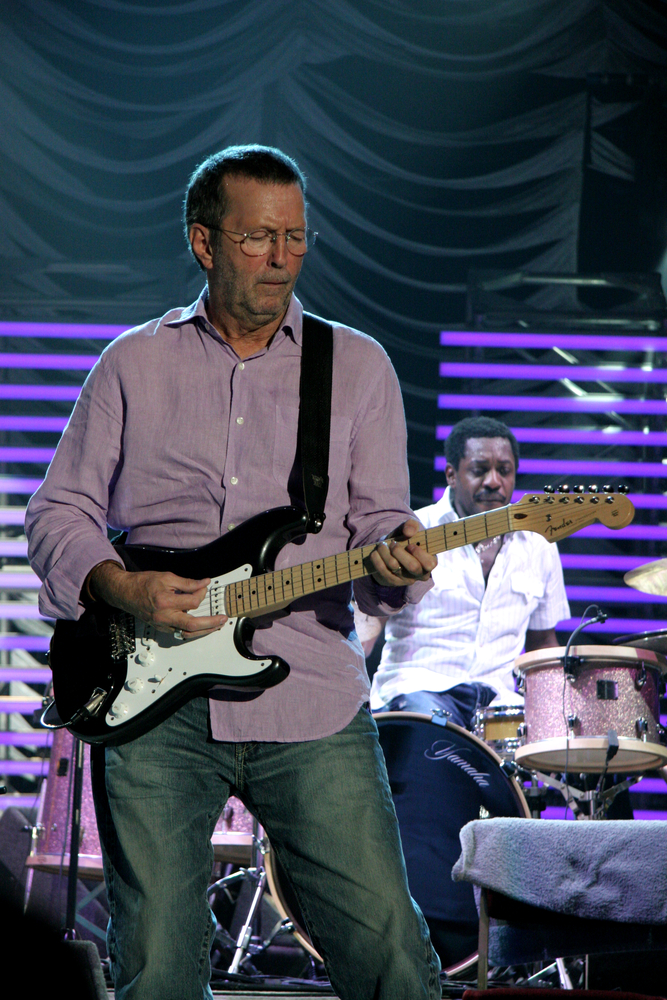
eric-clapton

Mick Jagger, Elton John, Rod Stewart, Ed Sheeran, Phil Collins and George Michael all grew up in or near London and have very recognizably British accents.  Once on stage, they sing like someone who grew up in New England rather than old.  Yet another example is Adele, who has a lovely speaking voice, a very heavy cockney accent, yet her singing pipes do not indicate her dialect.  One might argue that Adele’s speaking and singing voices were two different people if listening without visuals.  Going beyond the British, we see the same thing with other non-American musicians, such as the Swedish band ABBA, and many others singing in English, yet from various places around the world. It seems like no matter where you’re from, if you’re singing in English, you’re probably singing with an American accent, unless you’re actively trying to retain your native accent, which some groups do.

There are several reasons we notice accents ‘disappearing’ in song, and why those singing accents seem to default to “American”.   In a nutshell, it has a lot to do with phonetics, the pace at which they sing and speak, and the air pressure from one’s vocal chords.  As far as why “American” and not some other accent, it’s simply because the generic “American” accent is fairly neutral.  Even American singers, if they have, for instance, a strong “New Yorker” or perhaps a “Hillbilly” accent, will also tend to lose their specific accent, gravitating more towards neutral English, unless they are actively trying not to, as many Country singers might.

For the specific details, we’ll turn to linguist and author, David Crystal, from Northern Ireland.  According to Crystal, a song’s melody cancels out the intonations of speech, followed by the beat of the music cancelling out the rhythm of speech.  Once this takes place, singers are forced to stress syllables as they are accented in the music, which forces singers to elongate their vowels.  Singers who speak with an accent, but sing it without, aren’t trying to throw their voice to be deceptive or to appeal to a different market; they are simply singing in a way that naturally comes easiest, which happens to be a more neutral way of speaking, which also just so happens to be the core of what many people consider an “American” accent.

To put it in another way, it’s the pace of the music that affects the pace of the singer’s delivery.  A person’s accent is easily detectable when they are speaking at normal speed.  When singing, the pace is often slower.  Words are drawn out and more powerfully pronounced and the accent becomes more neutral.

Another factor is that the air pressure we use to make sounds is much greater when we sing.  Those who sing have to learn to breathe correctly to sustain notes for the right amount of time, and singing requires the air passages to expand and become larger.  This changes the quality of the sound.  As a result, regional accents can disappear because syllables are stretched out and stresses fall differently than in normal speech.  So, once again, this all adds up to singing accents becoming more neutral.

So at this point, you might be wondering if the musicians actually know they are losing their accents when they sing. Working in radio, I’ve contemplated how accents seem to disappear over my 20-year career.   Keith Urban isn’t British, though fans of the Aussie singer swoon over his speaking voice (many women could listen to him read the dictionary) and have noticed that he sounds more American when he sings.  I have spoken to Keith a few times and decided the good-natured Keith wouldn’t mind me posing the question:  How is it you sing differently than you talk?  (Certainly not wanting to offend Keith, I began with a few genuine compliments admiring his genius guitar skills.)  He took it all in stride, laughed, then responded, ‘I don’t know.’  (More like kneh-owww)  ‘Good question,’ he said.  Though I don’t think I have an accent.  I think you do!’  It’s quite reasonable to believe that a Hoosier like me sounds a bit hillbilly to a guy from down under.  Keith could not really explain the mystery behind it, and instead went on to explain why he was wearing black toenail polish the last time I chatted him up in person.  (His wife, Nicole, has since been his inspiration to stop, he says.)  So it would seem, that at least with this sample size of one, the artist in question is not aware of any accent change when he sings. So what about others?

Andy Gibson, a New Zealand researcher at AUT’s University Institute of Culture, Discourse & Communication also believes the change in accent between speaking and singing is not a deliberate one, nor are artists even aware of the change.  A 2010 study he conducted of singers with speaking accents showed indeed that they were not aware that they sounded any different; they felt they were singing naturally.  Crystal says it is unusual for a singer to hold a regional accent through an entire song, resulting in what he calls ‘mixed accents’ for most.

And then there’s Kate Nash, the anti-norm.  The English-singing sensation was an unknown until Lily Allen mentioned her on a MySpace page and now she boasts more than 100,000 followers on twitter.  She didn’t know she had talent until she picked up her first guitar two years ago, and the rest is history.  Nash has garnered success on the music charts, accent and all, and flat out refuses to even attempt to sing with an American accent. She makes no apologies for her background and even themes her lyrics toward an English audience.  She is as English as tea in the afternoon and proud of bucking the trend that so many British artists seem to follow, whether intentionally, or more likely in most cases, not.

1 Comment

Filed under Humor and Observations

China to build world’s most insane bridge

China to build world’s most insane bridge

Published December 05, 2013

FoxNews.com
  • Bridge_04.jpg

    The Dutch firm NEXT Architects was awarded first prize in a competition to design a bridge, which will span a river within the town of Meixi Lake. (NEXT ARCHITECTS)

  • Bridge_05.jpg

    The design was based on the Mobius ring, a one-sided surface made by twisting and joining one end of a rectangle with its other fixed end, as well as knots found in ancient Chinese folk art. (NEXT ARCHITECTS)

The phrase “we’ll cross that bridge when we come to it” is about to have a whole new meaning in China.

The “Mobius” bridge, proposed for the Dragon King Harbor River development in Changsha, China, is about to become the craziest bridge anyone ever had to cross.

The pedestrian bridge, which would span over 490 feet long and 78 feet high, will be made of a series of interwoven, spaghetti-like pathways all constructed at a range of different heights.

The Dutch firm NEXT Architects was awarded first prize in a competition to design the bridge, which will span a river within the town of Meixi Lake. The firm based its design on the Mobius ring, a one-sided surface made by twisting and joining one end of a rectangle with its other fixed end, as well as knots found in ancient Chinese folk art.

“Now we’ve been chosen it will be a big challenge to keep the design alive the way it is,” Next co-founder Bart Reuser told Wired. “But the prospects are pretty good.”

Construction is scheduled to begin next year.

Leave a comment

Filed under Humor and Observations

Amazon testing deliveries by drone

Amazon testing deliveries by drone

Published December 02, 2013

FoxNews.com

Online retailer Amazon announced Sunday that it is planning a new delivery service in which products would be delivered with the use of unmanned drones.

Amazon CEO Jeff Bezos unveiled the so-called “Octocopters” in an interview that aired Sunday on CBS “60 Minutes,” and claimed that the drones would not be ready to take flight for another four or five years. However, after the interview aired, Amazon released a statement promising that “Prime Air vehicles will be as normal as seeing mail trucks on the road today.”

“I know this looks like science fiction. It’s not,” Bezos said in the CBS interview with Charlie Rose. “It drops the package. You come and get your package and we can do half-hour deliveries.”

Federal Aviation Administration regulations currently prohibit the kind of flights Bezos proposes that Prime Air octocopters undertake. However, rule changes could come as early as 2015.

Bezos said that the vehicles currently being tested have a range of ten miles and can carry products under five pounds, which he estimates make up 86 percent of Amazon’s inventory.

In urban areas, you could actually cover very significant portions of the population,” Bezos said.  “This is all electric, it’s very green, it’s better than driving trucks around.”

The CEO also admitted that the drones required more safety testing, noting “This thing can’t land on somebody’s head while they’re walking around their neighborhood.”

Leave a comment

Filed under Humor and Observations

NORAD’s Santa tracker draws criticism with fighter jet escort

NORAD’s Santa tracker draws criticism with fighter jet escort

Published December 04, 2013

FoxNews.com
  • noradsantafighter12.jpg

    Nov. 27, 2013: Santa’s sled is escorted by a pair of fighter jets in this still image taken from an handout NORAD animated video.(REUTERS)

A North American Aerospace Defense Command website showing Santa Claus delivering presents while flanked by fighter jets has some child advocates raising concerns about Saint Nick’s new travel companions.

NORAD Tracks Santa, operated by the joint U.S.-Canada command, has provided children with information about Santa’s whereabouts since 1955. In recent years, Santa updates have included animated videos showing Santa on his flight path.

In addition to Santa’s traditional sleigh and reindeer, NORAD has added an animated fighter plane escort to give a realistic feel to the popular program, a command spokesman told Reuters.

“We wanted to let folks know that, hey, this is a NORAD video, and we’re the military and this is our mission,” Navy Captain Jeff Davis said.

Allen Kanner, a California child and family psychologist and co-founder of the Boston-based Campaign for a Commercial Free Childhood, told The Boston Globe the Pentagon is “completely out of line” for linking Christmas with the military.

“Children associate Santa with gifts and fun and everything else that is positive about Christmas,” Kanner told the newspaper. “They are associating this with the military in children’s minds.”

Another video on the NORAD Tracks Santa website shows military personnel preparing for a test flight with an intelligence officer asserting that “intel can confirm that Jack Frost and the Abominable Snowman will not be a threat,” The Globe reported.

“I think people are quite aware of the military’s true mission,” said Amy Hagopian, a professor of public health at the University of Washington, told the newspaper. “If the military wants to keep its ranks stocked, it needs to appeal to children. The military knows it can’t appeal to adults to volunteer. It is like the ad industry.”

Davis told Reuters that NORAD videos have linked fighter escorts and Santa since the 1960s, but 2013 marked the first time the jets had appeared in an animated version.

“It’s still cutesy since it’s for kids, but we don’t want people to lose sight of our true mission,” Davis told The Boston Globe.

NORAD Tracks Santa began nearly 60 years ago when a newspaper listed the wrong number for children to call Santa and they ended up calling NORAD’s predecessor, the Continental Air Defense Command.

The program drew 22.3 million unique website visitors last year and generated 114,000 phone calls fielded by 1,200 volunteers, Davis told The Globe. This website will be available in eight languages this year.

6 Comments

Filed under Humor and Observations

Human Regenerator That Controls Aging

German Company Develops Human Regenerator That Controls Aging
Anti-Aging Human Regenerator Pod

Scientists have struggled for a very long time to get a hold of this thing we all go through which is aging. Medicine and hygiene have added about 20-30 years to the average lifespan since a couple hundred years ago, but we want more life it seems. While some scientists focus on the human building blocks (our DNA) others are focusing on healing our body. A German company recently announced a new product called Human Regenerator that can control aging.

The company, System 4 Technologies Gmbh recently showcased their “pod” at the World Luxury Expo held at the Abu Dhabi’s Emirate palace. This Human Generator looks like something out of a science fiction movie, and its purpose is somewhat like it too. By utilizing a unique technology by the name of Quantum Cell Code, humans are apparently able to control aging. However, don’t be fooled, you can’t stop aging altogether, but it is said that the apparatus can rejuvenate the cells in your body and at least slow it down.

So what is this thing and how does it accomplish this almost holy grail-like miracle? Well, I will try to explain it to the extent that I understand it myself. The developers have used silicon and aluminum deposits which supposedly help create the anti-aging effect. The Human Regenerator imitates the body’s natural frequencies through quantum cell technology and longitudinal waves. Don’t ask me how but that’s as much as I understand.

Don’t expect this gadget to be cheap either. Unfortunately, it’s not for everyone. The basic modelwill have a price tag of $557,000 and only 50 units will be created. The one used at the Abu Dhabi expo was a promotional unit that had been pimped out with 6880 carats worth of diamonds, which sets the price tag for this particular unit at around $10 million. I guess if you want everlasting youth you will have to bust out the big wallet. Eternal youth is apparently not for the less fortunate ones, but we already knew this from the silver screen, didn’t we? – More information at Human Regenerator.

System 4 Technologies’ Human Regenerator

Anti-Aging Human Regenerator

Anti-Aging Human Regenerator

Author: Richard Darell

Richard Darell is the founder and CEO of Bit Rebels, a multifaceted online news outlet that reports daily on the latest developments in technology, social media, design and everything geek. Today this media entity welcomes more than 2.5 million unique visitors per month and is considered the go to place for people in constant motion. As an Internet entrepreneur, he is dedicated to constantly trying to develop new ways to bring content faster and closer to the end user in a more streamlined way. His excitement for statistics has allowed him to further develop systems that continuously produce accurate and fast-paced analytics to better optimize the approach by which Bit Rebels presents news and content. His graphic design background has proven to be an important tool when designing new systems and features for Bit Rebels since the development of solid and stable code depends entirely on their structure and implemented procedures. Richard currently resides in Stockholm, Sweden and directs the Bit Rebels offices in both Stockholm and Atlanta. You can reach Richard at richard@bitrebels.com

3 Comments

Filed under Humor and Observations

Brightest explosion ever seen in the universe

Brightest explosion ever seen in the universe

By Denise Chow

Published November 22, 2013

  • brightest-gamma-ray-burst

    An unusually bright gamma-ray burst produced a jet that emerged at nearly the speed of light. (NASA/SWIFT/CRUZ DEWILDE)

  • gamma-ray-burst-swift-nasa

    A gamma-ray burst that exploded in April 2013 is the most luminous object in the field, as seen in this image from NASA’s Swift satellite. All the other objects seen in the image are stars from our own galaxy, while the gamma-ray burst is milli (NASA/SWIFT SATELLITE)

  • gamma-ray-burst-swift

    Close-up image of the brightest gamma-ray burst ever seen, taken in April 2013 by the ultraviolet/optical telescope on NASA’s Swift satellite. (NASA/SWIFT SATELLITE)

A mysterious blast of light spotted earlier this year near the constellation Leo was actually the brightest gamma-ray burst ever recorded, and was triggered by an extremely powerful stellar explosion, new research reports.

On April 27, several satellites — including NASA’s Swift satellite and Fermi Gamma-ray Space Telescope — observed an unusually bright burst of gamma radiation. The explosion unleashed an energetic jet of particles that traveled at nearly the speed of light, researchers said.

“We suddenly saw a gamma-ray burst that was extremely bright — a monster gamma-ray burst,” study co-author Daniele Malesani, an astrophysicist at the Niels Bohr Institute at the University of Copenhagen in Denmark, said in a statement. “This [was] one of the most powerful gamma-ray bursts we have ever observed with the Swift satellite.” [Top 10 Strangest Things in Space]

The gamma-ray burst was described in a series of studies published online Thursday in the journal Science.

‘The exploding matter was traveling at [nearly] the speed of light.’

– Giacomo Vianello, a postdoctoral scholar at Stanford University

Gamma-ray bursts, or GRBs, are the most powerful type of explosions in the universe and typically mark the destruction of a massive star. The original stars are too faint to be seen, but the supernova explosions that signal a star’s death throes can cause violent bursts of gamma radiation, researchers said.

Gamma-ray bursts are usually short but extremely bright. Still, ground-based telescopes have a tough time observing them because Earth’s atmosphere absorbs the gamma radiation.

The extremely bright gamma-ray burst seen earlier this year, officially dubbed GRB 130472A, occurred in a galaxy 3.6 billion light-years away from Earth, which, though still far away, is less than half the distance at which gamma-ray bursts have previously been seen. This closer proximity to Earth enabled astronomers to confirm for the first time that one object can simultaneously create a powerful GRB and a supernova explosion.

“We normally detect GRBs at great distance, meaning they usually appear quite faint,” study co-author Paul O’Brien, an astronomer at the University of Leicester in the United Kingdom, said in a statement. “In this case, the burst happened only a quarter of the way across the universe — meaning it was very bright. On this occasion, a powerful supernova was also produced — something we have not recorded before alongside a powerful GRB — and we will now be seeking to understand this occurrence.”

The jet produced by the gamma-ray burst was formed when a massive star collapsed on itself and created a black hole at its center. This generated a blast wave that caused the stellar remnants to expand, producing a glowing shell of debris that was observed as an extremely bright supernova explosion.

After analyzing properties of the light produced by the gamma-ray burst, scientists determined that the original star was only three to four times the size of the sun, but was 20 to 30 times more massive. This extremely compact star was also rapidly rotating, the researchers said.

The GRB was the brightest and most energetic ever witnessed and triggered dynamic internal and external shock waves that are still not well understood. Though scientists have a clearer view of the violent explosion, mysteries remain. For instance, space telescopes detected more photons and more high-energy gamma-rays than theoretical models predicted for a gamma-ray burst of this magnitude.

Researchers are still investigating why the energy levels seen with GRB 130472A do not quite match predictions from existing models of gamma-ray bursts. Their results could lead to more refined theories about how particles are accelerated, which could help astronomers better predict the behavior of cosmic events.

“The really cool thing about this GRB is that because the exploding matter was traveling at [nearly] the speed of light, we were able to observe relativistic shocks,” study co-author Giacomo Vianello, a postdoctoral scholar at Stanford University in California, said in a statement. “We cannot make a relativistic shock in the lab, so we really don’t know what happens in it, and this is one of the main unknown assumptions in the model. These observations challenge the models and can lead us to a better understanding of physics.”

Leave a comment

Filed under Humor and Observations

UK Investigates Booby Trapped Pricing…

Storm in a D-cup — UK launches sports bra probe

Published September 20, 2013

  • photo_1379687626638-1-HD.jpg

    Russian tennis star Anna Kournikova promotes the ‘Shock Absorber’ bra in Eastbourne on June 14, 2002. Three of Britain’s top department stores, and the manufacturer of the ‘Shock Absorber’ sports bra, are under investigation for fixing prices, the trade watchdog says. (AFP/FILE)

LONDON (AFP) –  Three of Britain’s top department stores, and the manufacturer of a sports bra once promoted by tennis star Anna Kournikova, are under investigation for fixing prices, the trade watchdog said Friday.

The Office of Fair Trading (OFT) alleges that underwear firm DB Apparel UK entered anti-competitive agreements with John Lewis, Debenhams and House of Fraser between 2008 and 2011.

It said they had the effect of increasing the retail prices of DBA’s “Shock Absorber” brand of sports bra, which was advertised in a campaign starring Kournikova with the slogan “Only the ball should bounce”.

“The OFT takes allegations of price-fixing seriously,” said Ann Pope, the watchdog’s senior director of services, infrastructure and public markets.

“Resale price maintenance limits competition between retailers and can lead to consumers paying higher prices.”

She added: “We will carefully consider the parties’ representations… before deciding whether competition law has in fact been infringed.”

DB Apparel, which had approximately 15 percent of the sports bra market during the period in question, said it would “defend ourselves vigorously in this investigation”.

“We reject any allegations by the OFT that we have entered into any agreement or understanding with retailers as to their retail prices of our products,” the company said.

The department stores said they had all acted within the law.

1 Comment

Filed under Humor and Observations

Nah – we’re not heading to a police state…

If you remember the millions of rounds of ammunition and assault vehicles for homeland security, this article will also cheer you up:

Spoils of war: Police getting leftover Iraq trucks

Published November 25, 2013

Associated Press
  • armor-cop-truck-660.jpg
    AP
  • armor-cop-truck-660-2.jpg
    AP
QUEENSBURY, N.Y. –  Coming soon to your local sheriff: 18-ton, armor-protected military fighting vehicles with gun turrets and bulletproof glass that were once the U.S. answer to roadside bombs during the Iraq war.

The hulking vehicles, built for about $500,000 each at the height of the war, are among the biggest pieces of equipment that the Defense Department is giving to law enforcement agencies under a national military surplus program.

For police and sheriff’s departments, which have scooped up 165 of the mine-resistant ambush-protected vehicles, or MRAPS, since they became available this summer, the price and the ability to deliver shock and awe while serving warrants or dealing with hostage standoffs was just too good to pass up.

“It’s armored. It’s heavy. It’s intimidating. And it’s free,” said Albany County Sheriff Craig Apple, among five county sheriff’s departments and three other police agencies in New York that have taken delivery of an MRAP.

See: Battelle’s ‘stealth’ armored pickup truck

But the trucks have limits. They are too big to travel on some bridges and roads and have a tendency to be tippy on uneven ground. And then there’s some cost of retrofitting them for civilian use and fueling the 36,000-pound behemoths that get about 5 miles to the gallon.

The American Civil Liberties Union is criticizing what it sees as the increasing militarization of the nation’s police. ACLU affiliates have been collecting 2012 records to determine the extent of military hardware and tactics acquired by police, planning to issue a report early next year.

“One of our concerns with this is it has a tendency to escalate violence,” said ACLU Center for Justice senior counsel Kara Dansky.

An Associated Press investigation of the Defense Department military surplus program this year found that a disproportionate share of the $4.2 billion worth of property distributed since 1990 — everything from blankets to bayonets and Humvees — has been obtained by police and sheriff’s departments in rural areas with few officers and little crime.

After the initial 165 of the MRAP trucks were distributed this year, military officials say police have requests in for 731 more, but none are available.

Ohio State University campus police got one, saying they would use it in large-scale emergencies and to provide a police presence on football game days. Others went to police in High Springs, Fla., and the sheriff’s office in Dallas County, Texas.

In Boise, Idaho, police reported using their MRAP two weeks ago to serve a warrant, saying they had evidence the suspect might be heavily armed and have explosives. Authorities said they found 100 pounds of bomb-making material and two guns. A second MRAP from nearby Nampa’s police department was used to shield officers and neighbors from a possible explosion.

In New York, the Albany County sheriff’s department already had four smaller military-surplus Humvees, which have been used for storm evacuations and to pull trees out of roadways. The new MRAP truck will go into service after technicians remove the gun turret and change the paint from military sand to civilian black.

Sheriff Apple rejected the idea that the nation’s police forces are becoming too militaristic.

“Nothing could be further from the truth,” he said. “Our problem is we have to make sure we are prepared to respond to every type of crisis.”

For example, he said, if SWAT teams need to get close to a shooter or get bystanders safely away from one, the MRAP would be the vehicle of choice.

In Warren County, at the southern edge of the Adirondack Mountains, Undersheriff Shawn Lamouree said its MRAP, which can hold six people and reach 65 mph, will have its turret closed up except for a small slot, the only place to fire a gun. Its bulletproof windows don’t open. The proposed retrofit, including new seating, loudspeakers and emergency lights, would cost an estimated $70,000. The department has applied for grants.

“We have no plans of mounting a machine gun,” he said. “The whole idea is to protect the occupants.”

While Warren County’s Lamouree acknowledged the MRAP will likely spend most of its time in a heated garage, with “minimal” maintenance costs, it could be used occasionally by the emergency response team, which has used armored vehicles to serve drug warrants.

“We live in the North Country,” he said. “It’s very common for people to have high-powered hunting rifles.”

In one recent incident, a team used its armored military-surplus Humvee to approach a barricaded suspect, similar to a circumstance in which it might use the MRAP.

“We rolled the Humvee in the front yard, gave a couple of commands and he said, ‘OK, I’m coming out,” said investigator Jeff Gildersleeve. “That’s the way we like them to end.”

Others in New York that got big armored trucks included sheriff’s departments in Jefferson County, Steuben County and Sullivan County, and police in Nassau County, Plattsburgh and Hamburg Village. Police departments statewide have also acquired almost 150 other trucks and Humvees, a dozen of them armored, over the past two years.

1 Comment

Filed under Humor and Observations

Should Paul Walker’s Death Serve as a Warning?

Paul Walker died in a fiery car crash.  The driver, Roger Rodas, was a car designer and former race car driver.  Both left behind children, Paul Walker a 15 year old, and the driver a 5 year old.  Rumors are that they died while drag racing on a curvy road, but traffic cameras indicate they might have been alone.  In any case, high speeds were involved.

As many of you know, Paul Walker starred in many of the Fast and Furious movies that show outrageous car chases, racing, and high speed driving.  Do these movies encourage people, including Paul Walker himself, to take to dangerous driving themselves?

It’s the old question, do movies, TV shows and video games encourage others to try the same type of stunt, or at the very least, make high speed driving look safer than it is?  I always hated the movies where a cop car would flip through the air several times and the people remove themselves dazed but unharmed.  In real life, such situations are tragic.  Most people do not realize that the only thing holding their car to the ground is four spots around six inches square.  That’s right, the bottom of your tires.  At high speeds, you get lift, which reduces the gravitational grip your car has on the road.  If you add to that centripetal and centrifugal force and very little keeps your car under control.

They plan to continue the fast and furious series of films, along with all the other high speed movies.

I pray for the families and friends of Paul Walker and Roger Rodas that their grief may be borne and that it will not impact their lives more drastically than it must.

1 Comment

Filed under Humor and Observations, Uncategorized