
A bit late, but here are some cute dog pictures for Monday…
-

- Affectionate Shar-pei Puppies
A bit late, but here are some cute dog pictures for Monday…





























Filed under Animals, Humor and Observations
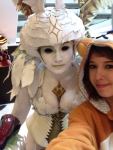
Cosplayers and cosplay for your Saturday!






























































Filed under Humor and Observations

Foodini is a 3D printer that can print pizza, ravioli, burgers and more. (Natural Machines)
Here’s an appliance to help you make perfect pizza every time, and we mean every time.
The same technology being used to make guns, toys and even diamond rings, is being applied to homemade food.
Barcelona-based 3D printing startup Natural Machines is releasing the Foodini, a 3D printer that allows cooks to create perfectly formed meals, reports the BBC.
Users can combine up to six ingredients to at a time, and with a push of a button, the food comes out of the nozzle in a preprogrammed pattern. Think evenly made pizzas, burgers, and ravioli. And it’s designed so the ordinary home cook can use it.
The Foodini, which looks a bit like a miniature oven, can also perform other useful food prep tasks, like decorate cakes.
However, it can only print in one material at a time, so you’ll have to switch different ingredients as you print. And it can only combine ingredients and not actually cook them.
But the concept is interesting because while it automates food production, it also allows home cooks to make items they would otherwise get from the box, like pasta.
The Foodini is expected to go on sale this spring for about $1,400.
Filed under Humor and Observations
July 23, 2015 | by Janet Fang

photo credit: raneko/Flickr CC BY 2.0.
It’s been over four years since an earthquake and subsequent tsunami struck the Fukushima Daiichi nuclear power plant, releasing radiation out into the environment. Asrobot-led investigations and cleanup efforts grind on, research teams from around the world have been studying the impacts of the contamination on wildlife, both in the short term and for years to come.
In 2014, we learned that the lifespans and population sizes of certain bird and butterfly species have dropped. Some also showed signs of abnormal growths and growth rates: atypical feathers on barn swallows, for example, and smaller forewings on pale grass blue butterflies. Meanwhile, irradiated monkeys exhibited low red and white blood cell counts. However, for each of these sorts of conclusions, there’s also news of animals adapting. Some bird species living in the exclusion zone around Chernobyl, for instance, aren’t just coping – they appear to be benefiting.
And what about plants? A genetic analysis of rice seedlings exposed to radiation near Fukushima revealed changes to DNA repair mechanisms and the induction of genes involved in cell death. Near Chernobyl, dead trees and fallen leaves aren’t decaying (even decades later) because radiation inhibited the microbial decomposers.
Then there’s this. Back in May, Twitter user @san_kaido from Nasushiobara posted this striking photo:
マーガレットの帯化(那須塩原市5/26)②
右は4つの花茎が帯状に繋がったまま成長し,途中で2つに別れて2つの花がつながって咲いた。左は4つの花茎がそのまま成長して繋がって花が咲き輪の様になった。空間線量0.5μSv地点(地上高1m) http://t.co/MinxdFgXBC—
三悔堂 (@san_kaido) May 27, 2015
According to International Business Times, the tweet reads: “The right one grew up, split into 2 stems to have 2 flowers connected each other, having 4 stems of flower tied belt-like. The left one has 4 stems grew up to be tied to each other and it had the ring-shaped flower. The atmospheric dose is 0.5 μSv/h at 1m above the ground.”
They might look like deformed victims of a nuclear disaster, but these daisies are likely the result of a rare, but natural condition called fasciation, or crested growth. This can happen when the parts of a growing embryo fuse abnormally, resulting in a flattened-looking stem. And oftentimes, flowers and leaves will develop unusual shapes and show up at odd angles to that stem. As gardeners will tell you, fasciated plants are not exclusive to disaster sites. The causes of this condition range from infections and severe pruning to hormonal imbalances and (run-of-the-mill) genetic mutations.
Filed under Uncategorized

Physics may have just taken a new leap forward, as three independent groups of physicists have found strong evidence for massless particles called “Weyl fermions,” which exist as quasiparticles – collective excitations of electrons. Ultimately, this discovery is over 80 years in the making, dating back to Paul Dirac.
In 1928, Dirac came up with an equation that described the spin of fermions (fermions are the building blocks that make up all matter). Within his equation, he discovered that, in relation to particles that have charge and mass, there should be a another particle and antiparticle—what we know as the electron and (its antiparticle) the positron.
Yet, there are more than one ways to skin a cat.
Other solutions to this equation hinted at more exotic kinds of particles. Enter Hermann Weyl, a German mathematician who, in 1929, come up with a solution that involved massless particles. These became known as “Weyl fermions.” And, for a number of years, physicists believed that neutrinos (subatomic particles that are produced by the decay of radioactive elements) were actually Weyl particles. Yet, further studies, which were published in 1998, indicated that neutrinos do, in fact, have mass, which means that they cannot be the aforementioned Weyl particles.
But now, we have evidence that Weyl fermions actually exist.
The research comes thanks to Zahid Hasan over at Princeton University, who uncovered these particles in the semimetal tanatalum arsenide (which is referred to as TaAs). Hasan and his team suggested that TaAs should contain Weyl fermions and (here is the important bit) it should have what is known as a “Fermi arc.” And in 2014, the team found evidence of such an arc.

But that’s not all, another team, led by Hongming Weng at the Chinese Academy of Sciences, found similar evidence in an independent study that used the same methods. And Marin Soljačić and colleagues (hailing from MIT and the Univeristy of China) have seen evidence of Weyl fermions in a different material, specifically, a “double-gyroid” photonic crystal.
In this latter case, the team fired microwaves at the crystal and measured microwave transmission through it, varying the frequency of the microwaves throughout the experiment. Through this process, the team could map the structure of the crystal, allowing them to determine which microwave frequencies can travel through the crystal and which cannot. In the end, this revealed the presence of “Weyl points” in the structure, which is strong evidence for Weyl fermion states existing within the photonic crystal.
The significance of this find, quite literally, cannot be overstated. Hasan is clear to point this out, noting in the press release that, “The physics of the Weyl fermion are so strange, there could be many things that arise from this particle that we’re just not capable of imagining now.”
He goes on to note more specific applications: “It’s like they have their own GPS and steer themselves without scattering. They will move and move only in one direction since they are either right-handed or left-handed and never come to an end because they just tunnel through. These are very fast electrons that behave like unidirectional light beams and can be used for new types of quantum computing.” Soljačić, the head of the second study, adds that, “The discovery of Weyl points is not only the smoking gun to a scientific mystery, it paves the way to absolutely new photonic phenomena and applications.”
Ultimately, it is believed Weyl fermions could be very useful, in that, because they are massless, they can conduct electric charge much faster than normal electrons. Admittedly, this same feature is exhibited by electrons in graphene. Yet, graphene is a 2D material, Weyl fermions are thought to exist in more practical 3D materials.
Filed under Uncategorized
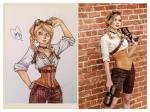
Enjoy these cosplayers and cosplay for your Saturday!





































































Filed under Humor and Observations


Like the Swiss Army Knife of tiny homes, the Ecocapsule packs everything you need into one very efficient, compact design. Replete with rather luxurious amenities, including a double bed, kitchenette, storage space, and bathroom with a shower and a toilet that collects bio waste, the Ecocapsule can used as a tiny home just for you, a pop-up hotel, a humanitarian refuge, or even an electric car charging station. Its 9744Wh battery is powered by a 750W silent wind turbine and 600W solar outputs that enable it to operate completely off-grid. A dual-power system offers an additional source of electricity during periods without sufficient sunlight or wind. The structure’s rounded shape also helps to easily collect rain water, which is then purified with a built-in filtration system.


Nice Architects plans to announce pricing for the Ecocapsule egg home at the end of 2015 – just in time for pre-orders. They’ve focused on reducing the size and weight of the pod so that it can be easily transported – approximate shipping costs range from 1500 Euros from Slovakia to Melbourne, to 2200 Euros from Slovakia to New York. Nice Architects plans to launch one version of the
Ecocapsule initially, and they plan to offer additional customizations after the first units are sold.


Filed under Humor and Observations

First, impress your guests with some history. The modern European tea party began about 20 years before the publication of Alice in Wonderland, at which point it was still extremely fashionable. Although there are scattered references to fashionable ladies drinking a cup of tea mid-afternoon in the 17th century, most sources trace the tradition back to the 1840s and Anna Maria Russell, the Duchess of Bedford, a lifelong friend of Queen Victoria’s. In the Duchess’s day, most British people ate two main meals: a huge breakfast served early, and an 8 p.m. dinner (there was a light, informal luncheon in between). The Duchess complained of getting a “sinkful feeling” during the long, snackless gap in between, and started taking a pot of tea and some light treats in her boudoir around 4 p.m.
Tea consumption in Europe had increased dramatically in the early 19th century, especially after Europeans learned the secrets of tea cultivation and began establishing their own plantations, instead of relying on China. The idea of an afternoon tea-based snackfest caught on after Anna began inviting friends to meet her for a cuppa (as Brits now call it) and “a walk in the fields.” Other high society hostesses imitated her party idea, creating intimate afternoon events that usually involved elegant rooms, fine china, hot tea, small sandwiches, and plenty of gossip. The custom really caught on when Queen Victoria attended some of these gatherings, adding her royal imprimatur.
The middle classes followed suit, discovering that tea parties were a relatively economical way to host a gathering. There were garden teas, tennis teas, croquet teas, and more. Eventually, the custom of taking a mid-afternoon tea break became standard across British society, although it diverged into two traditions: “afternoon tea,” for the leisured classes (tea and light snacks) and “high tea” or “meat tea,” a heartier workingman’s dinner that would be served when laborers arrived home after work.
If you’d like to hold a Victorian-style tea party, consider following some of the guidelines for various kinds of teas dispensed in 1893’s Etiquette of Good Society by Lady Gertrude Elizabeth Campbell or Etiquette: What to Do, and How to Do It, written by Lady Constance Eleanora C. Howard in 1885. Both are freely available on Google Books in case you need more information about which spoon to use with your clotted cream.
Campbell says: “a tea, of whatever kind, may be made one of the most agreeable of meals; for tea always seems to produce sociability, cheerfulness, and vivacity.”
She offers the following guidelines for a country-based high tea, perhaps after some archery or lawn tennis in summer, or music, card games, or charades in winter:
Campbell shares these tips for a light afternoon tea, also known as a “small tea,” usually served around 5 p.m., where things are less formal:
Howard offers the following advice for a formal 5 o’clock tea in London, noting “ladies like it extremely; gentlemen, as a rule, detest it most cordially.”
Filed under Uncategorized
September 3, 2015 | by Eugene Lim

photo credit: Scientists are searching for collisions between different ‘universe bubbles’ in the cosmic microwave background. Geralt
It is important to keep in mind that the multiverse view is not actually a theory, it is rather a consequence of our current understanding of theoretical physics. This distinction is crucial. We have not waved our hands and said: “Let there be a multiverse”. Instead the idea that the universe is perhaps one of infinitely many is derived from current theories like quantum mechanics and string theory.
The Many-Worlds Interpretation
You may have heard the thought experiment of Schrödinger’s cat, a spooky animal who lives in a closed box. The act of opening the box allows us to follow one of the possible future histories of our cat, including one in which it is both dead and alive. The reason this seems so impossible is simply because our human intuition is not familiar with it.
But it is entirely possible according to the strange rules of quantum mechanics. The reason that this can happen is that the space of possibilities in quantum mechanics is huge. Mathematically, a quantum mechanical state is a sum (or superposition) of all possible states. In the case of the Schrödinger’s cat, the cat is the superposition of “dead” and “alive” states.
But how do we interpret this to make any practical sense at all? One popular way is to think of all these possibilities as book-keeping devices so that the only “objectively true” cat state is the one we observe. However, one can just as well choose to accept that all these possibilities are true, and that they exist in different universes of a multiverse.

Miaaaaultiverse Robert Couse-Baker/Flickr, CC BY-SA
The String Landscape
String theory is one of our most, if not the most promising avenue to be able to unify quantum mechanics and gravity. This is notoriously hard because gravitational force is so difficult to describe on small scales like those of atoms and subatomic particles – which is the science of quantum mechanics. But string theory, which states that all fundamental particles are made up of one-dimensional strings, can describe all known forces of nature at once: gravity, electromagnetism and the nuclear forces.
However, for string theory to work mathematically, it requires at least ten physical dimensions. Since we can only observe four dimensions: height, width, depth (all spatial) and time (temporal), the extra dimensions of string theory must therefore be hidden somehow if it is to be correct. To be able to use the theory to explain the physical phenomena we see, these extra dimensions have to be “compactified” by being curled up in such a way that they are too small to be seen. Perhaps for each point in our large four dimensions, there exists six extra indistinguishable directions?
A problem, or some would say, a feature, of string theory is that there are many ways of doing this compactification –10500 possibilities is one number usually touted about. Each of these compactifications will result in a universe with different physical laws – such as different masses of electrons and different constants of gravity. However there are also vigorous objections to the methodology of compactification, so the issue is not quite settled.
But given this, the obvious question is: which of these landscape of possibilities do we live in? String theory itself does not provide a mechanism to predict that, which makes it useless as we can’t test it. But fortunately, an idea from our study of early universe cosmology has turned this bug into a feature.
The Early Universe
During the very early universe, before the Big Bang, the universe underwent a period of accelerated expansion called inflation. Inflation was invoked originally to explain why the current observational universe is almost uniform in temperature. However, the theory also predicted a spectrum of temperature fluctuations around this equilibrium which was later confirmed by several spacecraft such as Cosmic Background Explorer, Wilkinson Microwave Anisotropy Probe and the PLANCK spacecraft.
While the exact details of the theory are still being hotly debated, inflation is widely accepted by physicists. However, a consequence of this theory is that there must be other parts of the universe that are still accelerating. However, due to the quantum fluctuations of space-time, some parts of the universe never actually reach the end state of inflation. This means that the universe is, at least according to our current understanding, eternally inflating. Some parts can therefore end up becoming other universes, which could become other universes etc. This mechanism generates a infinite number of universes.
By combining this scenario with string theory, there is a possibility that each of these universes possesses a different compactification of the extra dimensions and hence has different physical laws.

The cosmic microwave background. Scoured for gravitational waves and signs of collisions with other universes.NASA / WMAP Science Team/wikimedia
Testing The Theory
The universes predicted by string theory and inflation live in the same physical space (unlike the many universes of quantum mechanics which live in a mathematical space), they can overlap or collide. Indeed, they inevitably must collide, leaving possible signatures in the cosmic sky which we can try to search for.
The exact details of the signatures depends intimately on the models – ranging from cold or hot spots in the cosmic microwave background to anomalous voids in the distribution of galaxies. Nevertheless, since collisions with other universes must occur in a particular direction, a general expectation is that any signatures will break the uniformity of our observable universe.
These signatures are actively being pursued by scientists. Some are looking for it directly through imprints in the cosmic microwave background, the afterglow of the Big Bang. However, no such signatures are yet to be seen. Others are looking for indirect support such as gravitational waves, which are ripples in space-time as massive objects pass through. Such waves could directly prove the existence of inflation, which ultimately strengthens the support for the multiverse theory.
Whether we will ever be able to prove their existence is hard to predict. But given the massive implications of such a finding it should definitely be worth the search.
Eugene Lim is Lecturer in theoretical particle physics & cosmology at King’s College London
This article was originally published on The Conversation. Read the original article.
Filed under Uncategorized
Cute dogs to perk up the start of your week…






































Filed under Animals, Humor and Observations
 Michael Bradley - Time Traveler
