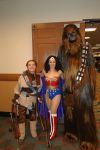
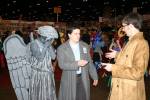
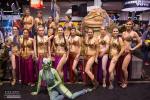
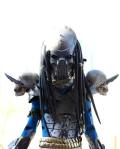
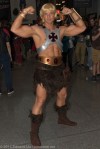
This Saturday I will be appearing at Keen Halloween. I will be reading some works of terror on a panel at 3 pm, and appearing at a book signing from Noon until 2:30 pm. on Saturday, September 24, 2016 at the Phoenix Convention Center ONLY. If you can, stop by and say hello!
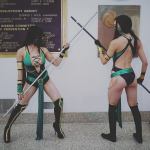
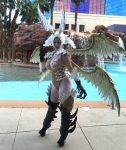
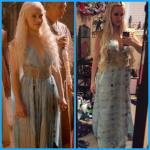
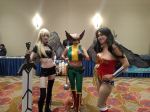
Cosplay Pictures for the Weekend
Cosplayers and cosplay to enjoy!
Filed under Humor and Observations
Economist says uploaded brains will take over all jobs within 100 years
Eugene Sergeev / Shutterstock
We’ve all heard wild visions of the future. Hearing them from an economist, in a new book from Oxford University Press, makes them seem unusually real.
Robin Hanson predicts in “ The Age of Em ” that we’ll develop cheap technology for emulating brains on computers in the next 100 years.
He expects emulations, or ems, to be like human brains but able to run 1,000 times faster and be copied. He predicts they will quickly put every human out of work and create a radical new civilization, living by the billions or trillions in a few megacities.
Humans who have investments and other protection will do fine in this era, but those who don’t could be screwed.
Hanson is an associate professor of economics at George Mason and research associate at Oxford University with degrees in physics and philosophy from the University of Chicago and a doctorate in social science from CalTech and nine years experience in AI research at Lockheed and NASA.
Tech Insider spoke with him about what’s coming next.
End of the industrial era
We should have at least several decades before the singularity, when machine intelligence leaves human intelligence in the dust. Enjoy the twilight of the industrial era while it lasts.
Hanson expects the coming years to be relatively predictable and pleasant.
“People have seen consistent trends not only to individual wealth, but also towards more democracy, less slavery, more leisure, more promiscuity, less religion,” Hanson says. In other words, the world is getting better.
“There’ve always been people telling you the world’s getting worse. Objectively, it’s less true today,” Hanson says.
Sure, there are risks, but society is increasingly protected against many of them. Pandemics could kill people by the millions, but our technology for fighting them is getting better. War could break out, but that happens less these days than ever. Climate change could be disastrous, but at least some people are preparing for it. Meanwhile, people will keep losing jobs to machines, but it’s happening slowly enough that society can adapt.
And then suddenly everything will change.
Rise of the robots
Courtesy of Oxford University Press
Hanson thinks we’ll figure out whole brain emulation before we figure out human-level artificial intelligence—a view he shares with Google futurist Ray Kurzweil. The idea is that recreating a functionally similar brain computer is easier than creating consciousness through code.
If emulations do come first, then the singularity could sneak up on us. Quiet developments in brain scanning, brain cell models, and signal-processing hardware might suddenly allow us to put a brain on a computer, and within a few years it could be cheap enough for ems to conquer the world.
“There’s a transition phase lasting five years, perhaps, but then once it finally gets going and it’s full mode, then humans retire,” Hanson predicts. “[Ems] basically beat humans at being more cost effective at all jobs.”
Ems, which think about 1000x faster than humans, can do everything a human worker can and more.
“The emulations typically work in virtual reality, because most jobs are office jobs, but some of their jobs are physical jobs, like operating a crane or operating a factory or driving a truck or things like that, and for that they have bodies, real bodies, and the bodies are whatever are appropriate for that task,” Hanson says.
The only remaining jobs for humans would be based on nostalgia for the old era.
“If there are rich humans who just get a thrill out of hiring real human waiters or … even real human prostitutes, perhaps, then those jobs might be done by human,” Hanson says.
The ems would quickly take over every almost every corporation and government and start some of their own.
“Even if [Google] has a human CEO at the very top, that human CEO can’t be making very many fast decisions,” Hanson says. “They’ll have to rubber stamp recommendations made to them by the ems. Maybe they’ll cover that up, but the effect of things will be the ems are making most of the concrete decisions…. Similarly, for government, human governments could still oversee and regulate but only slowly, so they’ll have to delegate a lot of authority to fast ems.”
Hanson expects the ems to cluster in a few incredibly dense cities, which could emerge wherever there’s a good combination of early momentum and low regulation.
“At the very beginning, the ems will just want to be near their customers and near their suppliers, and that suggests they’d want to be near big cities, and wherever they start out, it will probably be hard to move,” Hanson says. “[But] the ems will be looking for places with relatively low regulation and relative freedom to do things differently.”
Em megacities might rise up in a special economic zone near a major city. Ems might also just push humans out of a prime location.
“At some point they may decide to just buy out New York City,” Hanson says. “They basically say we’ll just pay for everything, buy out the entire thing, and then we’ll fill it all with our computer hardware.”
Could ems take over human property violently? Hanson thinks this less likely. He expects ems to act more like giant corporations, growing as fast as possible within legal means.
Hanson’s book goes deep into the intricacies of em civilization, how our successors will work, love, live, and more, even while acknowledging that the age of ems might last only a year or two before transitioning to something even strange.
The book only glosses over, however, what will happen to humans. It’s not bad for everyone, but it could be for many.
Surviving the future
Eugene Sergeev / Shutterstock
In Hanson’s vision of the future, humans who have investments will be in great shape. After all, the economy will grow unimaginably fast with ems at the wheel.
“Humans own most of this world, so as it grows, say, doubling every month, then their wealth doubles every month, so collectively humans get very rich, very fast,” Hanson says.
These rich capitalists will lives of pleasure, assuming it’s possible to find happiness without meaningful work. They will of course have access to amazing virtual reality and more wonders of the future.
Humans who have sufficient insurance or sharing arrangements (Hanson’s terms for various financial structures that will guarantee regular income) will also be fine.
“You could get insurance privately. You could get insurance via a family. Or you could get insurance via a government,” Hanson says. “[As for sharing], you might get help from a wide range: churches, charities of all sorts.”
Universal basic income? Hanson says this idea would only work reliably if it were implemented on a global scale. Otherwise, any location that tried to fund it alone would risk getting left behind in the rise of ems and having no money left.
Thus savvy humans will figure out how to protect themselves. Governments might be able to do it. Rich organizations, possibly including the ems themselves, might do it. Still many humans could be left out in the cold.
“There is a substantial risk that a lot of people will be in trouble,” Hanson says.
Hanson’s advice for young people today?
“Be ready, I guess, is the straightforward advice,” he says. “That is, most of what I’m talking about won’t happen anytime soon, but when it does happen, it will happen pretty fast.”
That means accumulating financial assets, setting yourself up for sharing or insurance arrangements, or—in an unusual option discussed at in the book—trying to increase your odds that some ems will be based on your brain or your descendant’s brain.
If you want to increase your likelihood of seeing this era, Hanson advocates another approach: cryogenics. He has been a member of industry pioneer, Alcor, for around 20 years and wears a chain around his neck with instructions to freeze his body when he dies in the hopes that future medicine will be able to revive him.
The problem with science fiction
“Dollhouse” on Fox
Hanson says the problem with most science-fiction and lots of futurism is that it doesn’t pay attention to things like economics.
“Even what they call hard science fiction tries often to get the physics or get the science right, but they’re usually just laughably wrong about the social science.”
One piece of science-fiction he likes is “ Kiln People ” by David Brin, which bears a lot in common with “The Age of Em.”
“His scenario was people made of clay that you could copy your mind into, so it was not computer based, but he works out many of the similar implication about the effects on jobs and things like that,” Hanson says.
“ Star Wars ”?
“‘Star Wars’ is silly both on the physics, computers, and the social things.”
“ Star Trek ”?
“Also pretty silly on all these criteria.”
Hanson had not seen “ Doll House ” by Joss Whedon, which imagines a world where personalities can be uploaded from or downloaded into people, but he points out that it doesn’t go far enough.
“The number of bodies in the world doesn’t change. What you’re just switching is who’s running each body.”
The truth about the future? It will follow a lot of the same non-fantastic realities that govern the world today.
“One indication that I’ve been successful,” Hanson writes in the introduction to “The Age of Em,” “will be if my scenario description sounds less like it came from a typical comic book or science-fiction movie, and more like it came from a typical history text or business casebook.
Hanson tells Tech Insider he has recently accepted a grant from the Open Philanthropy Foundation to analyze what will happen if traditional AI reaches human-level thinking before we develop ems. This scenario would play out differently, but with about the same outcome for us.
“What happens to humans is going to have to be pretty similar, but it will be more gradual and foreseen,” Hanson says.
One way or another, the machines are taking over.
Read the original article on Tech Insider. Follow Tech Insider on Facebook and Twitter.
Filed under Humor and Observations
Does a Massive Flood Confirm China’s Creation Myth?
Evidence shows a cataclysmic flood occurred along the Yellow River 3,200 years ago

Flood Skeletons
Remains discovered in the village of Lajia, allowing researchers to date the massive earthquake and flood on the Yellow River (Cai Linhai)
By Jason Daley
SMITHSONIAN.COM
According to legend, the history of China began with heavy flooding along the Yellow River. A man named Gun helped control the floods temporarily by building dikes, but it wasn’t until his son Yu took over the project and taught the locals to dredge the river and channel the water that the problem was finally fixed. Yu’s innovations ushered the expansion of agriculture and the beginning of the Chinese civilization, which he led as the first emperor of the Xia Dynasty. There is no historical evidence of Yu’s reign and the fact that a yellow dragon and black turtle supposedly helped him dig the channels has placed the story squarely in the realm of myth.

As for the giant flood, however, researchers in China recently revealed that they’ve found evidence of a cataclysmic event along the Yellow River around 1200 B.C. According to a press release, study leader Qinglong Wu of Peking University in Beijing led a team of archaeologists and geologists to reconstruct a series of events along the Yellow River in Qinghai Province. What they found is that a landslide dammed the river, eventually flooding the area downstream. Mapping the sediments, they were able to determine that the flood was truly massive. Their study appears in the journal Science.
Co-author Darryl Granger of Purdue University said in a conference call that the floodwaters topped out at almost 125 feet above the current river level. That is a cataclysm “roughly equivalent to the largest Amazon flood ever measured,” he says, and 500 times larger than any flood caused by heavy rains on the Yellow River.

The researchers believe that an earthquake in the area caused the landslide that obstructed the river in the Jishi Gorge, reports Nicholas Wade at The New York Times. According to Michael Greshko at National Geographic, Wu found the remnants of the dam in the Gorge that were half a mile wide, three-quarters of a mile long, and 660 feet tall. “That’s as big as the Hoover Dam or the Three Gorges Dam,” Granger tells Greshko. “Imagine a dam like that failing.”
Six to nine months later, that temporary dam did break, releasing 3.8 cubic miles of water that surged downstream for 1,250 miles causing major floods all the way and even redirecting the river’s course, Wade writes.
Researchers were able to date the earthquake and the flood by testing the remains of three children found 16 miles downstream in the village of Lajia, which was devastated by the earthquake then washed over when the dam broke.
The dates line up with what little scholars know about Emperor Yu. “If the great flood really happened, then perhaps it is also likely that the Xia dynasty really existed too. The two are directly tied to each other,” study co-author David Cohen of National Taiwan University tells Greshko.
However, critics are skeptical that the Great Flood and Emperor Yu are based on historical fact, Wade reports. After all, many creation myths are based on the idea of the world or civilizations emerging from receding floodwaters. Instead, they argue that the Yu story is probably a conflation of several myths about floods.
“These are relatively late legends that were propagated for philosophical and political reasons,” Paul Goldin, a China scholar at the University of Pennsylvania tells Wade, “and it’s inherently questionable to suppose that they represent some dim memory of the past.”
Read more: http://www.smithsonianmag.com/smart-news/massive-flood-may-confirm-chinas-creation-myth-180960037/#L3fOrhl0k4j6khZe.99
Give the gift of Smithsonian magazine for only $12! http://bit.ly/1cGUiGv
Follow us: @SmithsonianMag on Twitter
Filed under Humor and Observations
Cosplay Pictures for Your Saturday!
After traveling a few weeks – I’m back for blog posts…
Cosplayers and their cosplay for your enjoyment!
Filed under Humor and Observations
Cosplay for Your Weekend Fun!
Enjoy these awesome pictures of cosplayers and their cosplay!
- Samus Aran cosplay by Thebrambear
- Victoria Dee, photo by hollyjophoto
- Tayliss Forge
- Soni Balestier
- Shermie Cosplay
- Siracha
- Lady Chewie
- Poison Ivy by KrisEz
- Otakuteart Cosplay
- Miranda Lawson from Mass Effect
- Miracole Burns
- Milena Dereka
- Marc A Restucci
- Lyndsey Elyse
- Lyddie Kyddie
- Lobo – DC Comics by megmurrderher
- Lana kendrick – Lara Croft
- Kristina Wang
- Kristi Kai
- Kravchenko Anastasia
- The outfit that made Jessica Nigri famous
- Garuda from Final Fantasy XIV Egg Sisters Cosplay
- Freddie Novack
- Cara Nicole, AZ Powergirl
- De La Cruz Gordillo William.
- Dark Incognito cosplay
- Chilly Plasma
- Carrie Marie
- Captain Irachka Cosplay
- Caitlin Fluck
- BAYONETTA cosplay
- Arizona Avengers 2011
- Anna Yermakova
- Itty Bitty Geek
- Kato from Steamgirl.com
Filed under Humor and Observations
Instant Portable Keyboard…
GET READY TO CHANGE THE WAY YOU TYPE WITH THIS AMAZING WEARABLE KEYBOARD
By Andy Boxall — May 12, 2016
In the near future, you may not need to touch your phone, tablet, or keyboard when you want to type. That’s the concept behind the Tap Strap, an amazing wearable Bluetooth keyboard that converts finger movements into key presses, so you can tap out messages using any surface as a virtual keyboard.
Don’t expect a visual prompt, or some laser-projected keyboard to guide you. It’s all done using gestures. You start by putting on the Tap Strap. It slides over your fingers like a glove, and is made from a soft smart-fabric that has sensors inside to analyze finger movements. It can go on either hand, or you can wear two for faster two-handed typing.
Tapping with each finger will see a character or number appear on the screen, and it’s possible to punctuate and insert special characters using different gestures. While Tap Systems, the company behind the Tap Strap, hasn’t said exactly how it works, a Bloomberg report says a single tap from each of your five fingers translates into a vowel, and combinations add consonants.
There are apparently 31 possible finger taps, and although an accuracy of 99 percent is promised, we expect a strong predictive text element to play a part of the Tap Strap’s typing skills. Most people struggle to remember more than handful of gestures, let alone 31. Tap Systems sees the Tap Strap as an alternative to voice control, emphasizing the privacy aspect of using gestures to type messages as one of its major benefits.
Bluetooth connectivity
The Tap Strap connects using Bluetooth, and therefore should operate with almost any mobile device, but the real advantage here could be for use with VR headsets. Anyone who has tried typing on the Gear VR — where you must look at each individual character on the screen — will know how laborious the process can be. Wear the Tap Strap, and you could tap out commands on your leg. It also negates the problem of how to type on a smartwatch’s small screen, and is already compatible with smart TVs, Windows and Mac OS X, plus Android and iOS devices.
Its use goes beyond virtual keyboard control, and Tap Systems founder Ran Poliakine envisages it being used for playing music on digital devices, and being incorporated into mixed reality hardware such as Microsoft’s HoloLens headset. To promote the Tap Strap’s multiple uses, a development kit and a reference design will be available to developers and hardware manufacturers.
If you’ve heard Poliakine’s name before, it’s because he also founded Powermat Technologies, one of the companies still battling for wireless charging supremacy. We’ve also seen various virtual alternative keyboards over the past years, but the Tap Strap seems to be the closest to becoming reality. It’s on its way out to selected beta testers right now, and the intention is for it to be on sale before the end of the year.

Read more: http://www.digitaltrends.com/mobile/tap-strap-wearable-keyboard-news/#ixzz4CTccl6my
Follow us: @digitaltrends on Twitter | digitaltrendsftw on Facebook
Filed under Uncategorized
7 Irregularities that suggest Earth’s Moon was engineered
Even though the Apollo missions brought back to Earth huge amounts of data about the moon, it has remained an enigma for astronomers and scientists alike. Dr. Robert Jastrow, the first president of NASA’s Commission of Lunar Exploration called the moon “the Rosetta Stone of the planets.”


But what is it about the moon that fascinates everyone? Well, there are many people who firmly believe that Earth’s moon is actually a terraformed and engineer piece of hardware that has a 3-mile thick outer layer of dust and rocks. Beneath this layer, it is believed that the moon has a solid shell of around 20 miles made of highly resistant materials such as titanium, uranium 236, mica, neptunium 237. Definitely, elements that you would not expect to find “inside” the moon.

There are many UFOlogists around the world who speculate that the moon is actually a giant base where extraterrestrials survey mankind’s progress.
There are so many mysteries surrounding Earth’s moon that there are those who have proposed that the moon could be something entirely different.
Robin Brett, a scientist from NASA stated, “It seems easier to explain the non-existence of the Moon than its existence.”
Here are 7 Irregularities that suggest Earth’s Moon was engineered and might be a giant hollow base:
1) The Moon seems engineered. On November of 1969, NASA intentionally crashed a lunar module that caused an impact equivalent to one ton of TNT on the Moon. The shock waves built up and NASA scientists listened to what was happening on the Moon. Strangely, after impact, NASA scientists said that the Moon rang like a bell and the reverberation continued for thirty minutes. According to Ken Johnson, supervisor of the data and photo control department, the Moon not only rang like a bell but the whole Moon “wobbled” in such a precise way that it was “almost as though it had gigantic hydraulic damper struts inside it.
2) The Moon has elements it should not have. In the 1970’s Mikhail Vasin and Alexander Shcerbakov from the Soviet Academy of science wrote an article called: “Is the Moon the creation of Alien Intelligence?” It was a very interesting article that asked some important questions. How is it possible that the surface of the moon is so hard and why does it contain minerals like Titanium? Mysteriously, there are some lunar rocks that have been found to contain PROCESSED METALS, such as Brass, Mica and the elements of Uranium 236 and Neptunium 237 that have NEVER been found to occur naturally. Yet there are traces of them on the Moon. Uranium 236 is a radioactive nuclear waste which is found in spent nuclear and reprocessed Uranium. More interestingly, Neptunium 237 is a radioactive metallic element and a by-product of nuclear reactors and the production of Plutonium. You have to ask the question: What is happening on Earth’s Moon? From where are these elements and minerals coming from?
3) Earth’s Moon does not have a solid core like every other planetary object. Researchers are nearly 100 percent sure that the Moon is, in fact, hollow or has a very low-intensity interior. Strangely, the Moon’s concentration of mass is located at a series of points just below the surface.
4) The Moon is older than Earth. Our Moon is unlike any other satellite discovered in the known universe. Researchers know the Moon is 4.6 billion years old and that raises a lot of questions. This means that the moon is older than the Earth by nearly 800,000 years according to scientists.
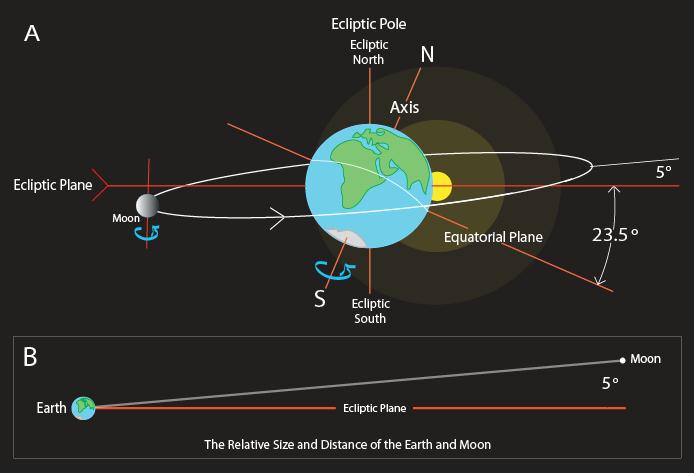
5) Incredible orbit. Earth’s moon is the only moon in the solar system that has a stationary, nearly “perfect” circular orbit. It’s a fact that the Moon does not spin like a natural celestial body. In other words, our Moon does not share any characteristics with other moons found in our Solar System. If it wasn’t strange enough, from any point on the surface of our planet, only one side of the Moon is visible. What is the moon hiding?
6) Lunar rocks and titanium. There are some lunar rocks that have been found to contain ten times more titanium than “titanium rich” rocks on planet Earth. Here on Earth, we use Titanium in supersonic jets, deep diving submarines and spacecraft. It’s unexplainable. Dr Harold Urey, Nobel Prize winner for Chemistry said he was “terribly puzzled by the rocks astronauts found on the moon and their Titanium content. The samples were unimaginable and mind-blowing since researchers could not account for the presence of Titanium.
7) Precise position. If all of the above points did not get you to think differently about the Earth’s moon here are some more interesting things about the Moon. What is keeping the moon in its nearly perfect position? the moon has a precise altitude, course and speed, allowing it to “function” properly in regards of planet Earth.
Simply put the Moon should not be where it is currently. Everything points to the possibility that Earth’s moon was in fact placed into its current position in the distant past. The Moon’s unnatural orbit and irregular composition raise hundreds of questions that neither NASA scientists, astronomers or geologists are able to answer today. Despite all efforts to understand Earth’s “natural” satellite, the truth is that we have very little information about the Moon’s origin and purpose. What do you think the moon is? A nearly perfect natural occurrence? Or do the Moon’s origins surpass human understanding?
Filed under Humor and Observations