Art and Eye Exams Meet: The Prize Winning Microart of Yukari Ehara

The carving above was made by microartist Yukari Ehara, as you may have noticed, on the tip of a green pencil crayon measuring 1.5mm in height.

This is nothing new for Ehara who works primarily in the 1cm to 0.1mm size range. Up until only recently she accomplished this and the other works seen below without the aid of a magnifying glass or microscope .

In addition to her pencil tip carvings let’s take a look at her miniature origami and paintings on single grains of rice and penny sized canvases.

First here are some of Yukari Ehara’s carvings which can be seen on her blog.

6mm Maneki Neko

3mm Coffee Cup

Some flowers which Ehara says takes about 30 minutes to complete
This 2.5mm by 1mm strawberry shortcake took about 3 hours to do.

Ehara also does micro painting on what has to be the cutest little canvases ever.

These small-scale works lend themselves nicely to unique handmade jewelry.

Going even smaller are her rice drawings which can also be made into jewelry.

She makes these rice drawings with her stockpile of tiny pencils.  Here they are compared to regular pencils and pins.

Going even smaller is Ehara’s origami. Unfortunately they’re so small the camera doesn’t really pick them up.

Yukari Ehara combined all of her talents into one work and entered it in the Ouchi Gallery7th 100 Artists Exhibition where it earned first place. Including origami, rice art, and carvings the entire work measures 33cm by 33cm and each inner frame measures 4.8cm by 4.8 cm.

There’s also a miniature hanafuda deck of cards. Hers are seen below a regular deck in this picture.

Finally, we’ll leave you with arguably Yukari Ehara’s coolest work: a pencil with a hand carved in it holding an even smaller (working) pencil.

This talented artist has a lot more to offer on her blog and hopefully has much more lined up for the future.

Source: Microart – The World’s Smallest via Kotaro 269 (Japanese)

1 Comment

Filed under Humor and Observations

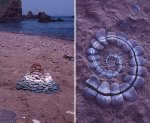
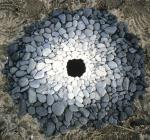
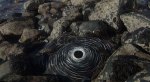
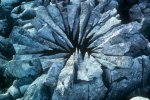
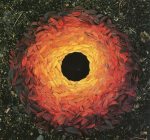
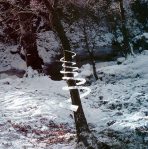
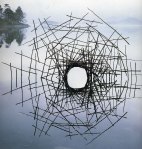
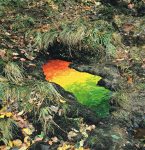
Man Arranges Leaves, Sticks, And Stones To Create Magical Land Artworks

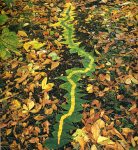
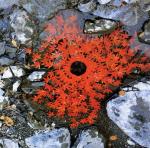
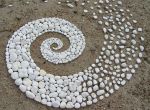
Scottish sculptor Andy Goldsworthy creates transitory works of art by arranging leaves, sticks, rocks or anything else he can find outside.

Most of Goldsworthy’s art is considered transient and ephemeral, causing people to perceive it as a criticism on the Earth’s fragility. However, for Goldsworthy, the meaning is more complicated.

“When I make something, in a field or street, it may vanish but it’s part of the history of those places,” he says in an interview. “In the early days my work was about collapse and decay. Now some of the changes that occur are too beautiful to be described as simply decay. At Folkestone I got up early one morning ahead of an incoming tide and covered a boulder in poppy petals. It was calm and the sea slowly and gently washed away the petals, stripping the boulder and creating splashes of red in the sea. The harbor from which many troops left for war was in the background.”

More info: Amazon | Website


Check Out Andy Goldsworthy’s photo books on Amazon

Leave a comment

Filed under Humor and Observations

Cosplay Pictures to Enjoy

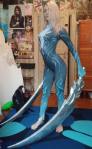
Cosplayers and their excellent cosplay to enjoy!  (luckily my cosplay flashdrive with some 20k pics on it survived the washer and dryer…)

Leave a comment

Filed under Humor and Observations

Cute Dog Pictures for Your Monday Blues!

Enjoy the cute dogs to start your week!

Leave a comment

Filed under Animals

Cosplay Pictures for the Weekend

Cosplayers and cosplay to enjoy!

Leave a comment

Filed under Humor and Observations

Vehicles – If You could only choose one…

Which of the following would you pick if you could only have one?

Leave a comment

Filed under Uncategorized

Mysterious giant sphere unearthed in forest divides opinion

Suad Keserovic cleans a stone ball in Podubravlje village 
Suad Keserovic cleans a stone ball in Podubravlje village  CREDIT: REUTERS/DADO RUVIC

This round rock could be the oldest stone sphere made by human hands, says Bosnian archaeologist Semir Osmanagic.

Discovered in a forest near the Bosnian town Zavidovici, the ball has a radius of between four and five feet, and an “extremely high” iron content.

Dr Osmanagic believes the sphere proves the existence of an advanced lost civilisation dating back more than 1,500 years ago.

Suad Keserovic cleans a stone ball 
CREDIT: REUTERS/DADO RUVIC

According to his fellow researcher Dr. Sam Osmanagich, the region used to have many more of the spheres well into the 20th century. Many were apparently destroyed in the 1970s due to rumours there was gold hidden in the middle of them.

Dr Osmanagic, known as “the Bosnian Indiana Jones,” hit headlines in 2005 when he claimed that a cluster of hills in  Bosnia’s Visoko Valley was in fact the site of ancient pyramids linked by a network of underground tunnels.

While his claims were mocked by some, the Bosnian government gave financial backing enabling excavations to be carried out in the region. Nedzad Brankovic, Bosnian Prime Minister at the time: “We were told the world was laughing at us … but there is no government in the world that should stay quiet on things which are positive.”

Suad Keserovic poses as he measures a stone ball 
CREDIT: REUTERS/DADO RUVIC /SUAD KESEROVIC CLEANS A STONE BALL I

Anthony Harding, the president of the European Association of Archaeologists, described the Visoko excavation as “a total absurdity”, saying: “There is some genuine archaeology on the hill and I’m told it’s medieval, possibly Bronze Age or Roman. But the speculation that there could be a 12,000-year-old structure beneath is a complete fantasy and anyone with basic knowledge of archaeology or history should recognise that.”

In 2016, critics are once again lining up to poke holes in Dr Osmanagic’s rather grand claims. Discussing the Zavidovici spehere, Mandy Edwards of the University of Manchester’s School of Earth, Atmospheric and Environmental Sciences told MailOnline the rock may not be man-made at all, and have been formed by the “precipitation of natural mineral cement within the spaces between sediment grains” – a process known as concretion.

Leave a comment

Filed under Humor and Observations

Cosplay Pictures for Your Saturday!

Cosplayers and cosplay to enjoy!

Leave a comment

Filed under Uncategorized

Mars meteorite 1st look at Red Planet’s ancient crust

Sawn surface of the Mars meteorite NWA 7533 showing both light and dark clasts in grey matrix.

Sawn surface of the Mars meteorite NWA 7533 showing both light and dark clasts in grey matrix. (Luc Labenne)

A meteorite found last year in the Sahara Desert is likely the first recognized piece of ancient Martian crust, a new study reports.

The Mars meteorite NWA 7533 is 4.4 billion years old and contains evidence of long-ago asteroid strikes, suggesting that the rock came from the Red Planet’s ancient and cratered southern highlands, researchers said.

“We finally have a sample of the Martian highlands, that portion of Mars that holds all the secrets to Mars’ birth and early development,” lead author Munir Humayun of Florida State University told SPACE.com via email. [Photos: Amazing Meteorites from Mars]

“It’s the part of Mars’ history where the oceans and atmosphere developed, and where life would have developed if it ever did on Mars,” Humayun added. “I will liken this to opening a treasure chest — it may take a while before we find the best treasures, but treasures aplenty lurk in this meteorite.”

Humayun and his colleagues subjected NWA (short for northwest Africa, where the rock was found) 7533 to a series of analyses. The researchers determined the meteorite’s age, for example, by determining that crystals within it called zircons formed about 4.4 billion years ago.

“This date is about 100 million years after the first dust condensed in the solar system,” Humayun said in a statement. “We now know that Mars had a crust within the first 100 million years of the start of planet-building, and that Mars’ crust formed concurrently with the oldest crusts on Earth and the moon.”

The team also found high concentrations of normally rare elements such as nickel, osmium and iridium in NWA 7533, indicating that the rock formed in a region that was pummeled by chondritic meteors, which are relatively enriched in these materials.

Further, after measuring the abundances of certain elements within the meteorite, Humayun and his team were able to calculate a thickness for the Red Planet’s crust.

“The amount of melting on Mars was low, sufficient to accumulate a 50-kilometer-thickness [31 miles] crust, but Mars evidently escaped the giant impact-style melting that affected the Earth and moon,” Humayun told SPACE.com. (Most scientists think the moon formed from material blasted into space when a planet-size body crashed into Earth more than 4 billion years ago.)

“This is the first reliable geochemical estimate of the thickness of Mars’ crust, and it agrees with geophysical estimates from gravity and topography,” he added.

Though researchers believe ancient Mars was relatively warm and wet, the team found no hydrous silicate minerals — which form in the presence of liquid water — within NWA 7533. Scientists will likely unearth more such puzzling details as they study the meteorite further, Humayun said.

“I expect more surprises as we dig deeper into our Martian treasure chest — some we will understand, and others may continue to befuddle us for a while to come,” he said.

Leave a comment

Filed under Humor and Observations

Cosplay Pictures for Your Weekend

Cosplayers and cosplay for your enjoyment!

Leave a comment

Filed under Humor and Observations