
I now have around 15 pounds of titanium, plastic and high grade ceramic instead of a left hip and femur. Many of us have artificial parts added to or inside our bodies now. Fake bones, fake joints, artificial limbs, the new eye contact lenses I posted earlier, and so on. Yet no one has looked at me and said I am no longer human. But what if all my original parts were replaced?
Now they can tie human thought processes to control machines, such as artificial parts, and even have those parts send back signals like your real arm would. We have decoded DNA and are starting to work with DNA splicing and improvement. There are currently successful projects making progress on mapping brain impulses and memory centers.
My personal prediction is that in forty years, the distinction of what is human will be seriously blurred. Maybe they can’t fix your severed spinal cord that makes you quadraplegic, so they drop your head onto a whole new mechanical body. Suppose you get Alzheimers, so they take an earlier neural mapping of your brain and stick it into a neural net computer and replace your brain. You think the same and have the same memories, but are you YOU? Eventually, it will lead to every human part being replaced as it wears out. After a hundred years or so, you will be all machine. You will still think you are human, but are you? Does your implanted memories and thought process into a completely artificial body retain its humanity? If you are a believer, do you still have a soul? Did your soul leave when your mind was replaced?
As robotics and electronic devices started to accelerate in their ability to replace and improve our natural parts, I believe cloning will not be as prevalent. At some point, why even have skin? It is difficult to maintain and prone to damage. Sex? Why not run a neural net program that simulates it instead of going out to a bar to find a partner? We are only one or two generations away from artificial bodies being as accepted as smart phones and computer pads are now. Yet how many have pondered the ramifications of this new world?
Here is an interesting article on the topic:
Half Man, Half Machine: Becoming Robotic
By Daniel Maas
show/hide words to know

What’s in the Story?
Darth Vader, Luke Skywalker, Dr. Octopus, or Master Chief, what do they all have in common? Besides being famous villains and heroes, they are all part robot, or cyborgs.
Have you wondered if it were possible to become part robot like any of these characters? Thanks to science, it is no longer impossible. The PLoS Biology journal article “Learning to Control A Brain-Machine Interface for Reaching and Grasping by Primates,” discusses how our brains can control robotic parts.
Becoming a Machine
 A great example of this comes from the movie Spider-Man 2. Dr. Octopus is a scientist who invents four mechanical, octopus-like arms. He attaches them to his back so he can control them from his spinal cord. Then “Doc Oc” controls his robot arms with his own thoughts! Of course, things go wrong and the machine arms start to control him, making him a villian that Spider-man must stop.
Modern day science has not advanced enough to the point where you can have giant robot arms attached to your back, but we do know it’s not completely impossible. Some researchers are finding which parts of the central nervous system work best to control robot arms. When they find a good area, they attach a Brain-Machine Interface to connect the robotic parts to the nervous system. Scientists are already finding out what part of the brain works best to control robot parts.
Getting in Your Head
In the Dr. Octopus example, he thought that the best place for a brain-machine interface was in his spinal column because there are lots of neurons in your spinal cord. Neurons are the cells that receive and send signals from your brain to your muscles. But researchers in this study were more interested in how brain-machine interfaces connect to the brain, which also has lots of neurons. The scientists knew certain spots in the front and sides of the brain work better than others for this kind of task.
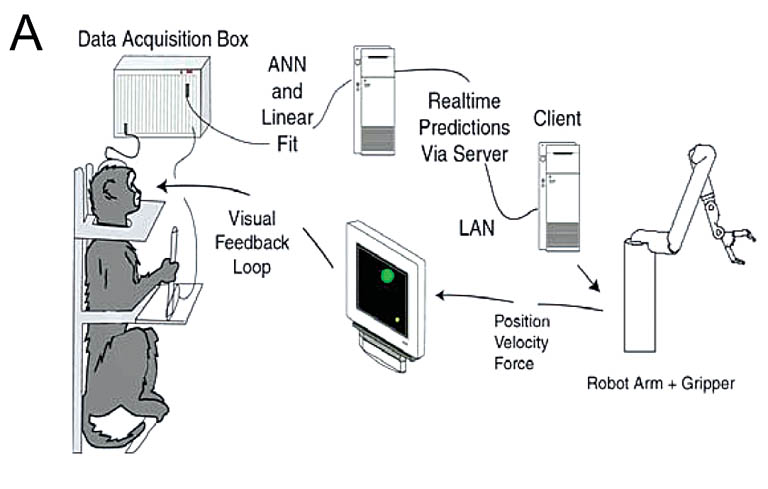
In the experiment, monkeys were trained to use a control stick and move it with their arms. Kind of like using an old video game controller. The monkeys used these control sticks to move one ball on a screen to a specific place on the other side of the screen. Once the monkeys got the hang of it, the control stick was removed and they watched the ball being move on its own. The trick was that the monkeys still thought they were controlling the motion. Finally, a robot arm was placed near the monkeys to make the same moves. Scientists took all of these steps so that the monkeys thought they were in control of the robotic arm moving the ball.
During all of these steps, the scientists watched the brain wave patterns from the monkeys to see how different parts of the brain acted. The researchers monitored four specific areas of the brain to record how the monkeys though when they were moving the control sitck versus “moving” the robotic arm. This information was then used to recommend the best places to put a brain-machine interface.
What Did They Find?
After using many graphs and doing a lot of math, the team found that the front and sides of the brain contain lots of neurons that send signals to make your muscles move. Scientists suggested that any place in the brain was suitable to attach a brain-machine interfae, as long as it was attached to plenty of neurons. They also found out that it takes time to learn how to use the brain-machine interface. Scientists saw that the monkeys slowly adjusted to the robot arm, but with practice they thought their brains were using it.
What does this mean for us? It means that maybe like Dr. Octopus, people can start to use robotic limbs better. Scientists think that by using the areas they found, a brain-machine interface can work better in humans. Not only that, but scientists have proven that if you use a brain-machine interface like a robotic arm often enough, it would become easy to use and even feels like it is an actual part of our bodies. Just look at this guy playing checkers with his robotic arm!

Robot drawing from Wikimedia – Mikael Nordin
Hand with robot hand from Wikimdia – Richard Greenhill and Marie De Ryck
Robot hand and light bulb from Wikimedia – Richard Greenhill and Hugo Elias
 Michael Bradley - Time Traveler