Tag Archives: antarctica

Active Volcano Discovered Underneath Antarctic

Active Volcano Discovered Underneath Antarctic Ice Sheet, Confirming Long-Held Suspicions

Posted: 11/18/2013 10:26 am EST  |  Updated: 11/18/2013 2:52 pm EST

 
Volcano Under Antarctica

By Becky Oskin, LiveScience Staff Writer:

Earthquakes deep below West Antarctica reveal an active volcano hidden beneath the massive ice sheet, researchers said today (Nov. 17) in a study published in the journal Nature Geoscience.

The discovery finally confirms long-held suspicions of volcanic activity concealed by the vast West Antarctic Ice Sheet. Several volcanoes poke up along the Antarctic coast and its offshore islands, such as Mount Erebus, but this is the first time anyone has caught magma in action far from the coast.

“This is really the golden age of discovery of the Antarctic continent,” said Richard Aster, a co-author of the study and a seismologist at Colorado State University. “I think there’s no question that there are more volcanic surprises beneath the ice.”

The volcano was a lucky find. The research project, called POLENET, was intended to reveal the structure of Earth’s mantle, the layer beneath the crust. In 2010, a team led by scientists from Washington University in St. Louis spent weeks slogging across the snow, pulling sleds laden with earthquake-monitoring equipment. [Images: Trek Across Antarctica]

Right place, right time

Two earthquake swarms struck beneath the researchers’ feet in January 2010 and March 2011, near the Executive Committee Range in the Marie Byrd Land region of the continent. As the researchers later discovered, the tremors — called deep, long-period earthquakes (DLPs) — were nearly identical to DLPs detected under active volcanoes in Alaska and Washington. The swarms were 15 to 25 miles (25 to 40 kilometers) below the surface.

“It’s an exciting story,” said Amanda Lough, the study’s lead author and a graduate student in seismology at Washington University in St. Louis. Though there were no signs of a blast, a 3,200-foot-tall (1,000 meters) bulge under the ice suggests the volcano had blasted out lava in the past, forming a budding peak.

volc3
The POLENET/ANET field team drags equipment to install remote seismic and GPS stations at Mount Sidley, a volcano in Antarctica (seen in background).

“We can say with pretty high confidence that there wasn’t an eruption while we were out there,” Lough told LiveScience’s OurAmazingPlanet. “We had people installing [seismometer] stations and flying airborne radar over the ice. But from the bed topography, we can see there is something building up beneath the ice.”

Scientists think that underground magma and fluids pushing open new paths and fracturing rock cause deep, long-period earthquakes. Many active volcanoes in Alaska’s Aleutian Islands have frequently produced these deep earthquake swarms without any signs of impending eruptions. However, researchers also monitor the tremors because a sudden uptick in shaking was seen before eruptions at Mount Spurr and Mount Redoubt in Alaska.

A volcanic flood

If the volcano in Antarctica did erupt, it would melt the bottom of the ice sheet immediately above the vent. Scientists aren’t sure what would happen next. In Iceland, volcanic eruptions can melt glaciers, causing massive floods calledjökulhlaups. But the ice above the Antarctic volcano is more than a half-mile (1 km) thick.

“How West Antarctic ice streams would react to an eruption a hundred or more kilometers [60 miles] inland from the grounding line is a yet-to-be-answered question,” said Stefan Vogel, a glaciologist with Australian Antarctic Division who was not involved in the study. The grounding line is the spot where glaciers detach from rock and float on water.

“There is certainly a need for more research, both in mapping the distribution and monitoring the activity level of subglacial volcanic activity beneath ice sheets, as well as studying the impact of subglacial volcanic activity on the hydrological system of glaciers and ice sheets,” Vogel said in an email interview.

It would take a super-eruption in the style of Yellowstone’s ancient blowouts to completely melt the ice above the active volcano, Lough and her co-authors calculated. And if the volcano under the ice is similar to ones close by, such as Mount Sidley, there’s no risk of a super-eruption. [Big Blasts: History’s 10 Most Destructive Volcanoes]

Instead, the millions of gallons of meltwater might simply hasten the flow of the nearby MacAyeal Ice Stream toward the sea.

“People hear the word ‘volcano’ and get caught up in the idea that it will change the way the ice sheet works, but this stuff has been going on underneath the ice [for millions of years], and the ice sheet is in balance with it,” Lough said. “Everyday magmatism isn’t enough to cause major problems.”

Hugh Corr, a glaciologist at the British Antarctic Survey who also discovered a buried Antarctic volcano, said an eruption could have a big effect, but it’s difficult to quantify.

“The biggest effect on the West Antarctic Ice Sheet is still climate change — warming the ocean, melting the ice shelves. That’s the most immediate risk, compared to if a volcano might go off,” said Corr, who was not involved in the study.

A geologic puzzle

Signs of active and extinct volcanoes pop up all over Antarctica. Ash layers and lava indicate volcanoes spouted while the continent froze during the past 20 million years or more. (An 8,000-year-old ash layer sits above the newly found volcano, but it comes from Mount Waesche, a nearby peak.)

“The [West] coast of Antarctica is like a ring of fire,” Corr said.

volc2
The Executive Committee Range in West Antarctica is home to a newly discovered active volcano.

The earthquake swarms line up with older volcanoes in the Executive Committee Range, suggesting the volcanic activity there is slowly migrating south by 6 miles (9.6 km) every million years. This migration is perpendicular to the motion of Antarctica’s tectonic plate, so a hotspot or mantle plume is not feeding the volcanoes, Lough said. (A mantle plume should make volcanoes that line up parallel to plate motion, like those of the Hawaiian Islands.)

The big mystery is figuring out why the volcano and its forerunners even exist. “Antarctica is certainly one of the most fascinating and enigmatic of all of Earth’s continents,” Aster said. [Video – Antarctica: Solving Geologic Mysteries]

Let’s set the scene. Antarctica is split by an incredible mountain range. Imagine if Utah’s spectacularly steep Wasatch Mountains cleaved North America from Texas all the way to Canada. That’s what the Transantarctic Mountains are like. In the West, the land dives off into a deep rift valley, where the crust has been tearing apart for about 100 million years. The newly found volcano sits on the other side of this rift, in a higher-elevation region called Marie Byrd Land.

While the torn crust may seem like the best explanation for Antarctica’s many volcanoes, many of the peaks fit no obvious pattern. Rifting and volcanism in Antarctica could be like nowhere else on Earth. “What is going on with the crust in Antarctica is still puzzling,” Lough said.

Email Becky Oskin or follow her @beckyoskin. Follow us @OAPlanetFacebook &Google+Original article on LiveScience’s OurAmazingPlanet.

1 Comment

Filed under Humor and Observations

Away From it All – Lenin’s Silent Vigil in Antarctica

Away From It All

http://www.stumbleupon.com/su/1Zcys9/:z!d9N!8.:Y.@noMBR/www.futilitycloset.com/2009/11/19/away-from-it-all-2/

http://commons.wikimedia.org/wiki/File:Southern_Pol_of_Inaccessibility_Henry_Cookson_team_n2i.JPG

Image: Wikimedia Commons

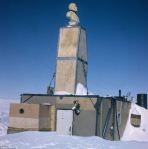
If you’re looking for a challenge, see if you can reach 82°06′S 54°58′E — it’s the most inaccessible point in Antarctica, the farthest from the ocean and the coldest place in the world.

You’ll know you’ve arrived because you’ll find a bust of Lenin peering weirdly across the ice toward Moscow.

Dig down 20 feet and you’ll uncover a pair of locked doors. Get those open and you can enter an old Soviet research hut, now completely entombed in snow.

And inside the hut is a golden visitors’ book to sign.

Leave a comment

Filed under Humor and Observations

Whale Skeleton Found

Whale Skeleton Found On Sea Floor In Antarctica, Along With Several New Marine Species

The Huffington Post  |  By Posted: 03/20/2013 9:08 am EDT

Talk about a whale of a find.

In what’s being called the first discovery of its type, scientists recently stumbled upon a whale skeleton on the ocean floor near Antarctica — one of only six natural whale skeletons found worldwide.

whale skeleton

That’s not all. As the researchers took a closer look at their find, they noticed something else quite remarkable — at least nine never-before-seen species of deep-sea organisms feeding on the bones and skull.

“Whale skeletons are able to support life on the seafloor, even after a considerable amount of time,” study author Diva Amon, a Ph.D. student at the University of Southampton in England, told The Huffington Post.

Whales sink to the ocean floor after their deaths, and then the carcasses, known as “whale fall,” become a sort of feeding ground for other marine life.

The researchers said the skeleton they found, believed to be that of a Minke whale and “several decades” old, was unearthed in a crater about a mile beneath the ocean’s surface.

In this instance — as in many “whale fall” discoveries — the skeleton was uncovered with the help of a remotely operated vehicle (ROV).

“We were at the end of a very long remotely operated vehicle survey with the U.K. ROV Isis and had already gone an hour over our allocated time on the seafloor, when we spotted a row of curious white blocks in the distance,” Amon said. “Upon investigation, we realized it was a whale skeleton with lots of deep-sea animals living on and around it.”

Those deep-sea organisms, which were confirmed as new discoveries, included a type of bone-eating Osedax worm. The researchers collected three of the whale bones and shipped the specimens to the U.K. for analysis by the British Antarctic Survey and the Natural History Museum.

A paper about the discoveries, “The discovery of a natural whale fall in the Antarctic deep sea,” was published in the online journal Deep-Sea Research II: Topical Studies in Oceanography.

Leave a comment

Filed under Animals, Humor and Observations

What Antarctica looked like before the ice

What Antarctica looked like before the ice

By Becky Oskin

Published March 08, 2013

LiveScience

  • antarctica_3d

    This 3-D reconstruction of the topography hidden under Antarctica’s two-mile-thick coating of ice was made using data from radar surveys. The continent was relatively flat before glaciers started carving deep valleys 34 million years ago, a new (Stuart N. Thomson/UA department of geosciences)

Like Alaska’s mighty Yukon, a broad river once flowed across Antarctica, following a gentle valley shaped by tectonic forces at a time before the continent became encased in ice. Understanding what happened when rivers of ice later filled the valley could solve certain climate and geologic puzzles about the southernmost continent.

The valley is Lambert Graben in East Antarctica, now home to the world’s largest glacier. Trapped beneath the ice, the graben (which is German for ditch or trench) is a stunning, deep gorge. But before Antarctica’s deep freeze 34 million years ago, the valley was relatively flat and filled by a lazy river, leaving a riddle for geologists to decode: How did Lambert Graben get so steep, and when was it carved?

The key to Lambert Graben’s history was found in layers of sediments just offshore, in Prydz Bay. In a new study, Stuart Thomson, a geologist at the University of Arizona (UA) in Tucson, looked into the past by decoding sands deposited by the river, and the messy piles left behind by the glacier. The river sands are topped with a thick layer of coarser sediment that signals the onset of glacial erosion in the valley, the researchers found. The erosion rate more than doubled when the glaciers moved in, Thomson said.

‘Glaciers can carve deep valleys quickly — and did so on Antarctica before it got … covered by 1 or 2 miles of thick, stationary ice.’

– Peter Reiners, a UA geologist 

“The only way that could happen is from glaciers,” he said. “They started grinding and forming deep valleys.”

Understanding when glaciers first wove their way across Antarctica will help scientists better model the ice sheet’s response to Earth’s climate shifts, the researchers said.

“There’s a big effort to model how glaciers flow in Antarctica, and these models need a landscape over which glaciers can flow,” Thomson told OurAmazingPlanet. “Once these models can predict past changes, they can more accurately predict what will happen with future climate changes.”

The sediments also hold clues to the tectonic evolution of East Antarctica, and a mountain range buried beneath the vast, thick ice sheet. [Album: Stunning Photos of Antarctic Ice]

The findings are detailed in the March 2013 issue of the journal Nature Geoscience.

History of the ice
Lambert Graben formed during the breakup of Gondwana, an ancient supercontinent, a process that happened in stages. Antarctica, India and Africa tore apart in the Late Cretaceous (about 80 million years ago). The split created long, linear valleys oriented perpendicular to the continental coastlines. At the time, Earth’s climate was warmer than it is today, and as Antarctica moved southward, settling into its home over the South Pole, the continent teemed with plants and animals.

Scientists can partially reconstruct this past environment with fossils and through radar that peers beneath the ice to map the shapes of the rock below. A 3D map of Antarctica today shows chasms carved by glaciers, rugged mountains and other remnants of its warmer existence.

But the surveys tell nothing about how the landscape looked before the ice carved out all those features. “People have speculated when the big fjords formed under the ice,” Thomson said. “But no one knows for sure until you sample the rocks or the sediments.”

Thomson and his colleagues analyzed sediments drilled from the ocean floor just offshore of Lambert Glacier, as well as from onshore moraines, the rock piles pushed up by glaciers. Tests on minerals in the sands and muds helped them figure out when and how fast the surface eroded.

Here’s what the sediments say: From about 250 million to 34 million years ago, the region around Lambert Glacier was relatively flat, and drained by slow-moving rivers, Thomson said. About 34 million years ago, which coincides with a cooling of Earth’s climate, big glaciers appeared, shaping the spectacular valley now hidden under thick ice.

“It seemed like it occurred very early on, 34 [million] to 24 million years ago,” Thomson said. Erosion slowed dramatically as the ice sheet stabilized about 15 million years ago, he said.

Some 5,250 to 8,200 feet of rock have since disappeared, ground down by glaciers and carried away by the ice, according to the study.

“Glaciers can carve deep valleys quickly — and did so on Antarctica before it got so cold that the most of it got covered by 1 or 2 miles of thick, stationary ice,” Peter Reiners, a UA geologist and study co-author, said in a statement.

Clues to buried mountain range

Lambert Graben extends about 375 miles inland, ending at one of Antarctica’s most enigmatic features — an entombed mountain range called the Gamburtsev Mountains. Buried under the ice, the mountains rose during Gondwana’s rifting. Geologic evidence suggests two pulses of upliftfrom rifting events about 250 million years ago and 100 million years ago pushed up the jagged peaks.

But Thomson and his colleagues did not find evidence in the sediments for a second uplift phase 100 million years ago. The river sands contain minerals from the Gamburtsev Mountains, and the tiny grains suggest the mountains got their height with one tectonic push.

“This underscores both the mountain range’s remarkable age and the extraordinary degree of subglacial landscape preservation,” writes Darrel Swift in an accompanying article in Nature Geoscience. Swift, a geologist at the University of Sheffield in the United Kingdom, was not involved in the study.

Read more: http://www.foxnews.com/science/2013/03/08/what-antarctica-looked-like-before-ice/?intcmp=obinsite#ixzz2O9j2guAz

Leave a comment

Filed under Humor and Observations