Tag Archives: archaeology

Most Ancient Port, Hieroglyphic Papyri Found

Most Ancient Port, Hieroglyphic Papyri Found

APR 12, 2013 02:00 PM ET // BY ROSSELLA LORENZI
 
Most Ancient Port Found in Egypt
PIERRE TALLE

An ancient Egyptian harbor has emerged on the Red Sea coast, dating back about 4,500 years.

“Evidence unearthed at the site shows that it predates by more than 1,000 years any other port structure known in the world,” Pierre Tallet, Egyptologist at the University of Paris-Sorbonne and director of the archaeological mission, told Discovery News.

PIERRE TALLET

Built at the time of the fourth dynasty of King Cheops, the owner of the Great Pyramid in the Giza Plateau, the port was discovered at Wadi el-Jarf, nearly 110 miles south the coastal city of Suez by a team of Franco-Egyptian archaeologists.

Egyptologist Sir John Garner Wilkinson
PD-ART/WIKIMEDIA COMMON

The site was first explored in 1823 by British pioneer Egyptologist Sir John Garner Wilkinson, who found a system of galleries cut into the bedrock a few miles from the coast. He believed them to be catacombs.

“The place was then described by French pilots working on the Suez Gulf during the 1950s, but no one realized that it concealed the remains of an ancient pharaonic harbor,” Tallet said.

.
PIERRE TALLET

Tallet has been excavating the area since 2011 with archaeologist Gregory Marouard, of the University of Chicago’s Oriental Institute, topographer Damien Laisney of the French National Center for Scientific Research, and doctoral students Aurore Ciavatti and Serena Esposito from the Sorbonne University. The team first focused on the most visible part of the site: the galleries described by Wilkinson.

The excavation revealed 30 of these galleries, measuring on average 65 feet long, 10 feet wide and 7 feet high.

PIERRE TALLET

Used to store dismantled boats after the expeditions that were regularly led to transfer copper and stones from Sinai to the Nile valley, the galleries featured an elaborate closure system which made use of large and heavy limestone blocks inscribed with the name of Cheops (about 2650 BC).

An ancient Egyptian harbor has emerged on the Red Sea coast, dating back about 4,500 years.

“Evidence unearthed at the site shows that it predates by more than 1,000 years any other port structure known in the world,” Pierre Tallet, Egyptologist at the University of Paris-Sorbonne and director of the archaeological mission, told Discovery News.

Built at the time of the fourth dynasty of King Cheops, the owner of the Great Pyramid in the Giza Plateau, the port was discovered at Wadi el-Jarf, nearly 110 miles south the coastal city of Suez by a team of Franco-Egyptian archaeologists.
PD-ART/WIKIMEDIA COMMON
 
PIERRE TALLET

Inside the galleries Tallet and his team found several fragments of boats, ropes and pottery dating to the early fourth dynasty. Three galleries contained a stock of storage jars, which probably served as water containers for boats.

PIERRE TALLET

Underwater exploration at the foot of the jetty revealed 25 pharaonic anchors — and pottery similar to that uncovered in the galleries — all dating  from the fourth dynasty.

PIERRE TALLET

About 200 meters from the sea side, the archaeologists also found the remains of an Old Kingdom building where 99 pharaonic anchors had been stored (visible at the center of the photo).

“Some of them were inscribed with hieroglyphic signs, probably with the names of the boats,” Tallet said.

PIERRE TALLET

Most interestingly, the storage galleries also contained hundreds of papyrus fragments.

Among them, 10 were very well preserved.

“They are the oldest papyri ever found,” Tallet said

Many of the papyri describe how the central administration, under the reign of Cheops, sent food — mainly bread and beer — to the workers involved in the Egyptian expeditions departing from the port.

PIERRE TALLET

But one papyrus is much more intriguing: it’s the diary of Merrer, an Old Kingdom official involved in the building of the Great Pyramid of Cheops.

From four different sheets and many fragments, the researchers were able to follow his daily activity for more that three months.

“He mainly reported about his many trips to the Turah limestone quarry to fetch block for the building of the pyramid,” Tallet said.

“Although we will not learn anything new about the construction of Cheops monument, this diary provides for the first time an insight on this matter,” Tallet said.

Leave a comment

Filed under Humor and Observations

Treasure-filled warrior’s grave found in Russia

Treasure-filled warrior’s grave found in Russia

By Owen Jarus

Published February 21, 2013

LiveScience

  • ancient-treasures-8

    The burial of the warrior was richly adorned and contained more than a dozen gold artifacts. This fibula-brooch, despite being only 2.3 by 1.9 inches in size, contains intricate decorations leading towardthe center where a rock crystal bead is (Photo courtesy Valentina Mordvintseva)

  • ancient-treasures-13.jpg

    This iron axe is one of many weapons found with the burial of the warrior. (Valentina Mordvintseva)

  • warrior-burial-diagram.jpg

    The grave of a male warrior who was laid to rest some 2,200 years ago in what is now the mountains of the Caucasus in Russia, shown here in a diagram of the warrior’s skeleton and numerous artifacts. (Valentina Mordvintseva)

Hidden in a necropolis situated high in the mountains of the Caucasus in Russia, researchers have discovered the grave of a male warrior laid to rest with gold jewelry, iron chain mail and numerous weapons, including a 36-inch iron sword set between his legs.
That is just one amazing find among a wealth of ancient treasures dating back more than 2,000 years that scientists have uncovered there.

Among their finds are two bronze helmets, discovered on the surface of the necropolis. One helmet (found in fragments and restored) has relief carvings of curled sheep horns while the other has ridges, zigzags and other odd shapes.

Although looters had been through the necropolis before, the warrior’s grave appears to have been untouched. The tip of the sword he was buried with points toward his pelvis, and researchers found “a round gold plaque with a polychrome inlay” near the tip, they write in a paper published in the most recent edition of the journal Ancient Civilizations from Scythia to Siberia. [See Images of the Warrior Burial and Artifacts]

The remains of three horses, a cow and the skull of a wild boar were also found buried near the warrior.

“These animals were particularly valuable among barbarian peoples of the ancient world. It was [a] sign of [the] great importance of the buried person, which was shown by his relatives and his tribe,” wrote team member Valentina Mordvintseva, a researcher at the Ukrainian National Academy of Sciences Institute of Archaeology, in an email to LiveScience. The animal bones and pottery remains suggest that a funeral feast was held in his honor.

Without written records it is difficult to say exactly who the warrior was, but rather than ruling a city or town, “he was rather a chief of a people,” Mordvintseva said.

The necropolis is located near the town of Mezmay. Grave robbers discovered the site in 2004 and rescue excavations began in 2005.

Who used the necropolis?
Based on the artifacts, researchers believe the warrior’s burial dates back around 2,200 years, to a time when Greek culture was popular in west Asia, while the necropolis itself appears to have been in use between the third century B.C. and the beginning of the second century A.D.

Researchers were careful to note that the artifacts cannot be linked to a specific archaeological culture. Mordvintseva points out that “this region is very big, and not sufficiently excavated,” particularly in the area where the necropolis is located. “[I]t is situated high in mountains. Perhaps the population of this area [had] trade routes/passes with Caucasian countries — Georgia, Armenia etc.,” Mordvintseva writes in the email.

While the people who used the necropolis were clearly influenced by Greek culture, they maintained their own way of life, said Mordvintseva. “Their material culture shows that they were rather very proud of themselves and kept their culture for centuries.”

Gold treasures
This way of life includes a fondness for gold-working. The warrior’s burial included more than a dozen artifacts made of the material. Perhaps the most spectacular find was a gold fibula-brooch with a rock crystal at its center. Although the brooch was only 2.3 by 1.9 inches, it had several layers of intricately carved decorations leading toward the mount.

“Inside the mount a rock-crystal bead has been placed with a channel drilled through it from both ends,” the researchers write.

The team was surprised to find that two of the warrior’s swords (including the one pointing toward his pelvis) had gold decorations meant to be attached. In one case a short 19-inch-long iron sword had a gold plate, with inlayed agate, that was meant to adorn its sheath. Until now, scholars had never seen this type of golden sword decorations in this part of the ancient world, the researchers write. The “actual fact that these articles were used to decorate weapons sets them apart in a category all of their own, which has so far not been recorded anywhere else …”

Read more: http://www.foxnews.com/science/2013/02/21/treasure-filled-warrior-grave-found-in-russia/?intcmp=related#ixzz2Qg0OO2BM

Leave a comment

Filed under Humor and Observations

Ancient Complex Found Near Birthplace of Abraham

Ancient Complex Discovered Near Biblical Birthplace Of Abraham In Southern Iraq

The Huffington Post  |  By Posted: 04/04/2013 2:10 pm EDT  |  Updated: 04/06/2013 1:01 pm EDT

A huge complex uncovered near what some believe to be the Biblical birthplace of Abraham is exciting researchers who for years were unable to investigate the region.

The site was discovered by a team of British archeologists working at Tell Khaiber in southern Iraq, near the ancient city of Ur, according to the Associated Press.

Stuart Campbell, a professor of Near Eastern Archaeology at Manchester University and head of its Department of Archeology, told the AP that the site is unusual because it’s so large. (It’s about the size of a football field.)

“This is a breathtaking find and we feel privileged to be the first to work at this important site,” Campbell said, according to Phys.org. “The surrounding countryside, now arid and desolate, was the birthplace of cities and of civilization about 5,000 years ago and home to the Sumerians and the later Babylonians.”

Discovery of the site was first made via satellite, according to Phys.org, followed by a geographical survey and trial excavations. Campbell said the site is provisionally dated to 2,000 B.C.

In an email to The Huffington Post, Campbell said researchers will use modern technology to help better understand that time period.

“Because of the gap in archaeological work in this region, any new knowledge is important to archaeologists in this area – and this find has the potential to really move forward our understanding of the first city-states,” Campbell wrote.

National Geographic notes that Ur probably originated “sometime in the fifth millennium B.C.” and was discovered in the 1920s and 1930s after an expedition. Once a commercial hub, Ur is also believed by many Biblical scholars to be the birthplace of Abraham.

Abraham, a descendant of Noah, is often described as the “spiritual father of Jews, Christians, and Muslims,” Slate notes. The Old Testament includes references to Abraham’s family members and a place called Ur of the Chaldeans. Some scholars have pointed to this as evidence that Ur was once Abraham’s home.

Campbell notes that there are alternative theories to Abraham’s birthplace, although Ur is commonly identified as the site. The archeologist added that his team is still excavating the complex.

The fact that Campbell’s team was able to work at the site at all is good news for researchers. For decades, culturally rich sites like Ur lay untouched due to unrest. Some sites were looted, and others were damaged by war, according to USA Today.


Stuart Campbell / AP


Leave a comment

Filed under Humor and Observations

Amateur with metal detector finds 1,600-year-old royal ring

Amateur with metal detector finds 1,600-year-old royal ring

Published March 28, 2013

FoxNews.com

  • Escrick Ring 1.jpg

    The Escrick Ring, an intricately worked gold ring surrounding a brilliant blue sapphire discovered in 2009 by metal-detector enthusiast Michael Greenhorn, seen here with his discovery. (Kippa Matthews / York Museums Trust)

  • Escrick Ring.jpg

    A unique piece of jewelry called the Escrick Ring is only the second known use of a sapphire in jewellery found in the country, the first being a 5th century Roman example. It was found with a metal detector in 2009. (Kippa Matthews / York Museums Trust)

Did this intricate piece of sapphire, gold and glass belong to the King of France, some 1,600 years ago?
A group of archaeologist met at the Yorkshire Museum in England last week to discuss the Escrick Ring, an intricately worked gold ring surrounding a brilliant blue sapphire discovered in 2009 by an amateur metal-detector enthusiast.

‘Nothing like it has been found in this country.’

– Natalie McCaul, curator of archaeology at the Yorkshire Museum 

The ring, among the oldest pieces of sapphire jewelry ever found in the country, was thought to date from the 10th or 11th centuries — until the group took a closer look.

“Nothing like it has been found in this country,” said Natalie McCaul, curator of archaeology at the Yorkshire Museum. “This sapphire ring is even more special than we had previously thought.”

The panel’s conclusion: The Escrick Ring was made in Europe, possibly France, and would have belonged to a king or leader — not just a Bishop, as had been previously thought. It’s likely to date far earlier than previously thought as well: the 5th or 6th century, as much as 600 years earlier than archaeologists had believed.

“Hopefully this will lead us to finding out more about the ring and possibly even who might have owned it,” she said.

The ring was found by Michael Greenhorn, from York and District Metal Detecting Club, in 2009. The Yorkshire Museum raised over $50,000 to purchase it.

Attendees of the workshop, which the Yorkshire Museum said included more than 30 experts from across the country, decided that the sapphire in the ring was probably cut earlier, possibly during the Roman period, but the ring itself was specially made around the sapphire. By looking at the wear on the ring it is thought that it was worn for at least 50 years before it was lost.

The gold hoop that forms the ring also looks slightly different to the main part of the ring, with suggestions being made that it was turned into a ring later, possibly from a brooch or mount.

Further research, including an X-ray analysis and samples from the gold hoop, may help to pinpoint its origin.

Read more: http://www.foxnews.com/science/2013/03/28/amateur-with-metal-detector-finds-1600-year-old-royal-ring/#ixzz2Otd8nD7U

Leave a comment

Filed under Humor and Observations

600 Year Old Chinese Coin Found In Kenya

Illinois scientists find rare coin in Kenya

Digging History

Published March 13, 2013

Associated Press

  • 600-year-old Chinese coin found in Kenya

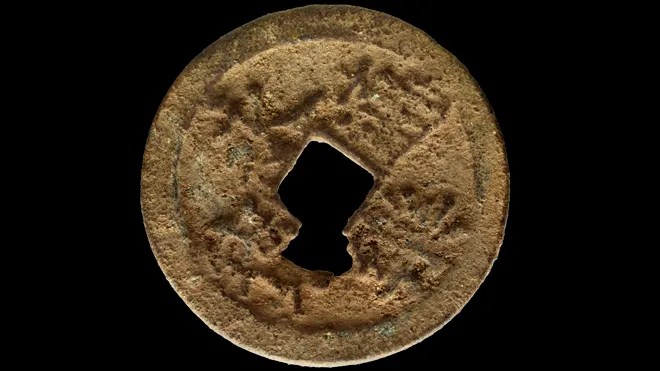
    Feb. 8, 2013: A rare, 600-year-old Chinese coin that scientists from Illinois discovered on the Kenyan island of Manda. The museum announced the discovery Wednesday, March 13. (AP Photo/Courtesy The Field Museum, John Weinstein)

CHICAGO –  Scientists from Illinois have found a rare, 600-year-old Chinese coin on the Kenyan island of Manda.

The Field Museum in Chicago announced the find Wednesday. The joint expedition was led by Chapurukha Kusimba of the museum and Sloan Williams of the University of Illinois-Chicago. Researchers say the coin proves trade existed between China and eastern Africa decades before European explorers set sail.

The coin is made of copper and silver. It has a square hole in the center so it could be worn on a belt. Scientists say it was issued by Emperor Yongle of China and his name is written on the coin.

Scientists from Kenya, Pennsylvania and Ohio also participated in the expedition. They also found human remains and other artifacts predating the coin.

Read more: http://www.foxnews.com/science/2013/03/13/illinois-scientists-find-rare-coin-in-kenya/?intcmp=obinsite#ixzz2OQNpWSIh

1 Comment

Filed under Humor and Observations

500-million-year-old sea creature found

500-million-year-old sea creature found

By Tia Ghose

Published February 28, 2013

LiveScience

  • arthropod-fossil-2

    Scientists have unearthed a stunningly preserved arthropod, called a fuxhianhuiid, in a flipped position that reveals its feeding limbs and nervous system. (Yie Jang (Yunnan University))

Scientists have unearthed extraordinarily preserved fossils of a 520-million-year-old sea creature, one of the earliest animal fossils ever found, according to a new study.

The fossilized animal, an arthropod called a fuxhianhuiid, has primitive limbs under its head, as well as the earliest example of a nervous system that extended past the head. The primitive creature may have used the limbs to push food into its mouth as it crept across the seafloor. The limbs may shed light on the evolutionary history of arthropods, which include crustaceans and insects.

‘This is as early as we can currently see into arthropod limb development.’

– Javier Ortega-Hernández, an earth scientist at the University of Cambridge 

“Since biologists rely heavily on organization of head appendages to classify arthropod groups, such as insects and spiders, our study provides a crucial reference point for reconstructing the evolutionary history and relationships of the most diverse and abundant animals on Earth,” said study co-author Javier Ortega-Hernández, an earth scientist at the University of Cambridge, in a statement. “This is as early as we can currently see into arthropod limb development.”

The findings were published Wednesday, Feb. 27, in the journal Nature.

Primordial animal

The fuxhianhuiid lived nearly 50 million years before animals first emerged from the sea onto land, during the early part of the Cambrian explosion, when simple multicellular organisms rapidly evolved into complex sea life. [See Images of the Wacky Cambrian Creatures ]

While paleontologists have unearthed previous examples of a fuxhianhuiid before, the fossils were all found in the head-down position, with their delicate internal organs obscured by a large carapace or shell.

However, when Ortega-Hernández and his colleagues began excavating in a fossil-rich region of southwest China around Kunming called Xiaoshiba, they unearthed several specimens of fuxhianhuiid where the bodies had been flipped before fossilization. All told, the team unearthed an amazingly preserved arthropod, as well as eight additional specimens.

These primeval creatures probably spent most of their days crawling across the seabed trawling for food and may have also been able to swim short distances. The sea creatures, some of the earliest arthropods or jointed animals, probably evolved from worms with legs.

The discovery sheds light on how some of the earliest ancestors of today’s animals may have evolved.

“These fossils are our best window to see the most primitive state of animals as we know them – including us,” Ortega-Hernández said in a statement. “Before that there is no clear indication in the fossil record of whether something was an animal or a plant – but we are still filling in the details, of which this is an important one.”

Read more: http://www.foxnews.com/science/2013/02/28/500-million-year-old-sea-creature/?intcmp=obinsite#ixzz2NjmkstbB

Leave a comment

Filed under Humor and Observations

Ancient Arctic Camel

Ancient Arctic camel a curious conundrum

Published March 05, 2013

Associated Press

  • Pliocene Candian Camel.jpg

    The High Arctic camel on Ellesmere Island during the Pliocene warm period, about 3.5 million years ago. The camels lived in a boreal-type forest that included larch trees; the depiction is based on records of plant fossils found at nearby fossil deposits. (Julius Csotonyi)

  • Pliocene Candian Camel 1.jpg

    The fossil bones of the High Arctic Camel laid out in Dr. Rybczynski’s lab at the Canadian Museum of Nature. The fossil evidence consists of about 30 bone fragments, which together form part of a limb bone of a Pliocene camel. (Martin Lipman, Canadian Museum of Nature)

  • Pliocene Candian Camel 2.jpg

    View of Camp 2 at the Fyles Leaf Bed Site on Ellesmere Island, near Strathcona Fiord. Across the valley lay exposed tilted Devonian-era beds, partially obscured by low-lying cloud. (Martin Lipman, Canadian Museum of Nature)

  • Pliocene Candian Camel 3.jpg

    A fragment of the camel fossil lying in situ on the Fyles Leaf Bed site. The fossil looks very similar to wood. The fossil evidence consists of about 30 bone fragments, which together form part of a limb bone of a Pliocene camel.Found on Ellesmere Island, this is the northernmost discovery of camels in the Arctic, about 1,200 km further north than the Yukon camel.The fossil record from this area shows the camel lived about 3.5 million years ago, when the region supported a boreal-type forest.Ellesmere Island..”Fyles Leaf Bed site” refers to an exposure located about 9 km Southwest of the Beaver Pond site near Strathcona Fiord. The section was visited previously by John Fyles (Geological Survey of Canada), and briefly in 1992 by Fyles and Richard Harington. In 1992 they prospected for about 2 hours. The first detailed stratigraphic work on the site was by Adam Csank (supervised by Jim Basinger) as part of his M.Sc. thesis (2006). At the time Adam measured 40 m of section, but in 2008 John Gosse determined that the Tertiary section was 90 m in thickness. (Martin Lipman, Canadian Museum of Nature)

OTTAWA –  Ancient, mummified camel bones dug from the tundra confirm that the animals now synonymous with the arid sands of Arabia actually developed in subfreezing forests in what is now Canada’s High Arctic, a scientist said Tuesday.

About 3.5 million years ago, Strathcona Fiord on Ellesmere Island’s west-central coast would have looked more like a northern forest than an Arctic landscape, said paleobotanist Natalia Rybczynski of the Canadian Museum of Nature in Ottawa.

“Larch-dominated, lots of wetlands, peat,” said Rybczynski, lead author of a study published Tuesday in the journal Nature Communications. Nearby fossil sites have yielded evidence of ancient bears, horses, deer, badgers and frogs. The average yearly temperature would have been about 32 Fahrenheit.

“If you were standing in it and watching the camel, it would have the feel of a boreal-type forest.”

The Arctic camel was 30 percent larger than modern camels, she said. Her best guess is it was one-humped.

Although native camels are now only found in Africa and Asia, scientists have long believed the species actually developed in North America and later died out. Camel remains have been previously found in the Yukon.

What makes Rybczynski’s find special is not only how far north it was found, but its state of preservation.

The 30 fragments found in the sand and pebbles of the tundra were mummified, not fossilized. So despite their age, the pieces preserved tiny fragments of collagen within them, a common type of protein found in bones.

Analyzing that protein not only proved the fragments were from camels, but from a type of camel that is much more closely related to the modern version than the Yukon camel. Out of the dozens of camel species that once roamed North America, the type Rybczynski found was one of the most likely to have crossed the Bering land bridge and colonized the deserts.

“This is the one that’s tied to the ancestry of modern camels,” she said.

Read more: http://www.foxnews.com/science/2013/03/05/ancient-arctic-camel-curious-conundrum/?intcmp=features#ixzz2NNHSu4Ih

2 Comments

Filed under Animals, Humor and Observations

Mummies Show Clogged Arteries 4,000 years ago.

Even 4,000 year-old mummies had clogged arteries, study reveals

Published March 11, 2013

Associated Press

  • MummyHeartDisease.JPG

    March 10, 2013: A a group of cardiologists lead by Saint Luke’s Mid America Heart Institute in Kansas City, USA, show the mummy Hatiay (New Kingdom, 18th Dynasty, 1550 to 1295 BCE) as it is returned to its display back in the Antiquities Museaum in Cairo after it underwent a CT scanning. (AP)

  • Egypt Mummies Heart Disease 1.jpg

    March 10, 2013: The sarcophagus of the mummy Hatiay (New Kingdom, 18th Dynasty, 1550 to 1295 BCE) is closed after the mummy underwent a CT scanning, in Cairo, Egypt. (AP Photo/Dr. Michael Miyamoto)

  • Egypt Mummies Heart Disease 2.jpg

    March 10, 2013: Egyptologists prepare the mummy Hatiay (New Kingdom, 18th Dynasty, 1550 to 1295 BCE) for CT scanning in Cairo, Egypt, which later demonstrated evidence of extensive vascular disease. (AP Photo/Dr. Michael Miyamoto)

  • Egypt Mummies Heart Disease.jpg

    March 10, 2013: The mummy Hatiay (New Kingdom, 18th Dynasty, 1550 to 1295 BCE) gets a CT scan in Cairo, Egypt, where it was found to have evidence of extensive vascular disease. (AP Photo/Dr. Michael Miyamoto)

Even without modern-day temptations like fast food or cigarettes, people had clogged arteries some 4,000 years ago, according to the biggest-ever hunt for the condition in mummies.

Researchers say that suggests heart disease may be more a natural part of human aging rather than being directly tied to contemporary risk factors like smoking, eating fatty foods and not exercising.

‘Heart disease has been stalking mankind for over 4,000 years.’

– Dr. Randall Thompson, a cardiologist at Saint Luke’s Mid America Heart Institute in Kansas City 

CT scans of 137 mummies showed evidence of atherosclerosis, or hardened arteries, in one third of those examined, including those from ancient people believed to have healthy lifestyles. Atherosclerosis causes heart attacks and strokes. More than half of the mummies were from Egypt while the rest were from Peru, southwest America and the Aleutian islands in Alaska. The mummies were from about 3800 B.C. to 1900 A.D.

“Heart disease has been stalking mankind for over 4,000 years all over the globe,” said Dr. Randall Thompson, a cardiologist at Saint Luke’s Mid America Heart Institute in Kansas City and the paper’s lead author.

The mummies with clogged arteries were older at the time of their death, around 43 versus 32 for those without the condition. In most cases, scientists couldn’t say whether the heart disease killed them.

The study results were announced Sunday at a meeting of the American College of Cardiology in San Francisco and simultaneously published online in the journal Lancet.

Thompson said he was surprised to see hardened arteries even in people like the ancient Aleutians who were presumed to have a healthy lifestyle as hunter-gatherers.

“I think it’s fair to say people should feel less guilty about getting heart disease in modern times,” he said. “We may have oversold the idea that a healthy lifestyle can completely eliminate your risk.”

Thompson said there could be unknown factors that contributed to the mummies’ narrowed arteries. He said the Ancestral Puebloans who lived in underground caves in modern-day Colorado and Utah, used fire for heat and cooking, producing a lot of smoke.

“They were breathing in a lot of smoke and that could have had the same effect as cigarettes,” he said.

Previous studies have found evidence of heart disease in Egyptian mummies, but the Lancet paper is the largest survey so far and the first to include mummies elsewhere in the world.

Dr. Frank Ruehli of the University of Zurich, who runs the Swiss Mummy Project, said it was clear atherosclerosis was notably present in antiquity and agreed there might be a genetic predisposition to the disease.

“Humans seem to have a particular vulnerability (to heart disease) and it will be interesting to see what genes are involved,” he said. Ruehli was not connected to the study. “This is a piece in the puzzle that may tell us something important about the evolution of disease.”

Other experts warned against reading too much into the mummy data.

Dr. Mike Knapton, associate medical director at the British Heart Foundation, said calcified arteries could also be caused by other ailments including endocrine disorders and that it was impossible to tell from the CT scans if the types of calcium deposits in the mummies were the kind that would have sparked a heart attack or stroke.

“It’s a fascinating study but I’m not sure we can say atherosclerosis is an inevitable part of aging,” he said, citing the numerous studies that have showed strong links between lifestyle factors and heart disease.

Researcher Thompson advised people to live as healthy a lifestyle as possible, noting that the risk of heart disease could be reduced with good eating habits, not smoking and exercising. “We don’t have to end up like the mummies,” he said.

Read more: http://www.foxnews.com/science/2013/03/11/study-reveals-even-4000-year-old-mummies-had-clogged-arteries/?intcmp=related#ixzz2NNFOasby

1 Comment

Filed under Humor and Observations

Ancient Shoes Found In Egypt

Lost and found: Ancient shoes turn up in Egypt temple

By Owen Jarus

Published February 28, 2013

LiveScience

  • 4-Egypt-shoe-discovery

    The unwrapped shoe bundle showing the two pairs of children’s shoes and the adult isolate. (© 2005 Franco M. Giani – Milano – Italy)

More than 2,000 years ago, at a time when Egypt was ruled by a dynasty of kings of Greek descent, someone, perhaps a group of people, hid away some of the most valuable possessions they had — their shoes.

Seven shoes were deposited in a jar in an Egyptian temple in Luxor, three pairs and a single one. Two pairs were originally worn by children and were only about 7 inches long. Using palm fiber string, the child shoes were tied together within the single shoe (it was larger and meant for an adult) and put in the jar. Another pair of shoes, more than 9 inches long that had been worn by a limping adult, was also inserted in the jar.

The shoe-filled jar, along with two other jars, had been “deliberately placed in a small space between two mudbrick walls,” writes archaeologist Angelo Sesana in a report published in the journal Memnonia.

Whoever deposited the shoes never returned to collect them, and they were forgotten, until now. [See Photos of the Ancient Egyptian Shoes]

‘The shoes were in pristine condition and still supple upon discovery.’

– André Veldmeijer, an expert in ancient Egyptian footwear 

In 2004, an Italian archaeological expedition team, led by Sesana, rediscovered the shoes. The archaeologists gave André Veldmeijer, an expert in ancient Egyptian footwear, access to photographs that show the finds.

“The find is extraordinary as the shoes were in pristine condition and still supple upon discovery,” writes Veldmeijer in the most recent edition of the Journal of the American Research Center in Egypt. Unfortunately after being unearthed the shoes became brittle and “extremely fragile,” he added.

Pricey shoes
Veldmeijer’s analysis suggests the shoes may have been foreign-made and were “relatively expensive.” Sandals were the more common footwear in Egypt and that the style and quality of these seven shoes was such that “everybody would look at you,” and “it would give you much more status because you had these expensive pair of shoes,” said Veldmeijer, assistant director for Egyptology of the Netherlands-Flemish Institute in Cairo.

The date of the shoes is based on the jar they were found in and the other two jars, as well as the stratigraphy, or layering of sediments, of the area. It may be possible in the future to carbon date the shoes to confirm their age.

Why they were left in the temple in antiquity and not retrieved is a mystery. “There’s no reason to store them without having the intention of getting them back at some point,” Veldmeijer said in an interview with LiveScience, adding that there could have been some kind of unrest that forced the owners of the shoes to deposit them and flee hastily. The temple itself predates the shoes by more than 1,000 years and was originally built for pharaoh Amenhotep II (1424-1398 B.C.).

Design discoveries
Veldmeijer made a number of shoe design discoveries. He found that the people who wore the seven shoes would have tied them using what researchers call “tailed toggles.” Leather strips at the top of the shoes would form knots that would be passed through openings to close the shoes. After they were closed a long strip of leather would have hung down, decoratively, at either side. The shoes are made out of leather, which is likely bovine.

Most surprising was that the isolated shoe had what shoemakers call a “rand,” a device that until now was thought to have been first used in medieval Europe. A rand is a folded leather strip that would go between the sole of the shoe and the upper part, reinforcing the stitching as the “the upper is very prone to tear apart at the stitch holes,” he explained. The device would’ve been useful in muddy weather when shoes are under pressure, as it makes the seam much more resistant to water.

In the dry (and generally not muddy) climate of ancient Egypt, he said that it’s a surprising innovation and seems to indicate the seven shoes were constructed somewhere abroad.

Health discoveries
The shoes also provided insight into the health of the people wearing them. In the case of the isolated shoe, he found a “semi-circular protruding area” that could be a sign of a condition called Hallux Valgus, more popularly known as a bunion. [The 9 Most Bizarre Medical Conditions]

“In this condition, the big toe starts to deviate inward towards the other toes,” Veldmeijer writes in the journal article. “Although hereditary, it can also develop as a result of close fitting shoes, although other scholars dispute this ….”

Another curious find came from the pair of adult shoes. He found that the left shoe had more patches and evidence of repair than the shoe on the right. “The shoe was exposed to unequal pressure,” he said, showing that the person who wore it “walked with a limp, otherwise the wear would have been far more equal.”

Still, despite their medical problems, and the wear and tear on the shoes, the people who wore them were careful to keep up with repairs, Veldmeijer said. They did not throw them away like modern-day Westerners tend to do with old running shoes.

“These shoes were highly prized commodities.”

Veldmeijer hopes to have the opportunity to examine the shoes, now under the care of the Ministry of State for Antiquities, firsthand.

Read more: http://www.foxnews.com/science/2013/02/28/lost-and-found-ancient-shoes-turn-up-in-egypt-temple/?intcmp=obinsite#ixzz2NIf3IGOv

1 Comment

Filed under Humor and Observations

New Meteorite Found In Antartica

Huge Meteorite Found In Antarctica, Largest Discovered There In 25 Years 

The Huffington Post  |  By Posted: 03/01/2013 1:00 pm EST

Meteorite Found Antarctica
An unusually large meteorite has been discovered by an international team of researchers in Antarctica.

The team, searching an area known as the Nansen Ice Field, discovered the 40-pound space rock in late January, according to OurAmazingPlanet.

Scientists from Université Libre de Bruxelles (ULB), Vrije Universiteit Brussel (VUB), Japan’s National Institute of Polar Research (NIPR) and Tokyo University were part of the expedition that discovered the extraterrestrial chunk, the largest such meteorite found in the region in close to a quarter century. The team was based out of the Princess Elisabeth Antarctica research station.

“This meteorite was a very unexpected find for us, not only due to its weight, but because we don’t normally find such large meteorites in Antarctica,” Vinciane Debaille, a geologist who led the Belgian arm of the research team, said in a written statement on Feb. 28. “This is the biggest meteorite found in East Antarctica for 25 years, so it’s a very special discovery for us, only made possible by the existence and location of Princess Elisabeth Antarctica.”

Known collectively as SAMBA, the international team had been searching the ice field since mid-December, according to the group’s website. The team’s current project is to collect large meteorites and study them. Eventually, the meteorites will be publicly displayed.

The SAMBA website describes the goal of such research:

Understanding how our planet works necessitates studying its interior. Direct geological records only document the crustal or uppermost fraction of our planet while the deeper parts remain totally outside of our reach. Meteorites coming from the asteroid belt between Mars and Jupiter have recorded information on how other planets formed and evolved through time; from undifferentiated primitive asteroids to differentiated small planets, showing the development of a crust, a mantle, and a metallic core just like those of the Earth.

Debaille’s Feb. 28 statement also explained the group’s work. “We study meteorites in order to better understand how the solar system formed, how it evolved, how the Earth became such a unique planet in our solar system,” said Debaille.

OurAmazingPlanet notes that United States scientists also ventured “out on the polar ice to collect meteorites this season,” but they were searching on the opposite end of Antarctica from the SAMBA outfit.

While meteors generally burn up in the atmosphere, in mid-February a huge meteor exploded over central Russia, showering the area in debris and creating a shock wave that injured hundreds.

Leave a comment

Filed under Humor and Observations