Tag Archives: archaeology

Woman Sought to Have Neanderthal Baby

Scientist seeks ‘adventurous woman’ to have Neanderthal baby

Published January 21, 2013

FoxNews.com

  • Homo Neanderthalensis

    Hyper-realistic busts of human ancestors — like this version of homo neandertal — give us a glimpse of what our ancient relatives may have looked like. (John Gurche)

  • An artist imagines the typical Neanderthal family.

    An artist imagines the typical Neanderthal family. (NASA/JPL-Caltech)

  • Neanderthal Tooth Fairy

    In this picture made available by Szczecin University’s Department of Archaelogy on Monday, Feb. 1, 2010 one of three Neanderthal teeth discovered in Poland is pictured . A team of Polish scientists say they have discovered three Neanderthal teeth in a cave in the southern part of the country. Mikolaj Urbanowski, an archaeologist and the lead researcher, said Monday that, although Neanderthal artifacts have been unearthed in Poland before, the teeth are the first remains of Neanderthals themselves discovered in the country. (AP)

EDITOR’S NOTE: The genetics professor quoted here, George Church, said after publication of this story that his quotes to the German magazine on which this article is based were distorted. An updated version of the story appears here.

Where’s Fred Flintstone when you need him?

A professor of genetics at Harvard’s Medical School believes he’s capable of bringing the long-extinct Neanderthal back to life — all he’s lacking is the right mother.

“I can create a Neanderthal baby, if I can find a willing woman,” George Church told German newspaper Spiegel Online. The DNA of the Neanderthal, a long extinct relative of man, has been more or less rebuilt, a process called genetic sequencing.

In 2005, 454 Life Sciences began a project with the Max Planck Institute to sequence the genetic code of a 30,000 year old Neanderthal woman. Now nearly complete, the sequence will let scientists look at the genetic blueprint of humankind’s nearest relative, understand its biology and maybe even create a living person.

And with that blueprint, it’s very possible to “resurrect” the Neanderthal, he argues — something Church has been pushing for years. Church did not respond to FoxNews.com requests to confirm the Spiegel Online story, but last year, he told Bloomberg he was keen on the idea.

“We have lots of Neanderthal parts around the lab. We are creating Neanderthal cells. Let’s say someone has a healthy, normal Neanderthal baby. Well, then, everyone will want to have a Neanderthal kid. Were they superstrong or supersmart? Who knows? But there’s one way to find out.”

Last year, researchers finished sequencing the genome of another extinct human relative, the denisovan — based solely off a piece of fingerbone and two molars.

Read more: http://www.foxnews.com/science/2013/01/21/scientist-seeks-adventurous-woman-to-have-neanderthal-baby/?intcmp=features#ixzz2LaOI7PjA

1 Comment

Filed under Humor and Observations

New Pyramids Discovered on Google Earth

Lost Egyptian pyramids found … by Google?
Images from Google Earth reveal what appear to be two long-lost pyramid complexes.
Mon, Aug 13 2012 at 11:43 AM
 
Google Earth pyramids
Have two new Egyptian pyramids been located thousands of years after they were last seen by human eyes? That may be the case, as images from Google Earth appear to show two long-lost pyramid complexes in Upper Egypt near the city of Abu Sidhum,Discovery News reports.
The images were identified by satellite archaeology researcher Angela Micol, who posted her observations on her website, Google Earth Anomalies.
Google Earth is a 3D virtual globe and mapping program that combines satellite imagery and aerial photography. First created by a company funded by the Central Intelligence Agency, the program was acquired by Google in 2004.
Egypt’s best-known pyramids, including the fabled Great Pyramid, are located at Giza, not far from the capital city of Cairo, but 115 others are known to be scattered throughout the country. That number keeps growing. Most recently, the so-called “headless pyramid” was rediscovered in 2008. The 4,000-year-old structure had been documented by archaeologist Karl Richard Lepsius in 1842 but it was lost when desert sands covered it back up for more than a century and a half.
The two new sites are located about 90 miles from each other and Micol has verified with Egyptologists that they are not among the 118 known pyramids. “The images speak for themselves. It’s very obvious what the sites may contain but field research is needed to verify they are, in fact, pyramids and evidence should be gathered to determine their origins,” Micol said in a press release on her site.
The first of the two sites contains what Micol characterizes as “a distinct, four-sided, truncated, pyramidal shape that is approximately 140 feet in width.” The site also contains three small mounds aligned in a diagonal manner similar to the pyramids at Giza.
The second site, shown in the photo above, contains four mounds, the two largest of which are each 250 feet in width. The smaller mounds are each approximately 100 feet wide.
Micol has not revealed the exact locations of the two sites, saying they must first be identified and protected by Egyptian officials.
The researcher has been using satellite images for 10 years to identify previously unknown sites. She recently released an image she identified as a possible underwater city located near the coast of the Yucatan peninsula.
Micol says she is forming a nonprofit organization to promote satellite archaeology and remote sensing and is raising money to fund a documentary about the some of the sites she has unearthed using Google Earth.
Photo above: Google Earth

Leave a comment

Filed under Humor and Observations

Blood of King Louis XVI Authenticated

Blood of guillotined King Louis XVI is ‘authentic’
Now that it has confirmed the blood came from Louis XVI, researchers are planning to reconstruct the entire genome of the deposed French monarch.

Tia Ghose, LiveScience

Wed, Jan 02 2013 at 2:56 PM

A gourd emblazoned with heroes of the French Revolution contained the blood of Louis XVI. (Photo: Davide Pettener)

More than 200 years ago, France’s King Louis XVI was killed (along with his wife, Marie Antoinette) via guillotine, and legend has it someone used a handkerchief to soak up the king’s blood, then stored the handkerchief in a gourd.
Now scientists have confirmed that a squash emblazoned with figures from the French Revolution indeed contains the dried blood of the executed king.
Scientists matched DNA from the blood with DNA from a detached and mummified head believed to be from a direct ancestor of King Louis XVI, the 16th-century French king Henry IV. The new analysis, which was published Dec. 30 in the journal Forensic Science International, confirmed the identity of both French royals.
“We have these two kings scattered in pieces in different places in Europe,” said study co-author Carles Lalueza-Fox, a paleogenomics researcher at Pompeu Fabra University in Spain. The new analysis confirms that the two men “are separated by seven generations and they are paternally related.” [See Photos of the Embalmed Head & Gourd]
French King Henry IV's embalmed head
Two French kings
King Henry IV was born in 1553 and became king in 1589 after a crazed monk killed his predecessor, Henry III. To ascend to the throne, Henry, a Protestant, converted to Catholicism and laid siege to Paris. Through his fair and peaceful reign, he earned a reputation as “Good King Henry.”
But in 1610, a fanatical Catholic assassinated him, and his body was embalmed and laid to rest in northern Paris. There it stayed until the French Revolution, when looters desecrated the graves of bygone monarchs. At this point, someone must have cut off King Henry’s head.
The head (at right) was held privately until 2010, when researchers used a facial reconstruction to argue that it once belonged to Good King Henry. But DNA taken from tissues in the head was too contaminated to analyze for any definitive conclusion.
Meanwhile, a wealthy Italian family possessed the gourd that allegedly contained the blood of the unpopular King Louis XVI. (The handkerchief presumably had disintegrated.)
Louis XVI was born in 1754 and died in 1793, when the rising tide of revolution swept him and Marie Antoinette from power and eventually to the guillotine. At his execution, legend had it that witnesses dipped their handkerchiefs in the monarch’s blood, Lalueza-Fox told LiveScience. Text on the gourd recounts the gruesome story: “On January 21, Maximilien Bourdaloue dipped his handkerchief in the blood of Louis XVI after his decapitation.” [10 Historically Significant Political Protests]
Blood relatives
Last year Lalueza-Fox analyzed the genetic material in the blood and found it came from a blue-eyed European male. But without any comparison DNA, he couldn’t definitively say it was the blood of the last French king.
Last year, however, the forensic scientist who originally studied the embalmed headsent DNA from inside it to the research team. The new DNA was not as badly damaged, and Lalueza-Fox and his colleagues were able to get parts of the Y, or male sex, chromosome, which is often used to identify male lineages.
By comparing the Y chromosome in both samples, the team concluded that the two men were 250 times more likely to be genetically related than unrelated. Both samples had genetic variants characteristic of the Bourbon region of France, and those variants are very rare in Europe today.
Given the history behind the samples, the new findings confirm that both the dried blood belongs to King Louis XVI. It also verifies that the embalmed head once belonged to King Henry IV.
Now that it has confirmed the blood came from Louis XVI, the team is planning to reconstruct the entire genome of the deposed French monarch.
“This could be the first historical genome ever to be retrieved,” Lalueza-Fox said.
Photo: Philippe Charlier
Follow LiveScience on Twitter @livescience. We’re also on Facebook & Google+

Leave a comment

Filed under Humor and Observations

Ancient temple discovered in Peru

Ancient temple discovered in Peru

Published February 15, 2013

LiveScience

  • peru-elParaiso

    Excavators stand near a newly discovered temple at the archeological site El Paraíso in Peru. (Peru Ministry of Culture)

Archaeologists in Peru have uncovered what they believe is a temple, estimated to be up to 5,000 years old, at the site of El Paraíso, north of Lima.

Inside the ruins of the ancient room, which measures about 23 feet by 26 feet, there’s evidence of a ceremonial hearth, where offerings may have been burned, archaeologists say. The temple also had a narrow entrance and stone walls covered with yellow clay, on which traces of red paint were found, according to a statement from Peru’s Ministry of Culture.

El Paraíso, located on the central coast of Peru, just north of Lima, is a site made up of 10 buildings stretching over 123 acres. It’s one of the earliest known examples of monumental stone architecture in the Americas, dating back to the Late Preceramic period (3500-1800 B.C.). The newly found building is thought to date back to 3000 B.C., which should be confirmed with a radiocarbon analysis.

Rafael Varón, Peru’s deputy minister for culture, said in a statement that the discovery of the temple “has particular importance because it is the first structure of this type found on the central coast.” It suggests that the Lima region had more religious, economic and political importance during this early period than previously thought, Varón added.

Previously, man-made mounds shaped like orcas, condors and even a duck were discovered in Peru’s coastal valleys, including at El Paraíso, by anthropologist Robert Benfer, professor emeritus of the University of Missouri, who spotted the mounds in satellite photos. One curious mound found in El Paraíso in the Chillón Valley was of a condor head whose burned-charcoal eye was likely the place where offerings were once burned. The condor was also positioned to line up with the most extreme orientation of the Milky Way as seen from the Chillón Valley. [See Photos of the Animal Mounds]

A second mound, right next to the condor, looked like a combination of a puma and alligatorlike cayman, Benfer said. That one was oriented toward the spot where the sun rises on the day of the June solstice, the start of summer.

Dating to more than 4,000 years ago, the structures may be the oldest evidence of animal mounds outside of North America, Benfer said last year. The previous oldest animal structures date to about 2,000 years ago, part of the Nazca Lines. These lines are simple stone outlines of animals decorating the Nazca Desert in Peru.

Read more: http://www.foxnews.com/science/2013/02/15/ancient-temple-discovered-in-peru/?intcmp=features#ixzz2L7a2CVrS

Leave a comment

Filed under Humor and Observations

Sunken Cities Of The Ancient World

Sunken Cities Of The Ancient World

AUGUST 2, 2011

Though finding Atlantis may still be a pipe dream, these cities, long submerged in the depths of their surrounding oceans, provide enough mystery and wonder to whet your imaginations.

Cleopatra’s Kingdom, Alexandria, Egypt

we4Md Sunken Cities Of The Ancient World

Lost for 1,600 years, the royal quarters of Cleopatra were discovered off the shores of Alexandria. A team of marine archaeologists, led by Frenchman, Franck Goddio, began excavating the ancient city in 1998. Historians believe the site was submerged by earthquakes and tidal waves, yet, astonishingly, several artifacts remained largely intact. Amongst the discoveries were the foundations of the palace, shipwrecks, red granite columns, and statues of the goddess Isis and a sphinx. The Egyptian Government plans to create an underwater museum and hold tours of the site.

1uj3n Sunken Cities Of The Ancient World

dUZYr Sunken Cities Of The Ancient World

HAosg Sunken Cities Of The Ancient World

FZjVQ Sunken Cities Of The Ancient World

Bay of Cambay, India

XmnGi Sunken Cities Of The Ancient World

The Bay of Cambay was discovered by marine scientists in early 2002. The city is located 120 feet underwater in the Gulf of Cambay off the western coast of India. The city is five miles long and two miles wide, carbon dating estimates the site to be a whopping 9,500 years old, and, more amazingly, architectural and human remains are still intact. The discovery astounded scientists because it predates all other finds in the area by 5,000 years, suggesting a much longer history of the civilization than was first assumed. Marine scientists used sonar images and sum-bottom profiling to locate the lost ruins and it is believed the area was submerged when the ice caps melted in the last Ice Age. The Indian nationals have dubbed the find ‘Dwarka’ (The Golden City) in honor of ancient submerged city said to belong to Hindu god, Krishna.

Dpyxp Sunken Cities Of The Ancient World

Port Royal, Jamaica

NAs6L Sunken Cities Of The Ancient World

Once referred to as the ‘Wickedest City on Earth’ (because of its rampant piracy, prostitution and rum consumption), part of Port Royal sank after an earthquake in 1692. The ruins scattered in the Kingston Harbor, and currently, the remains of the city encompasses 13 acres at depths of up to 40 feet. Archaeological investigations of the site began in 1981, led by the Nautical Archaeology Program of Texas A&M University. The investigations unearthed historical documents, organic artefacts and vast amount of architectural debris.

YnukN Sunken Cities Of The Ancient World

Yonaguni-Jima, Japan

YXMyc Sunken Cities Of The Ancient World

Some 68 miles past the east coast of Taiwan, off the coast of Yonaguni Islands, a sunken ruin was discovered by a sport diver, in 1995. The ruins are estimated to be around 8,000 years old, however, it is still unclear which missing city they made up. The most spectacular discovery amongst the submerged ruins is a large pyramid structure, finely designed archways resembling the Inca civilization, staircases and hallways, and carved stones.

Nvw7n Sunken Cities Of The Ancient World

y8LS3 Sunken Cities Of The Ancient World

v0YLc Sunken Cities Of The Ancient World

Baiae and Portus Julius, Italy

gJ7nJ Sunken Cities Of The Ancient World

Baiae was an ancient Roman town overlooking the Bay of Naples, where rich Romans and emperors whiled away their time in their villas. It was also connected to the Roman Empire’s biggest naval base, Portus Julius. However, the town and port were built on a tract of volcanic land, the activity of which is said to have caused the structure to collapse into the ocean.

AXmaR Sunken Cities Of The Ancient World

w6Mvn Sunken Cities Of The Ancient World

Pavlopetri, Greece

5vM1k Sunken Cities Of The Ancient World

The ruins of the ancient Mycenaean town of Pavlopetri date back to the Neolithic period (2,800 BC), and unveil a cultural hub of ancient Greece. The submerged city was discovered three to four metres off the coast of southern Laconia, and has many intact buildings, courtyards, streets, chamber tombs and graves. Pavlopetri was believed to be a thriving harbour town and sheds light on many mysteries of the Mycenaean civilization.

YeSUj Sunken Cities Of The Ancient World

KlKb0 Sunken Cities Of The Ancient World

YZ7vg Sunken Cities Of The Ancient World

Leave a comment

Filed under Humor and Observations

35 ancient pyramids discovered in Sudan

35 ancient pyramids discovered in Sudan

By Owen Jarus

Published February 07, 2013

LiveScience

  • sedeinga pyramids.jpg

    Among the discoveries are pyramids with a circle built inside them, cross-braces connecting the circle to the corners of the pyramid. Outside of Sedeinga only one pyramid is known to have been built in this way. (Vincent Francigny/SEDAU)

  • sedeinga-pyramids-1.jpg

    This aerial photo shows a series of pyramids and graves that a team of archaeologists has been exploring at Sedeinga in Sudan. Since 2009 they have discovered at least 35 small pyramids at the site, the largest being 22 feet in width. (B-N Chagny, SEDAU/SFDAS)

  • sedeinga-pyramids-5.jpg

    People were buried beside the pyramids in tomb chambers that often held more than one individual. This image shows a child who was buried with necklaces. (Vincent Francigny/SEDAU)

At least 35 small pyramids, along with graves, have been discovered clustered closely together at a site called Sedeinga in Sudan.

Discovered between 2009 and 2012, researchers are surprised at how densely the pyramids are concentrated. In one field season alone, in 2011, the research team discovered 13 pyramids packed into roughly 5,381 square feet, or slightly larger than an NBA basketball court.

They date back around 2,000 years to a time when a kingdom named Kush flourished in Sudan. Kush shared a border with Egypt and, later on, the Roman Empire. The desire of the kingdom’s people to build pyramids was apparently influenced by Egyptian funerary architecture.

‘They reached a point where [the necropolis] was so filled with people and graves that they had to reuse the oldest one.’

– Vincent Francigny, a research associate with the American Museum of Natural History in New York 

At Sedeinga, researchers say, pyramid building continued for centuries. “The density of the pyramids is huge,” said researcher Vincent Francigny, a research associate with the American Museum of Natural History in New York, in an interview with LiveScience. “Because it lasted for hundreds of years they built more, more, more pyramids and after centuries they started to fill all the spaces that were still available in the necropolis.”

The biggest pyramids they discovered are about 22 feet wide at their base with the smallest example, likely constructed for the burial of a child, being only 30 inches long. The tops of the pyramids are not attached, as the passage of time and the presence of a camel caravan route resulted in damage to the monuments. Francigny said that the tops would have been decorated with a capstone depicting either a bird or a lotus flower on top of a solar orb.

The building continued until, eventually, they ran out of room to build pyramids. “They reached a point where it was so filled with people and graves that they had to reuse the oldest one,” Francigny said.

Francigny is excavation director of the French Archaeological Mission to Sedeinga, the team that made the discoveries. He and team leader Claude Rilly published an article detailing the results of their 2011 field season in the most recent edition of the journal Sudan and Nubia.

The inner circle
Among the discoveries were several pyramids designed with an inner cupola (circular structure) connected to the pyramid corners through cross-braces. Rilly and Francigny noted in their paper that the pyramid design resembles a “French Formal Garden.”

Only one pyramid, outside of Sedeinga, is known to have been constructed this way, and it’s a mystery why the people of Sedeinga were fond of the design. It “did not add either to the solidity or to the external aspect [appearance] of the monument,” Rilly and Francigny write.

A discovery made in 2012 may provide a clue, Francigny said in the interview. “What we found this year is very intriguing,” he said. “A grave of a child and it was covered by only a kind of circle, almost complete, of brick.” It’s possible, he said, that when pyramid building came into fashion at Sedeinga it was combined with a local circle-building tradition called tumulus construction, resulting in pyramids with circles within them.

An offering for grandma?
The graves beside the pyramids had largely been plundered, possibly in antiquity, by the time archaeologists excavated them. Researchers did find skeletal remains and, in some cases, artifacts.

One of the most interesting new finds was an offering table found by the remains of a pyramid. . It appears to depict the goddess Isis and the jackal-headed god Anubis and includes an inscription, written in Meroitic language, dedicated to a woman named “Aba-la,” which may be a nickname for “grandmother,” Rilly writes.

It reads in translation:

Oh Isis! Oh Osiris!

It is Aba-la.

Make her drink plentiful water;

Make her eat plentiful bread;

Make her be served a good meal.

The offering table with inscription was a final send-off for a woman, possibly a grandmother, given a pyramid burial nearly 2,000 years ago.

Read more: http://www.foxnews.com/science/2013/02/07/35-ancient-pyramids-discovered-in-sudan/#ixzz2KX2Ox858

Leave a comment

Filed under Humor and Observations

Sacred Sites of Ancient Greece

Sacred Sites of Ancient Greece

Temple of Hephaestus
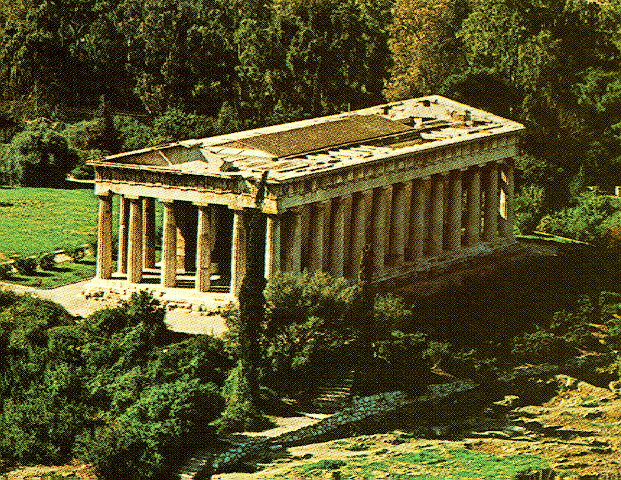
The Temple of Hephaestus in central Athens, Greece, is the best-preserved ancient Greek temple in the world, but is far less well-known than its illustrious neighbour, the Parthenon. The temple is also known as the Hephaesteum or Hephaesteion. It is sometimes called the Theseum, due to a belief current in Byzantine times that the bones of the legendary Greek hero Theseus were buried there; in fact the bones alleged to be those of Theseus were buried in the 5th century BC at another site nearer to the Acropolis.

The temple is located about 500m north-west of the Acropolis and about 1km due west of the modern centre of Athens, Syntagma Square. It was built in about 449 BC on what was then the western edge of the city of Athens, in a district which contained many foundries and metalwork shops. It was therefore dedicated to Hephaestos, the god of blacksmiths and metallurgy. It was designed by Ictinus, one of the architects who worked on the Parthenon. It stands on a slight rise and in ancient times commanded a fine view of the Agora.

Built of marble from Mount Pentelus, in the Doric style, the temple is hexastyle, that is with six columns under the pedimented ends, and has thirteen columns on each side (counting the corner columns twice). The temple is peripteral, with columns entirely surrounding the central enclosed cella. In the entablature there is the plain frieze that is expected with the sober Doric mode, but above it in the spaces between the triglyphs – which are like decoratively grooved beam-ends pegged into place – the labours of Heracles are depicted in bas-relief. Sculpted into the low-relief metope is the great story of Theseus and of his quest to kill the minotaur.

Unlike the Parthenon, the temple has all its columns and pediments intact, and even has most of its original roof. Its friezes and other decorations, however, have inevitably been badly damaged by thieves and looters over the centuries. It owes its survival to its conversion to a Christian Church, the Church of St George, in the 7th century AD. The survival of the exterior came at the cost of the ancient interior, which was removed and replaced by the structures of a Christian church.

During the centuries of Ottoman rule in Greece, the temple was the main Greek Orthodox church in Athens. When the first king of independent Greece, King Othon, entered the city in 1834, the service welcoming him to his new capital was held in the church.Today the temple has been preserved as an archaeological site under the supervision of the Ephorate of Antiquities of the Greek Interior Ministry. The temple itself has a small fence, but the visitor can get much closer than is possible at the Parthenon or most other antiquities in Greece. The temple is now surrounded by an ornamental garden. The site gets much less tourist traffic than the Acropolis and is a pleasant green spot in the heart of Athens.


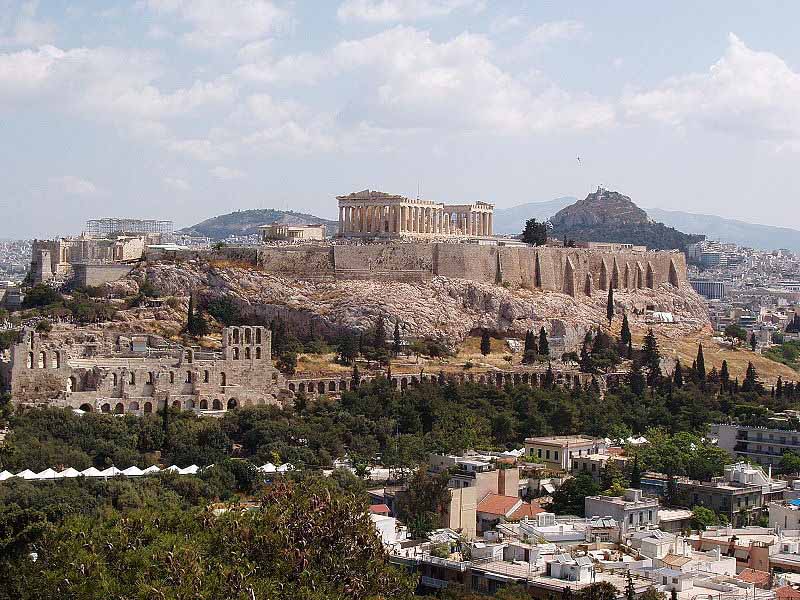
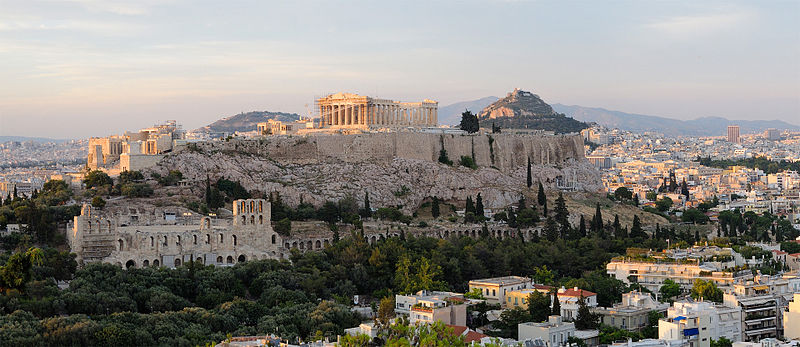
The Acropolis in Athens

The Acropolis is high above the city on a natural prominence.


Mount Olympus
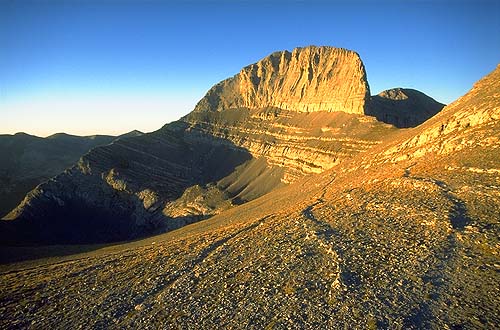
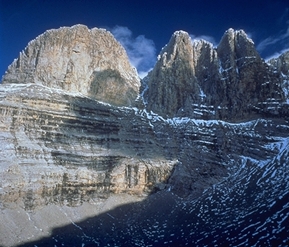
Mount Olympus s the highest mountain in Greece, at 2,917 (or 2,919, according to new measurements ) meters high; it is situated at 40°05 2N 22°21 2E, in mainland Greece.

Mount Olympus is noted for its very rich flora with several endemic species. The highest peak on Mount Olympus is Mitikas, which in Greek means “nose.” There are two refuges on a plain about forty five minutes away from Mitikas. Mitikas is the highest peak in Greece, the second highest being Stefani.

In Greek mythology, Mount Olympus is the home of the Twelve Olympians, the principal gods in the Greek pantheon. The Greeks thought of it as built up with crystal mansions wherein the gods, such as Zeus, dwelt. The etymology and meaning of the name Olympus (Olympos) is unknown, and it may be of Pre-Indo-European origin.


The Tumulus of Marathon
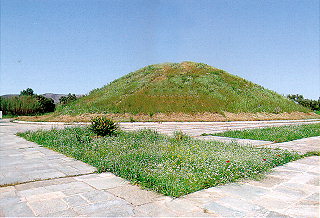
The fertile plain of Marathon was a natural place for the establishment and development of human activity from prehistoric to Roman times. Here on this plain the battle between the Athenians and the Persians was fought in 490 B.C. To this great event Marathon owes its worldwide fame and its important place in the conscience of the ancient Greeks. The Mound was raised over the graves of the 192 Athenians who died in the battle and whose remains were buried here after cremation of the dead.
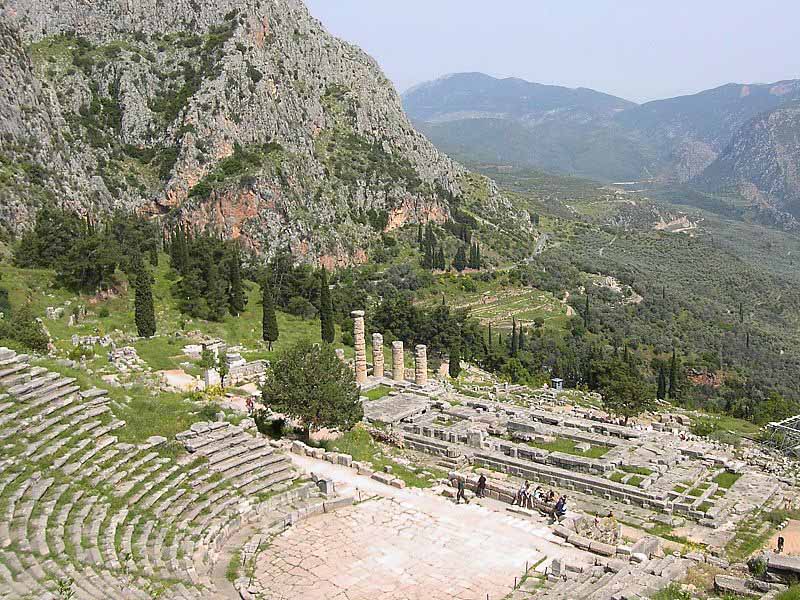


Theatre and Temple of Apollo in mountainous country at Delphi


Delphi, GreeceLocated about one hundred miles northwest of Athens is the ancient site of the panhellenic sanctuary of Delphi. The complex of buildings, which includes the Temple of Apollo where sat the famous oracle, The sacred Corycian Cave, and the Castalian Spring, is nestled in the forested slopes and rocky crags on the south side of the sacred mountain Mountains and the Sacred called Parnassus. The site had been sacred since at least the Bronze Age. According to legend, the shrine was originally guarded by the she-dragon Pytho. She was killed by Apollo who then took over the oracle. In antiquity, Delphi was regarded as the centre of the world.


Temple of Apollo
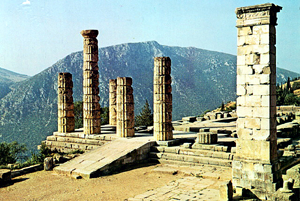
The visible ruins belong to the last temple, dated to the 4th century BCE, which was peripteral, in Doric order. It was erected on the remains of an earlier temple, dated to the 6th century BCE. Inside was the “adyton”, the centre of the Delphic oracle and seat of Pythia. The monument was partly restored during 1938-1941.


Castalian Spring
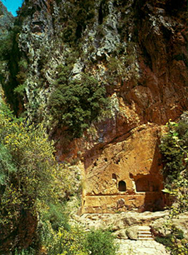
In Greece, the Phaedriades (“the shining ones”) were the pair of cliffs, ca 700 m high on the lower southern slope of Mt. Parnassos, which enclose the sacred site of Delphi, the center of the Hellenic world. Strabo, Plutarch and Pausanias all mentioned the Phaedriades in describing the site, a narrow valley of the Pleistus (today Xeropotamos) formed by Parnasse and Mt. Cirphis. Between them rises the Castalian Spring. Even today, at noontime, the rock faces reflect a dazzling glare.

The Castalian Spring in the ravine between the Phaedriades at Delphi is where all comers to Delphi, the contestants in the Pythian Games and especially suppliants who came to consult the Oracle, stopped to wash their hair. Two fountains fed by the sacred spring survive. The archaic (early 6th century BCE) fountain house has a marble-lined basin surrounded by benches. There is also a Hellenistic or Roman fountain with niches hollowed in the rock to receive votive gifts. The Castalian Spring predates all of classical Delphi: the archaic guardian of the spring was the serpent or dragon Python, killed by Apollo in its lair beside the spring.


Sanctuary of Poseidon and Athena at Sounion
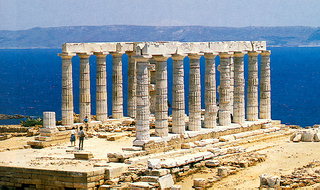
The sanctuary at Sounion is one of the most important sanctuaries in Attica. Sporadic finds point to the conclusion that the site was inhabited in the prehistoric period but there is no evidence of religious practice in such an early date. “Sounion Hiron” (sanctuary of Sounion) is first mentioned in the Odyssey, as the place where Menelaos stopped during his return from Troy to bury his helmsman, Phrontes Onetorides.

The finds of the 7th century B.C. are numerous and prove the existence of organized cult on two points of the promontory: at the southern edge where the temenos of Poseidon was situated, and about 500 m. to the NE of it, where the sanctuary of Athena was established.

Important votive offerings were dedicated during the 6th century B.C., but the architectural form of both sanctuaries remained unpretentious until the beginning of the 5th century B.C., when the Athenians initiated the construction of an imposing poros temple in the temenos of Poseidon.

The building was never completed, though, as both the temple and the offerings were destroyed by the Persians in 480 B.C. In the following decades, Sounion, like the rest of Attica, flourished, and an important building project was undertaken at both sanctuaries. At the end of the 5th century and during the Peloponnesian War, the Athenians fortified Sounion cape.

From the 1st century B.C. onwards, the sanctuaries gradually declined and Pausanias, who sailed along the coast of the promontory in the mid-2nd century A.D., wrongly considered the prominent temple on the top of the hill as the temple of Athena. The site of the temple was known in the following centuries, as is proved by descriptions of modern travelers, who visited Sounion before the excavations started, as well as by graffiti on the stones, among which, that made by Lord Byron.

Restricted excavations in the sanctuary of Poseidon were conducted in 1825 by the Dilettanti and by the German architect W. Doerpfeld. Systematic investigation was undertaken between 1897 and 1915 by the Athens Archaeological Society, under the direction of Val. Stais, with the collaboration of A. Orlandos. Since 1994, the Archaeological Society has been carrying out excavations at the Fortress.


Sanctuary of Poseidon
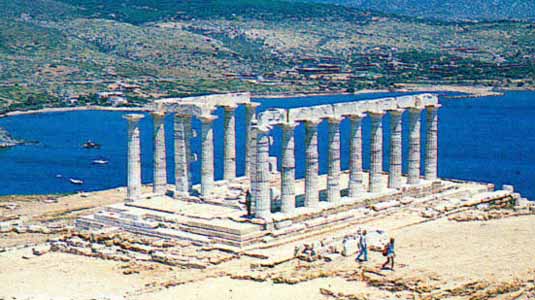
It is situated in the southernmost, highest part of the promontory. The area was evened off and supported by means of retaining walls on the north and west sides. A Propylon was constructed on the north side, and porticoes along the north and the east for the accommodation of the pilgrims. The site was dominated by the Classical temple.

At the end of the Archaic period an imposing temple was constructed in the position of the Classical one seen today, but it was slightly smaller in dimensions. It was Doric, made of poros, with an external colonnade of 6 x 13 columns, and an internal one which supported the roof. Its construction was interrupted by the Persian invasion and the temple remained unfinished.

The later temple, the one preserved today, was also Doric, with 6 x 13 columns, made of Agrileza marble, but without an internal colonnade. The stylobate measured 13,47 x 31,12 m. It was constructed in 450-440 B.C. and, according to another theory, was the work of the architect who had also built the Hephaisteion (“Theseion”) in the Ancient Agora of Athens, the Temple of Nemesis at Rhamnous, and the Temple of Ares which was probably erected in Acharnes.

The sculptural decoration of the temple, made of Parian marble, is preserved in a poor condition. The frieze of the east side depicted Centauromachy, and the east pediment (of which only a seated female figure is preserved) probably depicted the fight between Poseidon and Athena for the domination of Attica. The two antae of the east side and several of the columns of the east part of the temple are still preserved today, while the west is completely destroyed.

Propylon – Porticoes

The Propylon was constructed a little later than the Classical temple, and was made of marble and poros. It is Doric, distyle in antis on both sides (north and south). A partition wall inside the building has three doorways, of which the middle one is wider and has a ramp. A small rectangular hall is attached on the west wall of the Propylon, while porticoes are erected along the north and west sides of the sanctuary. The north of these porticoes is larger and slightly earlier.

The Fortress

Sounion cape was fortified in 412 B.C. during the Peloponnesian War, in order to control and secure the ships carrying cereals to Athens. The use of various materials and construction techniques is probably the result of repairs and additions made during the Chremonides’ War and the following years (266-229 B.C.). The sanctuary of Poseidon occupies the SE end of the fortress. The wall starts at the NE corner, extends to the north and turns to the west. Shipyards for the sheltering of two war ships were constructed on the coast, at the west end of the north branch of the fortification. Inside the fortress, excavations have brought to light part of a central street, remains of houses, and water cisterns.

Sanctuary of Athena

It is situated on a hill 500 m. to the NE of the Sanctuary of Poseidon. The area was evened off and enclosed with a poros polygonal circuit wall. Inside the enclosed area were erected the Temple of Athena, a smaller temple to the north, and altars. A deep pit on the SE side of the temenos was used as a deposit for the Archaic offerings destroyed by the Persians. The oval peribolos to the NW of the temenos has been identified as the “Heroon of Phrontes”.

Temple of Athena

It has a rectangular cella, measuring 16,4 x 11,6 m. The foundation of the pedestal supporting the cult statue is preserved on the west side of the cella, while four Ionic columns in the centre supported the roof. One of the peculiarities of the temple, mentioned also by Vitruvius, is the existence of an outer colonnade only on the east and south sides.

Some scholars consider that the temple of Athena Sounias was reconstructed after the mid-5th century B.C., while others believe that the cella was built during the Archaic period, was repaired after the Persian destructions, and the colonnade was added in the middle of the 5th century B.C. A second peculiarity of the sanctuary is the placement of the altar to the south of the temple.

Small Temple

Small, Doric, prostyle temple measuring 5 x 6.80 m., situated to the north of the Athena Temple. The pedestal of the cult statue is preserved inside the cella. The date of the structure and the identity of the deity worshipped is still a matter of debate.


The Ancient Agora of Athens
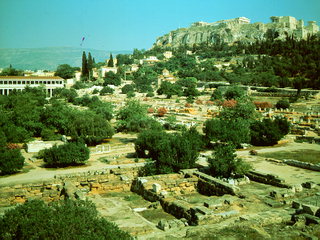
The Agora was the heart of ancient Athens, the focus of political, commercial, administrative and social activity, the religious and cultural center, and the seat of justice. The site was occupied without interruption in all periods of the city’s history. It was used as a residential and burial area as early as the Late Neolithic period (3000 B.C.). Early in the 6th century, in the time of Solon, the Agora became a public area.

After a series of repairs and remodeling, it reached its final rectangular form in the 2nd century B.C. Extensive building activity occurred after the serious damage made by the Persians in 480/79 B.C., by the Romans in 89 B.C. and by the Herulae in A.D. 267 while, after the Slavic invasion in A.D. 580, It was gradually abandoned. From the Byzantine period until after 1834, when Athens became the capital of the independent Greek state, the Agora was again developed as a residential area.

The first excavation campaigns were carried out by the Greek Archaeological Society in 1859-1912, and by the German Archaeological Institute in 1896-97. In 1890-91, a deep trench cut for the Athens-Peiraeus Railway brought to light extensive remains of ancient buildings. In 1931 the American School of Classical Studies started the systematic excavations with the financial support of J. Rockefeller and continued until 1941. Work was resumed in 1945 and is still continuing. In order to uncover the whole area of the Agora it was necessary to demolish around 400 modern buildings covering a total area of ca. 12 hectares.

In the 19th century the four colossal figures of Giants and Tritons at the facade of the Gymnasium were restored by the Greek Archaeological Society. In the years 1953-56, the Stoa of Attalos was reconstructed to become a museum and in the same period the Byzantine church of Aghioi Apostoloi, built around A.D. 1000, was restored by the American School. Between 1972 and 1975, restoration and preservation work was carried out at the Hephaisteion; the area was cleared of the vegetation, and the roof of the temple was repaired in 1978 by the Archaeological Service.


Stoa of Zeus Eleutherios
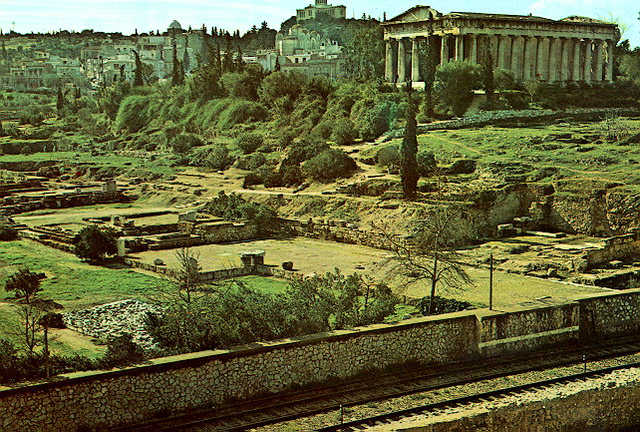
The stoa was erected at the end of the 5th century B.C. in honor of those who fought for the freedom and security of the city. Socrates is said to have met his friends in this stoa.

Temple of Apollo Patroos – Small Ionic temple, erected in ca. 340-320 B.C., identified as the temple of Apollo who was worshipped as the “Father” (Pater), the founder of the Ionian race. Inside the cella stood the cult statue of the god, made by the famous sculptor Euphranor.


Monument of the Eponymous Heroes
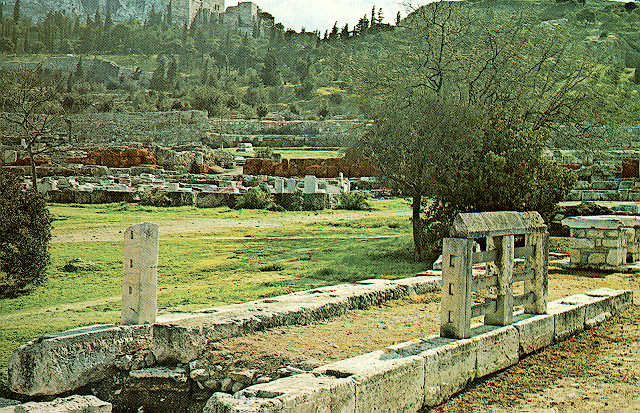
Remains of an oblong pedestal enclosed by a fence. It supported the bronze statues of the legendary heroes who gave their names to the ten tribes of Attica. In addition to its honorary function, the monument served as the official notice board of the city. It is dated to the second half of the 4th century B.C.


Rhamnous
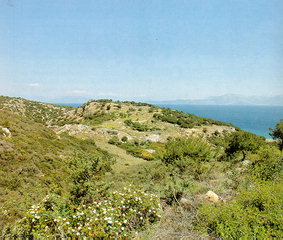
The site of ‘Rhamnous,’ the northernmost deme of Attica, lies north of Marathon overlooking the Euboean Strait. The site was known in Antiquity for its sanctuary of Nemesis, the implacable avenging goddess. A fortified acropolis dominates the two small harbors, from which grain was imported for Athens during the Peloponnesian War. Otherwise, Rhamnous was strategically significant enough to be fortified and receive an Athenian garrison. Remains of the two temples can be seen. The 6th century Temple of Nemesis was destroyed by the Persians in 480 BCE and replaced by a never-completed temple in the 5th century. A smaller temple that shares the sanctuary platform (peribolos) is thought to have been dedicated to Thetis, based on the dedications of two marble seats, to Nemesis and to Thetis.


Fortress
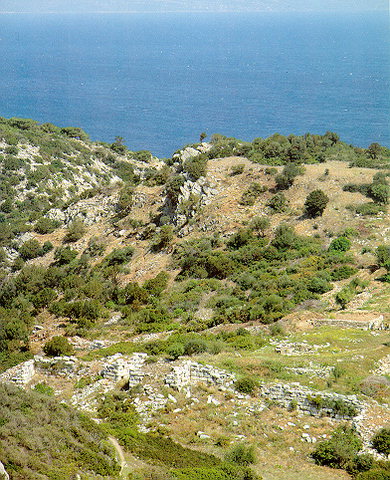
The Fortress comprises an outer system 800 metres long and a smaller interior circuit enclosing the top of the hill. The main entrance of the outer system is at the south and it is protected by square towers at each side of the gate. Within the circuit private and public buildings have been found, notable among which are the theatre and the gymnasium. Within this same area is also the agora of the deme. Military establishments stood at the top of the hill – within the interior circuit of the fortification. On the coast below two small harbors – the eastern and the western – served the ships that patrolled the Euboian channel. The Fortress of Rhamnous, as that of Sounion at the southern tip of Attica, is thought to have been constructed during the Peloponnesian War in order to control the ships bringing grain to Athens.


Thorikos
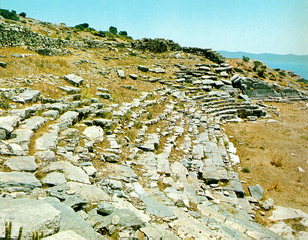
The hill known today as Velatouri is the centre of a Mycenaean settlement and also of the ancient deme of Thorikos. Preserved are the unusual theatre of the 6th-4th centuries B.C., parts of the settlement, some of the metal-working establishments, a square tower of the 4th century B.C., the cemeteries and the sanctuary of Demeter and Kore.

Between the years 1820 and 1995, excavations have been carried out by the Archaeological Society in Athens, the American School of Classical Studies, the Belgian Archaeological School, the 2nd Ephorate of Prehistoric and Classical Antiquities and by the Society of the Dilettanti.

The most important monuments and architectural units of the archaeological site are –

– The Mycenaean acropolis on the top of the Velatouri hill and the two tholos tombs of the same period.

– The Ancient Theatre of Thorikos. It is especially important for the history of the ancient theatre because of its unusual ellipsidal plan. Its original construction goes back to the 6th century B.C.

– ‘Industrial village’ – The central settlement of the ancient deme of Thorikos, which was a flourishing centre for the processing of metal from the Lavrion mines during the 5th and 4th centuries B.C. Roads and houses are spread out along the west slope of the Velatouri hill.

1 Comment

Filed under Humor and Observations

Ancient Roman Graffiti

11 Colorful Phrases From Ancient Roman Graffiti

Mark Mancini
IMAGE CREDIT:
FLICKR USER ROLLER COASTER PHILOSOPHY

When the cities of Pompeii and Herculaneum were suddenly consumed by the eruption of Mount Vesuvius in 79 C.E., many of their buildings were so intimately preserved that modern archaeologists can even read the graffiti scribbled onto their ancient walls. See if any of these remind you of a twenty-first century bathroom.

1. “PHILIROS SPADO.”

“Phileros is a eunuch.”

2. “LUCIUS PINXIT.”

“Lucius wrote this.”

3. “APOLLINARIS, MEDICUS TITI IMPERATORIS HIC CACAVIT BENE.”

“Apollinaris, doctor to the emperor Titus, had a good crap here.” In Latin profanity, “cacatne” pertained to defecation.

4. “OPPI, EMBOLIARI, FUR, FURUNCLE.”

“Oppius, you’re a clown, a thief, and a cheap crook.”

5. “MIXIMUS IN LECTO. FAETOR, PECCAVIMUS, HOSPES. SI DICES: QUARE? NULLA MATELLA FUIT.”

“We have wet the bed. I admit, we were wrong, my host. If you ask ‘why?’ There was no chamber pot.” Found inside an inn.

6. “VIRGULA TERTIO SU: INDECENS ES.”

“Virgula to Teritus: You are a nasty boy.”

7. “EPAPHRA, GLABER ES.”

“Epaphra, you are bald.”

8. “TALIA TE FALLANT UTINAM MEDACIA, COPO: TU VEDES ACUAM ET BIBES IPSE MERUM.”

“If only similar swindling would dupe you, innkeeper: you sell water, and drink the undiluted wine yourself.”

9. “VATUAN AEDILES FURUNCULI ROG.”

“The petty thieves request the election of Vatia as adele.” In ancient Pompeii, an “adele” was an elected official who supervised markets and local police, among other things.

10. “SUSPIRIUM PUELLAM CELADUS THRAEX.”

“Celadus makes the girls moan.”

11. “ADMIROR, O PARIES, TE NON CECIDISSE, QUI TOT SCRIPTORIUM TAEDIA SUSTINEAS.”

“I wonder, O wall, that you have not yet collapsed, so many writers’ clichés do you bear.” This phrase seems to have been a popular one, as slightly different versions of it appear in multiple locations throughout Pompeii’s ruins.

In the interest of avoiding hardcore lewdness and profanity, I’ve omitted some of the truly vulgar defacements. For some firmly NSFW examples, do go here.

These quotes were were recorded in a comprehensive, multi-volume collection of Latin inscriptions called Corpus Inscriptionum Latinarum, which was first published in in 1857. Image credit: Flickr user Roller Coaster Philosophy.

Read the full text here: http://mentalfloss.com/article/32276/11-colorful-phrases-ancient-roman-graffiti#ixzz2JFIcy4q2
–brought to you by mental_floss!

Leave a comment

Filed under Humor and Observations

2,000-year-old treasure found in Black Sea fortress

2,000-year-old treasure found in Black Sea fortress

By Owen Jarus

Published January 10, 2013

LiveScience

  • Black Sea treasure 1.jpg

    Researchers working at the site of Artezian in the Crimea (Ukraine) have discovered two hoards of buried treasure (one hoard shown here) dating to A.D. 45, a time when the people of the citadel were under siege by the Roman army. Here, two silver anklets, beads, numerous coins and a white, glass flask with a two-headed face, one side serious and the other happy. (Russian-Ukrainian Archaeological Artezian Expedition)

  • Black Sea treasure.jpg

    The citadel was torched by the Roman army in A.D. 45, with many of its inhabitants likely killed. Some time afterward Artezian was rebuilt with stronger fortifications although it, along with the rest of the Bosporan Kingdom, was under the sway of Rome. (Russian-Ukrainian Archaeological Artezian Expedition)

Residents of a town under siege by the Roman army about 2,000 years ago buried two hoards of treasure in the town’s citadel — treasure recently excavated by archaeologists.

More than 200 coins, mainly bronze, were found along with “various items of gold, silver and bronze jewelry and glass vessels” inside an ancient fortress within the Artezian settlement in the Crimea (in Ukraine), the researchers wrote in the most recent edition of the journal Ancient Civilizations from Scythia to Siberia.

“The fortress had been besieged. Wealthy people from the settlement and the neighborhood had tried to hide there from the Romans. They had buried their hoards inside the citadel,” Nikolaï Vinokurov, a professor at Moscow State Pedagogical University, explained. [See Photos of the Buried Treasure]

‘They had buried their hoards inside the citadel.’

– Nikolaï Vinokurov, a professor at Moscow State Pedagogical University 

Artezian, which covered an area of at least 3.2 acres and also had a necropolis (a cemetery), was part of the Bosporus Kingdom. At the time, the kingdom’s fate was torn between two brothers —Mithridates VIII, who sought independence from Rome, and his younger brother, Cotys I, who was in favor of keeping the kingdom a client state of the growing empire. Rome sent an army to support Cotys, establishing him in the Bosporan capital and torching settlements controlled by Mithridates, including Artezian.

People huddled in the fortress for protection as the Romans attacked, but Vinokurov said they knew they were doomed. “We can say that these hoards were funeral sacrifices. It was obvious for the people that they were going to die shortly,” he wrote in an email to LiveScience. The siege and fall of the fortress occurred in AD 45.

Curiously, each hoard included exactly 55 coins minted by Mithridates VIII. “This is possibly just a simple coincidence, or perhaps these were equal sums received by the owners of these caskets from the supporters of Mithridates,” the team wrote in its paper.

A Greek lifestyle

Vinokurov’s team, including a number of volunteers, has been exploring Artezian since 1989 and has found that the people of the settlement followed a culture that was distinctly Greek. The population’s ethnicity was mixed, Vinokurov wrote, “but their culture was pure Greek. They spoke Greek language, had Greek school; the architecture and fortification were Greek as well. They were Hellenes by culture but not that pure by blood.”

Greeks are known to have created colonies on the Black Sea centuries earlier, intermarrying with the Crimeans. The customs and art forms they introduced appear to have persisted through the ages despite being practiced nearly 600 miles (1,000 kilometers) from Greece itself.

This Greek influence can be seen in the treasures the people of Artezian buried. Among them is a silver brooch engraved with an image of Aphrodite, the Greek goddess of love, and gold rings with gems engraved with images of Nemesis and Tyche, both Greek deities.

When archaeologists excavated other portions of the torched site they found more evidence of a Greek lifestyle.

“In the burnt level of the early citadel, many fragmentary small terra cotta figures were found depicting Demeter, Cora, Cybele, Aphrodite with a dolphin, Psyche and Eros, a maiden with gifts, Hermes, Attis, foot soldiers and warriors on horseback, semi-naked youths,” the researchers wrote in their paper, adding fragments of a miniature oinochoai (a form of Greek pottery) and small jugs for libations also were found.

All this was torched by the Romans and later rebuilt by Cotys I, who had been successfully enthroned by Rome. However the treasures of the earlier inhabitants remained undiscovered beneath the surface, a testament to a desperate stand against the growing power of Rome.

Read more: http://www.foxnews.com/science/2013/01/10/2000-year-old-treasure-discovered-in-black-sea-fortress/?intcmp=features#ixzz2Iq68lRoH

Leave a comment

Filed under Humor and Observations

Ancient Cult Temple from Time of King David

Tel Motza Discovery: Temple And Ritual Vessels Of Cult From King David Era Found Near Jerusalem (PHOTOS)

The Huffington Post  |  By Posted: 12/27/2012 5:46 pm EST  |  Updated: 12/28/2012 7:29 am EST

 
Temple King David Tel Motza
Evidence of religious practices dating back to the early days of King David and the Kingdom of Judah have been discovered at excavations run by the Israel Antiquities Authority in Tel Motza, west of Jerusalem.

According to the Israel Ministry of Foreign Affairs, the finds — which include 2,750-year-old pottery figurines of men and horses — provide rare evidence of a ritual cult at the beginning of the period of the monarchy.

“The ritual building at Tel Motza is an unusual and striking find, in light of the fact that there are hardly any remains of ritual buildings of the period in Judea at the time of the First Temple,” excavation directors Anna Eirikh, Hamoudi Khalaily and Shua Kisilevitz told The Times of Israel.

The Jerusalem Post noted the rarity of the find, given that “around the time of Hezekiah and Isaiah, Judaism abolished many ritual sites” so the Temple in Jerusalem could concentrate its symbolic power.

During this time period, the city of Jerusalem was also the region’s main hub and the home to King David and King Solomon, according to the Times of Israel.

King David’s son King Solomon built Jerusalem’s First Temple, around the 10th century, B.C.

This is not the first time archaeological artifacts have been discovered at the Tel Motza site, however, the Jewish Telegraphic Agency reports, as previous finds have revealed artifacts from a number of periods.

An IAA statement described the walls of the religious structure as “massive,” according to the Jewish Press, and described it as including a wide, east-facing entrance, which would be typical of temple construction for that time period and region. The structure also included a square structure — possibly an altar — in the temple courtyard.

Getty Images

Leave a comment

Filed under Humor and Observations