
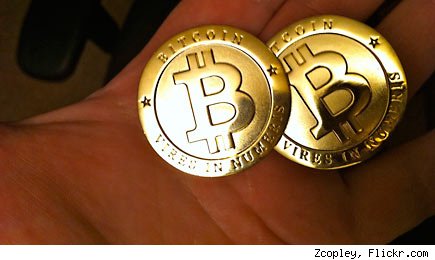
What are bitcoins you might ask? They are basically fake monopoly money taken as real tender. They are growing in popularity, but first, some basic economics:
Economics 101 Primer – It works like this, currency is backed by the government that issues it. It used to be backed by gold and silver. In fact, early currency was simply gold, silver or bronze stamped with the King’s face. Then it turned to paper. When it was backed by gold and silver, you could take the paper version to the bank and get actual metal. This stabilized its value. However, there is more economic activity than there is gold and silver in the world, so people switched to paper that is no longer backed by anything, other than faith that when you use it, you can buy stuff.
If there are 100 things to buy and 100 dollars, each costs around $1. If you print more money, say $200, but the economy does not grow, things cost $2 a piece and your dollar is worth only half as much. This is called inflation, which is bad for everyone.
If things keep growing in production (GDP growth) and money does not grow, you get deflation and it is difficult to do business. In that case, the now 200 items chasing $100 would only be able to get 50 cents each. The producers lose half their value.
So, a government is supposed to try to stabilize currency by having its supply go up and down as economic growth goes up and down, so their currency remains stable and so do prices. When governments run high deficits, borrow money, and print money for their own purpose rather than matching growth, bad things happen, like runs on banks and lack of faith that the currency ‘means” anything. That is one of the reason real gold prices have skyrocketed in the US.
Back to Bitcoins – People in Europe are losing faith in the British Pound Stirling and the Euro. So, someone created the Bitcoin, a currency on the Internet which is NOT issued by any government. It is simply issued in exchange for real money like euros, dollars and pounds, and then used as currency. The fact that it is NOT backed by a government also means it is not increased to pay for government purchases. People are so desperate that they are taking their Euros out of ATMs so fast that several governments are limiting withdrawals now. Italy closed its banks for a week. So, as they can, people in Italy, Greece and other places are turning in their euros for bitcoins. So far, the bitcoins have more faith and value than regular money, gaining in value by 1700% against regular currency since 2009. They cannot be used everywhere, but increasingly producers like restaurants and stores are taking them.
Can a privately held company through the internet successfully launch and maintain its own currency for the world better than governments? I would have told you no ten years ago, but lots has changed. In video games, there is an exchange rate now for fake game gold or credits to real cash. There are millionaires who have sold imaginary retail space to people in Second Life. Now, not in a video game, but in real life, we have fake money worth more than real money. Amazing.
Here is a piece of a story from AOL Daily Finance, posted by Ross Kenneth Urken:
Is Bitcoin a Panacea For the Euro’s Woes?
Quite simply, Bitcoins are an encrypted digital currency that can be freely exchanged between people or between consumers and merchants. Businesses like Bitcoin because it allows them to avoid paying credit card fees of up to 3% on transactions. Consumers get to dodge the costs normally associated with currency exchanges. It’s only available for use in a handful of physical locations in cities around the world (it’s mostly used via Internet), but a major use for it has been for conversions — you can buy Bitcoins and then exchange them for another currency at no charge.
Bitcoin is in some senses a financial island removed from the vicissitudes and consequences of a traditional banking system. It’s neither controlled by central banks nor governments, and thus not vulnerable to larger-scale shifts like changing interest rates or the rampant inflation of countries in decline.
But Bitcoin’s isolation from geopolitical turmoil has been its true selling point for those in Europe.
 Michael Bradley - Time Traveler