Tag Archives: Inc.

NASA eyes crew deep sleep option for Mars mission

  • SpaceWorksEnterprises.jpg

    Artwork by Mark Elwood (SpaceWorks Enterprises, Inc.)

A NASA-backed study explores an innovative way to dramatically cut the cost of a human expedition to Mars — put the crew in stasis.

The deep sleep, called torpor, would reduce astronauts’ metabolic functions with existing medical procedures. Torpor also can occur naturally in cases of hypothermia.

“Therapeutic torpor has been around in theory since the 1980s and really since 2003 has been a staple for critical care trauma patients in hospitals,” aerospace engineer Mark Schaffer, with SpaceWorks Enterprises in Atlanta, said at the International Astronomical Congress in Toronto last week. “Protocols exist in most major medical centers for inducing therapeutic hypothermia on patients to essentially keep them alive until they can get the kind of treatment that they need.”

Coupled with intravenous feeding, a crew could be put in hibernation for the transit time to Mars, which under the best-case scenario would take 180 days one-way.

So far, the duration of a patient’s time in torpor state has been limited to about one week.

“We haven’t had the need to keep someone in (therapeutic torpor) for longer than seven days,” Schaffer said. “For human Mars missions, we need to push that to 90 days, 180 days. Those are the types of mission flight times we’re talking about.”

Economically, the payoff looks impressive. Crews can live inside smaller ships with fewer amenities like galleys, exercise gear and of course water, food and clothing. One design includes a spinning habitat to provide a low-gravity environment to help offset bone and muscle loss.

SpaceWorks’ study, which was funded by NASA, shows a five-fold reduction in the amount of pressurized volume need for a hibernating crew and a three-fold reduction in the total amount of mass required, including consumables like food and water.

Overall, putting a crew in stasis cuts the baseline mission requirements from about 400 tons to about 220 tons.

“That’s more than one heavy-lift launch vehicle,” Schaffer said

Leave a comment

Filed under Humor and Observations

Star Trek Replicators for the US Army

In my ongoing efforts to explain that 3d printing is THEE revolutionary invention of today…  The US Army is now using 3d printing for onsite manufacturing of equipment in war zones.  Star Trek style replicators are here.  Now.

replicator-menageatroi

Star Trek replicators for the Army

By 

Published January 10, 2013

FoxNews.com

  • 3D Replicator Knife.jpg

    A design for a knife made from a 3D printer to help dismounted soldiers probe for IEDs. The tool had to be plastic so as to not conduct with any IED surfaces it might uncover. (Army Rapid Equipping Force)

  • 3D Replicator Flashlight guard design.jpg

    A commonly used Army-issue flashlight has raised, exposed button that allow the light to be accidently turned on in pocket or pouch. This guard was developed and printed to prevent accidental power up and to save batteries. (Army Rapid Equipping Force)

  • 3D Replicator Flashlight guard.jpg

    A commonly used Army-issue flashlight has raised, exposed button that allow the light to be accidently turned on in pocket or pouch. This guard was developed and printed to prevent accidental power up and to save batteries. (Army Rapid Equipping Force)

  • 3D Replicator thermal cameras.jpg

    Soldiers needed a way to see immediately right or left of a vehicle. This camera system was developed and printed in a lab, including CNC-made mounting brackets and a 3D-printed monitor mount. (Army Rapid Equipping Force)

There’s a new force on the front lines, and it’s anything but out of this world.

Remote operating bases in Afghanistan are using Star Trek-style replicators, 3D printers capable of fabricating on the spot whatever the Army may need — from replacement vehicle parts to an entirely new piece of technology.

The Army’s Rapid Equipping Force (REF) worked with Applied Minds, Inc. and Exponent to make the science fiction dream a reality.  Thanks to their efforts, a lab equipped with the 3D printers is only a helicopter ride away.

‘[It’s] basically like a huge glue gun.’

– Westley Brin, product manager with the Army’s Rapid Equipping Force

While the locations cannot be released, the first two labs were posted to forward operating bases in Afghanistan. The third is currently under construction and due to deploy around June this year.

There are four types of computer-driven replicator: 3D printers, CNC mills, laser cutters and water cutters.

The state of the art lab is contained in a 20,000 pound, 20-foot long container that can be carried by a Chinook helicopter. It’s equipped with a 3D printer and a CNC mill, machines that resemble very large microwaves.

With them an engineer can build essentially anything.

How does it work?
“Soldiers walk into the lab and say, ‘this is my problem.’ The PhDs then do the work and show it to the soldiers. The soldiers give them feedback,” and they work together tinkering with the tech until it is exactly fit for purpose, explained Westley Brin, product manager with the REF.

The team uses software similar to that an architect would use, like CAD or computer-assisted design programs, to design their solution in the battlefield. After a design is drawn, they send the file to the 3D printer or the CNC.

3D printers, sometimes called rapid prototypers, take glue or resin and layer it to build the design from scratch.

Brin describes their 3D printer as “basically like a huge glue gun. When you pick up the object created, you can feel the ridges because it builds the object layer by layer. That’s why it’s so fragile.”

The 3D printers can make only softer plastics that last for a month or two — it’s a short-term solution in the field. They can also build several soft models and send them back to the U.S. or anywhere else for volume manufacturing.

CNC mills work differently: Using a drill bit, they take a hunk of aluminum or metal and carves it out as a human would carve a sculpture.

HELP BUILD SOMETHING

REF and the labs use the Broad Agency Announcements (BAA) site to solicit solutions. Anyone can submit a solution and if they think it shows promise they will send someone out to take a look. Know a MacGyver up for creating something for the troops? Check out the site.

A CNC can cut parts from more durable material; Brin describes its output as the “end-all, be-all piece” — meaning it isn’t a stop-gap but a screw, knife, distributor cap or whatever that can be used for the duration.

The lab also lets technicians dial out of Afghanistan to anywhere in the world for advice, whether it’s the CEO of a Fortune 500 company, a college professor or a 13-year-old girl. Anyone with a bright idea to solve the problem or improve the current solution is accessible.

From several thousand miles away, the pinch-hitting engineer can design and feed a solution to the lab in Afghanistan, where the 3D printer and CNC will work overnight. When the team arrives in the morning, presto, a new part is waiting.

What does it make?
Project Powerhand is one of the labs many success stories. Soldiers in Afghanistan use hand-held, ground penetrating radar to detect mines — devices with a very limited battery life.

By creating tech that took the lifespan from 60 minutes to a whopping 36 hours, they immediately made soldiers safer and gave them a tool they could use on a three-day patrol.

Next in the replicator pipeline for the Army is a bigger printer that will combine the CNC and the 3D capabilities and most likely reside at a major base. The labs posted to forward operating bases will be able to communicate with this monster to produce parts as well.

As operations in Afghanistan draw down, the Star Trek-style lab will still have enormous utility, going out with the Army to accompany first-responders at natural disasters within 24 to 48 hours for example.

Read more: http://www.foxnews.com/tech/2013/01/10/star-trek-replicators-for-army/#ixzz2HjnNRuJd

Leave a comment

Filed under Humor and Observations

Pink Slime Gets Feelings Hurt – Sues ABC News!

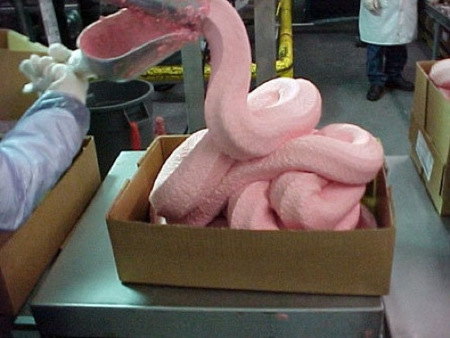
This is an update on my earlier story about pink slime.  Apparently, pink slime has feelings, and when it feels insulted, it fights back.

Pink Slime


reposted from foxnews.com from Associate Press

Published September 13, 2012

Associated Press

NORTH SIOUX CITY, S.D. –  Beef Products Inc. sued ABC News, Inc. for defamation Thursday over its coverage of a meat product that critics dub “pink slime,” claiming the network damaged the company by misleading consumers into believing it is unhealthy and unsafe.

The Dakota Dunes, S.D.-based meat processor is seeking $1.2 billion in damages for roughly 200 “false and misleading and defamatory” statements about the product officially known as lean, finely textured beef, said Dan Webb, BPI’s Chicago-based attorney.

The lawsuit filed in a South Dakota state court also names several individuals as defendants, including ABC news anchor Diane Sawyer and the Department of Agriculture microbiologist who coined the term “pink slime.”

The company’s reporting “caused consumers to believe that our lean beef is not beef at all — that it’s an unhealthy pink slime, unsafe for public consumption, and that somehow it got hidden in the meat,” Webb said before the company’s official announcement.

ABC News, owned by The Walt Disney Co., denied BPI’s claims.

“The lawsuit is without merit,” Jeffrey W. Schneider, the news station’s senior vice president, said in a brief statement Thursday. “We will contest it vigorously.”

The 257-page lawsuit names American Broadcasting Companies, Inc., ABC News, Inc., Sawyer and ABC correspondents Jim Avila and David Kerley as defendants. It also names Gerald Zirnstein, the USDA microbiologist who named the product “pink slime,” Carl Custer, a former federal food scientist, and Kit Foshee, a former BPI quality assurance manager who was interviewed by ABC.

Richard McIntire, a spokesman for the USDA’s Food Safety and Inspection Service, declined to comment and attempts to reach Foshee were unsuccessful. A spokesman for the Food Integrity Campaign, a whistleblower advocacy group that has worked with Foshee, said Thursday that he would attempt to contact Foshee. Spokesman Dylan Blaylock also said the Washington-based group may release a statement.

Although several news organizations used the term “pink slime,” Webb said ABC was being sued for attacking the company “night after night.” The “defendants engaged in a monthlong vicious, concerted disinformation campaign against BPI,” the lawsuit claims, citing 11 TV 14 online reports from March 7 to April 3.

Craig Letch, BPI’s director of food-quality assurance, said the company lost 80 percent of its business in 28 days. BPI has declined to discuss how much it lost in sales, but acknowledged it took a “substantial” hit. Some of the customers have returned, Letch said, but not enough to allow BPI to rehire former employees.

Webb said the reports had a “catastrophic” impact on the company, forcing it to close three of its four U.S. plants and lay off 700 workers.

ABC published a list of major grocery stores that stopped selling the product, pressuring others to follow suit by placing then on a “black list,” he said.

BPI will have to prove the network intended to cause harm for the defamation lawsuit to succeed, said Patrick Garry, a media law expert at the University of South Dakota School of Law.

“The media — regardless of your opinion of them — don’t usually print something that they know to be false,” Garry said. “It may be negligent, but usually there’s a malice requirement as well.”

Critics worry about how the meat is processed. Bits of beef are heated and treated with a small amount of ammonia to kill bacteria, a practice that has been used for decades and meets federal food safety standards. Webb said that ABC ignored that information, instead giving the impression “that it’s some type of chemical product … some kind of repulsive, horrible, vile substance that got put into ground beef and hidden from consumers.”

The name “pink slime” gained traction after The New York Times used it in a 2009 article on the safety of meat processing methods. Soon after, celebrity chef Jamie Oliver began railing against it. McDonald’s and other fast food companies stopped using the product, and major supermarket chains including Kroger and Stop & Shop vowed to stop selling beef containing the low-cost product. An online petition calling for it to be banned from school menus, attracting hundreds of thousands of supporters.

The U.S. Department of Agriculture has said the vast majority of states participating in its National School Lunch Program have opted to order ground beef that doesn’t contain the product. Only three — Iowa, Nebraska and South Dakota — chose to order beef that may contain it.

The uproar prompted Beef Products to suspend operations at plants in Amarillo, Texas; Garden City, Kan.; and Waterloo, Iowa. Beef Products’ plants in Iowa and Kansas each produced about 350,000 pounds of lean, finely textured beef per day, while the one in Texas produced about 200,000 pounds a day.

The company has won support from the governors of Iowa, Nebraska, Kansas, Texas and South Dakota. U.S. Agriculture Secretary Tom Vilsack has also defended the product, saying the federal government wouldn’t allow the product if it was unsafe.

The company has launched its own public relations offensive, including a website — http://www.beefisbeef.com — to advocate for the product.

Read more: http://www.foxnews.com/us/2012/09/13/bpi-sues-abc-news-for-pink-slime-defamation/%20?test=latestnews#ixzz26Qamm1hU


Yummy.

Leave a comment

Filed under Humor and Observations