Tag Archives: innovation

Use Your Laptop With Gestures Instead of Keyboard and Mouse?

Leap Motion, Gesture-Control Gadget For Your Laptop, Will Be Released This May For $80

The Huffington Post  |  By Posted: 02/27/2013 11:59 am EST

Leap Release
Turns out that 2013 is, indeed, a Leap Year.

Leap Motion, the company that makes the hotly anticipated gesture-control device of the same nameannounced Wednesday morning that the first Leap Motion units would ship to pre-orderers around the world on May 13, and that everyone could get their hands (and fingers) on one on May 19.

If you want one, you can order on Leap Motion’s website here or, somewhat curiously, on BestBuy.com right here. The Leap Motion Controller costs $80 at either outlet.

For a refresher, the Leap Motion controller plugs into almost any newer laptop and allows you to manipulate the screen via a series of hand and finger movements in the air. It’s sort of like having a touchscreen computer, but without actually touching the screen. Watch this video below, made by Leap Motion, to get an idea of how the small device can wholly transform your computer:

Previously, Leap Motion announced that it was sending 10,000 of its controllers to developers, so that there would be apps specifically built for gesture control; earlier this year, the company announced its app store, Airspace, and we’ve already seen one of those apps, by the developers behind the to-do list Clear, shown off.

In general, though, Leap Motion works with your existing operating system (Windows 7 or 8, or OS X 10.7 and 10.8), via zoom, scroll and zoom functions baked into the hardware, which you plug into your USB port. Wired’s Roberto Baldwin wrote that the Leap probably works best as a secondary controller, after your trackpad or mouse, and for specific apps or games written for it; but, like most reviewers, he came away very impressed by the little gizmo’s accuracy and speed.

For more on the Leap Motion Controller, and to pre-order, you can visit the official website right here.

1 Comment

Filed under Humor and Observations, Uncategorized

Inventors killed by their own inventions

Inventors killed by their own inventions

Reposted from Wikipedia

Direct casualties

Automotive

Aviation

Industrial

Maritime

Hunley Submarine

  • Horace Lawson Hunley (died 1863, age 40), Confederate marine engineer and inventor of the first combat submarineCSS Hunley, died during a trial of his vessel. During a routine exercise of the submarine, which had already sunk twice previously, Hunley took command. After failing to resurface, Hunley and the seven other crew members drowned.[11]
  • Thomas Andrews (shipbuilder) (7 February 1873 – 15 April 1912) was an Irish businessman and shipbuilder; managing director and head of the drafting department for the shipbuilding company Harland and Wolff in Belfast, Ireland. Andrews was the naval architect in charge of the plans for the ocean liner RMS Titanic. He was travelling on board the Titanic during its maiden voyage when it hit an iceberg on 14 April 1912 and was one of the 1,507 people who perished in the disaster. [12]

Medical

  • Thomas Midgley, Jr. (1889–1944) was an American engineer and chemist who contracted polio at age 51, leaving him severely disabled. He devised an elaborate system of strings and pulleys to help others lift him from bed. This system was the eventual cause of his death when he was accidentally entangled in the ropes of this device and died of strangulation at the age of 55. However, he is more famous—and infamous—for developing not only the tetraethyl lead (TEL) additive to gasoline, but also chlorofluorocarbons (CFCs).[13][14][15]
  • Alexander Bogdanov (22 August 1873 – 7 April 1928) was a Russian physician, philosopher, science fiction writer and revolutionary of Belarusian ethnicity who started blood transfusion experiments, apparently hoping to achieve eternal youth or at least partial rejuvenation. He died after he took the blood of a student suffering from malaria and tuberculosis, possibly due to blood type incompatibility. [16] [17]

Physics

Publicity and Entertainment

Karel Soucek in his barrel

  • Karel Soucek (19 April 1947 – 20 January 1985) was a Canadian professional stuntman who developed a shock-absorbent barrel nine feet long and five feet in diameter. He died when his barrel, with him inside, was prematurely dropped down a waterfall from the top of the Houston Astrodome.[21]

Punishment

Railways

Rocketry

  • Max Valier (1895–1930) invented liquid-fuelled rocket engines as a member of the 1920s German rocketeering society Verein für Raumschiffahrt. On 17 May 1930, an alcohol-fuelled engine exploded on his test bench in Berlin, killing him instantly.[27]

Popular myths and related stories

Perillos being pushed into his brazen bull

  • Jim Fixx (1932–1984) was the author of the 1977 best-selling book, The Complete Book of Running. He is credited with helping start America’s fitness revolution, popularizing the sport of running and demonstrating the health benefits of regular jogging. On 20 July 1984, Fixx died at the age of 52 of a fulminant heart attack, after his daily run, on Vermont Route 15 in Hardwick.[28][29]
  • Joseph-Ignace Guillotin (1738–1814) While he did not invent the guillotine, his name became an eponym for it.[30] Rumors circulated that he died by the machine, but historical references show that he died of natural causes.[31]
  • Perillos of Athens (circa 550 BCE), according to legend, was the first to be roasted in the brazen bull he made for Phalaris of Sicily for executing criminals.[32][33]
  • James Heselden (1948–2010), having recently purchased the Segway production company, died in a single-vehicle Segway accident. (Dean Kamen invented the Segway.)[34]
  • Wan Hu, a sixteenth-century Chinese official, is said to have attempted to launch himself into outer space in a chair to which 47 rockets were attached. The rockets exploded, and it is said that neither he nor the chair were ever seen again.

1 Comment

Filed under Humor and Observations

Zombie Update – Brain cells can outlive the body

Brain cells can outlive the body

By Tia Ghose

Published February 26, 2013

LiveScience

  • neurons

    Mouse neurons implanted into a rat brain can live twice as long as the mice from which they were taken, new research suggests. (iDesign, Shutterstock)

Brain cells can live at least twice as long as the organisms in which they reside, according to new research.

The study, published Monday, Feb. 25, in the journal Proceedings of the National Academy of Sciences, found that mouse neurons, or brain cells, implanted into rats can survive with the rats into old age, twice as long as the life span of the original mice. The findings are good news for life extension enthusiasts.

‘We are slowly but continuously prolonging the life of humans.’

– Dr. Lorenzo Magrassi, a neurosurgeon at the University of Pavia in Italy 

“We are slowly but continuously prolonging the life of humans,” said study co-author Dr. Lorenzo Magrassi, a neurosurgeon at the University of Pavia in Italy.

So if the human life span could be stretched to 160 years, “then you are not going to lose your neurons, because your neurons do not have a fixed lifetime.”

Long-lived cells
While most of the cells in the human body are being constantly replaced, humans are born with almost all the neurons they will ever have. [10 Odd Facts About the Brain]

Magrassi and his colleagues wanted to know whether neurons could outlive the organisms in which they live (barring degenerative diseases like Alzheimer’s).

To do so, the researchers took neurons from mice and implanted them into the brains of about 60 rat fetuses.

The team then let the rats live their entire lives, euthanizing them when they were moribund and unlikely to survive for more than two days, and then inspected their brains. The life span of the mice was only about 18 months, while the rats typically lived twice as long.

The rats were found to be completely normal (though not any smarter), without any signs of neurological problems at the end of their lives.

And the neurons that had been transplanted from mice were still alive when the rats died. That means it’s possible the cells could have survived even longer if they were transplanted into a longer-lived species.

Life extension
The findings suggest that our brain cells won’t fail before our bodies do.

“Think what a terrible thing it could be if you survive your own brain,” Magrassi told LiveScience.

While the findings were done in rats, not humans, they could also have implications for neuronal transplants that could be used for degenerative diseases like Alzheimer’s disease or Parkinson’s disease, Magrassi said.

But just because brain cells may be able to live indefinitely doesn’t mean humans could live forever.

Aging is dependent on more than the life span of all the individual parts in the body, and scientists still don’t understand exactly what causes people to age, Magrassi said.

Read more: http://www.foxnews.com/science/2013/02/26/brain-cells-can-outlive-body/?intcmp=features#ixzz2M9COJANr

1 Comment

Filed under Humor and Observations

Airless Car Tires

This is an older article from a nearly over a year ago, but I thought pretty cool anyway.

bridgestoneg

Bridgestone goes airless in tire concept for Tokyo show December 3, 2011 by Nancy Owano (PhysOrg.com) —

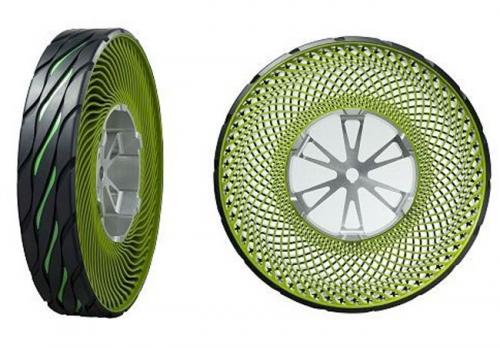
Visitors to the 42nd Tokyo Motor Show are to witness a new breed of airless tires from Bridgestone. Interest in the general press is already humming because of the material, design, and features of the Bridgestone debut on show. The concept tires use recycled thermoplastic, outside tread included. Fittingly colored green, the tires are being promoted for their green advantage of being completely recyclable.

The spokes are made of reusable thermoplastic resin. In design, interest is drawn toward the thermoplastic fins, staggered so that connections to the hub and the rim do not torque and there is no structural breakdown. The tires’ resin spokes radiate from rim to tread. They curve to the left and right to support vehicle loads. Bridgestone is not the first to experiment with an airless tire concept. Observers point to Michelin’s debut in 2005 of its airless Tweel tires. These were seen with much interest as a novel departure from the traditional wheel hub assembly, though concerns were raised in some quarters about their being noisy and vibrations at high speeds.

The name Tweel is a combination of the words tire and wheel. Michelin used polyurethane spokes arrayed in a wedge pattern. In describing differences between the Michelin and Bridgestone concept, observers say a key contrast is in size of the ribs. Michelin’s tires were viewed as more suitable for military applications—this is not like the Bridgestone concept, which is suited for something more consumer-driven. Another tire concept innovator has been Yokohama Rubber Co. Ltd. The company announced in October this year its airless tire concept which relies on mechanical rather than pneumatic support.

Yokohama introduced its tire concept earlier this year at a design expo in Japan. Bridgestone’s airless tires have a deeper structure of plastic ribs than either of the other two approaches, and it has a higher aspect ratio, according to Plastics News. Obviously, the key benefit for the consumer will be seen in the fact that the Bridgestone tires cannot suffer punctures. On the other hand, these have a way to go before seeing car commercialization. The tires are in prototype stage only and due for further evaluations. The company has tested the tires, nine inches across, on single-seater electric carts in Japan. Observers see similar uses, at this earlier level, as potential for use in motorized golf carts, lawnmowers and vehicles for the elderly.

Read more at: http://phys.org/news/2011-12-bridgestone-airless-concept-tokyo.html#jCp


Leave a comment

Filed under Humor and Observations

3D Pen – Draw 3D Art!

The world’s first 3D printing pen: Yours for just $75

The 3Doodler, 3D printing pen

Come September, if everything goes to plan, the world’s first 3D printing pen will go on sale for $75. The pen, called the 3Doodler, essentially allows you to lift your flat sketches off the paper — or, if you wish, to actually draw in three dimensions.

3Doodler is a Kickstarter project, and in under 24 hours it has obtained more than $500,000 in pledges — significantly more than its $30,000 target. As you can see in the video below, the inventors have already created an impressive prototype — and now it’s time to bring the 3Doodler to market. The target price is $75 for a September 2013 release. The inventors say they have already located a Chinese manufacturer who is capable of meeting these targets. The final device should 24mm (1in) thick and weigh less than 200g, with an external power brick that accepts 110-240V.

In essence, 3Doodler is a standard 3D printer, but your hand controls the print head instead of a bunch of computer-controlled motors. (See: What is 3D printing?) Inside the 3Doodler is a filament feeder (which accepts ABS or PLA plastic), a heating element, and an extruder — and that’s about it. The melted plastic comes out of the extruder and very quickly sets. As far as we can tell, the plastic oozes out of the extruder at a set rate — so depending on whether you want a thin (weak and flexible) or thick (strong and rigid) line, you move the 3Doodler quickly or slowly. For strength and flexibility, you just go back and forth over the same section, building up a web of plastic tendrils (like in the Eiffel Tower above).

Judging by the massive support for 3Doodler on Kickstarter, it’s safe to assume that people are really excited at the concept of a freehand 3D printer. It’s not hard to see why, though, if you were a child who dreamt of drawing sketches that literally jump off the paper. The actual reality of freehand 3D printing might be a little more complex than most users bargain for, but to that end the inventors have teamed up up with professional artists to provide 3Doodler backers with templates/stencils that you can simply fill in. The Kickstarter page also seems to lack any evidence that 3Doodler is capable of drawing straight lines, but hopefully it’s just a matter of using a ruler.

A collection of 3Doodler objects

Moving forward, this could be a very exciting stepping stone for inventors and hobbyists alike. While 3D printers have revolutionized rapid prototyping tool, the 3Doodler is even faster; it adds a whole new dimension (!) to back-of-the-napkin brainstorming. To begin with, I suspect it will be quite hard to create meaningful sketches with a 3Doodler, but in time — and with a whole range of usability tweaks and add-on accessories that I’m sure will follow — the 3D printing pen might become as ubiquitous as the 2D Bic ballpoint. (See: 3D printing: a replicator and teleporter in every home.)

1 Comment

Filed under Humor and Observations, Uncategorized

3d printing of guns – update

As followers know, I have said that 3d printing will change everything as we know it.  In an earlier post, I discussed how guns can be printed, and another post talks about how the military uses 3d printing for making knives and other tools.  Here is an update on this revolutionary technology:

Print and fire: 3D printing could muzzle new gun laws

By 

Published February 13, 2013

FoxNews.com

  • gunclip2.jpg

    Cody Wilson of Defense Distributed testing out the “Cuomo Clip” (DefenseDistributed.com)

  • gunclip3.jpg
    DefenseDistributed.com
  • gunclip4.jpg
    DefenseDistributed.com
  • gunclip1.jpg

    A computer rendering of a “Cuomo Clip”, a 30-round ammo magazine for the AR-15 rifle. (DefenseDistributed.com)

Gun owners who can’t buy high capacity ammo magazines because of new laws have another option: Print them.

Gun control measures passed or proposed in the wake of the Sandy Hook school massacre have targeted magazines that can feed 30 rounds or more into the firing chambers of AR-15s and other semi-automatic guns. New York has banned magazines holding more than seven rounds, and a federal bill proposed by Sen. Dianne Feinstein, D-Calif., would ban magazines holding more than 10 rounds.

But the laws are at least one step behind technology. Using 3D printers and schematics available on the Internet, gun owners can manufacture a fully functional, plastic magazine clip. Plans are free, although getting access to a 3D printer may prove expensive, at least for now.

“If you can download it, you can have it.”

– Cody Wilson, Defense Distributed/Wiki Weapons Project 

“If you can download it, you can have it,” said University of Texas law student Cody Wilson, who is part of Defense Distributed, a group that has created the design for what they refer to as a “Cuomo Clip” along with other gun parts. It is all under an initiative they refer to as the Wiki Weapon Project.

“It’s basically to head them [legislators] off at the pass, which we have,” Wilson added, noting that “hundreds of thousands” of visitors have gone to his group’s site to download the CAD file for the ammo magazine since it was first posted in mid-January.

The “Cuomo Clip,” named for New York Gov. Andrew Cuomo, who pushed the high-capacity clip ban through the Legislature, is made from a plastic filament similar to the type of material used to manufacture LEGO building blocks. It is also loaded with a large spring that helps to push rounds of ammo into the gun chamber.

The ammo magazine clip appears to be durable; Defense Distributed test-fired 86 rounds from a 30-round prototype last month, and the clip showed no signs of damage.

The cutting edge technology, in which three-dimensional objects can be manufactured from melted plastic thread, is likely to complicate efforts to control firearms. No such ability existed in 1994, when large-capacity clips were first banned in an initial federal assault weapons ban that lasted a decade.

Although the new ban proposed by Feinstein would prohibit the manufacture of magazines, it focuses on traditional arms makers and sellers. How the law might be enforced against individuals making their own magazines — and possibly even guns in the future — is unclear.

Rep. Steve Israel, D-N.Y., has called for amending the Undetectable Firearms Act of 1988, which initially sought to ban guns that could be sneaked through metal detectors, to include a ban on “homemade, 3-D printed, plastic high-capacity magazines.”

“Congress passed a law banning plastic guns for two decades when they were just a movie fantasy,” Israel told FoxNews.com. “With the advent of 3-D printers, these guns are suddenly a real possibility, and the law Congress passed is set to expire this year.

“We should act now to give law enforcement authorities the power to stop the development of these weapons before terrorists and criminals can easily bring them on planes. We need to be proactive and keep ahead of the technology. When the legislation was originally passed in 1988, no one would have imagined that parts of a gun and a magazine could be made with a printer — imagine what the technology will be even five years down the road.”

Defense Distributed and the Wiki Weapons Project also has made schematics of other parts of the AR-15 and other weapons and modifications, including pistol grips, but has avoided attempting to design and distribute plans for a fully-functional gun.

Read more: http://www.foxnews.com/tech/2013/02/13/print-draw-fire-3d-printing-could-muzzle-new-gun-laws/#ixzz2KoiE5x24

Leave a comment

Filed under Humor and Observations

3D Printer Makes Super Strong Beams

More on how 3D printing is going to change our entire world.

Custom 3D-Printed Beams Can Be 10,000 Times Stronger Than Steel
NOV 30, 2012 12:00 PM

Custom 3D-Printed Beams Can Be 10,000 Times Stronger Than Steel

Steel beams are pretty uniformly strong, but they’re all run of the mill, literally. If you start 3D-printing custom beams for the exact purpose they’re intended to serve though, you’ve got a regular space-age material on your hands. It’s lighter than steel and orders of magnitude stronger.

The process, developed byYong Mao of the University of Nottingham, UK and colleagues, isn’t just the product of one innovation, but rather a whole bunch of them wrapped up into one bundle. First, you start out withF a hollow beam and you test it with the load it needs to bear. When it inevitably fails, you use some sophisticated software to analyze that sucker and 3D print an internal fractal structure to provide support, kind of like what’s inside your bones. Then lather, rinse, and repeat. With each iteration of ever-smaller fractal innards, the beam can gain strength by the order of magnitude, with practically negligible weight gain. Third generation beams, about as far as we can hope to go with current tech, are 10,000 times stronger than steel.

There is one big limitation to how strong you can get with this stuff however, and it all depends on printer fidelity. Since these sorts of beams are specifically designed, there’s not much extra support to carry your load, so if the mesh isn’t perfect, you could be in trouble. As 3D printers get better however, imperfections won’t be a problem on the larger scales, and more and more iterations will be possible, making for structures that are both incredibly strong and incredibly light. Now if only they could figure out how to 3D print some new bones for us. [Physics World]

Leave a comment

Filed under Humor and Observations