Tag Archives: irish

How to drink a perfect whisky

I am doing it wrong…  I like a whisky stone in mine.  It chills it without diluting it.  First though, the spelling is important:

The difference between whiskey and whisky is simple but important: whisky usually denotes Scotch whisky and Scotch-inspired liquors, and whiskey denotes the Irish and American liquors.

The word itself (both spellings) is of Celtic origin, and modern whisky/whiskey distillation practices originated in Ireland and Scotland. Using whiskey to refer to Scotch whisky can get you in trouble in Scotland.

Now for the story written by Ali Rosen…

whisky_istock.jpg

There are very few hard and fast rules when drinking whisky. (iStock)

There are few drinks in life enjoyed as simply and purely as a glass of Scotch – and equally as few that have as much history and as many opinions contained in a single glass.

But is there a proper way to drink your whisky?

The perfect pour: “preferably more than a gnat could consume and less than an elephant would. “

With so many claims of right and wrong surrounding the beloved drink, we went straight to the Scottish experts to make sure we’re drinking whisky as perfectly as possible.

And the one thing we learned straightaway is that throwing out your rule book is a perfect place to begin.

No perfect pour

For starters, there isn’t even a standard pour.  Most experts recommend between one and two ounces should be served to you or a guest, but there are no hard and fast rules.

“A dram of whisky – the measurement we use to describe a pour – is an amount of whisky that the person pouring is happy to share from their bottle, and the person receiving is grateful to be given,” Nicholas Pollacchi, the founder of Whisky Dog and the whisky category director for Anchor Distilling Company says.

David Cox, the rare malts director for The Edrington Group – which includes The Macallan and Highland Park – concurs. His estimation is that you should pour, “preferably more than a gnat could consume and less than an elephant would,” but he does note that whatever you pour there should be head space in the glass for the whisky to breathe.

Don’t compromise on the glassware

There’s a common misconception that whisky should go in a rocks glass – or worse, in a shot glass. But the most commonly agreed upon vessel is the nosing glass. The tulip shaped glass help to concentrate the aromas in one point.

“Alcohol rises from the glass at different times,” Pollacchi explains. “They have weight to them, so the lighter, floral and sweeter notes will rise first, followed by heavier, darker and richer aromas. By using a glass that pulls these aromas to one point, you can fully appreciate the complexities within each dram.”

But Carl Reavey, from Bruichladdich Scotch whisky, maintains that for social drinking, you can use a wine glass or brandy balloon because “it is essential to have the ability to swirl the spirit in the glass and for the glass to have a bowl capable of retaining the aroma.”

Neat and water are okay, but no rocks

Once you have your whisky in hand – with the right glassware – there is agreement that whisky should probably be enjoyed without the rocks, since it dulls flavors.

Most recommend starting with it neat (without any additions) and then slowly adding water. The Balvenie distillery’s David Laird explains that this “is essential for detecting aromas as well as flavor on the pallet. This will allow you to open up the whisky and enjoy all of the flavor and aromas.”

Cox concurs, noting that “spring water at room temperature is the best accompaniment to allow the character to shine through, reducing some of the stronger alcoholic volatiles on the nose.”

But unlike glassware, this is an area that all the whisky-lovers admit needs to be a personal choice. Pollacchi insists that despite expert preferences it’s important to not be precious about how to drink whisky. It should instead be about, “allowing every person to find a path that allows them to find the most enjoyment from every whisky they try.”

But whether you’re defying the experts by adding ice or slowly adding water, it’s important that when it comes to drinking you take your time and whatever choice of Scotch you’ve made.

Sipping in steps

If you want to truly appreciate a great whisky – the process can involve many steps.

For example, when Bruichladdich master distiller Jim McEwan tastes, he starts by looking at the color, swirling and then looking at the legs on the glass. He looks at the color again, swirls, and then noses again followed by a first taste, usually by dipping a finger in. Then after another taste he adds some water carefully down the side of the glass, swirls and tastes again.

“You are looking for flavor and aromas, not alcohol. Introducing your nose to the whisky gradually will allow you to judge the perfect distance from the glass you prefer, so that you savor the most aromas without the alcohol desensitizing your senses,” Laird explains.

No matter the routine, all the experts stress that the key is in taking your time and enjoying when you have a great whisky in your hand without a feeling that there is a specific routine that must be followed.

“I have sometimes sat with a glass and just enjoyed intermittently nosing it for 5 to 10 minutes, savoring the complexities before rewarding myself with an eventual sip,” Pollacchi says.

Cox concurs noting that tasting your whisky is inexact, and should take long “enough for the aromas and flavors to envelope you.”

And if you’re sharing whisky with friends, don’t forget to toast.

The Scottish phrase Slàinte Mhath – Gaelic for ‘good health’ – is traditional, but just ensuring that the moment is savored is essential.

If you’re drinking a great whisky whose tradition has been honed over decades and aged to perfection the key element is to take your time and enjoy. And, as Cox points out, to stay upright.

Slàinte mhath!

2 Comments

Filed under Humor and Observations

Our Endangered Languages List

In a reverse Tower of Babel, mankind is consolidating its languages with globalism.  Our species speaks over 7,000 languages right now, but those are quickly being reduced to 20 or fewer.  Below is an article on some of the most endangered languages.  I was kind of surprised to find that Rapa Nui (the Easter Island language) was not already extinct.  If you look up my Irish history post on St. Patrick’s Day, you will find my ancestral language of Gaelic is nearly snuffed out on purpose by the Brits.

Endangered-languages-625x329

languagevitality

Irish Gaelic, Rapa Nui And More Endangered Languages From Around The World

by Libby Zay (RSS feed) on Jun 7th 2013 at 1:00PM

Mariano Kamp, Flickr

There are nearly 7,000 languages spoken throughout the world today, the majority of which are predicted to become extinct by the end of this century. Half the world’s population speaks the top 20 world languages – with Mandarin, Spanish and English leading the charge, in that order – and most linguists point to globalization as the main cause for the rapid pace languages are falling off the map.

The problem is, when a language dies so does much of the knowledge and traditions that were passed won using it. So when Mental Floss used data from the Alliance for Linguistic Diversity to post a list of several at-risk languages, we here at Gadling were saddened by the disappearing native tongues and decided to use data from the Alliance for Linguistic Diversityto highlight some in our own list.

Irish Gaelic: Despite the fact that the government requires Irish students to learn this language and it currently has an estimated 40,000 native speakers, it is still classified as vulnerable.

Rapa Nui: The mother tongue of Chile’s famous Easter Island has fewer than 4,000 native speakers, and is quickly being taken over by Spanish.

SenecaOnly approximately 100 people in three Native American reservation communities in the United States speak this language, with the youngest speaker in his 50s.

Yaw: Most young people living in the Gangaw District of Burma understand but do not speak this critically endangered language that has less than 10,000 native speakers.

Kariyarra: Although there are many people who have a passive understanding of this aboriginal language, only two fluent Kariyarra speakers are left in Western Australia.

Francoprovençal: There are only about 130,000 native speakers of this language, mostly in secluded towns in east-central France, western Switzerland and the Italian Aosta Valley.

Yagan: This indigenous language of Chile purportedly has only one remaining native speaker. Others are familiar with the language, but it will likely disappear soon.

Patuá: Derived from Malay, Sinhalese, Cantonese and Portuguese, less than 50 people in Macau, China and their diaspora speak this language. It is now the object of folkloric interest amongst those who still speak it.

3 Comments

Filed under Humor and Observations, Uncategorized

IRISH!!! (information and pictures)

I am Irish.  My name was Anglicized from O’Brolochain to Bradley when my ancestors arrived in America.  I could go on and on about my ancestral home, but I will try to hit on some high points.  Your pay off is that you can read it and learn cool stuff, or you can scroll down to the Irish picture gallery, which also has some fine looking Irish ladies mixed in.  My family comes from County Derry.  None of us were famous, we were from a minor clan, and someone rose to local parrish Abbot at some point.  We were poor and fled to America for jobs and food.  Our people fought in wars, fought in bars, built the railroads, owned slaves and led the Confederates, but filled the ranks of the Union too.  We have more Irish living abroad than in Ireland thanks to the damnable British!  Yes, I explain some of “The Troubles” below as well.
My son was asked to write about his family history as a child.  I told him we were poor, drunken brawlers.  We were starving, so we came to America and stayed mostly in the North where we were despised and worked at crap jobs like building the railroads.  The luckier and immoral ones went South, learned how to buy land and became slaveholders.  When slavery ended, many slaves took their old master’s last names.  If you meet a black person named Bradley, chances are they are descended from slaves that my ancestors owned.  Not a good history.  It gets worse…  In WW2, many of the Irish sided with Hitler as a chance to rebel against the British.  My son and I both have our names on the fly watch list because Michael Bradley and Alex Bradley are common names in our homeland, and apparently, some named that have been part of “The Troubles.”  As a result, I cannot check in more than two hours early, I get searched, show documentation with picture and birth-date, and all my luggage is searched.  Yes, it does not just happen to Middle Easterners.  My wife said, you can’t have him write that stuff for class.  I said, “Why not, it is true?  Not everyone is descended from people who had it easy.”

Erin go Bragh!
Erin_Go_Bragh_flag

Erin go Bragh is an anglicisation of the Irish phrase Éirinn go Brách (pronounced [ˈeːɾʲɪn̠ʲ ɡə ˈbˠɾˠɑːx]), in which Éirinn is the dative of Éire (meaning “Ireland”). In standard modern Irish the phrase is Éire go Brách (pronounced [ˈeːɾʲə ɡə ˈbˠɾˠɑːx]). It is probable that the English version was taken from what was a “dative” context, such as Go bhfanad in Éirinn go brách (“May I stay in Ireland for ever”) or Go bhfillead go hÉirinn go brách (“May I go back to Ireland for ever”).

Alternatively, given that in a few local dialects (particularly in Waterford Irish and South Connacht Irish) Éirinn has replaced Éire as the ordinary name for Ireland, it could be that the phrase was taken from a speaker of such a dialect. This replacement of the nominative by the dative is common among Irish feminine and some masculine nouns of the second and fifth declensions, and is most widespread in the two dialect areas mentioned.[2] The word brách is an adjective/nominal which is equivalent to “for ever”, “eternal”, “always”, “still”, and conveys the global semantics of “unchanging”—such as in the phrases Fan go brách (“Just wait – don’t move – be patient and wait a bit more”) or fuair sé an litir agus as go brách leis go dtí an sagart chun í a thaispeáint dó (“he got the letter and without waiting off with him to the priest to show him it”).

A phrase confused with Erin go Bragh is Érin go Breá.[citation needed] This is actually [Tá] Éire go breá (“Ireland is (doing) fine/great/excellent”).

St. Patrick’s Day

250px-Saint_Patrick_(window)

  • St. Patrick is known for “driving the snakes out of Ireland.”  This is generally believed to mean he drove out the remnants of paganism and converted the country to Christianity.  Although most hear that and think he was like the Pied Piper who led rats out of a city.  It does not in fact mean actual snakes, but anti-Christians, such as the serpent in the Garden of Eden.
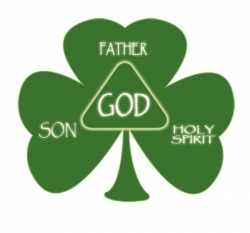
  • St. Patrick also made the Shamrock a national symbol of Ireland.  He used its three sections to explain the Holy Trinity of God the Father, Jesus the Son, and the Holy Spirit.  Each separate, but one.

draft_lens17603171module148005042photo_1297871374Holy-Trinity-Shamrock

  • Saint Patrick (LatinPatriciusProto-Irish*Qatrikias;[2] Modern IrishPádraig;[3] WelshPadrig;[4] c. 387 – 17 March c. 460[5] or c. 492[6]) was a Romano-British Christian missionary and bishop inIreland. Known as the “Apostle of Ireland”, he is the primary patron saint of the island along with Saints Brigid and Columba.
  • Two authentic letters from him survive, from which come the only generally accepted details of his life.[7] When he was about 16, he was captured from his home and taken as a slave to Ireland, where he lived for six years before escaping and returning to his family. After becoming a cleric, he returned to northern and western Ireland as an ordained bishop, but little is known about the places where he worked. By the seventh century, he had already come to be revered as the patron saint of Ireland.
  • Most available details of his life are from subsequent hagiographies, and these are now not accepted without detailed criticism. The Annals of Ulster state that he arrived in Ireland in 432, ministered inUlster around 443, and died in 457 or 461.[8] The text, however, distinguishes between “Old Patrick”[9] and “Patrick, archapostle of the Scots,”[10] who died in 492.[8] The actual dates of Patrick’s life cannot be fixed with certainty but, on a widespread interpretation, he was active as a missionary in Ireland during the second half of the 5th century.[11] He is generally credited with being the first bishop of ArmaghPrimate of All Ireland.
  • Saint Patrick’s Day is observed on March 17, the date of his death.[12] It is celebrated both inside and outside Ireland, as both a liturgical and non-liturgical holiday. In the dioceses of Ireland, it is both asolemnity and a holy day of obligation; outside Ireland, it can be a celebration of Ireland itself.

Irish in America

  • Irish immigrants of this period participated in significant numbers in the American Revolution, leading one British major general to testify at the House of Commons that “half the rebel Continental Army were from Ireland.”
  • The relatively small number of Irish Catholics concentrated in a few medium-sized cities, where they were highly visible, especially in CharlestonSavannah and New Orleans.[18][19] They became local leaders in the Democratic party, generally favored preserving the Union in 1860, but became staunch Confederates after secession in 1861.
  • During the American Civil War, Irish Americans volunteered in high numbers for the Union Army, and at least thirty-eight Union regiments had the word “Irish” in their title. 144,221 Union soldiers were born in Ireland; additionally, perhaps an equal number were of Irish descent.[43] Many immigrant soldiers formed their own regiments, such as the Irish Brigade.[44]
  • The majority of the Union Pacific track across the Nebraska and Wyoming territory till it approached Utah territory was built by veterans of both the Union and Confederate armies and many immigrant Irishmen.  (It upsets me that even history books now refer to the blacks and chinese building the railroad, when in fact it was the Irish in the East in Midwest and the Chinese in West.  A few blacks were employed but in insignificant numbers compared to the Irish.)  The blacks endured slavery and discrimination in the South, but the Irish suffered slavery and ethnic cleansing in their own country for decades, and received further abuse in America.  So our tale should not be forgotten either.

Number of Irish in America

  • After the potato famines and British land grabs and extermination of Irish, so many Irish moved to America, that by 1910 more Irish born lived in the United States than were left in Ireland.  Ever since then more Irish have lived outside Ireland.  The population in Ireland dropped from over 8 million to less than 4 million during that period of suffering.
  • Irish Americans are citizens of the United States who can trace their ancestry to Ireland. A total of 36,278,332 Americans—estimated at 11.9% of the total population—reported Irish ancestry in the 2008 American Community Survey conducted by the U.S. Census Bureau.[6] Roughly another 3.5 million (or about another 1.2% of Americans) identified more specifically with Scotch-Irishancestry. The Irish diaspora population in the United States is roughly six times the modern population of Ireland.
  • The only self-reported ancestral group larger than Irish Americans is German Americans.[6] The Irish are widely dispersed in terms of geography, and demographics. Irish American political leaders have played a major role in local and national politics since before the American Revolutionary War: eight Irish Americans signed the United States Declaration of Independence, and twenty-twoAmerican Presidents, from Andrew Jackson to Barack Obama, have been at least partly of Irish ancestry.

American Presidents with Irish ancestry

A number of the Presidents of the United States have Irish origins.[147] The extent of Irish heritage varies. For example, Chester Arthur‘s father and both of Andrew Jackson‘s parents were Irish born, whileGeorge W. Bush has a rather distant Irish ancestry. Ronald Reagan‘s father was of Irish ancestry,[148] while his mother also had some Irish ancestors. President Kennedy had Irish lineage on both sides. Within this group, only Kennedy was raised as a practicing Roman Catholic. Current President Barack Obama‘s Irish heritage originates from his Kansas-born mother, Ann Dunham, whose ancestry is Irish and English.[149] His Vice President Joe Biden is also an Irish-American.

United States President Ronald Reaganspeaking to large crowd in his ancestral home in Ballyporeen, Ireland in 1984.

Andrew Jackson
7th President 1829–37: He was born in the predominantly Scotch-Irish[150] Waxhaws area of South Carolina two years after his parents left Boneybefore, near Carrickfergus in County Antrim. A heritage centre in the village pays tribute to the legacy of ‘Old Hickory’, the People’s President. Andrew Jackson then moved to Tennessee, where he served as Governor[151]
James Knox Polk
11th President, 1845–49: His ancestors were among the first Ulster-Scots settlers, emigrating from Coleraine in 1680 to become a powerful political family in Mecklenburg CountyNorth Carolina. He moved to Tennessee and became its governor before winning the presidency.[152]
James Buchanan
15th President, 1857–61: Born in a log cabin (which has been relocated to his old school in Mercersburg, Pennsylvania). The Buchanans were originally from Deroran, near Omagh in County Tyronewhere the ancestral home still stands.[152]
Andrew Johnson
17th President, 1865–69: His grandfather left Mounthill, near Larne in County Antrim around 1750 and settled in North Carolina. Andrew worked there as a tailor and ran a successful business inGreenevilleTennessee, before being elected Vice President. He became President following Abraham Lincoln‘s assassination.[152]
Ulysses S. Grant
18th President, 1869–77: The home of his maternal great-grandfather, John Simpson, at DergenaghCounty Tyrone, is the location for an exhibition on the eventful life of the victorious Civil Warcommander who later served two terms as President. Grant visited his ancestral homeland in 1878.[153]
Chester A. Arthur
21st President, 1881–85: His election was the start of a quarter-century in which the White House was occupied by men of Ulster-Scots origins. His family left Dreen, near CullybackeyCounty Antrim, in 1815. There is now an interpretive centre, alongside the Arthur Ancestral Home, devoted to his life and times.[152][154]
Grover Cleveland
22nd and 24th President, 1885–89 and 1893–97: Born in New Jersey, he was the maternal grandson of merchant Abner Neal, who emigrated from County Antrim in the 1790s. He is the only president to have served non-consecutive terms.[152]
Benjamin Harrison
23rd President, 1889–93: His mother, Elizabeth Irwin, had Ulster-Scots roots through her two great-grandfathers, James Irwin and William McDowell. Harrison was born in Ohio and served as a brigadier general in the Union Army before embarking on a career in Indiana politics which led to the White House.[152][155]
William McKinley
25th President, 1897–1901: Born in Ohio, the descendant of a farmer from Conagher, near BallymoneyCounty Antrim, he was proud of his ancestry and addressed one of the national Scotch-Irish congresses held in the late 19th century.[156] His second term as president was cut short by an assassin’s bullet.[152][157]
Theodore Roosevelt
26th President, 1901–09: His mother, Mittie Bulloch, had Ulster Scots ancestors who emigrated from GlenoeCounty Antrim, in May 1729. Roosevelt praised “Irish Presbyterians” as “a bold and hardy race.”[158] However, he is also the man who said: “But a hyphenated American is not an American at all. This is just as true of the man who puts ‘native’ before the hyphen as of the man who puts German or Irish or English or French before the hyphen.” [1] (*Roosevelt was referring to “nativists“, not American Indians, in this context)[159]
William Howard Taft
27th President 1909–13[160][161]
Woodrow Wilson
28th President, 1913–21: Of Ulster-Scot descent on both sides of the family, his roots were very strong and dear to him. He was grandson of a printer from Dergalt, near StrabaneCounty Tyrone, whose former home is open to visitors.[152]
Warren G. Harding
29th President 1921–23[162]
Harry S. Truman
33rd President 1945–53[163][164]
John F. Kennedy
35th President 1961–63, (County Wexford)
Richard Nixon
37th President, 1969–74: The Nixon ancestors left Ulster in the mid-18th century; the Quaker Milhous family ties were with County Antrim and County Kildare.[152]
Jimmy Carter
39th President 1977–1981 (County Antrim and County Londonderry):[153] One of his maternal ancestors, Brandon McCain, emigrated from County Londonderry to America in 1810.
Ronald Reagan
40th President 1981–89: He was the great-grandson, on his father’s side, of Irish migrants from County Tipperary who came to America via Canada and England in the 1840s. His mother was of Scottish and English ancestry.[165]
George H. W. Bush
41st President 1989–93 (County Wexford): historians have found that his now apparent ancestor, Richard de Clare, Earl of Pembroke. Shunned by Henry II, he offered his services as a mercenary in the 12th-century Norman invasion of Wexford, Ireland in exchange for power and land. Strongbow married Aoife, daughter of Dermot MacMurrough, the Gaelic king of Leinster.[166][167]
Bill Clinton

Obama greets local residents on Main Street in Moneygall, Ireland, May 23, 2011.

42nd President 1993–2001: He claims Irish ancestry despite there being no documentation of any of his ancestors coming from Ireland [152][168]
George W. Bush
43rd President 2001–09: One of his five times great-grandfathers, William Holliday, was born in Rathfriland, County Down, about 1755, (a British merchant living in Ireland) and died in Kentucky about 1811–12. One of the President’s seven times great-grandfathers, William Shannon, was apparently born somewhere in County Cork about 1730, and died in Pennsylvania in 1784.[167]
Barack Obama
44th President 2009–present: Some of his maternal ancestors came to America from a small village called Moneygall, in County Offaly.[149][169] His ancestors lived in New England and the South and by the 1800s most were in the Midwest.

[edit]Vice Presidents of Irish descent

Joe Biden
47th Vice President 2009–present[170]

[edit]Other presidents of Irish descent

Sam Houston
President of Texas 1836–38 and 1841–44

[edit]Irish-American Justices of the Supreme Court

History of Ireland – High Points Only

  • The first known settlements in Ireland began around 8000 BC.
  • The 17th century was perhaps the bloodiest in Ireland’s history. Two periods of war (1641–53 and 1689–91) caused huge loss of life. The ultimate dispossession of most of the Irish Catholic landowning class was engineered, and recusants were subordinated under the Penal Laws.
  • During the 17th century Ireland was convulsed by eleven years of warfare, beginning with the Rebellion of 1641, when Irish Catholics rebelled against the domination of English and Protestant settlers. The Catholic gentry briefly ruled the country as Confederate Ireland (1642–1649) against the background of the Wars of the Three Kingdoms until Oliver Cromwell reconquered Ireland in 1649–1653 on behalf of theEnglish Commonwealth. Cromwell’s conquest was the most brutal phase of the war. By its close, up to a third of Ireland’s pre-war population was dead or in exile. As retribution for the rebellion of 1641, the better-quality remaining lands owned by Irish Catholics were confiscated and given to British settlers commenced. Several hundred remaining native landowners were transplanted to Connacht.
  • Forty years later, Irish Catholics, known as “Jacobites”, fought for James from 1688 to 1691, but failed to restore James to the throne of Ireland, England and Scotland.
  • Ireland became the main battleground after the Glorious Revolution of 1688, when the Catholic James II left London and the English Parliament replaced him withWilliam of Orange. The wealthier Irish Catholics backed James to try to reverse the Penal Laws and land confiscations, whereas Protestants supported William and Mary in this ‘Glorious Revolution’ to preserve their property in the country. James and William fought for the Kingdom of Ireland in the Williamite War, most famously at the Battle of the Boyne in 1690, where James’ outnumbered forces were defeated.

Slavery and Extermination by the British

  • From the 15th to the 18th century, Irish prisoners were sold as slaves. For centuries, the Irish were de-humanised by the English, described as savages, so making their murder and displacement appear all the more justified.[19] In 1654 the British parliament gave Oliver Cromwell a free hand to banish Irish “undesirables”. Cromwell rounded up Catholics throughout the Irish countryside and placed them on ships bound for the Caribbean, mainly Barbados. The authorities in the West Indies, fearing the Irish would resist servitude, treated the prisoners harshly. Records suggest that priests may have been routinely tortured and executed. By 1655, 12,000 political prisoners had been forcibly shipped to Barbados.[20]
  • Known as a hero in Britain, Oliver Cromwell led several armies to Ireland for the purpose of stealing their lands and thinning out the Irish population for resettlement by British.  He is probably the most hated person ever in Ireland.
  • Subsequent Irish antagonism toward England was aggravated by the economic situation of Ireland in the 18th century. Some absentee landlords managed their estates inefficiently, and food tended to be produced for export rather than for domestic consumption. Two very cold winters near the end of the Little Ice Age led directly to a famine between 1740 and 1741, which killed about 400,000 people and caused over 150,000 Irish to leave the island. In addition, Irish exports were reduced by the Navigation Acts from the 1660s, which placed tariffs on Irish products entering England, but exempted English goods from tariffs on entering Ireland. Despite this most of the 18th century was relatively peaceful in comparison with the preceding two centuries, and the population doubled to over four million.
  • The second of Ireland’s “Great Famines”, An Gorta Mór struck the country during 1845–49, with potato blight, exacerbated by the political and laissez-faire economic factors of the time[22] leading to mass starvation and emigration. (See Great Irish Famine.) The impact of emigration in Ireland was severe; the population dropped from over 8 million before the Famine to 4.4 million in 1911. Gaelic or Irish, once the island’s spoken language, declined in use sharply in the nineteenth century as a result of the Famine and the creation of the National School education system, as well as hostility to the language from leading Irish politicians of the time; it was largely replaced by English.
  • The English Parliament was well aware that they had removed the food from Ireland, left their fields fallow, and they were now suffering starvation.  When debated in Parliament, the British MPs discussed at length and decided the best thing would be to let the Irish starve or move away so it would be easier to suppress them and take their land.  They literally let over half the population of the country starve or cross oceans to get food, when they could have saved them.  The willful starvation and forced immigration of over half the Irish is why there is still so much hatred for the British, even centuries after Cromwell and slavery and land robbery.  The famines happened just 100 years ago, and Ireland has never been the same.

Here it is, picture gallery of Irishness…

2 Comments

Filed under Humor and Observations, Uncategorized

Was Dracula an Irishman?

Bram Stoker’s Dracula inspired by an Irish legend?

Dracula inspired many films - the vampire count is the most filmed character in the world after Sherlock Holmes.

Dracula inspired many films – the vampire count is the most filmed character in the world after Sherlock Holmes.

Did an early Irish vampire legend influence the creation of Count Dracula? There are a group of people in the north of Ireland who are sure Bram Stoker was influenced by a old story from their area.

When the Irish writer Bram Stoker published his novel ‘Dracula’ in 1897, it quickly grew into a worldwide publishing sensation. To this day it is Bram Stoker who has done most to shape the modern conception of vampires which we see in movies and fiction – from Lost Boys to the Twilight series.

There has been a lot of speculation about where Bram Stoker got the idea for the character of Dracula, and the unique characteristics he gave this fearsome vampire. Much has been made of the connection to Eastern-European vampire myths, and the medieval prince known as Vlad the Impaler or Vlad Tepes.

However there is also lesser-known but fascinating local Irish myth of an evil magician who could not be killed and came back from the grave three times, This is a highly unusual myth for Ireland, where there is little tradition of ‘undead’ stories. Thus it was a legend likely to attract the attention of an Irish writer such as Bram Stoker who was very interested in folklore.

The people who live near the final resting place of this Irish undead, have told me that the legend was the original inspiration for Bram Stoker’s Dracula. Not only that, but they tell me that this burial site continues to be associated with strange and disturbing events to this day.

The Story of Abhartach – the original Irish vampire

In County Derry in Northern Ireland, there is a small townland named ‘Slaghtaverty’ which in Irish means ‘ Abhartach’s Tomb’. When I was working in this rural area recently on a community history project, the locals told me the story of how the townland got it’s name, how the legend inspired Bram Stoker to create ‘Dracula’ and how strange events continue to happen in the vicinity of the large stone tomb that stands there.

Abhartach (pronounced Av-ar-chack), so the story goes, was an evil ruler in the area, a stunted man but a powerful magician. He terrorized all the people for miles around, until they wished him dead. But as none of his subjects had the courage to kill the magical man themselves they got a warrior from a neighbouring area to do it. This warrior, called Cathain, duly killed Abhartach and buried him upright as was traditional for a Celtic chief at this time.

However, the next day Abhartach appeared once more among his people, this time demanding a sacrifice of blood from the wrists of his subjects. He had become one of, what was called in Irish, the marbh beo – the living dead. Three times Cathain killed and buried Abhartach and three times he rose from his grave seeking blood from his people. Until the people, in their desperation, turned to a Christian saint who lived in the area and asked him how they could be rid of this evil undead creature forever.

Cathain was instructed by the saint to kill Abhartach once more but this time to do it with a sword made of yew wood, to bury him upside down, with a large stone on top and then to plant thorn trees around the grave. This Cathain did and Avartach has never been seen again, though his grave still stands in a field in the townland of Slaghtaverty, covered in an enormous stone slab, a lonely thorn tree growing beside it.

Other influences on Bram Stoker’s Dracula

Of course Bram Stoker would not have taken his inspiration for Count Dracula from a single source. Stoker was well aware of Eastern European folklore, as well as earlier Gothic vampire stories such as Politori’s ‘Vampyre’ and Carmilla by Sheridan Le Fanu.

Vlad the Impaler of Romania, a cruel Medieval prince, has often been sighted as inspiration for Dracula. While he may have lent Dracula his nickname (Dracul – son of the devil) he doesn’t share many characteristics with the blood-sucking Count; Vlad the Impaler was a cruel leader but he is never recorded as having drunk blood, or as having lived beyond the grave.

You can read more on this topic at my article: Count Dracula: myth, fiction and historical reality.

Abraham 'Bram' Stoker: Author of Dracula.

Abraham ‘Bram’ Stoker: Author of Dracula.

Did Abhartach influence Stoker’s Count Dracula?

The parallels between Abhartach and Bram Stoker’s Dracula are extremely interesting. The idea of an evil man who has a magical way to overcome death and rise from the grave, is familiar to anyone who has read Dracula or who has seen the film adaptations. Further similarities include the demands blood sacrifice from his subjects – the image of taking blood from weaker people ispowerfully interwoven with thevampire myth as we know it today. As is the idea that there is a special way to kill the undead – we are all very familiar today with the idea that vampires must be killed by a wooden stake, or buried upside down, just like the saint said Abhartach could be killed over a thousand years ago.

Although today few but the locals who live near the grave have heard of Abhartach, it was once a well-reported story in Ireland. The story is said to date from the 5th or 6th century BC – making it one of the world’s earliest vampire legends. It was treated as true history and published in the book A General History of Ireland by Dr Geoffrey Keating in 1631. It was later collected and printed as an interesting local legend included in the Ordnance Survery of County Londonderry in 1835 and the story of Avartach was further reprinted by Patrick Weston Joyce in A History of Ireland in 1880.

It is quite probable that Bram Stoker knew of this story and it may have influenced his decision to write a vampire novel. What is particularly interesting is that two of the earliest and most influential vampire novels were written by Irishmen – Carmilla by Sheridan Le Fanu and Dracula by Bram Stoker. Although they were surely influenced by European legends and Gothic literature as well, there is definitely a case for the argument that they were also inspired by the local Irish legend of Abhartach.

A textile depiction of 'Dracula's Grave'. The thorn tree still grows there today.

A textile depiction of ‘Dracula’s Grave’. The thorn tree still grows there today.

Strange events at ‘Dracula’s Grave’

Whatever the case for Stoker’s connection with Avartach’s grave, the tomb has a reputation for strange and unsettling events which continues into living memory of the local residents. In fact people in the area refer to the tomb as ‘Dracula’s Grave’. They rarely visit the site – and never after dark!

Not so many years ago the owner of the land where the tomb sits decided that it was time to get rid of the grave and the tree and to take full possession of his field. A group of men gathered together to do the work of moving the stones and a chainsaw was brought to cut down the tree. But when they tried to start the chainsaw to cut down the thorn tree the saw stalled and would not work. So a second chainsaw was brought down to the field and it too would not start which was too much of a co-incidence. The men began to feel distinctly unsettled.

But the final straw came when the tractor they had brought along to pull away the tombstone started of its own accord and drove itself to the other side of the field, crushing one of the chainsaws into the mud as it did so. The men fled. And no attempt to remove the tomb or the thorn tree has been made since.

6 Comments

Filed under Humor and Observations, Writing