Tag Archives: manufacturing

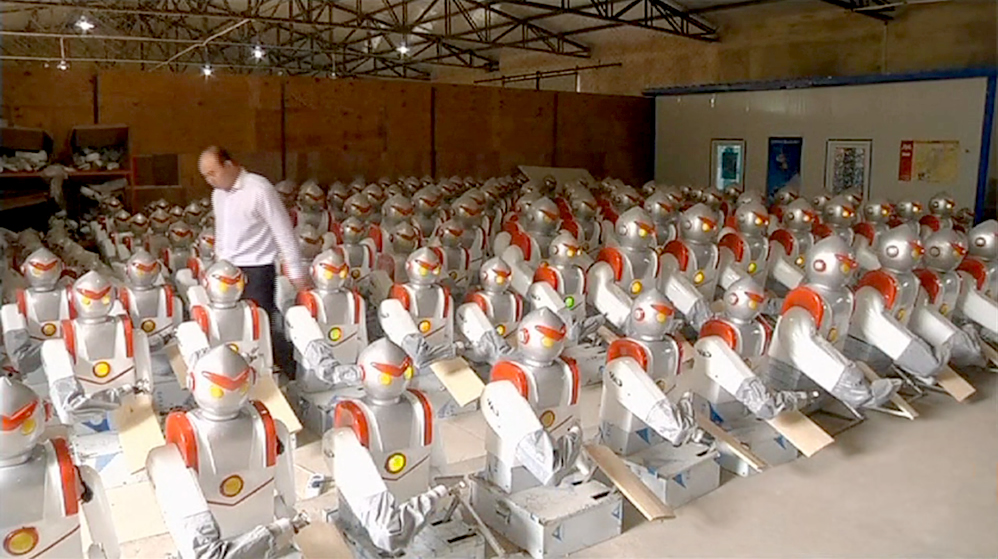
Chinese Building One Million Strong ‘robot army’

Foxconn to Speed Up ‘robot Army’ Deployment; 20,000 Robots Already in its Factories

Foxconn also looking at the U.S. and Indonesia for expansion

By Michael Kan 
Wed, June 26, 2013
 
IDG News Service (Beijing Bureau) — Manufacturing giant Foxconn Technology Group is on track with its goal to a create a “million robot army”, and already has 20,000 robotic machines in its factories, said the company’s CEO Terry Gou on Wednesday.
 
robot army 0

Workers’ wages in China are rising, and so the company’s research in robots and automation has to catch up, Gou said, while speaking at the company’s annual shareholder’s meeting in Taipei. “We have over 1 million workers. In the future we will add 1 million robotic workers,” he said. “Our [human] workers will then become technicians and engineers.”

Foxconn is the world’s largest contract electronics maker and counts Apple, Microsoft and Sony as some of its clients. Many of its largest factories are in China, where the company employs 1.2 million people, but rising Add a comment are threatening to reduce company profits.

To offset labor costs and improve its manufacturing, Foxconn has already spent three years on developing robots, Gou said. These machines are specifically developed to assemble electronics such as mobile phones, but it will take some time for Foxconn to fully develop the technology, he added.

robot army 1

“It’s a middle to long-term goal,” Gou said. But already 20,000 robot arms and robotic tools are in use at the company’s factories.

Robotics have long been used to manufacture cars and large electronics. But currently, human workers are still the best choice to put together small consumer gadgets, many of which contain complicated wiring and small sockets that are best handled with human hands, according to experts.

In addition, Foxconn’s CEO said the company is prepared to expand its manufacturing in the U.S., but the move will depend on “economic factors.” The company already has factories in Indianapolis and Houston, and employs thousands of workers in the country, according to Gou.

Last December, Foxconn customer Apple said it would manufacture one of its Mac lines in the U.S. by the end of next year. Soon after, Foxconn said it was considering growing its existing manufacturing base in the country.
robot army 2

The Taiwanese company is also exploring building factories in Indonesia, a country with significantly lower labor costs than the U.S. or China. One possible plan is for Foxconn to build electronics for the local market, which is home to 240 million people.

“Indonesia has great potential and its a great market for my company,” Gou said. “Definitely we will put a lot of investment in Indonesia.”

The company, however, is waiting for the nation’s government to improve the regulations for its tech sector. Standards over electronics safety are so low that anyone can get away with selling shoddy mobile phones, said a Foxconn official in December.

“The direction is right, but we need to take time,” Gou added. “We think in one or two years this will happen.”


1 Comment

Filed under Humor and Observations

First 3D Printed Working Automobile to be Made


In my continuing effort to preach to the world that the biggest revolution in technology in our lifetimes is 3d printing, here is yet another example.  The first “printed” car is to be manufactured and available in two years.  For other stories on this topic, type “3d printing” into the search box on the Home page.  You really should, the technology is already here, and it is amazing.

First 3D Printed Car To Hit The Roads In Two Years 

From NoCamels on 3/11/2013 at 4:27 PM

Avner Meyrav, NoCamels – Israel Innovation News

It might just be the precursor to the next industrial revolution and slowly but surely, 3D printing is expanding its presence into the realm of manufacturing. Now it seems that one of the first major industries to benefit from 3D printing is the same one that spawned the assembly line revolution – the automotive industry.

Israeli company Stratasys, already a major player in the field and its subsidiary, RedEye On Demand, will be part of a project aimed at putting the first 3D printed car on the roads within two years, in partnership with KOR EcoLogic.

“A future where 3D printers build cars may not be far off after all,” says Jim Bartel, VP of Stratasys and RedEye On Demand. “Jim Kor and his team at KOR EcoLogic had a vision for a more fuel-efficient car that would change how the world approaches manufacturing and today we’re achieving it. URBEE 2, the name of the car, shows the manufacturing world that anything really is possible. There are few design challenges [3D printing] capabilities can’t solve.”

A car built from 40 pieces

KOR EcoLogic will be in charge of the design end, building every inch of the car using computer aided design software. The design will then be turned into reality using RedEye On Demand and Stratasys printers. While standard cars have hundreds or even thousands of small parts, the URBEE 2 will be built using only 40 extremely complex interlocking pieces, made possible by 3D printing.

The material used to build the car will be a strong but lightweight plastic and the two-passenger vehicle will be able to travel at speeds of up to 70mph. According to Bartel, the car will also be highly fuel efficient. To prove it, Bartel explains, his team will try to set a world record by traveling in the car from San Francisco to New York City on only 10 gallons of fuel.

“As a mechanical engineer, I’ve always believed we could use technology to help us solve some of society’s greatest challenges, like minimizing our dependence on oil and reducing ozone emissions,” says Jim Kor, president and senior designer for Winnipeg-based KOR EcoLogic.

He adds: “How cool is it that American manufacturing can evolve to tackle these challenges head-on? Our team is excited to launch URBEE 2, putting a next-generation vehicle on the road that will eventually be sold to the public.”

URBEE 2 was preceded by URBEE 1, a prototype built entirely using 3D printing in 2011. While serving as proof to 3D printing’s potential, the car had no side mirrors or windshield wipers – both of which will be included in its updated version.

“With the Urbee 1 project, I learned that product design is nearly unencumbered by considerations on how parts can be made with digital manufacturing. That liberation is incredibly powerful and holds a lot of potential for the future of manufacturing,” says Kor.

.ORG-Connection: NoCamels.com is the leading news website on Israeli innovations in English. It covers all the latest Israeli innovations in the fields of technology, health, environment and lifestyle.

Leave a comment

Filed under Humor and Observations

Star Trek Replicators for the US Army

In my ongoing efforts to explain that 3d printing is THEE revolutionary invention of today…  The US Army is now using 3d printing for onsite manufacturing of equipment in war zones.  Star Trek style replicators are here.  Now.

replicator-menageatroi

Star Trek replicators for the Army

By 

Published January 10, 2013

FoxNews.com

  • 3D Replicator Knife.jpg

    A design for a knife made from a 3D printer to help dismounted soldiers probe for IEDs. The tool had to be plastic so as to not conduct with any IED surfaces it might uncover. (Army Rapid Equipping Force)

  • 3D Replicator Flashlight guard design.jpg

    A commonly used Army-issue flashlight has raised, exposed button that allow the light to be accidently turned on in pocket or pouch. This guard was developed and printed to prevent accidental power up and to save batteries. (Army Rapid Equipping Force)

  • 3D Replicator Flashlight guard.jpg

    A commonly used Army-issue flashlight has raised, exposed button that allow the light to be accidently turned on in pocket or pouch. This guard was developed and printed to prevent accidental power up and to save batteries. (Army Rapid Equipping Force)

  • 3D Replicator thermal cameras.jpg

    Soldiers needed a way to see immediately right or left of a vehicle. This camera system was developed and printed in a lab, including CNC-made mounting brackets and a 3D-printed monitor mount. (Army Rapid Equipping Force)

There’s a new force on the front lines, and it’s anything but out of this world.

Remote operating bases in Afghanistan are using Star Trek-style replicators, 3D printers capable of fabricating on the spot whatever the Army may need — from replacement vehicle parts to an entirely new piece of technology.

The Army’s Rapid Equipping Force (REF) worked with Applied Minds, Inc. and Exponent to make the science fiction dream a reality.  Thanks to their efforts, a lab equipped with the 3D printers is only a helicopter ride away.

‘[It’s] basically like a huge glue gun.’

– Westley Brin, product manager with the Army’s Rapid Equipping Force

While the locations cannot be released, the first two labs were posted to forward operating bases in Afghanistan. The third is currently under construction and due to deploy around June this year.

There are four types of computer-driven replicator: 3D printers, CNC mills, laser cutters and water cutters.

The state of the art lab is contained in a 20,000 pound, 20-foot long container that can be carried by a Chinook helicopter. It’s equipped with a 3D printer and a CNC mill, machines that resemble very large microwaves.

With them an engineer can build essentially anything.

How does it work?
“Soldiers walk into the lab and say, ‘this is my problem.’ The PhDs then do the work and show it to the soldiers. The soldiers give them feedback,” and they work together tinkering with the tech until it is exactly fit for purpose, explained Westley Brin, product manager with the REF.

The team uses software similar to that an architect would use, like CAD or computer-assisted design programs, to design their solution in the battlefield. After a design is drawn, they send the file to the 3D printer or the CNC.

3D printers, sometimes called rapid prototypers, take glue or resin and layer it to build the design from scratch.

Brin describes their 3D printer as “basically like a huge glue gun. When you pick up the object created, you can feel the ridges because it builds the object layer by layer. That’s why it’s so fragile.”

The 3D printers can make only softer plastics that last for a month or two — it’s a short-term solution in the field. They can also build several soft models and send them back to the U.S. or anywhere else for volume manufacturing.

CNC mills work differently: Using a drill bit, they take a hunk of aluminum or metal and carves it out as a human would carve a sculpture.

HELP BUILD SOMETHING

REF and the labs use the Broad Agency Announcements (BAA) site to solicit solutions. Anyone can submit a solution and if they think it shows promise they will send someone out to take a look. Know a MacGyver up for creating something for the troops? Check out the site.

A CNC can cut parts from more durable material; Brin describes its output as the “end-all, be-all piece” — meaning it isn’t a stop-gap but a screw, knife, distributor cap or whatever that can be used for the duration.

The lab also lets technicians dial out of Afghanistan to anywhere in the world for advice, whether it’s the CEO of a Fortune 500 company, a college professor or a 13-year-old girl. Anyone with a bright idea to solve the problem or improve the current solution is accessible.

From several thousand miles away, the pinch-hitting engineer can design and feed a solution to the lab in Afghanistan, where the 3D printer and CNC will work overnight. When the team arrives in the morning, presto, a new part is waiting.

What does it make?
Project Powerhand is one of the labs many success stories. Soldiers in Afghanistan use hand-held, ground penetrating radar to detect mines — devices with a very limited battery life.

By creating tech that took the lifespan from 60 minutes to a whopping 36 hours, they immediately made soldiers safer and gave them a tool they could use on a three-day patrol.

Next in the replicator pipeline for the Army is a bigger printer that will combine the CNC and the 3D capabilities and most likely reside at a major base. The labs posted to forward operating bases will be able to communicate with this monster to produce parts as well.

As operations in Afghanistan draw down, the Star Trek-style lab will still have enormous utility, going out with the Army to accompany first-responders at natural disasters within 24 to 48 hours for example.

Read more: http://www.foxnews.com/tech/2013/01/10/star-trek-replicators-for-army/#ixzz2HjnNRuJd

Leave a comment

Filed under Humor and Observations