Tag Archives: Newser

Unexpected find: Seating plan for Rome’s Colosseum

Unexpected find: Seating plan for Rome's Colosseum

A man dressed as a gladiator enjoys his lunch in front of Rome’s Colosseum, Friday Nov. 7, 2014. (AP Photo/Alessandra Tarantino)

Spectators who once flocked to Rome’s Colosseum could find their seats with the help of red numbers painted over entrance archways. What’s amazing is that hints of that paint still remain, Discovery reports.

A team restoring the Colosseum has spotted remnants of it in Latin numerals carved high up on an entrance gate. “This is an exceptional discovery because we did not expect that some trace of the red paint was still preserved,” Colosseum Director Rossella Rea tells the International Business Times.

The red color, derived from clay minerals and iron oxide, had to be repainted every two or three years—which makes the find that much more unexpected.

It also casts a light on how Romans found their seats when going to watch gladiators, wild beasts, and public executions. “The 50,000 spectators had a ticket that said which numbered gate arch they were supposed to enter,” says Rea.

“Inside the arena, there were other numbers to help people access their seats, which were assigned according to social class.” Admittance was free, but of course the emperor had the best seat in his private box, New Historian reports.

Rome’s social and political elite also sat high up, followed by upper-class businessmen and government officials, ordinary Roman men, and finally women and the poor, who had to sit or stand on wood benches.

Built in 70AD, the Colosseum is undergoing a $33 million restoration to clean off dirt that’s accumulated since the Middle Ages. (After its glory days, researchers say, the Colosseum became a “condo.”)

This article originally appeared on Newser: Surprise Find: Seating Plan for Rome’s Colosseum

Leave a comment

Filed under Humor and Observations

Ancient Greek drinking game makes a comeback

Ancient Greek drinking game makes a comeback

Kottabos was all about hurling wine. (AP Photo/Idaho Press-Tribune, Greg Kreller,File)

What better place to re-create an ancient drinking game than a college campus? A teacher at West Chester University in Pennsylvania and her students kept up an ancient Greek tradition by playing kottabos, a game that involves hurling one’s wine from a glass onto a target at the center of a room.

Greek men used to gather at symposia to drink, chat, and be entertained, and when they reached the bottom of their wine vessels—called kylixes—they would toss the dregs at the target, LiveScience reports.

(YouTube has some examples.) A variety of targets were used, WhatCulturereports. One was a figurine with a brass disc on top. The disc would land with a victorious ring as it hit the floor.

In other cases, players would throw wine into a saucer to fill it up, or toss wine at a saucer floating in water. Kylixes are a little hard to find these days, so the students used 3D-printed cups instead.

And since this was in a classroom, not a dorm, there was no alcohol involved; instead, students tossed grape juice. The best strategy, it seems, was to put a finger through one of a kylix’s handles and toss the wine out overhead.

“It must have gotten pretty messy,” says assistant professor Heather Sharpe. “By the end of our experiment we had diluted grape juice all over the floor.” (While students investigate the ancient Greek tradition, an icon of the era is in danger.)

This article originally appeared on Newser: Ancient Greek Drinking Game Is Reborn

Leave a comment

Filed under Humor and Observations

‘Uncontacted’ tribe attacks Amazon village

'Uncontacted' tribe attacks Amazon village

This Nov. 2011 file photo shows members of the Mashco-Piro tribe, photographed at an undisclosed location near the Manu National Park in southeastern Peru. (AP Photo/Diego Cortijo, Survival International, File)

Peru is evacuating a remote village near the Brazilian border after an unusual display of aggression from one of the 15 or so “uncontacted” tribes that live in its Amazon forests.

Last week, 200 men from the tribe, called Mashco-Piro, raided the village of Monte Salvado armed with bows and arrows.”There were no injuries although the men fired off arrows,” says a minister for intercultural affairs.

“The villagers took refuge in a guard post. They are safe but have no food and are terrified.” Officials are moving 39 people, 16 of whom are children, along with 22 more from nearby Puerto Nuevo to the region’s capital, Puerto Maldonado.

The Mashco-Piro raiders took tools, blankets, and food, reports the Guardian, as well as killed domestic animals. “We believe the Mashco-Piro are still in the area,” says the official running the evacuation.

It’s the third time this year that this particular tribe has traveled to Monte Salvado, reports the BBC, but this is the first time such a large group of just men (instead of families) have arrived armed.

Some suggest the tribe is growing desperate as loggers and drug-traffickers encroach on its protected land; others point to climate change, which has led to steeper drops in temperature.

“When there’s pressure on their territory or attacks against them, that’s when there are these violent reactions,” one anthropologist tells the Guardian. The Mashco-Piro were first spotted in May 2011; more on the tribe here.

Leave a comment

Filed under Humor and Observations

Oldest tool ever found in Turkey alters European history

The quartzite flake, described in Quaternary Science Reviews, is “the earliest securely-dated artifact from Turkey ever recorded,” and its discovery pushes back the presumed date of human migration into Europe, researcher Danielle Schreve says, per EurekAlert.

Her eye just happened to be “drawn to a pinkish stone on the surface” while studying a sediment deposit in an ancient river bend near Gediz.

“When I turned it over for a better look, the features of a humanly-struck artifact were immediately apparent,” Schreve says. Other hominin fossils were found in Turkey in 2007, but experts aren’t confident about their age.

Some say an ancient skull shows humans were in Turkey as far back as 1.3 million years ago, but others date it to about 500,000 years ago, LiveSciencereports.

In the case of the flake, researchers used high-precision radioisotopic dating on the ancient river deposit in which the artifact was found. They also used magnetic minerals within the regions’ rocks to gauge the position of the magnetic poles around the time it was left.

The data revealed a “secure chronology,” showing humans were in the area between 1.24 million and 1.17 million years ago, experts say. (Find out why modern humans’ bones are weaker than those of their ancestors.)

This article originally appeared on Newser: Turkey’s Oldest Tool Alters European History

1 Comment

Filed under Humor and Observations

Does ‘Blue Hole’ hold secret to Mayan collapse?

Does 'Blue Hole' hold secret to Mayan collapse?

This undated image provided by the Belize Tourist Board shows an aerial view of the Great Blue Hole, a popular diving site that’s part of Belize���s barrier reef. (AP Photo/Belize Tourist Board)

Everything from overhunting and a peasant uprising to deforestation and an alien invasion has been proposed to explain why the Mayan civilization collapsed,Smithsonian notes. But one theory has been gaining ground in recent years: extreme drought.

Now more evidence has surfaced to support the drought postulation—and the proof may just lie in Belize’s most famous underwater cave. Rice University professor Andre Droxler’s team analyzed sediment found in the “Great Blue Hole,” a 410-foot-deep sinkhole in the middle of Lighthouse Reef, LiveSciencereports.

Not only did the chemical composition of the silt indicate periods of sparse rainfall during the Mayan decline (likely between AD800 and AD1000): It also showed that a second huge drought probably occurred between AD1000 and AD1100—right around the time the Mayans’ relocation site of Chichen Itza is said to have fallen.

Over thousands of years, runoff from rivers and streams during periods of ample rainfall deposited layers of sediment in the Blue Hole’s lagoon, offering scientists a geological timeline to examine.

“It’s like a big bucket,” Droxler tells LiveScience. “It’s a sediment trap.” Excessive rain also erodes volcanic rock, which contains titanium. Droxler’s team found that the sediment’s mineral composition—specifically, the low ratio of titanium to aluminum—in the lagoon indicated periods of low rainfall during the times when the Mayas, for the most part, disappeared.

Scientists surmise that due to a climate glitch, monsoons may have skipped over the Yucatan Peninsula during these periods, leading to eventual catastrophe all around. “When you have major droughts, you start to get famines and unrest,” Droxler explains.

(A “lost” Mayan city with 15 pyramids was discovered in Mexico last year.)

This article originally appeared on Newser: ‘Blue Hole’ May Hold Secret to Mayan Collapse

Leave a comment

Filed under Humor and Observations

‘Alpha males’ like spicy food: study

'Alpha males' like spicy food: study

Small bottles of Tabasco sauce are boxed up at Avery Island, La., Monday, Oct. 15, 2007. (AP Photo/Alex Brandon)

Wonder if a guy has high testosterone? Just put a spice bottle next to him and see how much he pours on his dinner, according to a new study.

Scientists at the University of Grenoble say that among 114 men aged 18 to 44, those who added the most spicy sauce to their plate of mashed potatoes had the highest levels of testosterone.

Study co-author Laurent Begue tells the Telegraph that testosterone leads men into “more stimulating social groups” and inspires them to “take more risks,” and adds that “in this case, it applies to risk-taking in taste.” Perhaps, he says, regular spicy-food consumption “contributes to increasing testosterone levels, although so far this has only been demonstrated on rodents.” Study participants were invited into a test center, asked to rate their love for spice, and told to spice up the mashed potatoes “to their taste with little sachets of Tabasco sauce,” NHS reports.

At some point the men gave saliva samples that scientists used to measure testosterone. Published in the peer-reviewed journal Physiology and Behavior, the study found a “statistically significant” but hardly impressive correlation of 0.29 between spice-love and testosterone-level (0 indicates no correlation and 1 a “perfect” one, says NHS).

Called “Some Like It Hot,” the study found no causal link between the hormone and spice. NHS reports that other studies have linked high male testosterone to men who love “dominant colors” like red, so who knows, maybe that was it.

Leave a comment

Filed under Humor and Observations

Easter Islanders weren’t as isolated as we thought

Easter Islanders weren't as isolated as we thought

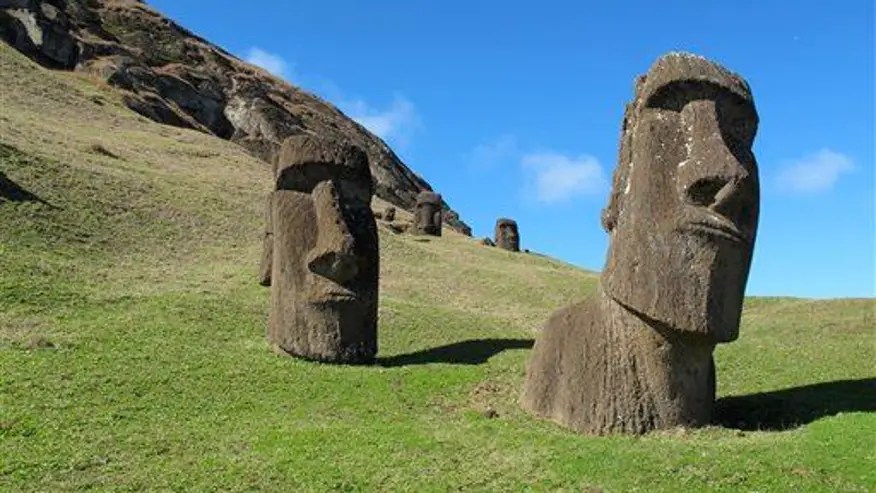
This August 2012 photo shows heads at Rano Raraku, the quarry on Easter Island. (AP Photo/Karen Schwartz)

Easter Island, or Rapa Nui, is such a remote speck of rock in the Pacific Ocean that it has been nicknamed “navel of the world.” Yet a review of genetic data of 27 natives suggests the islanders made contact with outsiders hundreds of years before the first Europeans arrived from Holland in 1722.

In fact, the Rapa Nui people appear to have had significant intermixing with Native Americans as far back as the late 13th century, researchers report in the journal Current Biology.

The findings indicate “an ancient ocean migration route between Polynesia and the Americas,” says the study’s lead author. Though the nearly 2,500-mile journey would have been perilous in their wooden outrigger canoes, the researchers say it’s more likely the islanders ventured to South America and back than others finding their way to Easter Island, reports Reuters.

Today’s Rapa Nui people are genetically about 76% Polynesian, 16% European, and 8% Native American, though the European intermingling dates back only to the 19th century, while the Native American intermingling appears to go back 19 to 23 generations.

A separate study also published in Current Biology this week details the genetic makeup of two ancient human skulls from Brazil’s indigenous Botocudo tribe. The skulls were genetically Polynesian without any Native American mixing, further suggesting that islanders traveled to the Americas.

(Check out the drug that scientists found in the island’s soil.)

This article originally appeared on Newser: Easter Islanders Not as Isolated as Thought

Leave a comment

Filed under Humor and Observations

Magnetic poles could swap sooner than we thought

(NEWSER) – Earth’s magnetic field is weakening at 10 times the rate experts thought it was — and that could mean a reversal of the magnetic north and south poles could be coming sooner than expected.

But don’t panic just yet: Scientists are talking in terms of some 2,000 years, Scientific American reports.

The magnetic field has been weakening at a rate of about 5% every decade, as opposed to 5% every century, as had been believed. The field, LiveScience notes, protects us from solar radiation.

Such polar flips remain somewhat mysterious, but they’re linked to the movement of iron at the planet’s center. That movement is occasionally disrupted for reasons that aren’t clear; this leads to weakening of the magnetic field, and, in some cases, a reversal of the poles. That process takes an average of 5,000 years, Scientific American reports, and it last happened 780,000 years ago.

It’s probably nothing to worry about, the publication notes: There’s no sign of a crisis in the fossil record during previous reversals. As for the solar protection, scientists haven’t seen evidence that the field has ever totally disappeared, NASA reports.

Leave a comment

Filed under Humor and Observations

Ebola Update

If President Obama asked you tomorrow to join the volunteers going to West Africa to treat Ebola and offered you substantial training and pay would you go?  You don’t have to answer for me, just for yourself.  I will tell you, it scares the crap out of me.

When the Ebola outbreak first started in West Africa I was shocked and disturbed by the number of memes on Facebook making light of the threat because it is only spread through fluids.  I spoke up early and indicated how naive that view was.  Unfortunately, I was correct.  Here are two stories…

 Ebola could arrive in US as soon as this month

Ebola could arrive in US���as soon as this month: study

American Aid goods are offloaded from an airplane, to be used in the fight against the Ebola virus spreading in the city of Monrovia, Liberia, Sunday, Aug. 24, 2014. (AP Photo/Abbas Dulleh)

Dr. Rick Sacra, the third American to contract Ebola, landed in Nebraska last week and will be moved to the Nebraska Medical Center in Omaha for treatment.

Experts insist there is no risk to the public, NBC News reports, but a new study in PLOS Currents finds that Ebola could soon make its way inside U.S. borders on its own.

The study looked at global flight patterns and passenger screening and found that the chance of at least one case arriving in the country by Sept. 22 was as high as 18 percent, NPR reports.

“What is happening in West Africa is going to get here. We can’t escape that at this point,” the study’s lead author says, adding it would likely occur in “small clusters of cases, between one and three.” The study also points to a 25 percent to 28 percent chance of the virus reaching the United Kingdom and a 50 percent chance of it spreading to Ghana before the month is over.

If the virus isn’t contained, the likelihood of its spread will “increase consistently,” the study notes. On a more optimistic note, Sacra’s wife says, “Rick is clearly sick” but “was in good spirits and he walked onto the plane” that took him to Nebraska.

“We are really encouraged by that news.” (Meanwhile, Sierra Leone is going on lockdown to fight Ebola.)

US works to step up Ebola aid, preps hospitals for potential patients

With growing criticism that the world still is not acting fast enough against the surging Ebola epidemic, President Barack Obama has called the outbreak a national security priority.

Obama is to travel to Atlanta on Tuesday to address the Ebola crisis during a visit to the Centers for Disease Control and Prevention, the White House said. During his visit, Obama is to be briefed about the outbreak and discuss the U.S. response with officials.

The administration hasn’t said how big a role the military ultimately will play – and it’s not clear how quickly additional promised help will arrive in West Africa.

“This is also not everything we can and should be doing,” Sen. Chris Coons, D-Del., who chairs a Foreign Relations subcommittee that oversees African issues, told the Senate last week.

He called for expanded military efforts and for Obama to appoint someone to coordinate the entire government’s Ebola response.

“I’ve heard from organizations that have worked to transport donated supplies and can fill cargo plane after cargo plane but are having difficulty getting it all to West Africa,” Coons added, urging government assistance.

Supplies aren’t the greatest need: “Trained health professionals for these Ebola treatment units is a critical shortage,” said Dr. Steve Monroe of the Centers for Disease Control and Prevention, or CDC.

Aiming to spur them, the CDC is beginning to train volunteer health workers headed for West Africa on how to stay safe, Monroe said. CDC sent its own staff to learn from Doctors Without Borders, which has the most experience in Ebola outbreaks. CDC will offer the course at a facility in Anniston, Alabama, for the next few months, teaching infection-control and self-protection and letting volunteers – expected to be mostly from nongovernment aid groups – practice patient triage.

“It’s gone beyond an Ebola crisis to a humanitarian crisis. It does require more of a U.S. government-wide response, more than just CDC,” Monroe said.

Here are some questions and answers about that response:

Q: What is the U.S. contributing?

A: The U.S. government has spent more than $100 million so far, said Ned Price of the National Security Council. Last week, the U.S. Agency for International Development announced it would spend up to $75 million more to provide 1,000 treatment beds in Liberia, the worst-hit country, and 130,000 protective suits for health workers.

The Obama administration has asked Congress for another $88 million to send additional supplies and public health experts, and to develop potential Ebola medications and vaccines.

Also, the State Department has signed a six-month contract, estimated at up to $4.9 million, for a Georgia-based air ambulance to be on call to evacuate any Ebola-infected government employees, and other U.S. aid workers when possible.

“The ability to evacuate patients infected with the Ebola virus is a critical capability,” said Dr. William Walters, the State Department’s director of operational medicine.

Q: Beyond delivering supplies, what’s happening on the ground?

A: The CDC currently has 103 staffers in West Africa working on outbreak control and plans to send about 50 more. They help to track contacts of Ebola patients, train local health workers in infection control and help airport authorities screen whether anyone at high risk of Ebola is attempting to leave.

Two of the CDC workers are in Ivory Coast to try to stay ahead of the virus, helping health authorities prepare in case an Ebola patient crosses the border into that country.

Q: What are the U.S. military’s plans?

A: The Defense Department has provided more than 10,000 Ebola test kits to the region and plans to set up a 25-bed field hospital in the Liberian capital for infected health care workers.

Pentagon spokesman John Kirby suggested Friday that more could be coming.

“The Department of Defense has capabilities that might prove helpful,” he said, adding, “We’re having those discussions right now.”

Q: Will Ebola come here?

A: U.S. health officials are preparing in case an individual traveler arrives unknowingly infected but say they’re confident there won’t be an outbreak here.

People boarding planes in the outbreak zone are checked for fever, but symptoms can begin up to 21 days after exposure. Ebola isn’t contagious until symptoms begin, and it takes close contact with bodily fluids to spread.

Q: Where would sick travelers be treated? The U.S. only has four of those isolation units where Ebola-stricken aid workers were treated.

A: “There’s still a perception in the public that the only place these people can be treated is at one of these specialized facilities like the one at Emory or Nebraska, and that’s just not the case,” Monroe said. “We are confident that any hospital in the U.S. can care for” an Ebola patient.

After all, five U.S. cases of similar hemorrhagic viruses – one Marburg virus, the others Lassa fever – have been treated in the past decade.

The CDC is telling hospitals to ask about travel if someone has suspicious symptoms, to put the person in a private room with a separate bathroom while asking CDC about testing and to wear a gown, mask and eye protection when delivering care.

“This virus is completely inactivated by all the normal disinfectants used in a hospital setting,” Monroe noted.

Leave a comment

Filed under Humor and Observations

Boy, 11, finds 3,000-year-old sword in river

As he dunked them into the water, he felt something graze his hand, pulled it out, and brought it home to show his dad, reports Xinhua.

Now experts say “it” turns out to be a 3,000-year-old bronze sword, probably from either the Shang or Zhou dynasty—”the dawn of Chinese civilization,” as the BBC puts it.

The head of the Gaoyou Cultural Relics Bureau thinks the 10-inch sword likely belonged to a civil official, since “it has both decorative and practical functions, but is not in the shape of [a] sword for military officers.” Recent dredging of the river may have brought the sword out of the silt and closer to the surface, according to the bureau official, who adds that archaeologists are now planning a larger dig there.

The boy’s dad admits that locals wanted to buy the sword from him for “high prices,” but he “felt it would be illegal to sell the cultural relic.” The bureau sent him and his inquisitive son a certificate and reward for finding the piece.

Leave a comment

Filed under Humor and Observations