Tag Archives: nuclear war

North Korea Update

North Korea Reportedly Entering ‘State Of War’ Against South Korea

By SAM KIM 03/30/13 04:23 PM ET EDT AP

SEOUL, South Korea — North Korea warned Seoul on Saturday that the Korean Peninsula had entered “a state of war” and threatened to shut down a border factory complex that’s the last major symbol of inter-Korean cooperation.

Analysts say a full-scale conflict is extremely unlikely, noting that the Korean Peninsula has remained in a technical state of war for 60 years. But the North’s continued threats toward Seoul and Washington, including a vow to launch a nuclear strike, have raised worries that a misjudgment between the sides could lead to a clash.

In Washington, the White House said Saturday that the United States is taking seriously the new threats by North Korea but also noted Pyongyang’s history of “bellicose rhetoric.”

North Korea’s threats are seen as efforts to provoke the new government in Seoul, led by President Park Geun-hye, to change its policies toward Pyongyang, and to win diplomatic talks with Washington that could get it more aid. North Korea’s moves are also seen as ways to build domestic unity as young leader Kim Jong Un strengthens his military credentials.

On Thursday, U.S. military officials revealed that two B-2 stealth bombers dropped dummy munitions on an uninhabited South Korean island as part of annual defense drills that Pyongyang sees as rehearsals for invasion. Hours later, Kim ordered his generals to put rockets on standby and threatened to strike American targets if provoked.

North Korea said in a statement Saturday that it would deal with South Korea according to “wartime regulations” and would retaliate against any provocations by the United States and South Korea without notice.

“Now that the revolutionary armed forces of the DPRK have entered into an actual military action, the inter-Korean relations have naturally entered the state of war,” said the statement, which was carried by Pyongyang’s official Korean Central News Agency, referring to the North’s official name, the Democratic People’s Republic of Korea.

Provocations “will not be limited to a local war, but develop into an all-out war, a nuclear war,” the statement said.

Hours after the statement, Pyongyang threatened to shut down the jointly run Kaesong industrial park, expressing anger over media reports suggesting the complex remained open because it was a source of hard currency for the impoverished North.

“If the puppet group seeks to tarnish the image of the DPRK even a bit, while speaking of the zone whose operation has been barely maintained, we will shut down the zone without mercy,” an identified spokesman for the North’s office controlling Kaesong said in comments carried by KCNA.

South Korea’s Unification Ministry responded by calling the North Korean threat “unhelpful” to the countries’ already frayed relations and vowed to ensure the safety of hundreds of South Korean managers who cross the border to their jobs in Kaesong. It did not elaborate.

South Korean Defense Ministry spokesman Kim Min-seok said the country’s military remains mindful of the possibility that increasing North Korean drills near the border could lead to an actual provocation.

“The series of North Korean threats – announcing all-out war, scrapping the cease-fire agreement and the non-aggression agreement between the South and the North, cutting the military hotline, entering into combat posture No. 1 and entering a `state of war’ – are unacceptable and harm the peace and stability of the Korean Peninsula,” Kim said.

“We are maintaining full military readiness in order to protect our people’s lives and security,” he told reporters Saturday.

In Washington, Caitlin Hayden, a spokeswoman for the White House National Security Council, noted the “reports of a new and unconstructive statement from North Korea.”

“We take these threats seriously and remain in close contact with our South Korean allies,” Hayden said. “But, we would also note that North Korea has a long history of bellicose rhetoric and threats, and today’s announcement follows that familiar pattern.”

The White House has stressed the U.S. government’s capability and willingness to defend itself and its allies and interests in the region, if necessary.

“We remain fully prepared and capable of defending and protecting the United States and our allies,” Hayden said.

The two Koreas remain technically at war because the 1950-53 Korean War ended in a truce, not a peace treaty. Naval skirmishes in the disputed waters off the Korean coast have led to bloody battles several times over the years.

But on the streets of Seoul on Saturday, South Koreans said they were not worried about an attack from North Korea.

“From other countries’ point of view, it may seem like an extremely urgent situation,” said Kang Tae-hwan, a private tutor. “But South Koreans don’t seem to be that nervous because we’ve heard these threats from the North before.”

The Kaesong industrial park, which is run with North Korean labor and South Korean know-how, has been operating normally, despite Pyongyang shutting down a communications channel typically used to coordinate travel by South Korean workers to and from the park just across the border in North Korea. The rivals are now coordinating the travel indirectly, through an office at Kaesong that has outside lines to South Korea.

North Korea has previously made such threats about Kaesong without acting on them, and recent weeks have seen a torrent of bellicose rhetoric from Pyongyang. North Korea is angry about the South Korea-U.S. military drills and new U.N. sanctions over its nuclear test last month.

Dozens of South Korean firms run factories in the border town of Kaesong. Using North Korea’s cheap, efficient labor, the Kaesong complex produced $470 million worth of goods last year.

Associated Press White House reporter Darlene Superville contributed to this report.

Follow Sam Kim at . http://www.twitter.com/samkim_ap
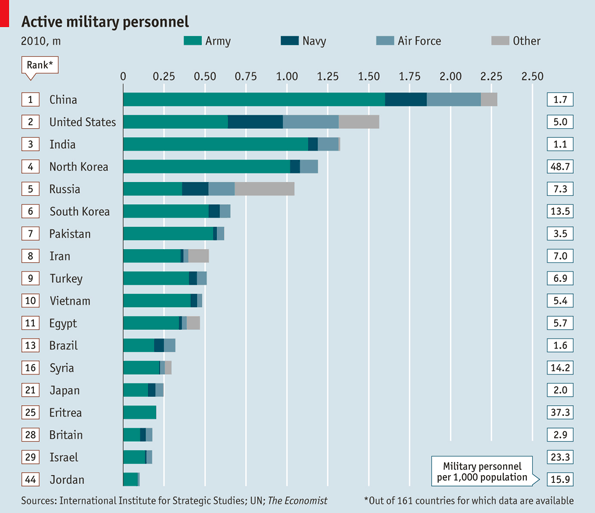
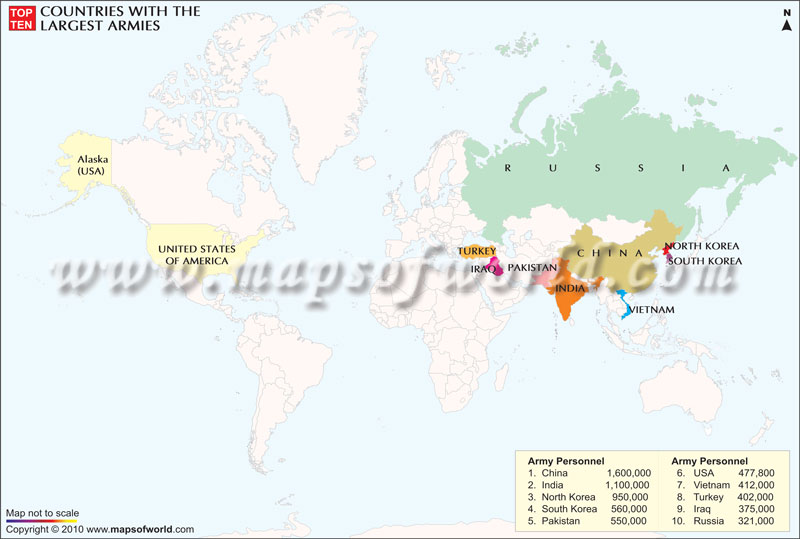
north korean military


largest armies


Leave a comment

Filed under Humor and Observations, Uncategorized

North Korea Threatens Nuclear War

First, a history lesson.  The Korean War, police action, or whatever you wish to call it, never ended.  That is right, a cease-fire was called, but the war never was ended.  My brother was stationed in Korea in the Army and they would occasionally come under fire, even in the late 1970s when he was over there.  I was in the US Air Force from 1984 to 1990 and each year participated in Operation Team Spirit.  Joint exercises to coordinate the South Korean and American military in case of renewal of hostilities with North Korea.  We have had these exercises for over 60 years now.  So, if you think what we are doing is new and provocative, it is not.  Most people living on the planet were not here in we first started joint exercises, including Kim Jong Un, the new leader.

If you think it can’t happen, just look at the Iran-Iraq War, the Russian invasion of Afghanistan and Chechnya, the break-up of Yugoslavia, the ethnic cleansing in Africa.  It can happen.  The saber rattling is to be taken seriously as Kim Jong Un has been raised in total isolation as a foolish sociopath.  While his country starves, he creates nuclear weapons and buys his wife he married when she was 16, expensive designer outfits and Dior handbags worth over $1,200 a piece.  Just some background to ponder while considering the story reposted below:


South Korea and US begin military drills as North Korea threatens war

Published March 11, 2013

Associated Press

  • SouthKoreaUSDrills.JPG

    March 9, 2013: The guided-missile destroyers USS Lassen (DDG 82), arrives to participate in the annual joint military exercises, dubbed Key Resolve, between the South Korean and United States. (AP)

SEOUL, South Korea –  North Korean state media said Monday that Pyongyang had carried through with a threat to cancel the 60-year-old armistice that ended the Korean War, as it and South Korea staged dueling war games amid threatening rhetoric that has risen to the highest level since North Korea rained artillery shells on a South Korean island in 2010.

Enraged over the South’s joint military drills with the United States and recent U.N. sanctions, Pyongyang has piled threat on top of threat, including vows to launch a nuclear strike on the U.S. Seoul has responded with tough talk of its own and has placed its troops on high alert.

The North Korean government made no formal announcement Monday on its repeated threats to scrap the armistice, but the country’s main newspaper, Rodong Sinmun, reported that the armistice was nullified Monday as Pyongyang had earlier announced it would.

The North followed through on another promise Monday, shutting down a Red Cross hotline that the North and South used for general communication and to discuss aid shipments and separated families’ reunions.

The 11-day military drills that started Monday involve 10,000 South Korean and about 3,000 American troops. Those coincide with two months of separate U.S.-South Korean field exercises that began March 1.

The drills are held annually, and this year, according to South Korean media, the “Key Resolve” drill rehearses different scenarios for a possible conflict on the Korean peninsula using computer-simulated exercises. The U.S. and South Korean troops will be used to test the scenarios.

Also continuing are large-scale North Korean drills that Seoul says involve the army, navy and air force. The South Korean defense ministry said there have been no military activities it considers suspicious.

The North has threatened to nullify the armistice several times in times of tension with the outside world, and in 1996 the country sent hundreds of armed troops into a border village. The troops later withdrew.

Despite the heightened tension, there were signs of business as usual Monday.

The two Koreas continue to have at least two working channels of communication between their militaries and aviation authorities.

One of those hotlines was used Monday to give hundreds of South Koreans approval to enter North Korea to go to work. Their jobs are at the only remaining operational symbol of joint inter-Korean cooperation, the Kaesong industrial complex. It is operated in North Korea with South Korean money and knowhow and a mostly North Korean work force.

The North Korean rhetoric escalated as the U.N. Security Council last week approved a new round of sanctions over Pyongyang’s latest nuclear weapons test Feb. 12.

Analysts said that much of the bellicosity is meant to shore up loyalty among citizens and the military for North Korea’s young leader, Kim Jong Un.

“This is part of their brinksmanship,” said Daniel Pinkston, a Seoul-based expert on North Korea with the International Crisis Group think tank. “It’s an effort to signal their resolve, to show they are willing to take greater risks, with the expectation that everyone else caves in and gives them what they want.”

Part of what North Korea wants is a formal peace treaty to end the Korean War, instead of the armistice that leaves the peninsula still technically in a state of war. It also wants security guarantees and other concessions, direct talks with Washington, recognition as a nuclear weapons state and the removal of 28,500 U.S. troops stationed in South Korea.

Pinkston said there is little chance of fighting breaking out while war games are being conducted, but he added that he expects North Korea to follow through with a somewhat mysterious promise to respond at a time and place of its own choosing.

North Korea was responsible for an artillery attack that killed four South Koreans in 2010. A South Korean-led international investigation found that North Korea torpedoed a South Korean warship that same year, killing 46 sailors. Pyongyang denies sinking the ship.

Among other threats in the past week, North Korea has warned Seoul of a nuclear war on the divided peninsula and said it was cancelling nonaggression pacts.

South Korean and U.S. officials have been closely monitoring Pyongyang’s actions and parsing its recent rhetoric, which has been more warlike than usual.

One analyst said Kaesong’s continued operations show that North Korea’s cutting of the Red Cross communication channel was symbolic. More than 840 South Koreans were set to cross the border Monday to Kaesong, which provides a badly-needed flow of hard currency to a country where many face food shortages, according to Seoul’s Unification Ministry.

“If South Koreans don’t go to work at Kaesong, North Korea will suffer” financially, said analyst Hong Hyun-ik at the private Sejong Institute in South Korea. “If North Korea really intends to start a war with South Korea, it could have taken South Koreans at Kaesong hostage.”

Under newly inaugurated President Park Geun-hye, South Korea’s Defense Ministry, which often brushes off North Korean threats, has looked to send a message of strength in response to the latest comments from Pyongyang.

The ministry has warned that the North’s government would “evaporate from the face of the Earth” if it ever used a nuclear weapon. The White House also said the U.S. is fully capable of defending itself against a North Korean ballistic attack.

On Monday, Park told a Cabinet Council meeting that South Korea should strongly respond to any provocation by North Korea. But she also said Seoul should move ahead with her campaign promise to build up trust with the North.

North Korea has said the U.S. mainland is within the range of its long-range missiles, and an army general told a Pyongyang rally last week that the military is ready to fire a long-range nuclear-armed missile to turn Washington into a “sea of fire.”

While outside scientists are still trying to determine specifics, the North’s rocket test in December and third atomic bomb test last month may have pushed the country a step closer to acquiring the ability to hit the U.S. with weapons of mass destruction. Analysts, however, say Pyongyang is still years away from acquiring the smaller, lighter nuclear warheads needed for a credible nuclear missile program.

But there are still worries about a smaller conflict, and analysts have said that more missile and nuclear tests are possible reactions from North Korea.

North Korea has a variety of missiles and other weapons capable of striking South Korea. Both the warship sinking and island shelling in 2010 occurred near a western sea boundary between the Koreas that North Korea fiercely disputes. It has been a recurring flashpoint between the rivals that has seen three other bloody naval skirmishes since 1999.

Last week, Kim Jong Un visited two islands just north of the sea boundary and ordered troops there to open fire immediately if a single enemy shell is fired on North Korean waters.

Kim was also quoted as saying his military is fully ready to fight an “all-out war” and that he will order a “just, great advance for national unification” if the enemy makes even a slight provocation, according to the North’s official Korean Central News Agency.

Read more: http://www.foxnews.com/world/2013/03/11/south-korea-and-us-begin-military-drills-as-north-korea-threatens-war/#ixzz2NNN9Jhqf

Leave a comment

Filed under Humor and Observations, Uncategorized