Tag Archives: romans

Railroad track history – humorous but true

Why Some Things Are, the Way They Are
6

 The U.S. Standard railroad gauge (distance between the rails) is 4 feet, 8.5 inches. That’s an exceedingly odd number. Why was that gauge used? Because that’s the way they built them in England, and English expatriates designed the U.S. Railroads.

Why did the English build them like that?

Because the first rail lines were built by the same people who built the pre-railroad tramways, and that’s the gauge they used.

Why did ‘they’ use that gauge then?

Because the people who built the tramways used the same jigs and tools that they had used for building wagons, which used that wheel spacing.
2

Why did the wagons have that particular Odd wheel spacing?

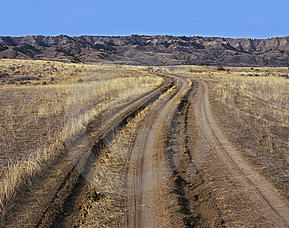
Well, if they tried to use any other spacing, the wagon wheels would break on some of the old, long distance roads in England, because that’s the spacing of the wheel ruts.

So, who built those old rutted roads?
3

Imperial Rome built the first long distance roads in Europe (including England) for their legions. Those roads have been used ever since.

And the ruts in the roads?

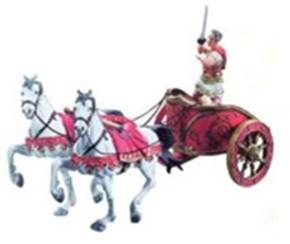
Roman war chariots formed the initial ruts, which everyone else had to match for fear of destroying their wagon wheels.

Since the chariots were made for Imperial Rome, they were all alike in the matter of wheel spacing. Therefore, the United States standard railroad gauge of 4 feet, 8.5 inches is derived from the original specifications for an Imperial Roman war chariot. In other words, bureaucracies live forever.

So the next time you are handed a specification, procedure, or process, and wonder, ‘What horse’s ass came up with this?’ , you may be exactly right.

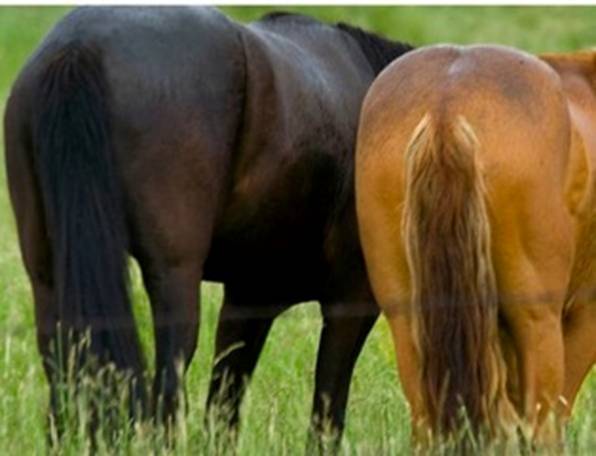
Imperial Roman army chariots were made just wide enough to accommodate the rear ends of two war horses.
4
Now, the twist to the story:

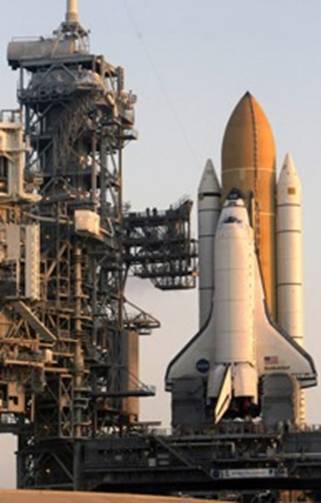
When you see a Space Shuttle sitting on its launch pad, you will notice that there are two big booster rockets attached to the sides of the main fuel tank. These are solid rocket boosters, or SRBs. The SRBs are made by Thiokol at their factory in Utah.
5

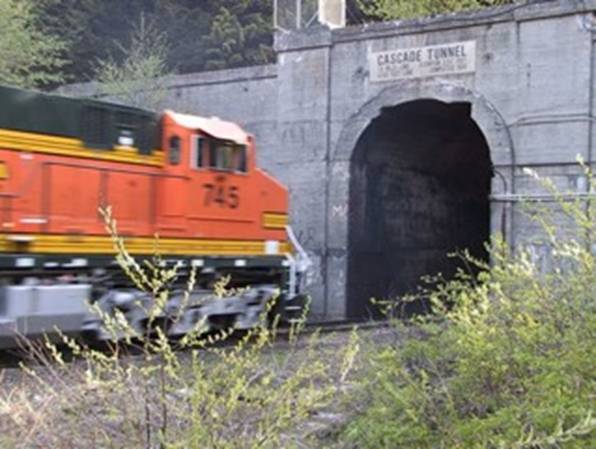
The engineers who designed the SRBs would have preferred to make them a bit larger, but the SRBs had to be shipped by train from the factory to the launch site. The railroad line from the factory happens to run through a tunnel in the mountains, and the SRBs had to fit through that tunnel. The tunnel is slightly wider than the railroad track, and the railroad track, as you now know, is about as wide as two horses’ behinds.

6
So, a major Space Shuttle design feature of what is arguably the world’s most advanced transportation system was determined over two thousand years ago by the width of a horse’s ass.

And you thought being a horse’s ass wasn’t important!
Now you know, horses’ asses control almost everything…explains a whole lot of stuff, doesn’t it?


1 Comment

Filed under Humor and Observations

Skeleton of ancient prince reveals Roman life

Skeleton of ancient prince reveals Roman life

By Rossella Lorenzi

Published September 23, 2013

Discovery News
  • 1.tomb.jpg

    Italian archaeologists have unearthed a 2,600-year-old intact Etruscan tomb that promises to reveal new depths of one of the ancient worlds most fascinating and mysterious cultures. (ROSSELLA LORENZI)

  • 5.breathless.jpg

    The archaeologists were left breathless by what they found inside. (ROSSELLA LORENZI)

The skeletonized body of an Etruscan prince, possibly a relative to Tarquinius Priscus, the legendary fifth king of Rome from 616 to 579 B.C., has been brought to light in an extraordinary finding that promises to reveal new insights on one of the ancient world’s most fascinating cultures.

Found in Tarquinia, a hill town about 50 miles northwest of Rome, famous for its Etruscan art treasures, the 2,600 year old intact burial site came complete with a full array of precious grave goods.

“It’s a unique discovery, as it is extremely rare to find an inviolate Etruscan tomb of an upper-class individual. It opens up huge study opportunities on the Etruscans,” Alessandro Mandolesi, of the University of Turin, told Discovery News. Mandolesi is leading the excavation in collaboration with the Archaeological Superintendency of Southern Etruria.

A fun loving and eclectic people who among other things taught the French how to make wine, the Romans how to build roads, and introduced the art of writing into Europe, the Etruscans began to flourish around 900 B.C., and dominated much of Italy for five centuries.

Known for their art, agriculture, fine metalworking and commerce, the Etruscans begun to decline during the fifth century B.C., as the Romans grew in power. By 300-100 B.C., they eventually became absorbed into the Roman empire.

Since their puzzling, non-Indo-European language was virtually extinguished (they left no literature to document their society), the Etruscans have long been considered one of antiquity’s great enigmas.

Indeed, much of what we know about them comes from their cemeteries. Only the richly decorated tombs they left behind have provided clues to fully reconstruct their history.

Blocked by a perfectly sealed stone slab, the rock-cut tomb in Tarquinia appeared promising even before opening it.

Indeed, several objects, including jars, vases and even a grater, were found in the soil in front of the stone door, indicating that a funeral rite of an important person took place there.

As the heavy stone slab was removed, Mandolesi and his team were left breathless. In the small vaulted chamber, the complete skeleton of an individual was resting on a stone bed on the left. A spear lay along the body, while fibulae, or brooches, on the chest indicated that the individual, a man, was probably once dressed with a mantle.

At his feet stood a large bronze basin and a dish with food remains, while the stone table on the right might have contained the incinerated remains of another individual.

Decorated with a red strip, the upper part of the wall featured, along with several nails, a small hanging vase, which might have contained some ointment. A number of grave goods, which included large Greek Corinthian vases and precious ornaments, lay on the floor.

“That small vase has been hanging on the wall for 2,600 years. It’s amazing,” Lorenzo Benini, CEO of the company Kostelia, said.

Along with Pietro Del Grosso of the company Tecnozenith, Benini is the private investor who has largely contributed to the excavation.

Although intact, the tomb has suffered a small natural structural collapse, the effects of which are visible in some broken vases.

Mandolesi and his team believe the individual was a member of Tarquinia’s ruling family.

The underground chamber was found beside an imposing mound, the Queen Tomb, which is almost identical to an equally impressive mound, the King’s Tomb, 600 feet away.

About 130 feet in diameter, the Queen’s Tomb is the largest among the more than 6,000 rock cut tombs (200 of them are painted) that make up the necropolis in Tarquinia. Mandolesi has been excavating it and its surrounding area for the past six years.

Both mounds date to the 7th century B.C., the Orientalizing period, so called due to the influence on the Etruscans from the Eastern Mediterranean.

According to Roman tradition, Demaratus, a Greek from Corinth, landed in Tarquinia as a refugee in the 7th century BC, bringing with him a team of painters and artisans who taught the local people new artistic techniques.

Demaratus then married an Etruscan noblewoman from Tarquinia, and their son, Lucumo, became the fifth king of Rome in 616 B.C., taking the name of Lucius Tarquinius Priscus.

The story emphasizes the importance of Tarquinia as one of the most powerful cities in the Etruscan league.

Indeed, the two imposing mounds would have certainly remarked the power of the princes of Tarquinia to anybody arriving from the sea.
According to Mandolesi, the fact that the newly discovered burial lies a few feet away from the Queen’s Tomb indicate that it belonged to one of the princes of Tarquinia, someone directly related to the owners of the Queen’s Tomb.

“The entire area would have been off limits to anybody but the royal family,” Mandolesi said.

“In the next days we are going to catalogue all the objects. Further scientific tests will tell us more about the individual and the tomb,” Mandolesi said.

Leave a comment

Filed under Humor and Observations

Summer Solstice Traditions

Summer Solstice Traditions

By History.com Staff

For many bygone civilizations, the summer solstice—the longest day of the year—was endowed with great significance. People celebrated this special day, which falls in June in the northern hemisphere and is also known as midsummer, with festivals, celebrations and other observances, some of which still survive or have experienced a revival in modern times.

Though a connection between the Celtic high priests and England’s Stonehenge has never been reliably established, many people who identify as modern-day Druids still gather at the mighty monument every midsummer. (Credit: Andrew Dunn/Wikimedia Commons)

Ancient Greeks
According to certain iterations of the Greek calendar—they varied widely by region and era—the summer solstice was the first day of the year. Several festivals were held around this time, including Kronia, which celebrated the agriculture god Cronus. The strict social code was temporarily turned on its head during Kronia, with slaves participating in the merriment as equals or even being served by their masters. The summer solstice also marked the one-month countdown to the opening of the Olympic games. Ancient Romans 
In the days leading up to the summer solstice, ancient Romans celebrated the Vestalia festival, which paid tribute to Vesta, the goddess of the hearth. Rituals included the sacrifice of an unborn calf remove from its mother’s womb. This was the only time of the year when married women were allowed to enter the sacred temple of the vestal virgins and make offerings to Vesta there.

Ancient Chinese 
The ancient Chinese participated in a ceremony on the summer solstice to honor the earth, femininity and the force known as yin. It complemented the winter solstice ritual, which was devoted to the heavens, masculinity and yang. Ancient Northern and Central European Tribes Many Germanic, Slavic and Celtic pagans welcomed summer with bonfires, a tradition that is still enjoyed in Germany, Austria, Estonia and other countries. Some ancient tribes practiced a ritual in which couples would jump through the flames to predict how high that year’s crops would grow.

Vikings 
Midsummer was a crucial time of year for the Nordic seafarers, who would meet to discuss legal matters and resolve disputes around the summer solstice. They would also visit wells thought to have healing powers and build huge bonfires. Today, “Viking” summer solstice celebrations are popular among both residents and tourists in Iceland.

Native Americans
Many Native American tribes took part in centuries-old midsummer rituals, some of which are still practiced today. The Sioux, for instance, performed a ceremonial sun dance around a tree while wearing symbolic colors. Some scholars believe that Wyoming’s Bighorn medicine wheel, an arrangement of stones built several hundred years ago by the Plains Indians, aligns with the solstice sunrise and sunset, and was therefore the site of that culture’s annual sun dance.

Maya and Aztecs 
While not much is known of how exactly the mighty pre-Columbian civilizations of Central America celebrated midsummer, the ruins of their once-great cities indicate the great significance of that day. Temples, public buildings and other structures were often precisely aligned with the shadows cast by major astrological phenomena, particularly the summer and winter solstices.

Druids
The Celtic high priests known as the Druids likely led ritual celebrations during midsummer, but—contrary to popular belief—it is unlikely that these took place at Stonehenge, England’s most famous megalithic stone circle. Still, people who identify as modern Druids continue to gather at the monument for the summer solstice, winter solstice, spring equinox and autumn equinox.

Leave a comment

Filed under Humor and Observations