Tag Archives: space.com

Water Found on Mars!

H2 oh my: NASA’s Curiosity rover finds water in Mars dirt

By Mike Wall

Published September 26, 2013

  • curiosity-mosaic-sol-85

    SA’s Mars rover Curiosity is a mosaic of photos taken by the rover’s Mars Hand Lends Imager taken on Sol 85, the rover’s 85th Martian day, as Curiosity was sampling rocks at a stop dubbed Rocknest in Gale Crater. Image released Sept. 26, 2013.(NASA/JPL-CALTECH/MALIN SPACE SCIENCE SYSTEMS)

  • curiosity-rocknest-closeup

    At left, a closeup view of the Mars rock target Rocknest taken by the Curiosity rover showing its sandy surface and shadows that were disrupted by the rover’s front left wheel. At right, a view of Mars samples from Curiosity’s third dirt scoop (SCIENCE/AAAS)

  • curiosity-chemin-science-result

    This image depicts the science result from the Mars rover Curiosity’s CheMin instrument, showing an X-ray diffraction of the rover’s fifth scoop of Martian dirt. The black semi-circle at the bottom is the shadow of the beam stop. Image released(SCIENCE/AAAS)

Future Mars explorers may be able to get all the water they need out of the red dirt beneath their boots, a new study suggests.

NASA’s Mars rover Curiosity has found that surface soil on the Red Planet contains about 2 percent water by weight. That means astronaut pioneers could extract roughly 2 pints of water out of every cubic foot of Martian dirt they dig up, said study lead author Laurie Leshin, of Rensselaer Polytechnic Institute in Troy, N.Y.

“For me, that was a big ‘wow’ moment,” Leshin told SPACE.com. “I was really happy when we saw that there’s easily accessible water here in the dirt beneath your feet. And it’s probably true anywhere you go on Mars.” [The Search for Water on Mars (Photos)]

The new study is one of five papers published in the journal ScienceThursday that report what researchers have learned about Martian surface materials from the work Curiosity did during its first 100 days on the Red Planet.

Soaking up atmospheric water
C
uriosity touched down inside Mars’ huge Gale Crater in August 2012, kicking off a planned two-year surface mission to determine if the Red Planet could ever have supported microbial life. It achieved that goal in March, when it found that a spot near its landing site called Yellowknife Bay was indeed habitable billions of years ago.

‘The dirt is acting like a bit of a sponge and absorbing water from the atmosphere.’

– Laurie Leshin, of Rensselaer Polytechnic Institute 

But Curiosity did quite a bit of science work before getting to Yellowknife Bay. Leshin and her colleagues looked at the results of Curiosity’s first extensive Mars soil analyses, which the 1-ton rover performed on dirt that it scooped up at a sandy site called Rocknest in November 2012.

Using its Sample Analysis at Mars instrument, or SAM, Curiosity heated this dirt to a temperature of 1,535 degrees Fahrenheit, and then identified the gases that boiled off. SAM saw significant amounts of carbon dioxide, oxygen and sulfur compounds — and lots of water on Mars.

SAM also determined that the soil water is rich in deuterium, a “heavy” isotope of hydrogen that contains one neutron and one proton (as opposed to “normal” hydrogen atoms, which have no neutrons). The water in Mars’ thin air sports a similar deuterium ratio, Leshin said.

“That tells us that the dirt is acting like a bit of a sponge and absorbing water from the atmosphere,” she said.

Some bad news for manned exploration
SAM detected some organic compounds in the Rocknest sample as well — carbon-containing chemicals that are the building blocks of life here on Earth. But as mission scientists reported late last year, these are simple, chlorinated organics that likely have nothing to do with Martian life. [The Hunt for Martian Life: A Photo Timeline]

Instead, Leshin said, they were probably produced when organics that hitched a ride from Earth reacted with chlorine atoms released by a toxic chemical in the sample called perchlorate.

Perchlorate is known to exist in Martian dirt; NASA’s Phoenix lander spotted it near the planet’s north pole in 2008. Curiosity has now found evidence of it near the equator, suggesting that the chemical is common across the planet. (Indeed, observations by a variety of robotic Mars explorers indicate that Red Planet dirt is likely similar from place to place, distributed in a global layer across the surface, Leshin said.)

The presence of perchlorate is a challenge that architects of futuremanned Mars missions will have to overcome, Leshin said.

“Perchlorate is not good for people. We have to figure out, if humans are going to come into contact with the soil, how to deal with that,” she said.

“That’s the reason we send robotic explorers before we send humans — to try to really understand both the opportunities and the good stuff, and the challenges we need to work through,” Leshin added.

A wealth of discoveries
The four other papers published in Science today report exciting results as well.

For example, Curiosity’s laser-firing ChemCam instrument found a strong hydrogen signal in fine-grained Martian soils along the rover’s route, reinforcing the SAM data and further suggesting that water is common in dirt across the planet (since such fine soils are globally distributed).

Another study reveals more intriguing details about a rock Curiosity studied in October 2012. This stone — which scientists dubbed “Jake Matijevic” in honor of a mission team member who died two weeks after the rover touched down — is a type of volcanic rock never before seen on Mars.

However, rocks similar to Jake Matijevic are commonly observed here on Earth, especially on oceanic islands and in rifts where the planet’s crust is thinning out.

“Of all the Martian rocks, this one is the most Earth-like. It’s kind of amazing,” said Curiosity lead scientist John Grotzinger, a geologist at the California Institute of Technology in Pasadena. “What it indicates is that the planet is more evolved than we thought it was, more differentiated.”

The five new studies showcase the diversity and scientific value ofGale Crater, Grotzinger said. They also highlight how well Curiosity’s 10 science instruments have worked together, returning huge amounts of data that will keep the mission team busy for years to come.

“The amount of information that comes out of this rover just blows me away, all the time,” Grotzinger told SPACE.com. “We’re getting better at using Curiosity, and she just keeps telling us more and more. One year into the mission, we still feel like we’re drinking from a fire hose.”

The road to Mount Sharp
The pace of discovery could pick up even more. This past July, Curiosity left the Yellowknife Bay area and headed for Mount Sharp, which rises 3.4 miles into the Martian sky from Gale Crater’s center.

Mount Sharp has been Curiosity’s main destination since before the rover’s November 2011 launch. Mission scientists want the rover to climb up through the mountain’s foothills, reading the terrain’s many layers along the way.

“As we go through the rock layers, we’re basically looking at the history of ancient environments and how they may be changing,” Grotzinger said. “So what we’ll really be able to do for the first time is get a relative chronology of some substantial part of Martian history, which should be pretty cool.”

Curiosity has covered about 20 percent of the planned 5.3-mile trek to Mount Sharp. The rover, which is doing science work as it goes, may reach the base of the mountain around the middle of next year, Grotzinger said.

Leave a comment

Filed under Humor and Observations

What is the ‘Hyperloop’?

What is the ‘Hyperloop’? Billionaire Elon Musk to reveal futuristic transportation idea

By Mike Wall

Smarter America

Published August 12, 2013

  • 091231-spacex-elon-02

    SpaceX CEO Elon Musk stands next to the company’s Falcon 9 rocket, which blasted SpaceX’s Dragon capsule into orbit in December 2010. (SpaceX)

The fevered speculation about billionaire entrepreneur Elon Musk’s mysterious “Hyperloop” transport system is about to come to an end.

Musk, the visionary behind electric-car firm Tesla and the private spaceflight company SpaceX, has said he will unveil a Hyperloop design on Monday, Aug. 12, after teasing the world about the superfast travel technology for more than a year.

The solar-powered Hyperloop would allow passengers to get from Los Angeles to San Francisco in less than 30 minutes, Musk has said, meaning it must travel at speeds greater than 600 mph. The system would be cheap and convenient, he added, with tickets costing less than a seat aboard a plane or train and Hyperloop vehicles departing frequently from their various stations.

‘[It’s] a cross between a Concorde and a railgun and an air hockey table.’

– Elon Musk 

Though we don’t know exactly how the Hyperloop will work or what it will look like, Musk has dropped some hints since first disclosing the concept in July 2012. For example, this past May he described the Hyperloop as a “cross between a Concorde and a railgun and an air hockey table.”

Using that statement as inspiration, self-described “tinker” John Gardi drew up a design of a system that uses air to blast cars through long tubes. Gardi’s concept “is the closest I’ve seen anyone guess so far,” Musk tweeted on July 15. (See the diagram on Gardi’s Twitter page here.)

Musk has shared some other news about the project lately, revealing that he probably won’t have much time to develop the Hyperloop — at least not in the near future.

“I have to focus on core Tesla business and SpaceX business, and that’s more than enough,” Musk said Tuesday, Aug. 7, during a conference call with Tesla investors, Gizmodo reported.

During the call, Musk expressed hope that the worldwide community of engineers, inventors and tinkers can make something happen with the Hyperloop design he puts out there. But he didn’t close off the possibility of helping out in the future.

“If nothing happens for a few years, with that I mean maybe it could make sense to make the halfway path with Tesla involvement,” Musk said, according to Gizmodo. “But [what] I would say is, you shouldn’t be speculative.”

Read more: http://www.foxnews.com/tech/2013/08/12/what-is-hyperloop-billionaire-elon-musk/?intcmp=trending#ixzz2bsGQEnOO

Leave a comment

Filed under Humor and Observations

Comet may hit Mars in 2014

‘Virgin’ comet may hit Mars in 2014

By Joe Rao

Published March 05, 2013

Space.com

  • comet-sliding-spring

    This NASA diagram shows the location and estimated orbit of comet C/2013 A1 (Siding Spring), discovered on Jan. 3, 2013, by astronomer Robert McNaught. (NASA/JPL)

A newfound comet is apparently on course to have an exceedingly close call with the planet Mars in October 2014, and there is a chance — albeit small — that the comet may even collide with the Red Planet.

The new comet C/2013 A1 (Siding Spring) was discovered Jan. 3 by the Scottish-Australian astronomer Robert H. McNaught, a prolific observer of both comets and asteroids who has 74 comet discoveries to his name.


It is apparently a new or ‘virgin’ comet, traveling in a parabolic orbit and making its very first visit to the sun.


McNaught is a participant in the Siding Spring Survey a program that hunts down asteroids that might closely approach the Earth. He discovered the new comet using the 0.5-meter Uppsala Schmidt Telescope at Siding Spring Observatory, New South Wales, Australia.

Pre-discovery images of the comet from Dec. 8, 2012 by the Catalina Sky Survey in Arizona were quickly found. Because the comet was discovered as part of its survey for asteroids, it bears the name of the observatory, Siding Spring. Officially it is catalogued as C/2013 A1.

When it was discovered, Comet Siding Spring was 669 million miles from the sun. Based on its orbital eccentricity, it is apparently a new or “virgin” comet, traveling in a parabolic orbit and making its very first visit to the vicinity of the sun. It is expected to pass closest to the sun (called perihelion) on Oct. 25, 2014 at a distance of 130 million miles.

But, less than a week earlier, on Oct. 19, 2014, the comet — whose nucleus is estimated to be anywhere from 5 to 30 miles in diameter — is projected to cross the orbit of Mars and pass very close to that planet. Preliminary calculations suggest that nominally at closest approach, Comet Siding Spring will come to within 63,000 miles of Mars.

However, because the comet is currently very far out in space and has been under scrutiny for less than three months, the circumstances of its orbit will likely need to be refined in the coming weeks and months. As such, the comet’s approach to Mars might ultimately end up being farther or closer than what current predictions suggest. In fact, last Wednesday (Feb. 27) observations made by Leonid Elenin, a reputable Russian astronomer who works at the Keldysh Institute of Applied Mathematics,suggested that the comet could pass even closer — just 25,700 miles from the center of Mars.

According to Elenin: “On the 19th October 2014, the comet might reach apparent magnitude of -8 to -8.5, as seen from Mars!” (This would make the comet 15 to 25 times brighter than Venus). “Perhaps it will be possible to acquire high-resolution images from the Mars Reconnaissance Orbiter (MRO),” he added.

Then there is also the small possibility that the comet could collide with Mars.

Moving at 35 miles per second, such a collision could create an impact crater on Mars up to ten times the diameter of the comet’s nucleus and up to 1.25 miles deep, with an energy equivalent up to of 2 × 10¹⁰ megatons!

Most readers will recall Comet Shoemaker-Levy’s plunge into Jupiter in July 1994 which left dark telltale scars on Jupiter’s cloud tops for many months thereafter.

Collision or not, Comet Siding Spring will definitely come extremely close to Mars less than 20 months from now. Incredibly, this will actually be the second close shave of Mars by a passing comet within a time span of just over a year.

On Oct. 1 of this year, the much awaited Comet ISON is due to pass 6.5 million miles from Mars on its way toward a grazing encounter with the sun in November. That rendezvous is close enough in its own right to be categorized as exceptional and yet, Siding Spring will approach about 100 times closer.

Read more: http://www.foxnews.com/science/2013/03/05/new-comet-potential-mars-collision-in-2014-explained/?intcmp=obinsite#ixzz2QUL8lgts

Leave a comment

Filed under Humor and Observations

Dark Matter Update

Dark matter, hidden substance that makes up the universe, possibly found by $2b space physics experiment

By Tia Ghose

Published April 03, 2013

Space.com

  • s134e007532

    The powerful Alpha Magnetic Spectrometer-2 (AMS) is visible at center left. The blackness of space and Earth’s horizon provide the backdrop for the scene, on May 20, 2011 (Flight Day 5 of the STS-134 shuttle mission). (NASA)

  • 478264main_ams_concept

    Artist’s concept of the Alpha Magnetic Spectrometer, a particle physics detector that will be installed on the starboard truss of the International Space Station. (NASA)

A massive particle detector mounted on the International Space Station may have detected elusive dark matter at last, scientists announced Wednesday.
The detector, the Alpha Magnetic Spectrometer (AMS), measures cosmic-ray particles in space. After detecting billions of these particles over a year and a half, the experiment recorded a signal that may be the result of dark matter, the hidden substance that makes up more than 80 percent of all matter in the universe.

AMS found about 400,000 positrons, the antimatter partner particles of electrons. The energies of these positrons suggest they might have been created when particles of dark matter collided and destroyed each other.

NASA will hold a press conference detailing the AMS science results at 1:30 p.m. EDT (1830 GMT) today. You can watch the AMS science results live on FoxNews.com.

Elusive matter
Dark matter emits no light and can’t be detected with telescopes, and it seems to dwarf the ordinary matter in the universe.

Physicists have suggested that dark matter is made of WIMPs, or weakly interacting massive particles, which almost never interact with normal matter particles. WIMPs are thought to be their own antimatter partner particles, so when two WIMPS meet, they would annihilate each other, as matter and antimatter partners destroy each other on contact. The result of such a violent collision between WIMPs would be a positron and an electron, said study co-author Roald Sagdeev, a physicist at the University of Maryland.

The characteristics of the positrons detected by AMS match predictions for the products of dark-matter collisions. For example, based on an overabundance of positrons measured by a satellite-based detector called the Payload for Antimatter Matter Exploration and Light-nuclei Astrophysics (PAMELA), scientists expected that positrons from dark matter would be found at energy levels higher than 10 gigaelectron volts (GeV), said study co-author Veronica Bindi, a physicist at the University of Hawaii.

And the positrons found by AMS increase in abundance from 10 GeV to 250 GeV, with the slope of the increase reducing by an order of magnitude over the range from 20 GeV to 250 GeV — just what scientists expect from positrons created by dark-matter annihilations.

Furthermore, the positrons appear to come from all directions in space, and not a single source in the sky. This finding is also what researchers expected from the products of dark matter, which is thought to permeate the universe.

Intriguing signal
The $2 billion AMS instrument was delivered to the International Space Station in May 2011 by the space shuttle Endeavour, and installed by spacewalking astronauts on the orbiting laboratory’s exterior backbone.

In just its first year and half, the AMS detector has measured 6.8 million positrons and electrons. As the instrument continues to collect data, scientists will be better able to tell whether the positron signal really does come from dark matter.

If the positrons aren’t created by annihilating WIMPs, there are other possible explanations. For example, spinning stars called pulsars spread out around the plane of our Milky Way galaxy.

But even with more AMS data, “we will still not be completely able to figure out if it’s really a dark-matter source or a pulsar,” Bindi told SPACE.com. To understand dark matter thoroughly, scientists hope to detect WIMPs directly via underground experiments on Earth, such as the Cryogenic Dark Matter Search and XENON Dark Matter projects.

Read more: http://www.foxnews.com/science/2013/04/03/dark-matter-major-astrophysics-discovery/?intcmp=features#ixzz2PQX63gak

Leave a comment

Filed under Humor and Observations

Four asteroids buzz Earth in single week

Four asteroids buzz Earth in single week

By Tariq Malik

Published March 11, 2013

Space.com

  • asteroid-2013-et-slooh-camera-1

    The 460-foot (140-meter) asteroid 2013 ET is seen through a Slooh Space Camera telescope in the Canary Islands on March 9, 2013, during its close approach to Earth. The asteroid was just within 600,000 miles of Earth, about 2.5 times the Earth- (Slooh Space Camera)

  • asteroid-2013-et-slooh-camera-2

    The 460-foot (140-meter) asteroid 2013 ET is seen through a Slooh Space Camera telescope in the Canary Islands on March 9, 2013, during its close approach to Earth. The asteroid was just within 600,000 miles of Earth, about 2.5 times the Earth (Slooh Space Camera)

In the last seven days, an asteroid the size of a city block and three smaller space rocks have zoomed safely by Earth, the latest demonstration that we live in a solar system that some scientists have dubbed a “cosmic shooting gallery.”
All four asteroid flybys occurred between March 4 and Sunday, March 10. The asteroids were also all discovered this month, some just days ago.

‘The scary part about this one is that it’s something we didn’t even know about.’

– Patrick Paolucci, president of the online Slooh Space Camera 

The biggest space rock encounter occurred Saturday, when the asteroid 2013 ET passed just inside 600,000 miles of Earth. That asteroid is about 460 feet long and approached within 2.5 times the distance between Earth and the moon.

The scary part about this one, of course, is that it’s something we didn’t even know about,” said Patrick Paolucci, president of the online Slooh Space Camera during a live webcast of 2013 ET’s flyby. The asteroid was first discovered on March 3 by the Catalina Sky Survey at the University of Arizona. [See a video of asteroid 2013 ET]

Also on Saturday, a smaller asteroid called 2013 EC20 (discovered on Thursday, March 7) came even closer to Earth, passing at a range of about 93,000 miles, less than half the distance to the moon. It was about 23 feet across.

Had asteroid 2013 ET actually hit the Earth, instead of zipping safely by, it could have destroyed a large city, Slooh Space Camera engineer Paul Cox said in the webcast. Cox controlled the remotely operated Slooh telescope in the Canary Islands, off the west coast of Africa, as the asteroid zoomed by Earth at a speed of 26,000 mph.

Recent asteroid events
The asteroid flybys came a few weeks after a 55-foot meteor exploded over Russia on Feb. 15 with the force of about 500 kilotons, injuring more than 1,200 people in the city of Chelyabinsk and causing extensive damage to city buildings. Later on Feb. 15, the larger asteroid 2012 DA14 passed within 17,200 miles or Earth —closer than many communications satellites.

The asteroid 2012 DA14 flyby, which was closely tracked by NASA and astronomers, prompted planetary scientists Bruce Betts of the Planetary Society to remind the public that Earth is in a “cosmic shooting gallery” where asteroids are concerned.

“This should be a wakeup call to governments,” Cox said. “We know that the solar system is a busy place. We’re not sitting here on our pale blue dot, on our own in nice safety.”

More space rock flybys
The two other space rocks to buzz Earth in the last week were asteroid 2013 EC and asteroid 2013 EN20, which zipped by the planet on March 4 and March 10, respectively.

The 39-foot long asteroid 2013 EC passed  Earth at about the same distance of the moon —about 238,000 miles. It was discovered on March 2, just two days before its closest approach. The Virtual Telescope Project, an online stargazing website in Italy run by astrophysicist Gianluca Masi, captured a video of the asteroid 2013 EC flyby.

Asteroid 2013 EN20 passed Earth today a range just beyond the moon’s orbit and is about 23 feet across. It was first discovered by astronomers on March 7.

NASA scientists and astronomers around the world routinely scan the sky for large asteroids that could pose an impact threat to Earth. While small asteroids sometimes zip by the planet unseen, about 100 tons of material – mostly grains of dust – fall harmlessly into Earth’s atmosphere each day, NASA scientists have said.

Sightings by amateur astronomers, who can also discover near-Earth asteroids and help refine their orbits with follow-up observations, can be vital in tracking newfound space rocks.

Cox said he used the Slooh telescope to send images of asteroid 2013 ET into the Minor Planet Center operated at the Smithsonian Astrophysics Observatory in Cambridge, Mass., for that purpose.

“Amateur astronomers can have a huge input into the field of astronomy,” Cox said.

Read more: http://www.foxnews.com/science/2013/03/11/four-asteroids-buzz-earth-in-single-week/?intcmp=trending#ixzz2Nqjtwv6e

Leave a comment

Filed under Humor and Observations

Asteroid Worth $195 Billion!

Earth-buzzing asteroid worth $195 billion, space miners say

By Mike Wall

Published February 13, 2013

Space.com

  • asteroid-art-130211

    An artist’s conception of the Feb. 15 flyby of asteroid 2012 DA14. (NASA.)

  • asteroid-path-130211

    This graphic shows 2012 DA14’s path past Earth. (NASA.)

The space rock set to give Earth a historically close shave this Friday, Feb. 15, may be worth nearly $200 billion, prospective asteroid miners say.

The 150-foot-wide asteroid 2012 DA14 — which will zoom within 17,200 miles of Earth on Friday, marking the closest approach by such a large space rock that astronomers have ever known about in advance — may harbor $65 billion of recoverable water and $130 billion in metals, say officials with celestial mining firm Deep Space Industries. 

‘While this week’s visitor isn’t going the right way for us to harvest it, there will be others that are.’

– Deep Space chairman Rick Tumlinson 

That’s just a guess, they stressed, since 2012 DA14’s composition is not well known and its size is an estimate based on the asteroid‘s brightness.

The company has no plans to go after 2012 DA14; the asteroid’s orbit is highly tilted relative to Earth, making it too difficult to chase down. But the space rock’s close flyby serves to illustrate the wealth of asteroid resources just waiting to be extracted and used, Deep Space officials said. [Deep Space Industries’ Asteroid-Mining Vision in Photos]

“While this week’s visitor isn’t going the right way for us to harvest it, there will be others that are, and we want to be ready when they arrive,” Deep Space chairman Rick Tumlinson said in a statement Tuesday.

Deep Space Industries wants to use asteroid resources to help humanity expand its footprint out into the solar system. The company plans to convert space rock water into rocket fuel, which would be used to top up the tanks of off-Earth satellites and spaceships cheaply and efficiently.

Asteroidal metals such as iron and nickel, for their part, would form the basis of a space-based manufacturing industry that could build spaceships, human habitats and other structures off the planet.

The idea is to dramatically reduce the amount of material that needs to be launched from Earth, since it currently costs at least $10 million to send 1 ton of material to high-Earth orbit, officials said.

“Getting these supplies to serve communications satellites and coming crewed missions to Mars from in-space sources like asteroids is key if we are going to explore and settle space,” Tumlinson said.

Deep Space Industries is just one of two asteroid-mining firms that have revealed their existence and intentions in the past 10 months. The other is Planetary Resources, which has financial backing from billionaires such as Google execs Larry Page and Eric Schmidt.

Deep Space aims to launch a phalanx of small, robotic prospecting probes called Fireflies in 2015. Sample-return missions to potential targets would occur shortly thereafter, with space mining operations possibly beginning around 2020.

Planetary Resources also hopes its activities open the solar system up for further and more efficient exploration. The company may launch its first low-cost prospecting space telescopes within the next year or so.

Read more: http://www.foxnews.com/science/2013/02/13/earth-buzzing-asteroid-worth-195-billion/?intcmp=features#ixzz2KpTMk900

1 Comment

Filed under Humor and Observations

2013 comet may be brightest ever

2013 comet may be brightest ever seen

By Joe Rao

Published January 13, 2013

Space.com

  • fireball photo.jpg

    A fireball meteor over Groningen. (Robert Mikaelyan / NASA)

  • comet-c-2012-s1-ison-color

    Comet C/2012 S1 (ISON) photographed at the RAS Observatory near Mayhill, NM on Sept. 22, 2012, by amateur astronomers Ernesto Guido, Giovanni Sostero and Nick Howes of the Remanzacco Observatory. (Remanzacco Observatory/Ernesto Guido, Giovanni Sostero & Nick Howes)

  • comet-c-2012-s1-ison-sky-map

    This star map (calculated for latitude 46 deg. north, time about 45 minutes before sunrise) for Nov. 10, 2013 shows the comet position of Comet C/2012 S1 (ISON). Image released Sept. 24, 2012. (rnesto Guido, Giovanni Sostero & Nick Howes)

Excitement continues to rise among both professional and amateur astronomers about Comet ISON, which on Nov. 28 of this year might become one of the brightest comets ever seen, outshining such recent dazzlers as Comet Hale-Bopp (1997) and Comet McNaught (2007).

Fortunately, Comet ISON was discovered 14 months before this perihelion passage — its closest point to the sun — while still distant and faint, thus giving observers time to plan. Another major advantage is that this fine object will be favorably placed for viewing, first in the morning sky before perihelion passage on Nov. 28, and then both in the morning and evening sky afterward.

Comet ISON was discovered photographically last Sep. 21 by Russians Vitali Nevski and Artyom Novichonok, who detected it using a 15.7-inch (0.4 meters) reflecting telescope of the International Scientific Optical Network (ISON) which is located near Kislovodsk at the northern foot of the Caucasus range in Russia.

Subsequently, pre-discovery images dating back to December 2011 were found by the Mount Lemmon Survey in Arizona and by the Panoramic Survey Telescope and Rapid Response System (PANSTARRS) in Hawaii from January 2012. ISON’s discovery was announced by the Minor Planet Center in Cambridge, Massachusetts on Sep. 24; it’s officially catalogued as C/2012 S1. [Spectacular Comet Photos (Gallery)]

Still far out

When first sighted, this very faint and distant comet was 625 million miles (1 billion kilometers) from Earth and 584 million miles (939 million km) from the sun, within the zodiacal constellation of Cancer (The Crab).

It was then shining at magnitude 18.8 on the scale used by astronomers to measure the brightness of sky objects (the lower the number, the brighter the object). That made the comet about 100,000 times fainter than the dimmest star that can be seen with the unaided eye.

Currently, the comet is among the stars of Gemini (The Twins) and will pass only about a half-degree south of the bright star Castor on Jan. 16. But it’s still very faint and distant at 474 million miles (762 million km) from the sun, tucked just inside the orbit of Jupiter.

Grazingly close, dazzlingly bright?

According to astronomer Gareth Williams at the Smithsonian Astrophysical Observatory, improved orbital elements based on 1,000 observations from Dec. 28, 2011 through Dec. 24, 2012 continue to show that Comet ISON will pass through the perihelion point of its orbit on Nov. 28 at 3:10 p.m. Eastern time .

At that moment, the comet will be describing a hairpin curve while whipping around the sun at a speed of 425,000 mph (684,000 kph). It will be just 732,000 miles (1.18 million km) above the sun’s blazing photosphere, literally grazing the solar surface.

Just how bright the comet will become at that moment cannot yet be forecast reliably. In his 2013 Astronomical Calendar, Guy Ottewell writes: “Using what formulas we can for magnitude, we have it reaching -12.6, the brightness of the full moon!” [Gallery: Photos of 2012’s ‘Supermoon’]

If this is correct, it might result in the view of a lifetime: A bright comet with a stubby silvery tail visible next to the sun in broad daylight, visible to the naked eye simply by screening the sun with an outstretched hand.

Ottewell imagines the comet as possibly resembling “. . . a lighted match at the sun’s edge.” Only on nine other occasions dating back to the late 17th century has a comet become bright enough to be seen in the daytime.

Mark your calendars!

As it approaches the sun, Comet ISON will pass just 6.5 million miles (10.5 million km) from Mars on Oct. 1, perhaps providing a worthy target for imaging by the NASA’s Mars rover Curiosity.

ISON will take exactly one month to cross from the orbit of Mars to the orbit of Earth, reaching us on Nov. 1. The comet will be steadily brightening during this time from magnitude +10 to +6. It will be in the morning sky, and during the first half of the month will be keeping pace just to the north of Mars as the pair slides eastward in the sky through the stars of Leo (The Lion).

On Oct. 14 and 15, Mars and ISON will line up closely with Leo’s brightest star, the blue first-magnitude Regulus. By the end of October, the comet should be easily visible in binoculars and quite possibly even with the unaided eye.

During November, as the comet races toward its rendezvous with the sun, it should brighten dramatically as it drops lower in the dawn twilight. A tail may begin to appear at this time, perhaps becoming noticeably longer with each passing morning.

On the morning of Nov. 18, ISON — now possibly as bright as 3rd magnitude — will stand less than 1 degree from the first-magnitude star Spica in the constellation Virgo. (Your outstretched fist held at arm’s length measures about 10 degrees.)

Five days later, the comet will shine perhaps as brightly as zero magnitude as it zips past the similarly bright planets Mercury and Saturn.

Finally, the comet will arrive at the sun on the Nov. 28. ISON will pass through the inner corona of the sun, experiencing temperatures of up to 2 million degrees Fahrenheit (1.1 million degrees Celsius)

Having been in a cosmic deep freeze for countless thousands of years, ISON will suddenly be subjected to unbelievable heat. Perhaps the comet’s nucleus will shatter, as sometimes happens when you pour hot tea into a cold cup.

But this is not a certainty; some sungrazers like the Great Comet of 1882 and Comet Ikeya Seki in 1965 indeed broke into several fragments and headed back out into deep space literally in shambles. Others like Comet Lovejoy in 2011 somehow emerged from out of the solar furnace still pretty much in one piece. [Photos: Comet Lovejoy’s Dive Through the Sun]

A spectacle at dusk and dawn        

If it does survive, Comet ISON will rapidly sweep around the sun and will then head north, becoming a spectacle both at dusk and dawn. The head of the comet will gradually fade in the days and weeks after its exceedingly close brush with the sun, but its potential daylight apparition might only serve as a prelude to an even more spectacular show.

As ISON slows its course and recedes back out into space, the comet will now be buffeted at close range by the solar wind, driving particles from the comet’s head (called the coma) out into a long stream preceding the comet.

The result? A tail, stretching perhaps for tens of millions of miles, might protrude from above the horizon like some ghostly searchlight beam. And while it will be moving away from the sun, ISON will now be approaching Earth, passing closest to us on the day after Christmas, vaulting over our planet at a distance of 39.6 million miles (63.7 million km).

By then the comet will be a circumpolar object for those in north temperate latitudes, neither rising nor setting, but instead remaining perpetually above the horizon all through the night!

Sizzler or fizzler?

One reason for the great excitement surrounding Comet ISON is the fact that its orbit is rather similar to the Great Comet of 1680, begging the question of whether both objects are one and the same or at the very least somehow related.

Discovered on Nov. 14, 1680 by German astronomer Gottfried Kirsch, this was the first comet ever discovered by telescope. By Dec. 4, the comet was visible at magnitude +2 with a tail 15° long. On Dec. 18 it arrived at perihelion at a distance of 312,000 miles (502,000 km) above the sun’s surface.

A report from Albany, N.Y., indicated that the comet could be glimpsed in daylight passing above the sun. In late December of 1680, it reappeared in the western evening sky, again at magnitude +2, and displaying a long tail that resembled a narrow beam of light that stretched for at least 70 degrees — more than one-third of the way across the sky. The comet faded from naked-eye visibility by early February 1681.

But now a word of caution: Some comets are notoriously fickle actors, and occasionally the actual performance falls far short of what had been scripted.

Those of a certain age might remember Comet Kohoutek in 1973. Like ISON, it was discovered when still remarkably far from the sun, suggesting that it was a giant among comets and would become extremely brilliant. Brightness predictions ranged up to magnitude -10 — as bright as a first or last quarter moon — and some astronomers announced (as also has been the case with ISON) that Kohoutek could be “the comet of the century.”

The news media took them at their word and ballyhooed the approach of a comet so bright it might be visible in broad daylight.

Sound familiar?

But Kohoutek turned out to be much fainter than the initial forecasts had indicated and, in fact, most people missed it entirely. The recriminations were nasty to say the least, with astronomers and the news media blaming each other and the public blaming both. Reporters shied away from comets thereafter, almost totally ignoring the truly spectacular Comet West in the spring of 1976.

So remember this anecdote from 40 years ago as a disclaimer.

Meanwhile, Comet ISON is still on its way and has a seemingly bright future. Here at SPACE.com, we’ll be monitoring it all through this year and will provide periodic updates on how it is developing, so stay tuned!

Editor’s note: If you have an amazing of Comet ISON or any other night sky view that you’d like to share for a possible story or image gallery, send photos, comments and your name and location to managing editor Tariq Malik at spacephotos@space.com.

Joe Rao serves as an instructor and guest lecturer at New York’s Hayden Planetarium. He writes about astronomy for The New YorkTimes and other publications, and he is also an on-camera meteorologist for News 12 Westchester, New York. Follow SPACE.com on Twitter @Spacedotcom. We’re also on Facebook & Google+.

Read more: http://www.foxnews.com/science/2013/01/13/comet-2013-among-brightest-ever-seen/?intcmp=trending#ixzz2JQ6bUDHW

Leave a comment

Filed under Humor and Observations

Inflatable Space Station Plans

Alpha Station: plans for an inflatable space station

By Leonard David

Published January 17, 2013

Space.com

  • bigelow-expandable activity-module.jpg

    Artists conception of the private-sector supplied Bigelow Expandable Activity Module (BEAM) to be launched around the summer of 2015. (Bigelow Aerospace)

  • bigelow-alpha-station.jpg

    Artists view of the Bigelow Alpha Station comprised of two BA 330 expandable habitats built by private spaceflight company Bigelow Aerospace. (Bigelow Aerospace)

The formal unveiling Jan. 16 of a NASA deal to add an inflatable room developed by commercial company Bigelow Aerospace to the International Space Station is a forerunner of things to come. The private space firm has its eyes on setting up its own commercial space outpost, which it is calling Alpha Station.

The new room to be attached to the International Space Station — a Bigelow Expandable Activity Module (BEAM) — will remain part of the orbiting laboratory for at least two years. During that time, astronauts will monitor the environment inside the module, recording a variety of parameters including temperature, pressure and radiation levels.

According to company details provided to SPACE.com, Bigelow Aerospace officials intend to use the BEAM to further validate the promise and benefits of expandable space habitats.

Space industry in orbit

The benefits of an expandable space habitat would be fully manifested by the Bigelow Aerospace’s BA 330 module, far larger than the BEAM. A single BA 330 expandable habitat would offer 330 cubic meters of internal volume and be able to support a crew of up to six astronauts, Bigelow says. [Photos: Bigelow’s Inflatable Space Station Idea]

‘Countries with no human spaceflight experience could take their first bold steps into space in a rapid and affordable fashion.’

– Bigelow Aerospace documents 

Bigelow Aerospace is pushing forward with Alpha Station, which it bills as the “historic first commercial space station. The station initially would consist of two BA 330s. The company plans to have the two BA 330s ready by late 2016.

Alpha Station would be the first of a number of commercial Bigelow space stations deployed as demand grows and the on-orbit industry matures.

Bigelow Aerospace is open to entering into joint ventures with interested partners, be they governments, corporations or even individuals, for future stations.

“Nations such as Japan, Canada, Brazil, the United Kingdom, the Netherlands and Sweden could secure the future of their human spaceflight programs and dramatically increase the size of their astronaut corps. Smaller countries with no human spaceflight experience such as Singapore or the United Arab Emirates could take their first bold steps into space in a rapid and affordable fashion,” according to a Bigelow Aerospace document.

Private space station costs

“The key to unlocking the potential of such opportunities is affordability,” the company observes, and is rolling out a description of costs “that represent a sea change from historic aerospace pricing.”

That pricing is being categorized as:

  • Astronaut Flight Costs: $26.25 to $36.75 million for a 60-day stay, depending on taxi selected.
  • Lease Block Cost: $25 million for exclusive use of and control over 110 cubic meters of volume for a two-month period.
  • Naming Rights: Full Alpha Station yearly for $25 million; half of Alpha Station (one BA 330 module) yearly for $12.5 million.

Customer base for space

Bigelow Aerospace would be able to transport an astronaut to Alpha Station for $26.25 million for countries, companies or even visiting individuals that wish to utilize SpaceX’s Falcon 9 rocket and Dragon capsule. Using Boeing’s CST-100 capsule and the Atlas 5 rocket, astronauts can be launched to Alpha Station for $36.75 million per seat, company officials said.

For clients that wish to enjoy exclusive access to and control over their own on-orbit volume and facilities, Bigelow Aerospace customers can lease a third of a BA 330 habitat (roughly 110 cubic meters, equal to an entire International Space Station module) for a period of 60 days for $25 million.

“Whether the customer is NASA, international clientele, corporations or even wealthy individuals, Bigelow Aerospace stands ready to leverage its robust, affordable technology to implement exceptional human spaceflight missions,” the Bigelow Aerospace document concludes.

Read more: http://www.foxnews.com/science/2013/01/17/alpha-station-private-inflatable-spacebase/#ixzz2IJJAcrkP

1 Comment

Filed under Humor and Observations

Largest Structure in the Universe

Largest Structure In Universe, Large Quasar Group, Challenges Cosmological Principle

Large Quasar Group

Large Quasar Group

Posted: 01/11/2013 9:45 am EST  |  Updated: 01/12/2013 5:34 pm EST

By: Mike Wall

Published: 01/11/2013 04:34 AM EST on SPACE.com

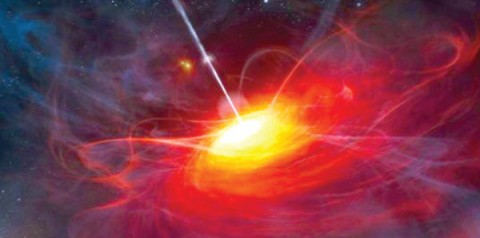
Astronomers have discovered the largest known structure in the universe, a clump of active galactic cores that stretches 4 billion light-years from end to end.

The structure is a large quasar group (LQG), a collection of extremely luminous galactic nuclei powered by supermassive central black holes. This particular group is so large that it challenges modern cosmological theory, researchers said.

“While it is difficult to fathom the scale of this LQG, we can say quite definitely it is the largest structure ever seen in the entire universe,” lead author Roger Clowes, of the University of Central Lancashire in England, said in a statement. “This is hugely exciting, not least because it runs counter to our current understanding of the scale of the universe.”

Large Quasar Group

Large Quasar Group

Quasars are the brightest objects in the universe. For decades, astronomers have known that they tend to assemble in huge groups, some of which are more than 600 million light-years wide.

But the record-breaking quasar group, which Clowes and his team spotted in data gathered by the Sloan Digital Sky Survey, is on another scale altogether. The newfound LQC is composed of 73 quasars and spans about 1.6 billion light-years in most directions, though it is 4 billion light-years across at its widest point.

To put that mind-boggling size into perspective, the disk of the Milky Way galaxy — home of Earth’s solar system — is about 100,000 light-years wide. And the Milky Way is separated from its nearest galactic neighbor, Andromeda, by about 2.5 million light-years.

The newly discovered LQC is so enormous, in fact, that theory predicts it shouldn’t exist, researchers said. The quasar group appears to violate a widely accepted assumption known as the cosmological principle, which holds that the universe is essentially homogeneous when viewed at a sufficiently large scale.

Calculations suggest that structures larger than about 1.2 billion light-years should not exist, researchers said.

“Our team has been looking at similar cases which add further weight to this challenge, and we will be continuing to investigate these fascinating phenomena,” Clowes said.

The new study was published today (Jan. 11) in the Monthly Notices of the Royal Astronomical Society.

Follow SPACE.com senior writer Mike Wall on Twitter @michaeldwall or SPACE.com @Spacedotcom. We’re also on Facebook and Google+

Leave a comment

Filed under Humor and Observations

New Earth Just 12 Light Years Away?

Potentially habitable planet just 12 light-years away

By Mike Wall

Published December 19, 2012

Space.com

  • tau-ceti-alien-planets.jpg

    Artist’s impression of five possible planets orbiting the star Tau Ceti, which is just 11.9 light-years from Earth. (J. Pinfield / University of Hertfordshire)

A sun-like star in our solar system’s backyard may host five planets, including one perhaps capable of supporting life as we know it, a new study reports.

Astronomers have detected five possible alien planets circling the star Tau Ceti, which is less than 12 light-years from Earth — a mere stone’s throw in the cosmic scheme of things. One of the newfound worlds appears to orbit in Tau Ceti’s habitable zone, a range of distances from a star where liquid water can exist on a planet’s surface.

With a minimum mass just 4.3 times that of Earth, this potential planet would be the smallest yet found in the habitable zone of a sun-like star if it’s confirmed, researchers said.

‘The galaxy must have many such potentially habitable Earth-sized planets.’

– Study co-author Steve Vogt, of the University of California

“This discovery is in keeping with our emerging view that virtually every star has planets, and that the galaxy must have many such potentially habitable Earth-sized planets,” study co-author Steve Vogt, of the University of California, Santa Cruz, said in a statement. “They are everywhere, even right next door.”

Gallery: 7 Potentially Habitable Exoplanets

The five planet candidates are all relatively small, with minimum masses ranging from 2 to 6.6 times that of Earth. The possibly habitable world, which completes one lap around Tau Ceti every 168 days, is unlikely to be a rocky planet like Earth, researchers said.

“It is impossible to tell the composition, but I do not consider this particular planet to be very likely to have a rocky surface,” lead author Mikko Tuomi, of the University of Hertfordshire in England, told SPACE.com via email. “It might be a ‘water world,’ but at the moment it’s anybody’s guess.”

Spotting signals in the noise

Tau Ceti is slightly smaller and less luminous than our sun. It lies 11.9 light-years away in the constellation Cetus (the Whale) and is visible with the naked eye in the night sky. Because of its proximity and sun-like nature, Tau Ceti has featured prominently in science fiction over the years.

Astronomers have searched for exoplanets around Tau Ceti before and turned up nothing. But in the new study, researchers were able to pull five possible planetary signals out from under a mountain of noise.

Tuomi and his team re-analyzed 6,000 observations of Tau Ceti made by three different spectrographs, instruments that allow researchers to detect the tiny gravitational wobbles orbiting planets induce in their parent stars.

The three instruments are the High Accuracy Radial velocity Planet Searcher (HARPS), on the European Southern Observatory’s 3.6-meter telescope in La Silla, Chile; the University College London Echelle Spectrograph (UCLES) on the Anglo-Australian Telescope in Siding Spring, Australia; and the High Resolution Echelle Spectrometer, or HIRES, on the 10-meter Keck telescope atop Mauna Kea in Hawaii.

Using new analysis and modeling techniques, the team spotted the five faint signals, successfully separating them from noise caused by stellar activity and other factors.

“We pioneered new data modeling techniques by adding artificial signals to the data and testing our recovery of the signals with a variety of different approaches,” Tuomi said in statement. “This significantly improved our noise modeling techniques and increased our ability to find low-mass planets.”

The new analysis methods should aid the search for small planets, allowing more and more of them to be spotted throughout the galaxy, researchers said.

A Galaxy Full of Alien Planets (Infographic)

A nearby planetary system?

The five planets remain candidates at this point and will not become official discoveries until they’re confirmed by further analysis or observations. And that’s not a sure thing, researchers said.

“I am very confident that the three shortest periodicities are really there, but I cannot be that sure whether they are of planetary origin or some artifacts of insufficient noise modelling or stellar activity and/or magnetic cycles at this stage,” Tuomi said, referring to the potential planets with orbital periods of 14, 35 and 94 days (compared to 168 days for the habitable zone candidate and 640 days for the most distantly orbiting world).

“The situation is even worse for the possible habitable zone candidate, because the very existence of that signal is uncertain, yet according to our detection criteria the signal is there and we cannot rule out the possibility that it indeed is of planetary origin,” he added. “But we don’t know what else it could be, either.”

If the Tau Ceti planets do indeed exist, their proximity would make them prime targets for future instruments to study, researchers said.

“Tau Ceti is one of our nearest cosmic neighbors and so bright that we may be able to study the atmospheres of these planets in the not-too-distant future,” James Jenkins, of the Universidad de Chile and the University of Hertfordshire, said in a statement. “Planetary systems found around nearby stars close to our sun indicate that these systems are common in our Milky Way galaxy.”

If confirmed, the Tau Ceti planets would not be the closest exoplanets to Earth. That title still goes to Alpha Centauri Bb, a roasting-hot, rocky world recently spotted just 4.3 light-years away, in the closest star system to our own.

The new study has been accepted for publication in the journal Astronomy & Astrophysics.

Read more: http://www.foxnews.com/science/2012/12/19/potentially-habitable-planet-detected-around-nearby-star/?intcmp=related#ixzz2Gnb1tP94

Leave a comment

Filed under Humor and Observations