
Thomas Edison produced a talking doll, which he called The Greatest Wonder of the Age
1890:
Edison’s Phonograph Doll, “The Greatest Wonder of the Age”
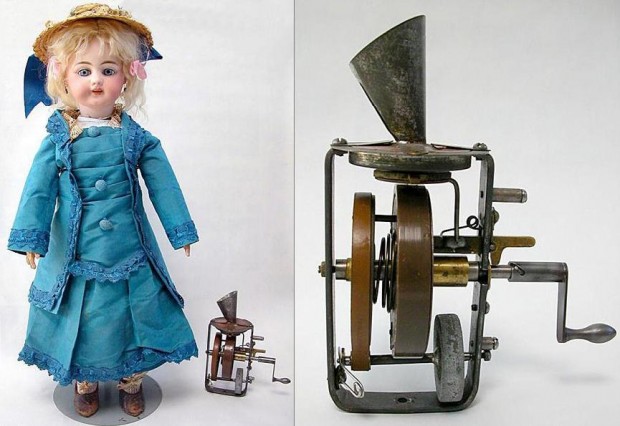
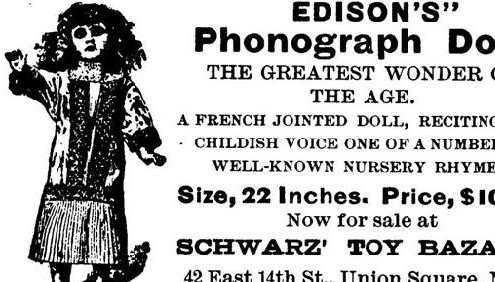


Thomas Edison produced a talking doll, which he called The Greatest Wonder of the Age
1890:
Edison’s Phonograph Doll, “The Greatest Wonder of the Age”
Filed under Humor and Observations
In my earlier post on the “current wars” and Nikola Tesla, I already debunk much of the myth on Edison. In truth, Edison was brilliant at creating the “skunkworks” a gathering of scientists and inventors in one place to develop and make practical applications for science advances. As a scientist himself, he was not so good. In fact, he was uneducated, was intimidated by smarter people, and refused to test theories mathematically. He preferred his trial and error method of “finding 1,000 ways that is does NOT work,” instead of finding the way it works by math. He was also a dishonest and immoral competitor, who killed both animals and created the electric chair for no other reason than to scare people from using AC electricity.
Here is a story I found which shed further light on Edison, from The Atlantic:

DEREK THOMPSON – Derek Thompson is a senior editor at The Atlantic, where he oversees business coverage for the website.
The myth of the solitary inventor — in 8 short stories

The world’s most famous inventors are household names. As we all know, Thomas Edison invented the light bulb, Alexander Graham Bell invented the phone, and Eli Whitney invented the cotton gin.
Except they didn’t. The ideas didn’t spring, Athena-like, fully formed from their brains. In fact, they didn’t spring fully formed from anybody’s brains. That is the myth of the lonely inventor and the eureka moment.
“Simultaneous invention and incremental improvement are the way innovation works, even for radical inventions,” Mark A. Lemley writes in his fascinating paper The Myth of the Sole Inventor.Lemley’s paper concentrates on the history and problems of patents. But he also chronicles the history of the 19th and 20th century’s most famous inventors — with an emphasis on how their inventions were really neither theirs, nor inventions. Here is a super-quick summary of his wonderful distillation of the last 200 years in collaborative innovation.

The fabric cotton comes from cotton fibers that mix with seeds in the pods of cotton plants. To make the fabric, therefore, you have to separate the fibers from the seeds. For centuries this was done mostly by hand, until Eli Whitney “invented” the cotton gin in 1793. But various forms of roller gins (i.e. technologies for separating fibers from seeds) had been around for thousands of years. Five years earlier, in 1788, Joseph Eve developed his own mechanized self-feeding roller gin. Whitney’s true innovation was to improve existing cotton gins by “replacing rollers with coarse wire teeth that rotated through slits to pull the fiber from the seed.” If this insight was a breakthrough, the glory goes to Whitney only he was faster than his competitors. In 1795, John Barcley filed a patent on a gin featuring circles of teeth — awfully similar to Whitney’s wire-tooth model (see left). In short, the modern cotton gin was a eureka moment that multiple inventors experienced nearly simultaneously and was expedited by their competition.
As the tale goes, Samuel Morse was having dinner with friends and debating electromagnetism (like you do) when he realized that if an electrical signal could travel instantly across a wire, why couldn’t information do the same? Like most fun eureka stories,  it’s a fib. The telegraph was invented by not only Morse, but also Charles Wheatstone, Sir William Fothergill Cooke, Edward Davy, and Carl August von Steinhiel so near to each other that the British Supreme Court refused to issue one patent. It was Joseph Henry, not Morse, who discovered that coiling wire would strengthen electromagnetic induction. Of Morse’s key contribution — the application of Henry’s electromagnets to boost signal strength — Lemley writes that “it is not even clear that he fully understood how that contribution worked.”
Like Morse, Alexander Graham Bell invented a technology that would later bear his name. But how much did he deserve it? The problem that Bell solved was to turn electrical signals into sounds. But this was such an obvious extension of the telegraph that there were many people working on it. Philip Reis had already designed a sound transmitter in 1860, and Hermann Ludwig Ferdinand von Helmholtz (one guy) had already built a receiver. Bell’s real contribution was “to vary the strength of the current to capture variations in voice and sound,” Lemley writes. In this tweak, he was racing against Thomas Edison. Even Bell’s final product — which combined transmitter, fluctuating current, and receiver — had company. Elisha Gray filed a patent application on the exact same day as Bell, only to lose the patent claim in court. Lemly’s conclusion: “Bell’s iconic status owes as much to his victories in court and in the marketplace as at the lab bench.”
 LIGHT-BULB
As just about everyone is taught, Thomas Edison invented the light-bulb. And as just about everyone later learns, Thomas Edison in no way invented the light-bulb. Electric lighting existed before him, incandescent light bulbs existed before him, and when other inventors got wind of Edison’s tinkerings, they roundly sued him for patent infringement. So what did Edison actually do? He discovered that a special species of bamboo had a higher resistance to electricity than carbonized paper, which means it could more efficiently produce light. Edison got rich off the bamboo, and filthy disgusting rich from superior manufacturing and marketing of his product. But within a generation other inventors had developed better filaments and today’s light-bulbs
Most of these stories here are about how we mistake incremental improvements for eureka moments. But the story of the movie projector is simpler. It’s basically a story about theft. Francis Jenkins built what we consider the ur-instrument of the motion-picture industry with a projector that showed strips of films for 1/24th of a second, creating the illusion of moving pictures. But his financial backer stole the Jenkins prototype and sold it to a theater chain, which called it the “Edison Vitascope” for no better reason than the word Edison was familiar and useful for branding. That Edison was tinkering with his own movie projector is true, but besides the point. His legacy here was mostly the work of a thief.
 Today’s cars bear the names of their founders and innovators: Benz, Peugeot, Renault. But have you ever heard of a Dodge bicycle? Or a Mercedes tricycle? In fact, both companies specialized in bikes before moving the autos. The car industry represents the epitome of incremental innovation. Take a tricycle. Add an engine. You’ve got a car. (Just look at the picture to the right, of the the original Benz Motorwagen from 1885). Condensing the invention of cars to those six words leaves out a lot of detail and a few main characters. It was Gottlieb Daimler and Wilhelm Maybach who designed the first four-wheel car with a four-stroke engine and Henry Ford who perfected the assembly line. But the long story short is that the car was a typical “invention” that was far too complicated for one person to conceive on his won.

Speaking of building bikes, that’s exactly what Orville and Wilbur Wright did before they became the first team to fly a heavier-than-air machine. But, as we’ve learned, every great inventor stands on the shoulders of giants. When the Wright brothers asked the Smithsonian for all available information on the history of flight in 1899, they opened a history that had begun with DaVinci’s scribbling and continued all the way to the 19th century gliders of Otto Liliental. But the Wrights solved one of the most nagging problems facing airplane developers — stability — by having “a single cable warp the wing and turn the rudder at the same time.” That was the tweak that put the first plane in the air.
The “Farnsworth Invention” was named after Philo T. Farnsworth, the nominal father of television. But his invention was neither his nor an invention. Teams of scientists and tinkerers all around the world were working to build, essentially, a radio for images — i.e.: to combine the technology of a wireless telegraph with the magic of a movie projector. One key was the cathode ray tube, a vacuum with an electron gun that beams images onto screen that can receive or transmit signals. But the cathode ray tube itself has so many fathers that it’s difficult to say exactly who invented even the central organ of the television, much less the television itself. In 1927, Farnsworth projected a straight line on a machine he called the Image Dissector, which is truly the basis for the all-electronic television. But, unlike Edison, he was not as gifted at marketing, producing, and becoming a household name for his tweak. “It may be accurate to describe Farnsworth as an inventor of the television, but surely not as the inventor,” Lemley writes.
At the end of this section, Lemley lists four inventors who, yeah, okay, really were alone. But the funny thing about the exceptions is that they’re almost all accidents.
Alexander Fleming discovered the anti-bacterial properties of penicillin because a sample of bacteria had accidentally been contaminated with mold. No one is sure where the mold came from; Fleming’s discovery was true serendipity. Even in that case, there is some evidence that others made the same accidental discovery. The adhesive behind the Post-It note was developed in 1968, and languished in 3M for six years before a different 3M employee hit on the idea of putting it to use attaching a bookmark to a book.
Charles Goodyear discovered vulcanized rubber when a batch of rubber was accidentally left on a stove; Goodyear had previously thought that heat was a problem for rubber, not the solution.
Wilson Greatbatch developed the pacemaker when he accidentally grabbed the wrong resistor from a box when he was completing a circuit.
Louis Daguerre invented film when, having failed to produce an image on an iodized silver plate, he put the plate away in a cabinet filled with chemicals and the fumes from a spilled jar of mercury produced an image on the plate.
It would seem that eureka is Greek for “oops.”
Images above from top: the cotton gin patent by Eli Whitney; a Morse key; Edison’s patent; the Benz patent; the Wright brothers take off, 1905; All credit: Wikimedia Commons
Filed under Humor and Observations
1878 first-ever captured Edison audio recording unveiled
Published October 25, 2012
Associated Press
SCHENECTADY, N.Y. – It’s scratchy, lasts only 78 seconds and features the world’s first recorded blooper.
The modern masses can now listen to what experts say is the oldest playable recording of an American voice and the first-ever capturing of a musical performance, thanks to digital advances that allowed the sound to be transferred from flimsy tinfoil to computer.
The recording was originally made on a Thomas Edison-invented phonograph in St. Louis in 1878.
At a time when music lovers can carry thousands of digital songs on a player the size of a pack of gum, Edison’s tinfoil playback seems prehistoric. But that dinosaur opens a key window into the development of recorded sound.
“In the history of recorded sound that’s still playable, this is about as far back as we can go,” said John Schneiter, a trustee at the Museum of Innovation and Science, where it will be played Thursday night in the city where Edison helped found the General Electric Co.
The recording opens with a 23-second cornet solo of an unidentified song, followed by a man’s voice reciting “Mary Had a Little Lamb” and “Old Mother Hubbard.” The man laughs at two spots during the recording, including at the end, when he recites the wrong words in the second nursery rhyme.
“Look at me; I don’t know the song,” he says.
When the recording is played using modern technology during a presentation Thursday at a nearby theater, it likely will be the first time it has been played at a public event since it was created during an Edison phonograph demonstration held June 22, 1878, in St. Louis, museum officials said.
The recording was made on a sheet of tinfoil, 5 inches wide by 15 inches long, placed on the cylinder of the phonograph Edison invented in 1877 and began selling the following year.
A hand crank turned the cylinder under a stylus that would move up and down over the foil, recording the sound waves created by the operator’s voice. The stylus would eventually tear the foil after just a few playbacks, and the person demonstrating the technology would typically tear up the tinfoil and hand the pieces out as souvenirs, according to museum curator Chris Hunter.
Popping noises heard on this recording are likely from scars left from where the foil was folded up for more than a century.
“Realistically, once you played it a couple of times, the stylus would tear through it and destroy it,” he said.
Only a handful of the tinfoil recording sheets are known to known to survive, and of those, only two are playable: the Schenectady museum’s and an 1880 recording owned by The Henry Ford museum in Michigan.
Hunter said he was able to determine just this week that the man’s voice on the museum’s 1878 tinfoil recording is believed to be that of Thomas Mason, a St. Louis newspaper political writer who also went by the pen name I.X. Peck.
Edison company records show that one of his newly invented tinfoil phonographs, serial No. 8, was sold to Mason for $95.50 in April 1878, and a search of old newspapers revealed a listing for a public phonograph program being offered by Peck on June 22, 1878, in St. Louis, the curator said.
A woman’s voice says the words “Old Mother Hubbard,” but her identity remains a mystery, he said. Three weeks after making the recording, Mason died of sunstroke, Hunter said.
A Connecticut woman donated the tinfoil to the Schenectady museum in 1978 for an exhibit on the 100th anniversary of the founding of the Edison company that later merged with another to form GE. The woman’s father had been an antiques dealer in the Midwest and counted the item among his favorites, Hunter said.
In July, Hunter brought the Edison tinfoil recording to California’s Berkeley Lab, where researchers such as Carl Haber have had success in recent years restoring some of the earliest audio recordings.
Haber’s projects include recovering a snippet of a folk song recorded a capella in 1860 on paper by Edouard-Leon Scott de Martinville, a French printer credited with inventing the earliest known sound recording device.
Haber and his team used optical scanning technology to replicate the action of the phonograph’s stylus, reading the grooves in the foil and creating a 3D image, which was then analyzed by a computer program that recovered the original recorded sound.
The achievement restores a vital link in the evolution of recorded sound, Haber said. The artifact represents Edison’s first step in his efforts to record sound and have the capability to play it back, even if it was just once or twice, he said.
“It really completes a technology story,” Haber said. “He was on the right track from the get-go to record and play it back.”
Filed under Humor and Observations
Nikola Tesla, who suffered from obsessive compulsive disorder and anxiety before those conditions were understood, is in my opinion, the smartest man ever. He was recommended to Thomas Edison by a colleague as a young Serbian scientist. Asked by Edison to fix his theory of direct current so it would be more useful, Tesla did so, being promised $50,000. Thomas Edison paid him $8 instead, saying welcome to America and our sense of humor.
To get even, Tesla created alternating current, which powers nearly everything in the world now. Tesla said that Edison would try 1,000 different things when simple math would have eliminated them in minutes. Edison actually despised formal education and the scientific method, but he hired a team of scientists as the Wizards of Menlo Park, and took credit for all their inventions.
Tesla was able to see new inventions in his head, then draw them in great detail as a sketch. Most people then could not even comprehend his ideas, even when shown the diagrams. As he aged, the battle between his backers – Westinghouse, and the Edison Company, backed by JP Morgan became brutal, and were publicly known as the current wars. Thomas Edison electrocuted an elephant in public to show Tesla’s AC power was too dangerous.

Tesla buckled under the strain and became reclusive. He had to have three napkins at a table and walk around the table three times to eat. However, he went on to invent things that even now are revolutionary. He built a large Tesla coil that powered a town of 30,000 people, with no wires, for free. He had plans for death rays. He even said he had developed a Tesla tower that could provide power for free to the entire world, as well as video and radio, but if set to the Earth’s frequency, it could destroy the planet.
The mad genius had accomplished so much magic, that upon his death, the US Government confiscated his paperwork and ideas, and to this day, no kidding, they are still locked in Top Secret vaults. Many feared that Tesla truly had discovered a way to destroy the planet. He invented radio years before Marconi, but never got the credit. Oddly enough, his one true friend was Samuel Clemens, better known as Mark Twain.
The following is a YouTube video that goes through some of his inventions, but far from all of them:
http://www.youtube.com/watch?v=q83LL3FsiGo
As a tribute, Nikola Tesla will play a key role in The Travelers’ Club series, in Book 2, 3 and 4, of the five book series.


Filed under Humor and Observations, Writing


 Michael Bradley - Time Traveler