Tag Archives: world history

Top 10 Little-Known Events in World War II

Top 10 Little-Known Events in World War II

OAHU808 MARCH 2, 2011

I love researching WWII, people, places, technology, anything. WWII had an amazing impact on the world and there is a ton of information out there. Studying all the battles, effects and the causes might get a little boring. So, here are some very interesting and unusual events, which are not mentioned in the textbooks. This is a list of ten (unordered) events of WWII that are moderately unknown to the average person. Hopefully you will enjoy them as much as I did.

Aleutian Islands Campaign

Aleutians Bunker Kiska 700

On June 3rd, 1942, Japanese forces invaded and occupied Attu and Kiska, two islands which were part of the state of Alaska. However, these islands had little value, very bad conditions and proved little of a threat to the United States. Many resulting casualties were not caused by gunfire, but booby traps, the weather and friendly fire. [More on Wikipedia]

9 Japanese Holdouts 

Life 84

Japanese holdouts were Japanese soldiers stationed on islands throughout the Pacific who refused to surrender, or did not know that Japan had surrendered. These soldiers remained isolated on these islands, often times by themselves, for several years, or decades. One famous case is Hiroo Onada, who finally surrendered in 1974, 29 years after Japan surrendered! [Site on Japanese holdouts]

South American Involvement 

Pracinhas

Although it is called “World War II”, many people do not include any South American countries on the list of combatants. The country of Brazil, “During the eight months of the Italian campaign, the Brazilian Expeditionary Force managed to take 20,573 Axis prisoners, including two generals, 892 officers and 19,679 other ranks. During the War, Brazil lost 948 of its own men killed in action across all three services.” Many other South American countries contributed in raw supplies and, in some cases, soldiers joined the Free French Forces. [Total list of countries in WWII]

Vichy France vs. the Allies 

2Xzdf5R4Ucdioqw64Nrrxd

After the French surrender in 1940, Germany created a puppet government in Vichy. This government did not have any real power or control. However, after the French defeat, there were still French forces in places such as Northern Africa, Pacific colonies and navy ships. During Operation Torch, Vichy forces were forced to fight against invading allies. “The stiff Vichy resistance cost the Americans 556 killed and 837 wounded. Three hundred British troops and 700 French soldiers were also killed.”

Operation Drumbeat 

B Operation Drumbeat

Typically, people think of U-boats attacking ships in the Atlantic, around Greenland or closer to Europe, rather than off the coast of the United States. However, Operation Drumbeat involved 40 U-Boats attacking shipping very close to the coastline of various states. An even scarier fact is that German U-Boats even landed saboteurs on American soil! At Long Island, New York, and Ponte Vedra, Florida, 8 English-speaking Germans snuck into America (the 4 at Long Island were captured after several weeks). [Site on Operation Drumbeat]

 Other Europeans in Nazi Forces 

Colourposter2

Many people believe that only Germans were serving in Nazi forces, but this is not the case. German recruitment programs were started in various occupied countries, and were aimed at enlisting citizens and former soldiers into Nazi forces, including the Waffen SS. The 373rd infantry battalion of Wehrmach was a German battalion comprised of Belgians. Frikorps Danmark was created in Denmark to recruit Danish Nazi’s. Similar forces were created in Estonia, France, Greece, Hungary, Poland, Norway, and even a British force (British Free Corps) was created with 27 soldiers (from various parts of the Empire including New Zealanders, Canadians, and Australians). [More from Wikipedia]

Japanese Fire Balloons 

220Px-Japanese Fire Balloon Moffet

From the Fall of 1944, until early 1945, the Japanese began launching over 9000 “Fire Balloons” from the island of Honshu. These balloons were made of Japanese paper (washi), filled with hydrogen and explosives. They were meant to go with the Jet Stream and fly to North America where they would detonate. The plan was very ineffective and only about 1000 made it the North America. However, 6 Americans were killed in 1945 in a single explosion. [More from Wikipedia]

Stalag Luft III 

Stalag Luft Iii 45

This is likely to be the best known item on the list. Stalag Luft III was a Nazi POW camp, mostly for allied airmen who’d been shot down and taken captive. However, these airmen were very crafty and over 600 had helped to organize an escape committee, which secretly began to dig tunnels and make plans. On March 24th, 1944, the plan was executed, but from the start, everything went wrong. Only 77 men managed to get into the escape tunnels, and were soon discovered. Of the 77, only 3 managed to get to safety. 50 escapees were executed by the orders of Hitler. This escape attempt was made into a 1963 film, “The Great Escape”. [Site about the escape]

The Ni’ihau Incident 

Shigenorinishikaichi

On December 7th, 1941, the Japanese bombed Pearl Harbor. Many Japanese pilots were able to return to aircraft carriers, but a few had been shot down, or had crashed on the island of Oahu. Japanese pilots were told that if they were to crash land, they should do so on the island of Ni’ihau, which they thought was uninhabited. Shigenori Nishikaichi was a pilot whose plane had been damaged. He crash landed on Ni’ihau, which he soon found out was inhabited. He was treated as a guest, but soon they found out about the attack on Pearl Harbor. 3 Japanese on the island tried to help Nishikaichi to escape, but eventually they were stopped, and Nishikaichi as well as one of the Japanese who tried to aid him were killed. This became known as the Ni’ihau incident. [Site onthe incident]

The Death Match 

Death Match-09

The Death Match was a football (soccer for Americans) match between a POW Soviet team, “FC Start”, and a team comprised of Luftwaffe members, “Flakelf”. The match was played on August 9th, 1942, and was refereed by a Waffen SS soldier. The ref was very biased, and allowed fouls against the Soviet side, and even allowed a German to kick the Soviet goalkeeper in the head. Eventually, the Soviet team pulled off a 5-3 win. This win had huge consequences for the winners. “A number of the FC Start players were arrested and tortured by the Gestapo, allegedly for being NKVD members (as Dynamo was a police-funded club). One of the arrested players, Mykola Korotkykh, died under torture. The rest were sent to the Syrets labour camp, where Ivan Kuzmenko, Oleksey Klimenko, and the goalkeeper Mykola Trusevich were later killed, in February 1943.” [More on Wikipedia]
Leave a comment

Filed under Humor and Observations

1,400 Year Old Monastery on Atlantic Island

Skellig Michael – Mysterious Monastery in the Atlantic

Saturday, March 26, 2011

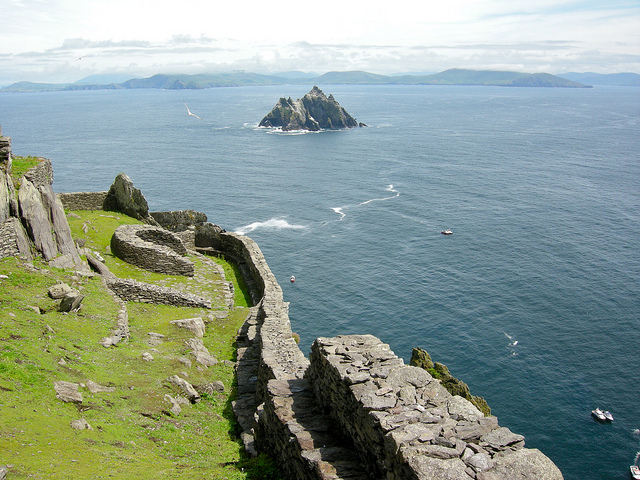
Nine miles off the coast of County Kerry in the west of Ireland there are two small rocky islands peeking out of the Atlantic Ocean.  The larger of the two, Skellig Michael, is home to something quite extraordinary – a 1400 year old monastery which only a handful of people get to see each year.

As you approach the island there is little, seemingly, to notice.  Yet closer inspection reveals the tell tale criss-cross of manmade paths.   Who could possibly have wanted to live here – and when?

It is thought that the monastery of Skellig Michael was founded at some point in the seventh century and monastic life persisted there for over 600 years.  Why it was abandoned is lost in the sands of time but because of the sheer inaccessibility of the island what the monks left behind remained, through the centuries, remarkably intact.

The name of the island is taken from the Irish language and means Michael’s Rock.  It is some rock, too, rising to 230 meters at its summit.  Atop this the Gaelic Monastery has become well known globally but very few make the journey to visit the site – not many are allowed. This very fact has meant that because its remoteness necessarily discourages tourists that the monastery is, for its age, wonderfully preserved.

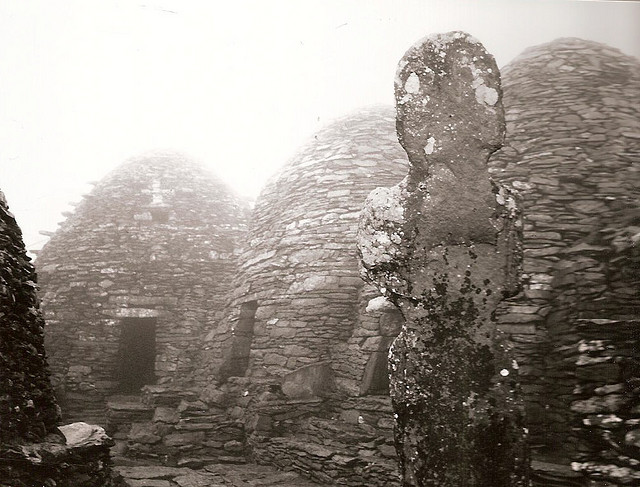
It is easy to imagine the early Irish Christian monks leading their extraordinarily spartan day to day existence here – to say that life would have been harsh for them is something of an understatement.  Their huts, in the shape of beehives and called clochans, indicate the bareness of life on the rock.  These monks would have shrugged off all of their earthly possessions before they came to live here. Although it is not by definition a hermitage it must surely have been a lonesome existence for the monks, despite the faith which initiated their decision to move there.

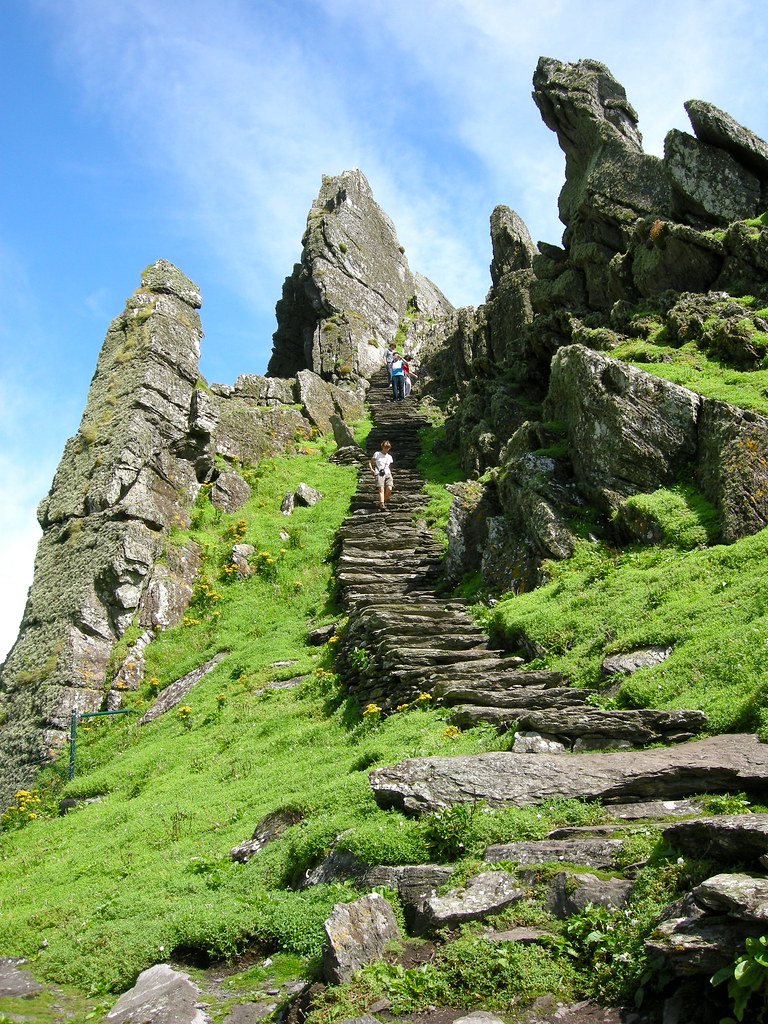
The monastery itself was terraced – a necessity because of the sheer sides of the rick.  Three flights of stairs (perhaps reflecting the Holy Trinity) lead up to Christ’s Valley which is the small depression between the peaks of Skellig Michael at 130 meters.  The visitor is not disappointed when greeted by the sight of six intact clochans.

Neither are they disappointed with the sight of the two oratories, graves and the monolithic cross which are to be discovered there.  There is more recent addition too – a church which was built as late as the thirteenth century.  The construction must have been a labor – the walls are almost two meters thick.

Although Skellig Michael was not intended as such there is a hermitage on the island, distinct from the monastery.   As if a rock in the Atlantic was not isolated enough this extreme form of retreat afforded those monks who wished to contemplate the divine in complete isolation the opportunity to do so.

Daily life and its demands also had to be taken in to account and there is a latrine on the island which is situated over an enormously yawning gap in the rock to ensure that waste matter was thoroughly disposed of.  There are also the remains of a garden which the monks would use to grow essential vegetables.

There is evidence that Skellig Michael suffered several Viking raids, though quite what the visitors from the north would have hoped to pillage is questionable.  However, these raids may have caused the monks to decamp to the mainland in the twelfth century even though the later chapel was built at around the same time. One can only attempt to imagine the dread that the isolated and virtually defenceless monks must have felt at the sight of an approaching Viking longship.

As a result of the deterioration of the monastery due to the tramp of tourists’ feet, the decision was taken to severely restrict the number of visitors to the island.  13 licenses are given to tour operators annually and each may only make a single trip to the rock.

It is thought that there were never more than a dozen or so monks on the island at any one time plus an abbot.  The mystery as to the abandonment of the rock is never likely to be satisfactorily solved but in many ways the monks did the rest of the world a favor.  It is unlikely that what we see now on the island would have remained intact if the island had continued to be populated.  Its very abandonment ensured its survival.

1 Comment

Filed under Humor and Observations

Early Snow Removal Devices

Scenes From the History of Snow Removal

IMAGE CREDIT:
UNIVERSITY OF VERMONT LIBRARIES CENTER FOR DIGITAL INITIATIVES

In some areas, the weather outside is pretty frightful. And since you’ve no place to go but outside to shovel, get cozy and read about snow removal in the good old days.

ON A ROLL

For a good stretch of American history, getting rid of snow was of no great concern. In fact, people actually wanted it around. While this might blow the minds of modern Northeasterners and Midwesterners, keep in mind that these were the days of the horse-drawn vehicle, not the Prius. To improve travel in winter conditions, horse carts and coaches traded their wheels in for ski-like runners. With those things on, the more packed snow on the roads, the better! Historian and weather geek Eric Sloane wrote that, in the 18th and 19th centuries, “snow was never a threat” to road travel, “but rather it was an asset.”

To keep roads in optimal snowy condition, many municipalities employed a “snow warden” to pack and flatten the snow with a crude vehicle called a snow roller—essentially a giant, wide wheel weighed down with rocks and pulled by oxen or horses. A far cry from the winter road work we see today, it was more like maintaining a ski slope or smoothing out an ice rink. Stranger still, snow wardens actually had to install snow on the pathways of covered bridges so that travel would not be interrupted.

PLOW ABOUT THAT

Photo Courtesy Schwartz Boiler Shop

By the mid 1800s, several different inventors had patented their own versions of a horse-drawn snow plow meant for clearing alleys and residential streets that saw more foot traffic than carriages. In 1862, Milwaukee became the first major municipality to try one out, and it was a hit. Over the next few years, the plows hit the streets in cities throughout the Snow Belt.

But horse-drawn plows didn’t stand a chance against the Blizzard of 1888, which bludgeoned the East Coast from the Chesapeake Bay up to Maine. After three days, some places were buried in up to 50 inches of snow, and high winds caused drifts up to 40 feet tall to form. The plow-pulling horses, like everyone else, had no choice but to stay inside and wait for the snow to melt. Cities in the region learned a valuable lesson about preparation, and the following year many implemented measures like hiring more plows and giving them assigned routes, and sending the plows out to start clearing the roads in the early stages of the storm.

BLOWN AWAY


The Jull Centrifugal Snow Plough. Photo Courtesy of Made In Canada

Around the same time, on the other side of the country, the rotary snowplow—or as we know it, the snow blower—was getting its start in an unlikely place far removed from the suburban driveways where they’re now normally seen. In the Canadian West, railroad men were having a hard time keeping their tracks clear of snow. The railroad snowplows used back east and on the prairies were the wedge-shaped cow-catcher type that pushed the snow to the sides of the track, and they just didn’t work in the deep, heavy snow of the western mountains.

J.W. Elliott, a Toronto dentist, had been tinkering with a plow design he thought might work well on a train. His plow had a rotary engine that drove a wheel rimmed with flat blades. As the plow went down the track, snow collected in a housing on the plow and then got funneled up to the blades, which tossed the snow out through an opening at the top of the housing. The railroads passed on it, but Elliot persisted. He hooked up with inventor Orange Jull to improve the design and commission a full-scale working model. The next winter, they convinced the Canadian Pacific Railroad to road-test the new plow on its line near Toronto. The plow cleared the track easily, tossing snow as far as 200 feet out of the way, and the railroad managers were impressed enough to buy eight plows and put them to work. Over the few decades, snowblowers got cheaper, smaller, and easier to use, with truck-mounted models and, eventually, human-powered ones for home use hitting the market.

CAR-PLOW


Photo Courtesy of the National Archives of Norway

As automobiles replaced horses and carriages on the roads of the U.S., the snow problem got flipped on its head. It wouldn’t be enough to clear the alleys and pack down the snow on the main roads anymore. Cars required dry, safe streets. Motorized salt spreaders were introduced, but they often didn’t do enough, and urban sprawl meant most cities were just too big for horse-drawn plows to clean all the streets. In the early 1920s, Norwegian brothers Hans and Even Overaasen and New Yorker Carl Frink independently came up with designs for car-mounted snow plows. These were, apparenty the perfect solution to the modern snow problem, and the company Frink started is still producing plows today.

As for the snow removal tool the average Joe is most familiar with, 100-plus patents have been granted for snow shovel designs since the 1870s. One of the first designs that hit upon the “scrape and scoop” combo was invented in 1889 by—get this—a woman named Lydia Fairweather.

Read the full text here: http://mentalfloss.com/article/32006/scenes-history-snow-removal#ixzz2NIgAvxQe
–brought to you by mental_floss!

Leave a comment

Filed under Humor and Observations

Travel the Ancient Roman Empire!

Below is a story from I09 about ORBIS.  ORBIS is an amazing site that actually allows you to explore the ancient Roman Empire by map, and see how long various modes of travel would take, what form they would take, and how many denarii would be needed.  Very cool.  First the link, then the story:

http://orbis.stanford.edu/#

This interactive travel map of the Roman Empire is like Oregon Trail meets Civilization

Ever wondered how long it would take to travel from Rome to Constantinople at the peak of the Roman Empire? Or from Luna to Larissa? Or Parma to Thessalonica? This map of the Roman World created at Stanford University is awesomely realistic — all the ancient transportation lines on it actually existed 2,000 years ago.

Tell us, would you like to travel to Rome by road, river or open sea? Would you stick to the coasts or set a course through the mainland? During which month would you journey? Would you opt for the fastest route (bearing in mind that the shortest course does not always translate to the quickest passage) or the cheapest? Speaking of expenses, how much would this journey cost you, anyway? (Please give your answer in denarii.)

Confused? Overwhelmed? Fear not — ORBIS is here to help you plan your trip. ORBIS is Stanford University’s geospatial network model of the Roman World. It’s fully interactive (as we alluded to above, you can adjust time of travel, mode of travel, starting points and destinations, and so on); highly customizable (select from fourteen different modes of transportation — and that’s just road travel); and positively bursting with information. It’s a little like Oregon Trailmeets Civilization, only without the dysentery and with infinitely more historical and comparative data. Yes, it is awesome, and — if you’re into this sort of thing — enormously time consuming.

Via Stanford:


For the first time, ORBIS allows us to express Roman communication costs in terms of both time and expense. By simulating movement along the principal routes of the Roman road network, the main navigable rivers, and hundreds of sea routes in the Mediterranean, Black Sea and coastal Atlantic [featured above is a depiction of navigable sea routes in July, with coastal routes in blue and overseas routes in green], this interactive model reconstructs the duration and financial cost of travel in antiquity.

Taking account of seasonal variation and accommodating a wide range of modes and means of transport, ORBIS reveals the true shape of the Roman world and provides a unique resource for our understanding of premodern history. [Featured below: a contour map of travel time to Rome in July.]


You can learn a little more about using ORBIS in this introductory video, but we highly recommend heading over to the ORBIS website, where you’ll learn more about this geospatial model’s applications and its historically rich digital architecture. This is really, really impressive stuff.

[ORBIS]

Top image via Shutterstock

Leave a comment

Filed under Humor and Observations, Uncategorized

Did Phoenicians Beat Columbus by 2,000 years?

Transatlantic crossing: Did Phoenicians beat Columbus by 2000 years?

By Sheena McKenzie, for CNN
February 28, 2013 — Updated 1317 GMT (2117 HKT)
Setting sail from Spain with a crew of 90 men, Christopher Columbus landed in the Caribbean in 1492. But it's unlikely he was the first European to set foot in the New World... Setting sail from Spain with a crew of 90 men, Christopher Columbus landed in the Caribbean in 1492. But it’s unlikely he was the first European to set foot in the New World…
Was Columbus first?
  • British adventurer aims to sail replica Phoenician sailboat across Atlantic
  • Journey could prove ancient civilization capable of reaching America
  • Could challenge theory Christopher Columbus first discovered New World
  • Historian dispute likelihood Phoenicians landed in America

Editor’s note: MainSail is CNN’s monthly sailing show, exploring the sport of sailing, luxury travel and the latest in design and technology.

(CNN) — Christopher Columbus has long been the poster boy Renaissance explorer who found fame and fortune by sailing from the Old World to the New.

Crossing the great unknown waters between Spain and the Caribbean in 1492, he became one of the most renowned — and pivotal — Europeans to set foot in America.

But more than five centuries later, a British adventurer plans to show that the New World could have been reached by another seafaring nation 2,000 years before Columbus.

Former Royal Navy officer Philip Beale hopes to sail a replica Phoenician boat 10,000 kilometers across the Atlantic in an ambitious voyage that could challenge maritime history.

Expedition leader Philip Beale.

Expedition leader Philip Beale.

By completing the journey, Beale aims to demonstrate that the Phoenicians — the ancient Mediterranean civilization that prospered from 1500BC to 300BC — had the capability to sail to the U.S.; a theory disputed by historians.

“It is one of the greatest voyages of mankind and if anyone could have done it [before Columbus], it was the Phoenicians,” said Beale.

“Of all the ancient civilizations they were the greatest seafarers — Lebanon had cedar trees perfect for building strong boats, they were the first to use iron nails, and they had knowledge of astrology and currents.”


The prospect of sailing a 50-ton wooden vessel identical to those built 2,600 years ago across the Atlantic might appear foolhardy, had Beale not already challenged maritime history two years ago.

Beale sailed the replica boat — aptly named The Phoenician — around Africa in 2010, in a bid to demonstrate the ancient civilization had the capability to circumnavigate the continent 2,000 years before the first recorded European; Bartolomeu Dias, in 1488.

Setting sail from Syria in 2008, The Phoenician covered 32,000 kilometers over two years, battling everything from six-meter waves off the Cape of Good Hope to Somali pirates.

“We had run the gauntlet of pirate-infested waters, overcome numerous technical problems and traveled deep into the Indian and Atlantic Oceans,” Beale says in a new book on the incredible voyage; ‘Sailing Close to the Wind.’

“I had proved she was an ocean-going vessel and when she was coasting along the waves, her sail billowing in the wind; to captain her had been an unforgettable experience.”

Beale based his ambitious quest on a quote by Greek Historian Herodotus, who claimed the Phoenicians circumnavigated Africa in 600BC.

Along with their sophisticated seafaring skills, the Phoenicians were renowned as an intellectual and industrious civilization who helped develop the alphabet we still use today.

Highly skilled in metalwork, ivory carving and glass-making, the name Phoenician derives from the iconic purple color they used to dye their superior textiles.

Dr Julian Whitewright, maritime archaeologist at the University of Southampton, added that a Phoenician voyage around Africa was “quite a plausible undertaking, based on the capabilities of the vessel of the period and historical material stating it took place.”

The boat was modeled on an ancient 19-meter Phoenician shipwreck excavated off the coast of Marseille. Using locally-sourced materials, shipbuilders stayed true to the original down to the exact thickness of the planks and position of the mast.

The crew of volunteers ranged from six to 15 people at any time, with 53 sailors from 14 different countries taking part over the entire journey.

It is one of the greatest voyages of mankind and if anyone could have done it, it was the Phoenicians
Philip Beale

“We didn’t have any mechanical winches and the anchor had to be pulled up and down by hand — it was back-breaking work,” Beale said.

“There was just one traditional toilet which dropped straight into the ocean, so you literally had to step out on the side of the boat to use it. When you had big waves coming at you in the middle of the night it could be quite scary. But at least there was no cleaning.”

The final leg of the journey took them wide out across the Atlantic and a mere 965 kilometers off the coast of Florida. It was here Beale got his inspiration for the journey to the U.S.

“Archeologists have found Egyptian mummies with traces of tobacco and cocaine which could only have come from the New World,” Beale said. “It indicates there was something going on across the Atlantic.”

Dr Mark McMenamin, professor of geology at Holyoke College, also points to evidence of Phoenician coins bearing maps of the Old and New World. He said copper coins with Phoenician iconography have also also been discovered in North America.

“The available evidence suggests that the Carthaginians (the western tribe of the Phoenicians) had the ability to cross the Atlantic at will,” he said.

Many historians however, remain doubtful. “If the Phoenicians got to England — which we think they did — I wouldn’t be surprised if the boat could get to America physically. But whether they could have done it without running out of food is a different matter,” maritimehistorian Sam Willis said.

There’s plenty of solid archeological proof the vikings got to America
Historian Sam Willis

“If you’re circumnavigating Africa you can always stop along the way. But you can’t when you’re going to America — it’s a massive stretch of sea and that’s the difference.”

Setting off from Tunisia, the modern-day Phoenician vessel is expected to take two to three months to reach America — granted Beale can raise £100,000 ($156,000) for the expedition.

New York’s Metropolitan Museum of Art has already invited him to display the boat as part of their upcoming exhibition on the Phoenicians, opening in September 2014.

“The conventional wisdom is that Christopher Columbus discovered America. But anyone who looks a little closer will see the Vikings were there around 900AD. They’ve found Viking settlements in Newfoundland, it’s undisputed,” Beale said.

“So Columbus was definitely second — at best. I put forward the theory that the Phoenicians could have been first and I hope to prove that was the case.”

Leave a comment

Filed under Humor and Observations

TOP 10 COUNTRIES THAT DISAPPEARED IN THE 20TH CENTURY

TOP 10 COUNTRIES THAT DISAPPEARED IN THE 20TH CENTURY

New nations seem to pop up with alarming regularity. At the start of the 20th century, there were only a few dozen independent sovereign states on the planet; today, there are nearly 200! Once a nation is established, they tend to stick around for awhile, so a nation disappearing is quite uncommon. It’s only occurred a handful of times in the last century. But when they do, they completely vanish off the face of the globe: government, flag, and all. Here then, in no particular order, are the top ten countries that had their moment in the sun but are, alas, no more.

10. EAST GERMANY, 1949-1990

east-germans-build-the-wall

Created from the Soviet controlled sector of Germany after the Second World War, East Germany was probably best known for its Wall and its tendency to shoot people who attempted to cross over it. Now, it’s one (over-reactionary) thing to shoot foreigners who are trying to enter your country illegally, but these were its own people!

Basically little more than a Soviet satellite state, the collapse of the notorious Wall and, with it, the demise of the old Soviet Union brought an end to this failed experiment in Communism, and it was integrated back into the rest of Germany in 1990. Because East Germany was so far behind the rest of Germany economically, however, its reintegration with the west almost bankrupted Germany. Today, however, things are swimming along nicely, thank you.

9. CZECHOSLOVAKIA, 1918-1992

hand-painted-map-of-czechoslovakia-570x392

Forged from the remnants of the old Austro-Hungarian Empire, during its brief existence it was one of the few bright spots in Europe, managing to maintain one of the continent’s few working democracies prior to the Second World War. Betrayed by England and France in 1938 at Munich, by March of 1939 it had been completely occupied by Germany, and vanished off the map. Later it was occupied by the Soviets, who turned it into another vassal state of the old Soviet Union until that nation’s collapse in 1991. At that time, it finally reestablished itself as a vibrant democracy.

That should have been the end of the story, and probably would have been, had not the ethnic Slavs in the eastern half of the country demanded their own independent state, breaking Czechoslovakia in two in 1992. Today, it exists as the Czech Republic in the west, and the nation of Slovakia in the east, making Czechoslovakia no more. Though considering that the Czech Republic maintains one of the more vibrant economies in Europe, the far-less-well-off Slovakia maybe should have reconsidered.

8. YUGOSLAVIA, 1918-1992

yugoslavia-570x595

Like Czechoslovakia, Yugoslavia was a by-product of the breakup of the old Austro-Hungarian Empire in the aftermath of WWI. Basically made up of parts of Hungary and the original state of Serbia, it unfortunately did not follow Czechoslovakia’s more enlightened example. Instead, it maintained a somewhat-autocratic monarchy until the Nazis invaded the country in 1941, after which it became a German possession. With the collapse of the Nazis in 1945, Yugoslavia somehow managed to avoid Soviet occupation but not Communism, coming under the socialist dictatorship of Marshal Josip Tito, the leader of the partisan Army during WWII. It remained a nonaligned authoritarian socialist republic until 1992, when internal tensions and rival nationalism resulted in civil war. The country then split into six smaller nations (Slovenia, Croatia, Bosnia, Serbia, Macedonia, and Montenegro,) making it a textbookexample of what happens when cultural, ethnic, and religious assimilation fails.

7. AUSTRO-HUNGARY, 1867-1918

austro-hungary-crest

While all of the countries that found themselves on the losing side after the First World War suffered economically, and geographically to some degree, none lost more than the once-powerful Austro-Hungarian Empire, which found itself carved up like a Thanksgiving Day turkey in a homeless shelter. Out of the dissolution of the once-massive empire came the modern countries of Austria, Hungary, Czechoslovakia, and Yugoslavia, with parts of it going to Italy, Poland, and Romania.

So why did it break apart when its neighbor, Germany did not? Because it lacked a common identity and language, and was instead home to various ethnic and religious groups, most of whom had little to do with each other…to put it mildly. In effect, it suffered a large-scale version of what Yugoslavia suffered, when it saw itself similarly torn apart by nationalistic fervor. The difference was that Austro-Hungary was carved up by the victors in WWI, whereas Yugoslavia’s dissolution was internal and spontaneous.

6. TIBET, 1913-1951

 tibet_location

While the land known as Tibet has been around for over a thousand years, it wasn’t until 1913 that it managed become an independent country. Under the peaceful tutelage of a chain of Dalai Lamas, it finally ran afoul of Communist China in 1951 and was occupied by Mao’s forces, thus ending its brief foray as a sovereign nation. China occupied an increasingly-tense Tibet throughout the ’50s until the country finally rebelled in 1959, which resulted in China’s annexation of the region and the dissolution of the Tibetan government. This finished the nation for good and turned it into a “region,” rather than a country. Today it remains a big tourist attraction for the Chinese government, though it still has issues with Beijing, by insisting it be granted its independence once again.

5. SOUTH VIETNAM, 1955-1975

vietnam-map

Created from the forceful expulsion of the French from Indo-China in 1954, someone decided it would be a good idea to split Vietnam in two, roughly at the 17th parallel, leaving a Communist north and a pseudo-democratic south. As with Korea before, it didn’t work any better in Vietnam, resulting in intermittent warfare between the two halves that ultimately dragged the United States into a conflict (again with the Korea comparisons,) that was to result in one of the most draining and costly wars in American history. Finally hounded out of the country by dissent at home, America left South Vietnam to fend for itself in 1973, which it did for only two more years, before the Soviet-backed North finally rolled over the country, bringing an end to South Vietnam and renaming Saigon—its capitol—Ho Chi Minh City. It’s been a socialist utopia ever since.

4. UNITED ARAB REPUBLIC, 1958-1971

uar-flag-570x367

In yet another ill-fated attempt to bring unity to the Arab world, Egypt’s fiery socialist president, Gamel Abdel Nasser, thought it would be a splendid idea to unite with his distant neighbor, Syria, in an alliance that would effectively surround their sworn enemy, Israel, and make them a regional superpower. Thus was created the short-lived U.A.R., an experiment that was doomed to failure almost from the start. Being several hundred miles apart made creating a central government almost impossible, while Syria and Egypt never could quite agree on what constituted national priorities.

The problem might have been rectified had Syria and Egypt managed to link their halves together by destroying Israel, but that nasty Six Days War came along in 1967, dashing their plans for a common border, and handing both halves of the U.A.R. a defeat of biblical proportions. After that the merger’s days were numbered, and finally came to an anti-climactic end with the death of Nasser in 1970. Without the charismatic Egyptian President around to hold the fragile alliance together, the U.A.R. quickly dissolved, restoring the nations of Egypt and Syria once again.

3. OTTOMAN EMPIRE, 1299-1922

the-growth-of-the-ottoman-empire-570x484

One of the great empires in history, the Ottoman Empire finally came to an end in November of 1922, after a pretty respectable run of over six hundred years. Once extending from Morocco to the Persian Gulf, and from Sudan to as far north as Hungary, its demise was a slow process of dissolution over many centuries until, by the dawn of the 20th century, it was but a shadow of its former self.

But even then, it was still the main power broker in the Middle East and North Africa, and might still be that way today had it not chosen to ally itself with the losing side in World War I. It saw itself dismantled in the aftermath, with the biggest chunk of it (Egypt, Sudan, and Palestine) going to England. By 1922 it had outlived its usefulness, and finally died when the Turks won their war of independence in 1922 and abolished the Sultanate, creating the modern-day nation of Turkey in the process. Still, you’ve got to give it credit for making such an impressive run before giving up the ghost.

2. SIKKIM, 8TH CENTURY CE-1975

map-sikkim-517x600

What? You’ve never heard of the place? What rock have you been hiding under? Seriously, it’s not likely you would have heard of tiny, land-locked Sikkim, nestled securely in the Himalayan Mountains between India and Tibet…er, China. About the size of a hot dog stand, it was basically one of those little-known, and largely forgotten, little monarchies that managed to hold on into the twentieth century before it finally realized it had no particularly good reason for being independent, and decided to merge with modern India in 1975.

Its coolest claim to fame? Though just a little bigger than Rhode Island, it has no fewer than eleven official languages, which must play havoc with traffic signs—assuming, that is, that they have any roads.

1. UNION OF SOVIET SOCIALIST REPUBLIC (SOVIET UNION), 1922-1991

ussr-map-570x396

What would the 20th century have been without the good ‘ol USSR to stir things up? One of the truly scary counties on the planet until its anticlimactic collapse in 1991, for seven decades it stood as the bulwark of Marxist Stalinism, with all the misfortune that brought with it. It was created in the chaotic aftermath of the breakup of Imperial Russia after WWI, and both survived and thrived despite inept economic policies and brutal leadership. The USSR actually managed to beat the Nazis when no one thought that Hitlercould be stopped, enslaved eastern Europe for over forty years, instigated the Korean War in 1950, and very nearly got into a shooting war with the United States over Cuba in 1962, making its tenor on the world stage nothing if not eventful.

Finally coming apart in the aftermath of the fall of the Berlin wall in 1989, and the subsequent collapse of Communism in eastern Europe, it broke into no fewer than fifteen sovereign countries, creating the largest new block of countries since the breakup of the Austro-Hungarian Empire in 1918. What followed was the pseudo-democratic Republic of Russia, though it still retains much of the autocratic air it has always been famous for.

Leave a comment

Filed under Humor and Observations