
What are bitcoins you might ask? They are basically fake monopoly money taken as real tender. They are growing in popularity, but first, some basic economics:
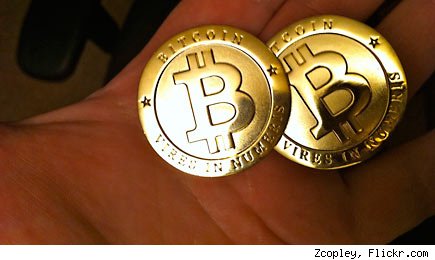
Economics 101 Primer – It works like this, currency is backed by the government that issues it. It used to be backed by gold and silver. In fact, early currency was simply gold, silver or bronze stamped with the King’s face. Then it turned to paper. When it was backed by gold and silver, you could take the paper version to the bank and get actual metal. This stabilized its value. However, there is more economic activity than there is gold and silver in the world, so people switched to paper that is no longer backed by anything, other than faith that when you use it, you can buy stuff.
If there are 100 things to buy and 100 dollars, each costs around $1. If you print more money, say $200, but the economy does not grow, things cost $2 a piece and your dollar is worth only half as much. This is called inflation, which is bad for everyone.
If things keep growing in production (GDP growth) and money does not grow, you get deflation and it is difficult to do business. In that case, the now 200 items chasing $100 would only be able to get 50 cents each. The producers lose half their value.
So, a government is supposed to try to stabilize currency by having its supply go up and down as economic growth goes up and down, so their currency remains stable and so do prices. When governments run high deficits, borrow money, and print money for their own purpose rather than matching growth, bad things happen, like runs on banks and lack of faith that the currency ‘means” anything. That is one of the reason real gold prices have skyrocketed in the US.
Back to Bitcoins – People in Europe are losing faith in the British Pound Stirling and the Euro. So, someone created the Bitcoin, a currency on the Internet which is NOT issued by any government. It is simply issued in exchange for real money like euros, dollars and pounds, and then used as currency. The fact that it is NOT backed by a government also means it is not increased to pay for government purchases. People are so desperate that they are taking their Euros out of ATMs so fast that several governments are limiting withdrawals now. Italy closed its banks for a week. So, as they can, people in Italy, Greece and other places are turning in their euros for bitcoins. So far, the bitcoins have more faith and value than regular money, gaining in value by 1700% against regular currency since 2009. They cannot be used everywhere, but increasingly producers like restaurants and stores are taking them.
Can a privately held company through the internet successfully launch and maintain its own currency for the world better than governments? I would have told you no ten years ago, but lots has changed. In video games, there is an exchange rate now for fake game gold or credits to real cash. There are millionaires who have sold imaginary retail space to people in Second Life. Now, not in a video game, but in real life, we have fake money worth more than real money. Amazing.
Here is a piece of a story from AOL Daily Finance, posted by Ross Kenneth Urken:
Is Bitcoin a Panacea For the Euro’s Woes?
Quite simply, Bitcoins are an encrypted digital currency that can be freely exchanged between people or between consumers and merchants. Businesses like Bitcoin because it allows them to avoid paying credit card fees of up to 3% on transactions. Consumers get to dodge the costs normally associated with currency exchanges. It’s only available for use in a handful of physical locations in cities around the world (it’s mostly used via Internet), but a major use for it has been for conversions — you can buy Bitcoins and then exchange them for another currency at no charge.
Bitcoin is in some senses a financial island removed from the vicissitudes and consequences of a traditional banking system. It’s neither controlled by central banks nor governments, and thus not vulnerable to larger-scale shifts like changing interest rates or the rampant inflation of countries in decline.
But Bitcoin’s isolation from geopolitical turmoil has been its true selling point for those in Europe.
 Michael Bradley - Time Traveler
“It is simply issued in exchange for real money like euros, dollars and pounds,..”
No – it is decidedly NOT issued that way. It is *exchanged* for dollars,euros,pounds,yen etc etc on exchanges. It is *issued* in strict accordance to a mathematical set of rules based on computer processing power. It is also not issued, owned or controlled by any company. It is a completely peer 2 peer system maintained as open source software by the community of users.
LikeLike
Julian, thank you for your comments. Here in Phoenix, Arizona, it is the first I have heard of them, so I am not completely familiar with them. I know it allows people to avoid typical credit card charges, but I don’t understand how people keep track of them without someone being paid for the computer time and records. I know they were hacked into once and about 90,000 Euros’ worth was stolen. Did someone replace that money to the account? Who actually issues Bitcoins? If you know I would be most interested, as I am sure others would be. In America we have guarantees on banks and credit unions to pay us back the first $120,000 or so if our account is lost. It is repaid from a fund created by the government through a surcharge on financial institutions. What happens if someone loses their Bitcoins?
LikeLike
Hi Michael, Bitcoin already has a global following (It’s not even certain where the original coder originated – nor does it matter), but awareness even amongst IT people seems patchy. It’s somewhat ‘out there’ and counter-intuitive, so I think many people dismiss it prematurely. With a GL capable browser like chrome, check out: http://blockchain.info/nodes-globe?series=48hrs for an idea of it’s spread. (And that only includes people running a ‘full node’)
As for paying people to ‘keep track of them’ – it’s actually like a giant shared accounting ledger in the cloud so to speak. People running full nodes hold a copy of the entire transaction history (may one day be optimised/truncated) but as transactions only show transfers between long ‘bitcoin addresses’, it’s not generally identifiable to an individual without a lot of digging. There are actually small fees that are paid on transactions to ensure they are ‘confirmed’ in a reasonable time. These are on the order of a few cents or fractions of a cent USD equivalent – and go to those who specialize in providing computer power to the network in order to secure it and ‘lock in’ the transaction chain. (so called ‘mining’)
This ‘mining’ is the issuing process based on contributed computing power – so there really is no ‘who’. The people who maintain the open source code don’t even have the freedom to just change things – because it would take agreement from the vast majority of existing network participants in order to proceed with a change that materially affected the rate of issuance etc. Bitcoiners in general are firmly attached to the idea of the scarcity being restricted to 21 Million coins for example – so this just isn’t going to change.
There have been various ‘hacks’ – but these are of peripheral services in the Bitcoin ecosystem. Anyone can start up a company and offer exchange and other services related to Bitcoin. Some of them have not been particularly well set up, or outright fraudulent. Best to keep in touch with the bitcoin community on the forums to check the reputation of particular services. Securing bitcoins can be a hassle – but the wallet systems are improving to make this easier for the average person.
If you lose the private keys which give you control of your bitcoins – you lose them forever. There is however – nothing to stop entrepreneurs from building insurance/guarantee/escrow systems on top of the raw bitcoin layer. It’s not all just a ‘tough luck’ mentality.. when a Bitcoin exchange in Poland lost it’s customers coins, another crowd (mtgox) stepped in and bought the exchange – and made good all the customer’s deposits.
I think Bitcoin is best seen as a protocol and system upon which services can be built. It’s spawning a global mini industry so far – though whether it gains serious traction with more than a niche of geeks is the big question.
LikeLike
This is an interesting development. Since currency is a lot like religion, it is only as powerful as the faith put in it, we could be seeing a paradigm shift in banking. What if bitcoin is just the first truly democratic currency? One chosen by the people for their needs. Even in the case of gold it’s value has largely hinged on two very arbitrary characteristics it’s appearance and rarity. The reassuring thing in all this is that while governments can fail the people will find a way to move on. I for one am excited about moving currency away from our government and all the artificial machinations to increase or decrease it’s value.
LikeLike
You’re right Vincent – there is an element of faith in any currency. The enforced scarcity and useful properties of Bitcoin, such as extreme divisibility and non-reversible transferability have so far resulted in a healthy ‘supply and demand’ driven value. (well.. things got overheated about 1 year ago with a ‘bubble’ in prices.. but it’s a lot more stable now)
I think gold’s value was hinged also on the fact that it is relatively easy to melt down ie it’s somewhat divisible – and also easily identifiable – making it good for trade between people who have no prior trust.
Bitcoin too has aimed to take ‘trust’ out of the equation. If the network confirms you’ve received bitcoins – then you’ve got them. Nobody can take them back or freeze them etc. This means for certain situations a consumer-protection layer and/or escrow system may be needed – so it flips things around in favour of the merchant compared to traditional credit card systems, but it’s arguable that policing merchants and maintaining reputation systems for them may be a more efficient way of doing things in the long run and could help drive down ecommerce costs.
LikeLike
At a time when we are all subject to the whims of a handful of men doing quantitative easing and de facto devaluing our currency and savings, bitcoins are a way to hedge. And a potential way to survive the collapse of national currencies, should the need arise.
LikeLike