
People across the world are preparing for the zombie apocalypse. It might not be zombies, it might be world economic collapse, nuclear post holocaust, or pandemic disease, but it is basically protecting yourself from the infected and from your fellow humans who go bonkers when things fall apart. Here are some of my favorites:
Monthly Archives: July 2012




















Predictions of Future Technology
I found this chart on StumbleUpon and thought it was pretty cool and thought provoking. Hopefully, you will as well.
http://www.stumbleupon.com/su/2FWuDt
Filed under Humor and Observations
Thank You to the Steampunk Book Club
The Steampunk Book Club met on Wednesday night at Lux and invited me as their speaker/guest. They also selected my book, The Travelers’s Club and the Ghost Ship for their book of the month. Thanks to all you wonderful fellow Steampunk fans! I hope you love the book.

Filed under Writing
Man, Cyborg, Robot, Soon it Will be Hard to Tell
I now have around 15 pounds of titanium, plastic and high grade ceramic instead of a left hip and femur. Many of us have artificial parts added to or inside our bodies now. Fake bones, fake joints, artificial limbs, the new eye contact lenses I posted earlier, and so on. Yet no one has looked at me and said I am no longer human. But what if all my original parts were replaced?
Now they can tie human thought processes to control machines, such as artificial parts, and even have those parts send back signals like your real arm would. We have decoded DNA and are starting to work with DNA splicing and improvement. There are currently successful projects making progress on mapping brain impulses and memory centers.
My personal prediction is that in forty years, the distinction of what is human will be seriously blurred. Maybe they can’t fix your severed spinal cord that makes you quadraplegic, so they drop your head onto a whole new mechanical body. Suppose you get Alzheimers, so they take an earlier neural mapping of your brain and stick it into a neural net computer and replace your brain. You think the same and have the same memories, but are you YOU? Eventually, it will lead to every human part being replaced as it wears out. After a hundred years or so, you will be all machine. You will still think you are human, but are you? Does your implanted memories and thought process into a completely artificial body retain its humanity? If you are a believer, do you still have a soul? Did your soul leave when your mind was replaced?
As robotics and electronic devices started to accelerate in their ability to replace and improve our natural parts, I believe cloning will not be as prevalent. At some point, why even have skin? It is difficult to maintain and prone to damage. Sex? Why not run a neural net program that simulates it instead of going out to a bar to find a partner? We are only one or two generations away from artificial bodies being as accepted as smart phones and computer pads are now. Yet how many have pondered the ramifications of this new world?
Here is an interesting article on the topic:
Half Man, Half Machine: Becoming Robotic
By Daniel Maas
show/hide words to know

How close are we to really having robot arms?
What’s in the Story?
Darth Vader, Luke Skywalker, Dr. Octopus, or Master Chief, what do they all have in common? Besides being famous villains and heroes, they are all part robot, or cyborgs.
Have you wondered if it were possible to become part robot like any of these characters? Thanks to science, it is no longer impossible. The PLoS Biology journal article “Learning to Control A Brain-Machine Interface for Reaching and Grasping by Primates,” discusses how our brains can control robotic parts.
Becoming a Machine
 A great example of this comes from the movie Spider-Man 2. Dr. Octopus is a scientist who invents four mechanical, octopus-like arms. He attaches them to his back so he can control them from his spinal cord. Then “Doc Oc” controls his robot arms with his own thoughts! Of course, things go wrong and the machine arms start to control him, making him a villian that Spider-man must stop.
Modern day science has not advanced enough to the point where you can have giant robot arms attached to your back, but we do know it’s not completely impossible. Some researchers are finding which parts of the central nervous system work best to control robot arms. When they find a good area, they attach a Brain-Machine Interface to connect the robotic parts to the nervous system. Scientists are already finding out what part of the brain works best to control robot parts.
Getting in Your Head
In the Dr. Octopus example, he thought that the best place for a brain-machine interface was in his spinal column because there are lots of neurons in your spinal cord. Neurons are the cells that receive and send signals from your brain to your muscles. But researchers in this study were more interested in how brain-machine interfaces connect to the brain, which also has lots of neurons. The scientists knew certain spots in the front and sides of the brain work better than others for this kind of task.
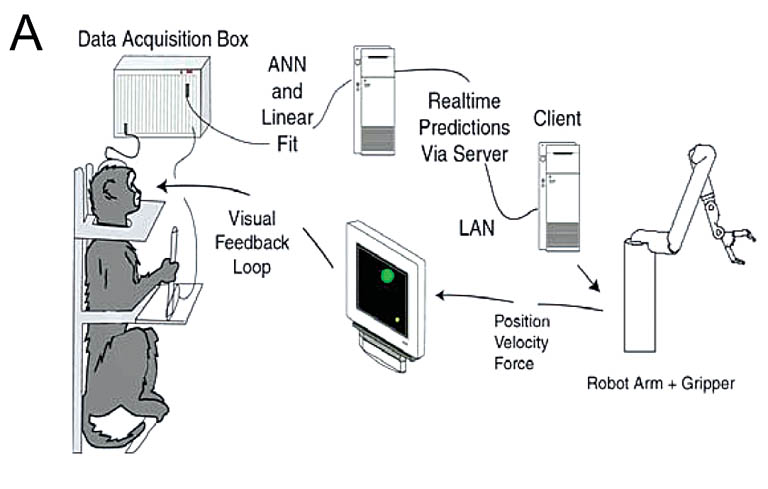
This is an illustrated representation of the experiment. The monkey almost looks like he’s playing video games here. But at the end of the experiment, the monkey believes the robotic arm is in control. Click to see larger version.
In the experiment, monkeys were trained to use a control stick and move it with their arms. Kind of like using an old video game controller. The monkeys used these control sticks to move one ball on a screen to a specific place on the other side of the screen. Once the monkeys got the hang of it, the control stick was removed and they watched the ball being move on its own. The trick was that the monkeys still thought they were controlling the motion. Finally, a robot arm was placed near the monkeys to make the same moves. Scientists took all of these steps so that the monkeys thought they were in control of the robotic arm moving the ball.
During all of these steps, the scientists watched the brain wave patterns from the monkeys to see how different parts of the brain acted. The researchers monitored four specific areas of the brain to record how the monkeys though when they were moving the control sitck versus “moving” the robotic arm. This information was then used to recommend the best places to put a brain-machine interface.
What Did They Find?
After using many graphs and doing a lot of math, the team found that the front and sides of the brain contain lots of neurons that send signals to make your muscles move. Scientists suggested that any place in the brain was suitable to attach a brain-machine interfae, as long as it was attached to plenty of neurons. They also found out that it takes time to learn how to use the brain-machine interface. Scientists saw that the monkeys slowly adjusted to the robot arm, but with practice they thought their brains were using it.
What does this mean for us? It means that maybe like Dr. Octopus, people can start to use robotic limbs better. Scientists think that by using the areas they found, a brain-machine interface can work better in humans. Not only that, but scientists have proven that if you use a brain-machine interface like a robotic arm often enough, it would become easy to use and even feels like it is an actual part of our bodies. Just look at this guy playing checkers with his robotic arm!

Sgt. Sebastian Cila demonstrates his new robotic hand on the Sesame Street special “Coming Home: Military Families Cope with Change,” Image from Wikimedia – Richard Termine
Robot drawing from Wikimedia – Mikael Nordin
Hand with robot hand from Wikimdia – Richard Greenhill and Marie De Ryck
Robot hand and light bulb from Wikimedia – Richard Greenhill and Hugo Elias
Filed under Humor and Observations, Uncategorized
Space Engine
You can be an intergalactic tourist with SpaceEngine
A free space simulation program allows you to travel the universe in 3D.

Published: July 11, 2012 at 12:14 PM
By KATE STANTON, UPI.com
Even if you’ve abandoned your childhood dream of captaining the Starship Enterprise, you can still explore the outer reaches of the universe with free space simulation software called SpaceEngine.
According to the program’s Web site, “all types of celestial objects are represented,” meaning you can steer spaceships over moons, stars, asteroids and across entire galaxies.
Writing for PC World, Cassandra Khaw explains the program’s virtual piloting capabilities:
“Not only can you zip through this virtual universe like the Silver Surfer with Free mode, but you can choose between Spacecraft mode and Aircraft mode, both of which utilize inertia to simulate a rigid body in zero gravity. The only thing that SpaceEngine is missing is a contingent of little green men.”
Unfortunately for space fans with less-than-stellar computer power, the program takes up a rather sizable amount of processing speed.
You can check out the system requirements and download the game at en.spaceengine.org.
Happy travels!
Filed under Humor and Observations, Uncategorized
Dogs With Captions to Perk Up Your Monday!
Here are some dog pictures I collected with cute captions:


Filed under Animals, Humor and Observations
Emma Watson Versus Kristen Stewart On Acting
The picture speaks for itself.

Filed under Humor and Observations, Uncategorized
Betty Crocker Through The Ages
I found this interesting, how they have changed the look of the non-existent Betty Crocker for the various time periods.

Filed under Humor and Observations, Uncategorized
We Will All Be Androids Soon
I now have 14 inches of titanium, plastic and ceramic instead of a left hip, joint and femur. Millions have artificial limbs, some mechanical hearts or metallic stints in their veins. Increasingly we add mechanical devices internally and externally to our bodies in order to modify or heal them for the better. This melding of human and machine is likely to accelerate over the next twenty to forty years. You might not recognize your grandchildren as humans.
Here is the latest – LED contact lenses that enhance your sight, can allow you to see in darkness, and can even show you movies and photos onto your eye instead of a screen. This is not the future, this is NOW.
LED Lights Make Augmented Vision a Reality

Okay, this is just freaky. We know LED lights are versatile enough to be used for practically anything, but LED contact lenses? Really?! Yes, as it turns out, really. University of Washington researchers have figured out how to implant semitransparent red and blue LED lights in contact lenses, for the purpose of receiving and displaying data in sharp visual images and video. This means wearers will literally be able to watch TV or view photos that are projected directly onto their eyeballs.
Once miniature green LEDs are developed (and they’re in the works, as of now), full color displays will be possible. Once that happens, the possibilities are endless. Think about everything your smart phone can do right now, and imagine the same being possible for your eyeball. This news is a little scary and a lot fascinating, if you ask me—at the very least, with LED contact lenses, your hands would be free to pet your robot or tinker with your hover board.
Lead researcher Babak Parvis comments “You won’t necessarily have to shift your focus to see the image generated by the contact lens,” it would just appear in front of you and your view of the real world will be completely unobstructed when the display is turned off.
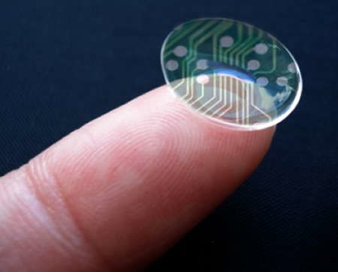
Ah, the real world. With augmented reality becoming a reality, it feels like the real world is fast becoming a relic of the past.
<div id=”embedded_article”><p><b>Source:</b> <a
Filed under Humor and Observations
The Dark Side of Social Media, Yelp, etc.
Unfortunately, no matter what tools we have to communicate with each other, someone will turn them to evil. Increasingly, people are using apps to determine where they eat, stay, recreate and purchase items. Some companies pay people to do “social media” for them to make them look good. I have no problem with this, it is simply a new form of advertising. Then there are the neutral folks, who legitimately post their impartial views of a particular company. Finally, there are those who extort businesses for free items to prevent them from trashing and ruining the reputation of the company.
Laws have not caught up with any of this. Regulators are usually at least ten years behind and even more with science and technology – example the late fiasco with their attempt to outlaw reblogging. As a result, there are no clear anti-extortion laws for social media, even though businesses are being threatened, in my opinion, unlawfully, with damage to their revenues if they don’t pay off. I would not have a problem telling a company, hey, if you give me a free meal I will blog FOR you, but saying give it to me or else I will TRASH you seems wrong to me. What do you think?
Here is an article that discussed the problem as well:
Scammers want restaurants to fork over payouts, or digest negative reviews


Scammers are making some restaurants an offer they can’t refuse: A payoff or discount, or they’ll post a nasty rating on online review sites like Yelp! or Angie’s List.
There’s no real data showing how often it’s happening, but anecdotal evidence suggests cyber-extortion is on the rise: scammers know online reviews carry a lot of weight, and can affect a company’s bottom line.
Some are willing to pay to keep bad reviews from popping up, but not Sonny Mayugba, owner of the popular Red Rabbit Kitchen and Bar in Sacramento. He described how a patron recently tried to shake him down after alleging they got food poisoning.
“He said, ‘I’m going to do a scathing review of you on Yelp!, I’m going to make sure my girlfriend does a scathing review on Yelp!, and then I’m going to report you to the health department. However, if you buy me a $100.00 gift card to Ella, which is a nice restaurant here in town, you’ll save me from doing all those things.’ To me, that was extortion.”
Mayugba didn’t pay a dime, and that customer’s post — while negative — didn’t mention anything about food poisoning, confirming the owner’s suspicion the allegation was made up.
Legal experts say he was wise not to pay, or — to file a lawsuit. They say if a business is seen as litigious, that can cause just as much damage as a negative review. Free speech advocate Matt Zimmerman, an attorney with the Electronic Frontier Foundation, says the better course is to use social media to explain their side of the story, and work even harder to earn more positive reviews.
“We can’t control all speech about us, and we should stop trying,” says Zimmerman. “Instead, we should try to encourage the positive feedback, try to encourage a more accurate picture of our business. Even if an ad or post is unfair, a business’ more effective response is going to be to create a counter-narrative online.”
Victim’s of cyber-extortion can’t blame the websites. Yelp!, Angie’s List, and other review sites are not legally responsible for what their users do. However, if someone crosses the line, and posts something totally false intended to cause harm, that defamatory speech is not protected under the Constitution, and that person could be successfully sued. Attorneys suggest business owners track threats, collect evidence and report them to the police.
While the sites themselves may not be liable, most, including Yelp!, work hard to weed out sham posts, both positive and negative. From a business standpoint, it’s in their best interest to try to screen out fake or malicious reviews if they want to maintain their popularity and integrity.
As Mayugba put it, a review site “is a wonderful sign post for those of us who use it correctly. When people use it to leverage value out of people for wrong, it devalues that media. That’s not only extortion, but it’s tainting the media platform.”
Filed under Humor and Observations, Uncategorized
 Michael Bradley - Time Traveler