Sacred Sites of Ancient Greece
Temple of Hephaestus
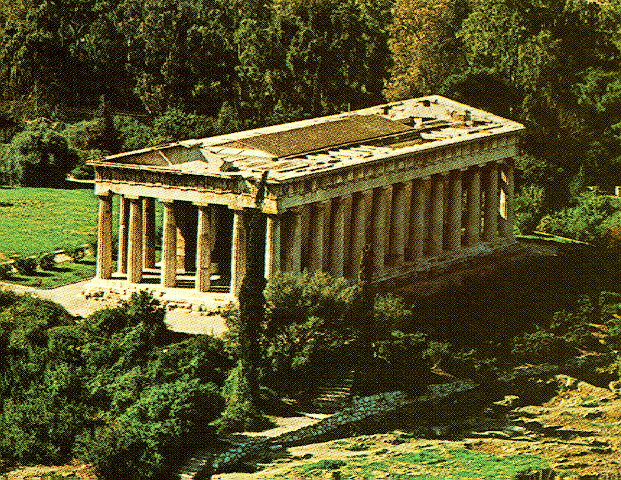
The Temple of Hephaestus in central Athens, Greece, is the best-preserved ancient Greek temple in the world, but is far less well-known than its illustrious neighbour, the Parthenon. The temple is also known as the Hephaesteum or Hephaesteion. It is sometimes called the Theseum, due to a belief current in Byzantine times that the bones of the legendary Greek hero Theseus were buried there; in fact the bones alleged to be those of Theseus were buried in the 5th century BC at another site nearer to the Acropolis.
The temple is located about 500m north-west of the Acropolis and about 1km due west of the modern centre of Athens, Syntagma Square. It was built in about 449 BC on what was then the western edge of the city of Athens, in a district which contained many foundries and metalwork shops. It was therefore dedicated to Hephaestos, the god of blacksmiths and metallurgy. It was designed by Ictinus, one of the architects who worked on the Parthenon. It stands on a slight rise and in ancient times commanded a fine view of the Agora.
Built of marble from Mount Pentelus, in the Doric style, the temple is hexastyle, that is with six columns under the pedimented ends, and has thirteen columns on each side (counting the corner columns twice). The temple is peripteral, with columns entirely surrounding the central enclosed cella. In the entablature there is the plain frieze that is expected with the sober Doric mode, but above it in the spaces between the triglyphs – which are like decoratively grooved beam-ends pegged into place – the labours of Heracles are depicted in bas-relief. Sculpted into the low-relief metope is the great story of Theseus and of his quest to kill the minotaur.
Unlike the Parthenon, the temple has all its columns and pediments intact, and even has most of its original roof. Its friezes and other decorations, however, have inevitably been badly damaged by thieves and looters over the centuries. It owes its survival to its conversion to a Christian Church, the Church of St George, in the 7th century AD. The survival of the exterior came at the cost of the ancient interior, which was removed and replaced by the structures of a Christian church.
During the centuries of Ottoman rule in Greece, the temple was the main Greek Orthodox church in Athens. When the first king of independent Greece, King Othon, entered the city in 1834, the service welcoming him to his new capital was held in the church.Today the temple has been preserved as an archaeological site under the supervision of the Ephorate of Antiquities of the Greek Interior Ministry. The temple itself has a small fence, but the visitor can get much closer than is possible at the Parthenon or most other antiquities in Greece. The temple is now surrounded by an ornamental garden. The site gets much less tourist traffic than the Acropolis and is a pleasant green spot in the heart of Athens.
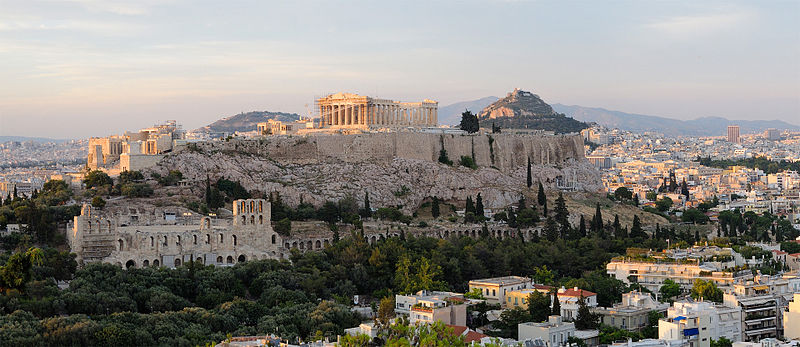
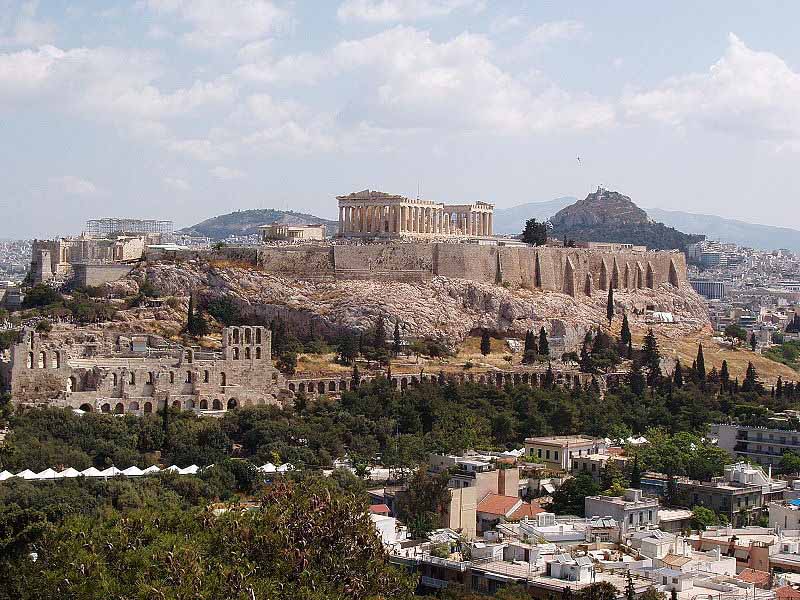
The Acropolis in Athens
The Acropolis is high above the city on a natural prominence.

Mount Olympus
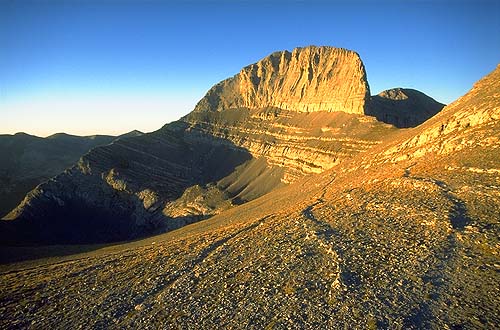
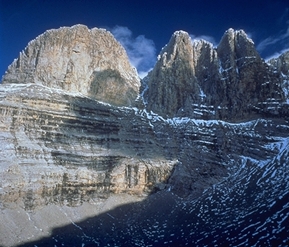
Mount Olympus s the highest mountain in Greece, at 2,917 (or 2,919, according to new measurements ) meters high; it is situated at 40°05 2N 22°21 2E, in mainland Greece.
Mount Olympus is noted for its very rich flora with several endemic species. The highest peak on Mount Olympus is Mitikas, which in Greek means “nose.” There are two refuges on a plain about forty five minutes away from Mitikas. Mitikas is the highest peak in Greece, the second highest being Stefani.
In Greek mythology, Mount Olympus is the home of the Twelve Olympians, the principal gods in the Greek pantheon. The Greeks thought of it as built up with crystal mansions wherein the gods, such as Zeus, dwelt. The etymology and meaning of the name Olympus (Olympos) is unknown, and it may be of Pre-Indo-European origin.
The Tumulus of Marathon
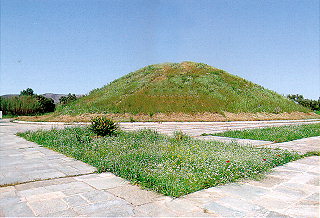
The fertile plain of Marathon was a natural place for the establishment and development of human activity from prehistoric to Roman times. Here on this plain the battle between the Athenians and the Persians was fought in 490 B.C. To this great event Marathon owes its worldwide fame and its important place in the conscience of the ancient Greeks. The Mound was raised over the graves of the 192 Athenians who died in the battle and whose remains were buried here after cremation of the dead.
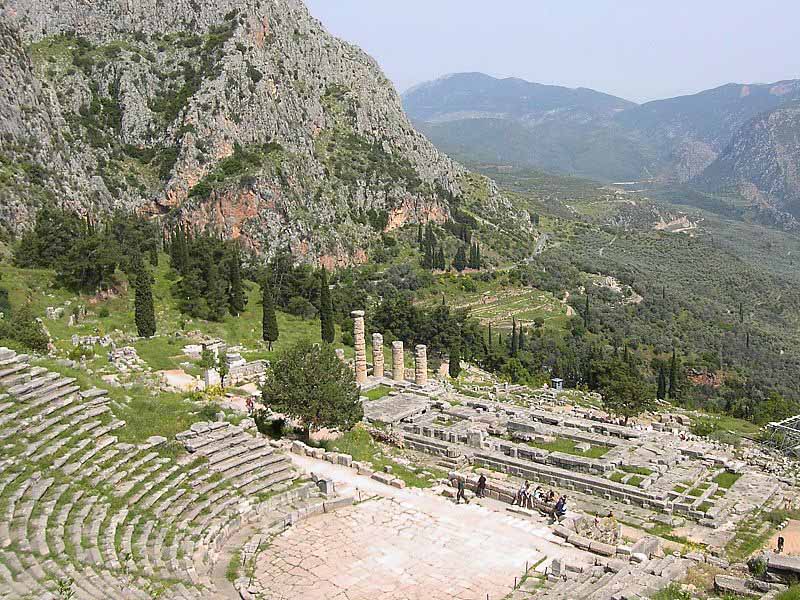 Theatre and Temple of Apollo in mountainous country at Delphi
Delphi, GreeceLocated about one hundred miles northwest of Athens is the ancient site of the panhellenic sanctuary of Delphi. The complex of buildings, which includes the Temple of Apollo where sat the famous oracle, The sacred Corycian Cave, and the Castalian Spring, is nestled in the forested slopes and rocky crags on the south side of the sacred mountain Mountains and the Sacred called Parnassus. The site had been sacred since at least the Bronze Age. According to legend, the shrine was originally guarded by the she-dragon Pytho. She was killed by Apollo who then took over the oracle. In antiquity, Delphi was regarded as the centre of the world.
Temple of Apollo
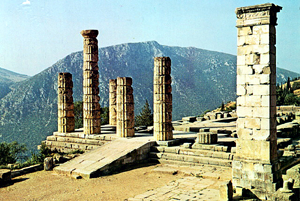 The visible ruins belong to the last temple, dated to the 4th century BCE, which was peripteral, in Doric order. It was erected on the remains of an earlier temple, dated to the 6th century BCE. Inside was the “adyton”, the centre of the Delphic oracle and seat of Pythia. The monument was partly restored during 1938-1941.
Castalian Spring
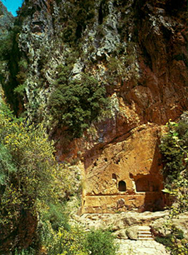
In Greece, the Phaedriades (“the shining ones”) were the pair of cliffs, ca 700 m high on the lower southern slope of Mt. Parnassos, which enclose the sacred site of Delphi, the center of the Hellenic world. Strabo, Plutarch and Pausanias all mentioned the Phaedriades in describing the site, a narrow valley of the Pleistus (today Xeropotamos) formed by Parnasse and Mt. Cirphis. Between them rises the Castalian Spring. Even today, at noontime, the rock faces reflect a dazzling glare.
The Castalian Spring in the ravine between the Phaedriades at Delphi is where all comers to Delphi, the contestants in the Pythian Games and especially suppliants who came to consult the Oracle, stopped to wash their hair. Two fountains fed by the sacred spring survive. The archaic (early 6th century BCE) fountain house has a marble-lined basin surrounded by benches. There is also a Hellenistic or Roman fountain with niches hollowed in the rock to receive votive gifts. The Castalian Spring predates all of classical Delphi: the archaic guardian of the spring was the serpent or dragon Python, killed by Apollo in its lair beside the spring.
Sanctuary of Poseidon and Athena at Sounion
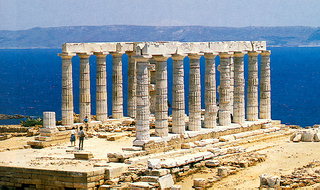
The sanctuary at Sounion is one of the most important sanctuaries in Attica. Sporadic finds point to the conclusion that the site was inhabited in the prehistoric period but there is no evidence of religious practice in such an early date. “Sounion Hiron” (sanctuary of Sounion) is first mentioned in the Odyssey, as the place where Menelaos stopped during his return from Troy to bury his helmsman, Phrontes Onetorides.
The finds of the 7th century B.C. are numerous and prove the existence of organized cult on two points of the promontory: at the southern edge where the temenos of Poseidon was situated, and about 500 m. to the NE of it, where the sanctuary of Athena was established.
Important votive offerings were dedicated during the 6th century B.C., but the architectural form of both sanctuaries remained unpretentious until the beginning of the 5th century B.C., when the Athenians initiated the construction of an imposing poros temple in the temenos of Poseidon.
The building was never completed, though, as both the temple and the offerings were destroyed by the Persians in 480 B.C. In the following decades, Sounion, like the rest of Attica, flourished, and an important building project was undertaken at both sanctuaries. At the end of the 5th century and during the Peloponnesian War, the Athenians fortified Sounion cape.
From the 1st century B.C. onwards, the sanctuaries gradually declined and Pausanias, who sailed along the coast of the promontory in the mid-2nd century A.D., wrongly considered the prominent temple on the top of the hill as the temple of Athena. The site of the temple was known in the following centuries, as is proved by descriptions of modern travelers, who visited Sounion before the excavations started, as well as by graffiti on the stones, among which, that made by Lord Byron.
Restricted excavations in the sanctuary of Poseidon were conducted in 1825 by the Dilettanti and by the German architect W. Doerpfeld. Systematic investigation was undertaken between 1897 and 1915 by the Athens Archaeological Society, under the direction of Val. Stais, with the collaboration of A. Orlandos. Since 1994, the Archaeological Society has been carrying out excavations at the Fortress.
Sanctuary of Poseidon
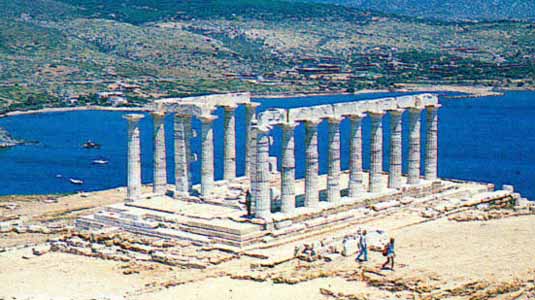
It is situated in the southernmost, highest part of the promontory. The area was evened off and supported by means of retaining walls on the north and west sides. A Propylon was constructed on the north side, and porticoes along the north and the east for the accommodation of the pilgrims. The site was dominated by the Classical temple.
At the end of the Archaic period an imposing temple was constructed in the position of the Classical one seen today, but it was slightly smaller in dimensions. It was Doric, made of poros, with an external colonnade of 6 x 13 columns, and an internal one which supported the roof. Its construction was interrupted by the Persian invasion and the temple remained unfinished.
The later temple, the one preserved today, was also Doric, with 6 x 13 columns, made of Agrileza marble, but without an internal colonnade. The stylobate measured 13,47 x 31,12 m. It was constructed in 450-440 B.C. and, according to another theory, was the work of the architect who had also built the Hephaisteion (“Theseion”) in the Ancient Agora of Athens, the Temple of Nemesis at Rhamnous, and the Temple of Ares which was probably erected in Acharnes.
The sculptural decoration of the temple, made of Parian marble, is preserved in a poor condition. The frieze of the east side depicted Centauromachy, and the east pediment (of which only a seated female figure is preserved) probably depicted the fight between Poseidon and Athena for the domination of Attica. The two antae of the east side and several of the columns of the east part of the temple are still preserved today, while the west is completely destroyed.
Propylon – Porticoes
The Propylon was constructed a little later than the Classical temple, and was made of marble and poros. It is Doric, distyle in antis on both sides (north and south). A partition wall inside the building has three doorways, of which the middle one is wider and has a ramp. A small rectangular hall is attached on the west wall of the Propylon, while porticoes are erected along the north and west sides of the sanctuary. The north of these porticoes is larger and slightly earlier.
The Fortress
Sounion cape was fortified in 412 B.C. during the Peloponnesian War, in order to control and secure the ships carrying cereals to Athens. The use of various materials and construction techniques is probably the result of repairs and additions made during the Chremonides’ War and the following years (266-229 B.C.). The sanctuary of Poseidon occupies the SE end of the fortress. The wall starts at the NE corner, extends to the north and turns to the west. Shipyards for the sheltering of two war ships were constructed on the coast, at the west end of the north branch of the fortification. Inside the fortress, excavations have brought to light part of a central street, remains of houses, and water cisterns.
Sanctuary of Athena
It is situated on a hill 500 m. to the NE of the Sanctuary of Poseidon. The area was evened off and enclosed with a poros polygonal circuit wall. Inside the enclosed area were erected the Temple of Athena, a smaller temple to the north, and altars. A deep pit on the SE side of the temenos was used as a deposit for the Archaic offerings destroyed by the Persians. The oval peribolos to the NW of the temenos has been identified as the “Heroon of Phrontes”.
Temple of Athena
It has a rectangular cella, measuring 16,4 x 11,6 m. The foundation of the pedestal supporting the cult statue is preserved on the west side of the cella, while four Ionic columns in the centre supported the roof. One of the peculiarities of the temple, mentioned also by Vitruvius, is the existence of an outer colonnade only on the east and south sides.
Some scholars consider that the temple of Athena Sounias was reconstructed after the mid-5th century B.C., while others believe that the cella was built during the Archaic period, was repaired after the Persian destructions, and the colonnade was added in the middle of the 5th century B.C. A second peculiarity of the sanctuary is the placement of the altar to the south of the temple.
Small Temple
Small, Doric, prostyle temple measuring 5 x 6.80 m., situated to the north of the Athena Temple. The pedestal of the cult statue is preserved inside the cella. The date of the structure and the identity of the deity worshipped is still a matter of debate.
The Ancient Agora of Athens
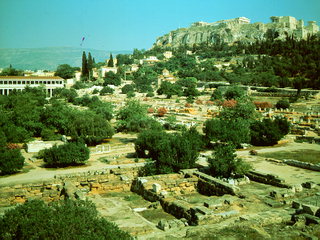 The Agora was the heart of ancient Athens, the focus of political, commercial, administrative and social activity, the religious and cultural center, and the seat of justice. The site was occupied without interruption in all periods of the city’s history. It was used as a residential and burial area as early as the Late Neolithic period (3000 B.C.). Early in the 6th century, in the time of Solon, the Agora became a public area.
After a series of repairs and remodeling, it reached its final rectangular form in the 2nd century B.C. Extensive building activity occurred after the serious damage made by the Persians in 480/79 B.C., by the Romans in 89 B.C. and by the Herulae in A.D. 267 while, after the Slavic invasion in A.D. 580, It was gradually abandoned. From the Byzantine period until after 1834, when Athens became the capital of the independent Greek state, the Agora was again developed as a residential area.
The first excavation campaigns were carried out by the Greek Archaeological Society in 1859-1912, and by the German Archaeological Institute in 1896-97. In 1890-91, a deep trench cut for the Athens-Peiraeus Railway brought to light extensive remains of ancient buildings. In 1931 the American School of Classical Studies started the systematic excavations with the financial support of J. Rockefeller and continued until 1941. Work was resumed in 1945 and is still continuing. In order to uncover the whole area of the Agora it was necessary to demolish around 400 modern buildings covering a total area of ca. 12 hectares.
In the 19th century the four colossal figures of Giants and Tritons at the facade of the Gymnasium were restored by the Greek Archaeological Society. In the years 1953-56, the Stoa of Attalos was reconstructed to become a museum and in the same period the Byzantine church of Aghioi Apostoloi, built around A.D. 1000, was restored by the American School. Between 1972 and 1975, restoration and preservation work was carried out at the Hephaisteion; the area was cleared of the vegetation, and the roof of the temple was repaired in 1978 by the Archaeological Service.
Stoa of Zeus Eleutherios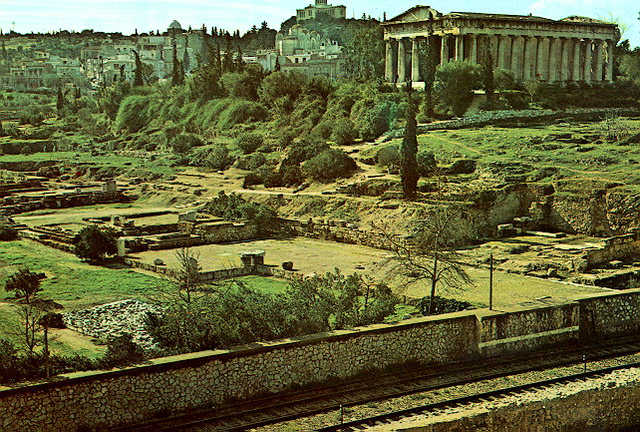
The stoa was erected at the end of the 5th century B.C. in honor of those who fought for the freedom and security of the city. Socrates is said to have met his friends in this stoa.
Temple of Apollo Patroos – Small Ionic temple, erected in ca. 340-320 B.C., identified as the temple of Apollo who was worshipped as the “Father” (Pater), the founder of the Ionian race. Inside the cella stood the cult statue of the god, made by the famous sculptor Euphranor.
Monument of the Eponymous Heroes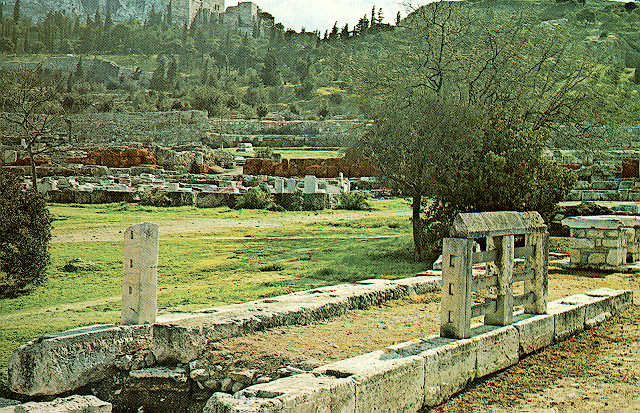
Remains of an oblong pedestal enclosed by a fence. It supported the bronze statues of the legendary heroes who gave their names to the ten tribes of Attica. In addition to its honorary function, the monument served as the official notice board of the city. It is dated to the second half of the 4th century B.C.
Rhamnous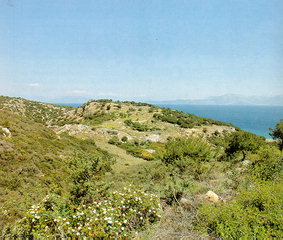
The site of ‘Rhamnous,’ the northernmost deme of Attica, lies north of Marathon overlooking the Euboean Strait. The site was known in Antiquity for its sanctuary of Nemesis, the implacable avenging goddess. A fortified acropolis dominates the two small harbors, from which grain was imported for Athens during the Peloponnesian War. Otherwise, Rhamnous was strategically significant enough to be fortified and receive an Athenian garrison. Remains of the two temples can be seen. The 6th century Temple of Nemesis was destroyed by the Persians in 480 BCE and replaced by a never-completed temple in the 5th century. A smaller temple that shares the sanctuary platform (peribolos) is thought to have been dedicated to Thetis, based on the dedications of two marble seats, to Nemesis and to Thetis.
Fortress
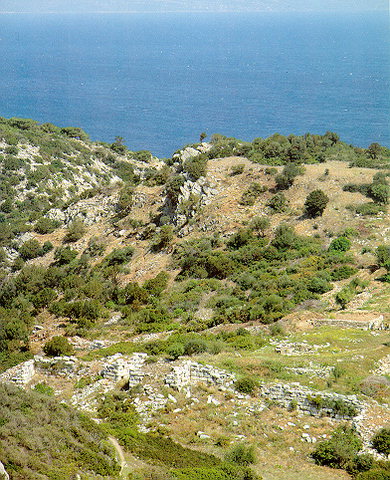 The Fortress comprises an outer system 800 metres long and a smaller interior circuit enclosing the top of the hill. The main entrance of the outer system is at the south and it is protected by square towers at each side of the gate. Within the circuit private and public buildings have been found, notable among which are the theatre and the gymnasium. Within this same area is also the agora of the deme. Military establishments stood at the top of the hill – within the interior circuit of the fortification. On the coast below two small harbors – the eastern and the western – served the ships that patrolled the Euboian channel. The Fortress of Rhamnous, as that of Sounion at the southern tip of Attica, is thought to have been constructed during the Peloponnesian War in order to control the ships bringing grain to Athens.
Thorikos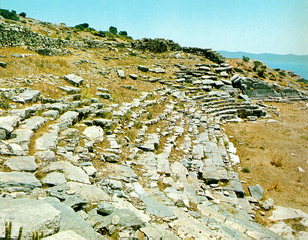
The hill known today as Velatouri is the centre of a Mycenaean settlement and also of the ancient deme of Thorikos. Preserved are the unusual theatre of the 6th-4th centuries B.C., parts of the settlement, some of the metal-working establishments, a square tower of the 4th century B.C., the cemeteries and the sanctuary of Demeter and Kore.
Between the years 1820 and 1995, excavations have been carried out by the Archaeological Society in Athens, the American School of Classical Studies, the Belgian Archaeological School, the 2nd Ephorate of Prehistoric and Classical Antiquities and by the Society of the Dilettanti.
The most important monuments and architectural units of the archaeological site are –
– The Mycenaean acropolis on the top of the Velatouri hill and the two tholos tombs of the same period.
– The Ancient Theatre of Thorikos. It is especially important for the history of the ancient theatre because of its unusual ellipsidal plan. Its original construction goes back to the 6th century B.C.
– ‘Industrial village’ – The central settlement of the ancient deme of Thorikos, which was a flourishing centre for the processing of metal from the Lavrion mines during the 5th and 4th centuries B.C. Roads and houses are spread out along the west slope of the Velatouri hill.




 ,
, 
 VIEW GALLERY









































































 Michael Bradley - Time Traveler