Monthly Archives: July 2013

Space-time loops may explain black holes

Space-time loops may explain black holes

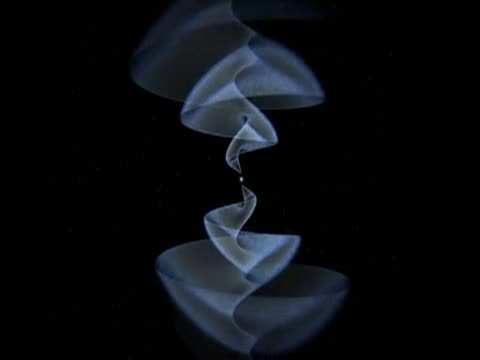
Black holes can't fully be described by general relativity, but physicists hope to understand the inner workings of these strange objects by applying a theory called loop quantum gravity.

Black holes can’t fully be described by general relativity, but physicists hope to understand the inner workings of these strange objects by applying a theory called loop quantum gravity. / FELIPE ESQUIVEL REED

Physics cannot describe what happens inside a black hole. There, current theories break down, and general relativity collides with quantum mechanics, creating what’s called a singularity, or a point at which the equations spit out infinities.

But some advanced physics theories are trying to bridge the gap between general relativity and quantum mechanics, tounderstand what’s truly going on inside the densest objects in the universe. Recently, scientists applied a theory called loop quantum gravity to the case of black holes, and found that inside these objects, space and time may be extremely curved, but that gravity there is not infinite, as general relativity predicts.

This was the first time scientists have applied the full loop quantum gravity theory to black holes, and the results were encouraging, researchers said.

“What they have done is a major step, because they have been able to provide a much more complete description of what really happens near the black hole singularity using loop quantum gravity,” said Abhay Ashtekar, a physicist who studies loop quantum gravity at Pennsylvania State University, who was not involved in the new research.”We still don’t have a clear picture of the details of what happens. So it is opening a new door that other people will follow.” [Images: Black Holes of the Universe]

A black hole is created when a huge star runs out of fuel for nuclear fusion and collapses under its own gravity. The star’s outer layers are expelled, and its core falls in on itself, with the pull of gravity becoming ever stronger, until what’s left is the core’s mass condensed into an extremely small area. According to general relativity, this area is a single point of space-time, and the density there is infinitely large — a singularity.

But most scientists think singularities don’t really exist, that they’re just a sign that equations have broken down and fail to adequately describe reality. Loop quantum gravity appears to be an improvement on general relativity in describing black holes because it doesn’t produce a singularity.

The idea is based on the notion of “quantization,” which breaks an entity up into discrete pieces.Whilequantum mechanics says atoms exist in quantized, discrete states, loop quantum gravity posits that space-time itself is made of quantized, discrete bits, in the form of tiny, one-dimensional loops.

“The loop means the fundamental excitations of space-time themselves are one-dimensional in nature,” said Jorge Pullin, a physicist at Louisiana State University, who co-authored the new study with Rodolfo Gambini of the University of the Republic in Montevideo, Uruguay. “The fundamental building block is a loop, or network of loops. For a visual image, think of a mesh fabric.”

This way of portraying space-time changes fundamental physics, especially in extreme settingssuch as black holes or the Big Bang — which is thought to have birthed the universe. The Big Bang, like black holes, is indescribable under general relativity, understood only as a singularity.

“The subject really took off in 2005 when it was realized loop quantum gravity can naturally resolve the Big Bang singularity and that quantum space-time is much larger than what Einstein envisioned,” Ashtekar told SPACE.com.

Pullin and Gambini said their work is just a preliminary step, far from a full description of the true complexity of black holes.

“This model we’ve done is extremely simple,” Pullin said. Under their simplified model,”the black hole exists forever and doesn’t evolve. As a consequence I cannot tell you exactly what nature is going to do inside a black hole. It could be that the singularity gets replaced by a region that gets highly curved, but not infinitely curved. Or it could be that it just doesn’t make sense — you get a region which doesn’t behave like classical space-time. It would interact with particles in different ways than we normally think.”

Now that they’ve achieved this step, the researchers hope to advance their work by making the black holes in their model more dynamic and changeable.

“The black holes we studied were in empty space — there was no matter in them. They were pure space-time,” Pullin said.”We’re trying to add matter, because then it addsdynamics. We’re in the middle of that now.”

The study was published May 23 in the journal Physical Review Letters.

Leave a comment

Filed under Humor and Observations

Random Humor

More random humor to brighten your day.

Leave a comment

Filed under Humor and Observations

The Future – Part One

I plan to write about the future for a few blog posts – I’m not sure how many.  This is not so much to predict the future as to extrapolate it.  With a graduate degree in Economics, it is hard not to employ that training to other things, like the future.  In Economics we use the latin term ceteris paribus, meaning “all other things held equal.”  For instance, if you change the monetary supply but everything else stays the same, what happens to the economy?  The thing is, nothing ever stays the same, but you have to pretend it will to isolate various factors.  It is also true that no economic model can consistently beat the ‘no change’ scenario.  If you simply predict things will be the same next period as they are this period, you will be correct most of the time.  A group of economists, making predictions and taking the mean results can beat this curve, even though individuals cannot.

Future

So, my prediction of the future is based on ceteris paribus and the no change scenario.  I simply continue the line with the same slope as we currently see it.  If you start back in 1800 and track technological innovations, absorption by society, and societal and political changes, we seem to be on a pretty steady line.  If we keep on that developmental line, then predicting the future is not as difficult as you might think.

To take one variable at a time – which never happens of course – I will address only certain aspects of the future, as I see it happening, in each post.  Here goes:

Religion – Religion is on a steady diminishing curve.  Even many religions themselves predict the eventual falling away of mankind from the path of righteousness.  These trends will lead to immense conflicts in the near future.  Those who are willing to die to restore faith will increasingly feel compelled to act to stave off atheism and moral relativism.  To be clear, I do not support such violence and conflict, I simply see it on the horizon.  The Arab Summer is a good example, where theologically based groups strive against secular groups for the control of Egypt, Syria, Libya and Turkey, even as a I write this.  There will likely be persecution of believers and persecution by believers.  Last year, over 100,000 Christians world-wide were killed for their beliefs.  If you look at all religions, millions are currently persecuted and jailed for their beliefs.  At the same time, theological groups like the Taliban torture and kill those who do not follow their version of belief.

believer vs non-believer

Government – Governments are increasing in size, cost and control daily.  Record amounts of the gross national product of countries go the government.  In the United States, in the last ten years alone, the government has taken control of banking, auto manufacturing, healthcare, student loans, welfare and education.  Increasingly the 10th Amendment is ignored and the “patchwork” of state laws are replaced by federal laws.  Internationally, the movement is to control people, resources and the economy through large centralized governments.  The private sector will get smaller and more regulated resulting in slower economic growth, higher unemployment and larger welfare roles.  Historically, these trends will continue until either an economic collapse, a war, or civil uprising.  I do not know how much longer the world can sustain rapidly growing central governments.  In this technological age, the new secret police to enforce government will are cameras, drones, email, electronic searches, phone records, gps and the fact that none of us have “real money.”  Our entire identity, wealth and liberty is kept in the hands of the government through our electronic signatures.

big government

Technology – Nothing we know now will count in twenty years.  People will have either a chip in their head, or a flexible plastic screen that has all phone, email, computing, movies and TV on it.  They can do virtually anything, anywhere.  That means they won’t drive to work, to theaters, to stores, to libraries or anyplace else they can access at home.  3d printing will allow them to produce their own products and even food at home.  They will only leave to be ‘live’ with others.  Any brick and mortar locations will be gone in the next generation.  Why have libraries?  Why have physical schools?  Why build anything if you can deliver the same product or service digitally?


When I was young there were no ATM machines.  You had to go to a bank between 10 am and 3 pm with a passbook.  If you lost your passbook, you were screwed.  We froze water and used ice picks to break it up for drinks.  There were no cell phones, no microwave ovens, no internet.  Computers came out while I was in junior high school and only us nerds could use them.  TV screens were heavy cathode ray tubes and there were three channels – ABC, CBS, and NBC.  Theaters had only one screen and one movie they would show for weeks.  Cars used leaded gasoline for 23 cents per gallon and you got savings stamps with them.  Cigarette ads were all over TV, magazines and billboards.  The number one selling magazine was TV Guide and people got their news at 6 pm or from the newspaper.  We burned leaves in our front yards, went shooting squirrels with shotguns unsupervised as children, and only the rich could fly by airplane.

future-tech-class-1

I bring up this nostalgic look because the world today with the power of a super computer in your smart fun or computer pad happened virtually overnight.  The trend for technology is to speed up, not slow down, in its advance.  Look for 3d printed organs, cloning, spare parts for human, and other ethic laden medical issues.  Half of us die from heart disease, another fourth from cancer.  As those are treated, the incidence of Alzheimers’ and dementia will grow astronomically.  What will the world be like when people live past 100 routinely?  What will the layered generations do with technology absorption issues?

Toddlers today can be seen tapping their coloring books and picture books and looking puzzled.  Why?  They are so used to I-pads and other devices being interactive that the concept of a book is strange to them.  At just two years old they have already grasped what many of us cannot.  Things are different.  They are going to get much MORE different and very quickly.


That ends part one.  I hope you enjoyed it and it proved to be thought provoking.  I will do part two soon…

2 Comments

Filed under Humor and Observations, Writing

Latest Issue of The WOD Magazine

Get your online copy free here:

TheWOD_Issue1-4_Color_LowRes (2)

Yours truly has a serial short story, movie reviews and other things in there this month.

Leave a comment

Filed under Humor and Observations, Writing

Cute Dogs for Your Monday Blues

Furry critters to cheer you up.

1 Comment

Filed under Animals

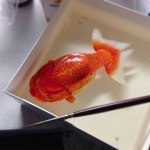
Three Dimensional Animals Painted in Layers of Resin by Keng Lye

Three Dimensional Animals Painted in Layers of Resin by Keng Lye

Singapore-based artist Keng Lye creates near life-like sculptures of animals relying on little but paint, resin and a phenomenal sense of perspective. Lye slowly fills bowls, buckets, and boxes with alternating layers of acrylic paint and resin, creating aquatic animal life that looks so real it could almost pass for a photograph. The artist is using a technique very similar to Japanese painter Riusuke Fukahori who was featured on this blog a little over a year ago, though Lye seems to take things a step further by making his paint creations protrude from the surface, adding another level of dimension to a remarkable medium. See much more of this series titled Alive Without Breath over on deviantART. (via ian brooks)

UPDATE: I have some additional details from the artist that I’d like to add here, as this post seems to be getting a lot of attention. Via email Lye shares with me:

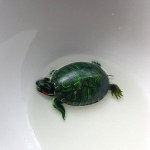
I started my first series in 2012 where all the illustrations were “flat” and depth was created using the layering of resin and acrylic over the different parts of the illustration. This year, I started on the octopus and it was purely an experiment; I just wanted to see whether I could push this technique to a higher level. After applying acrylic paint straight onto the resin, I incorporated a 3-D element in this instance, it was a small pebble for the ranchu and octopus. For the turtle, I used an egg shell for the turtle shell and acrylic paint for the rest of the finishing. The whole idea here was to give the art work an even more 3D effect therefore you can have a better view from any angle. I think there are still many other techniques to explore.

So to be clear the elements that extrude from the top of the resin are actually physical pieces that have been painted to match the layers of acrylic and resin below.

5 Comments

Filed under Humor and Observations

6,000-year-old wooly mammoth parts found in Iowa backyard

6,000-year-old wooly mammoth parts found in Iowa backyard

 A 10-inch tooth, a vertebrae, and a whole collection of ribs all thought to belong to wooly mammoths were found on the property of an anonymous citizen from Mahaska County, IA. The remnants of two adult wooly mammoths and one juvenile have already been unearthed, with more discoveries still being made after almost a year’s worth of digging. The age of the artifacts are estimated at between 14,000 and 16,000 years old.

Laura Decook, a member on the Mahaska County Conservation Board, is thrilled to work on the dig. “It’s fascinating to see that ancient history in Iowa is right below our feet,” she says. “It tells us a lot about what earth was like right here 16,000 years ago.” Thanks to the bones, scientists now believe that around 16,000 years ago, the climate of the rural Iowa town was similar to that of southern Canada today, and that Mahaska County was populated by fir and spruce trees. It is believed that the mammoths may have lived nearby because of a ‘plunge pool,’ a deep pool of water that exists under a waterfall. In 2010, flooding brought the bones back up.

While the ancient findings are priceless, they belong completely to the anonymous landowner, who has allowed conservationists to work on his property. He says that ultimately the bones should be kept in Mahaska County to be used educationally.

dig

1 Comment

Filed under Animals, Humor and Observations

Mysterious ‘Lorimer’ Waves From Another Galaxy Baffle Astronomers

Radio Bursts: Mysterious ‘Lorimer’ Waves From Another Galaxy Baffle Astronomers

The Huffington Post Canada  |  By  Posted: 07/08/2013 12:20 pm EDT  |  Updated: 07/08/2013 8:09 pm EDT

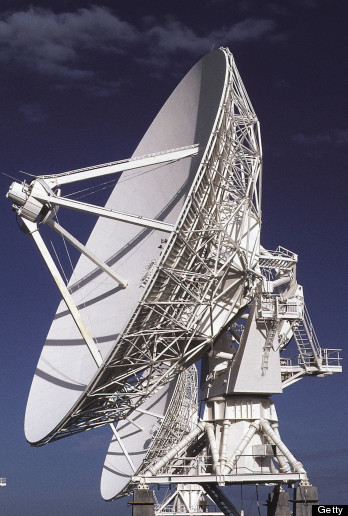
lorimer burst radio scope

It came from a galaxy far, far away.

A single, sudden burst of radio waves. And then it was gone.

The so-called ‘Lorimer’ burst was spotted in 2007 — and has been baffling scientists ever since.

“This is something that’s completely unprecedented,” Duncan Lorimer, the West Virginia University astrophysicist who made the discovery told Space at the time.

Today, the ‘burst’ is not alone. Indeed, four more identical flares have been observed,according to Popular Mechanics.

“You have to look at the sky for a very long time to find these,” British astrophysicist Dan Thornton, who observed the fresh, fleeting bursts, told the magazine. “The reason that we’re detecting them now is we’ve simply looked long enough.”

Thornton and his University of Manchester team published their findings in Science magazine, noting “the bursts’ properties indicate that they are of celestial rather than terrestrial origin.”

lorimer waves

The cause of the flares, which appear for only scant milliseconds, remains unknown. But researchers suggest an “explosive event” may be involved, as the bursts appear to be one-time events.

While the exact origins of the radio waves are also difficult to pinpoint in the vast expanse that is space, scientists are certain that the signals traveled a staggering distance.

Thornton suggests they took half the universe’s lifespan to get here. And, as Science News reports, they disappeared almost instantly upon arrival.

What may yet linger, however, is the wealth of data these flickering heralds bring.

Scientists say the bursts may shine light on the vast, previously unknown tracts of space that separate the galaxies.

“Staggeringly, we estimate there could be one of these flashes going off every ten seconds somewhere in the sky,” research team member Simon Johnston said in Global Times.

“With the ability to detect these very fast sources we are opening up a whole new area of astrophysics.”

Leave a comment

Filed under Humor and Observations

Earthworm Regeneration

Ever wonder how earthworms regrow or survive dissection?  It is one of those weird/bizarre things in nature which fascinate me.  Here is a pretty comprehensive story detailing all you would ever want to know about the topic, including worms that only reproduce through this self-mutilation, akin to a masochistic mitosis.

Making heads or tails out of severed earthworms

http://www.stumbleupon.com/su/7RAqS1/:ZfbbAu1e:Xl3NJ4zD/www.washingtonpost.com/wp-srv/special/metro/urban-jungle/pages/130604.html?tid=rssfeed/

The red wiggler, or compost worm, might regenerate a new head or a new tail, depending on where it suffers amputation.

red wiggler, Eisenia fetida, illustration by Patterson Clark

Loss of any of the first 8segments might result in a complete regeneration of the head.

The worm might grow a new head if cut behind the 13th segment, but it can’t replace sexual organs.

A separation between segments 20 and 21might yield a new tail for the head and a new head for the tail — a possible two worms.

The first 23 segments are roughly the limit for partial head regeneration by the cut-off tail. A loss of more than that might result in tail segments at both ends — and a dead end for the worm.

A cut-off head might regenerate a partial tail if separation occurs in front of the 55th segment. Behind the 55th, full tail regeneration is possible.

Eisenia fetida

Source: The Biological Bulletin

Every gardener has had the gruesome experience of plunging a spade into the ground, only to find that he has sliced anearthworm in half.

Will it die? Regenerate the lost part? Become two earthworms?

The answer depends on a variety of factors, including the type of earthworm and the location and tidiness of the amputation.

Scientists studying earthworms get mixed results even when using anesthesia and a scalpel, so sloppy surgery from a rusty trowel won’t do much for a worm’s chances for regeneration. However, worms can rebound from sacrificing some of their hundred-plus segments to a hoe or to a hungry robin or mole.

Regeneration of heads and tails commonly occurs when an injury activates stem cells that differentiate into replacement parts. Another transformation occurs when tissue suddenly finds itself closer to the front or back of a regenerating worm. Through a process of cellular reorganization, the tissue conforms to its new role in the worm.

The rules of regeneration

• Most earthworms can lose several segments from their head and grow them back. With the red wiggler, a worm often used in composting, the more head segments lost, the less likely they will be fully regenerated. The marsh-loving blackworm, however, always generates eight replacement head segments no matter where the worm has been bisected.

• The ability to generate a new tail is almost universal among segmented worms.

• An amputation between head and tail can sometimes result in two worms, with the front section growing a new tail and the severed tail growing a new head.

• Sometimes a severed tail generates new tail segments instead of a head. Like the rest of the worm, the twin-tailed creature absorbs oxygen from the soil and can stay alive for a while, but it’s unable to feed itself and will eventually perish.

• Severed red wiggler tails especially “have trouble mounting productive head regeneration and thus die of starvation and brainlessness, if you will,” says Mark Zoran, who studies nervous system regeneration at Texas A&M.

• A severed head made up of fewer than 20 segments can heal, but the animal tends to develop a dysfunctional lower digestive tract. Would it die of constipation? “I guess it is possible,” Zoran says, “but I doubt that little head fragment would be doing much eating while in such a state of disrepair.”

• If sexual organs are lost in an amputation,night crawlers can regenerate them, but red wigglers can’t.

The self-amputators

Temperature shifts can cause blackworms to develop a fissure between the head and tail, roughly at the 48th of its 150 segments. Each fragment develops a new head or tail, with each part forming a full set of gonads.

A not-too-distant relative of earthworms is the white worm, a tiny translucent worm that some people grow to feed to their aquarium fish.

One species of white worm relies exclusively on fragmentation to reproduce. It spontaneously fragments into five to 10 pieces, each of which grows a new head and tail. Sometimes, a fragment will grow heads at both ends, resulting in what scientists call a bipolar worm.

4 Comments

Filed under Animals, Humor and Observations

Man Walks around Cut In Half

Video:  (pretty funny)

http://foxnewsinsider.com/2013/07/20/man-cut-half-prank-scares-people


1 Comment

Filed under Humor and Observations