Monthly Archives: March 2014

1884: The Stevens Bicycle Rifle

1884: The Stevens Bicycle Rifle

March 7, 2014
Stevens-Bicycle-Rifle

Source: Old Bike
Nothing says Second Amendment rights like a nice rifle bicycle.  Stay in shape, get around, and protect yourself.  Could be good for a zombie apocalypse too…  Of course if they made something like this is Massachusetts today, the ATF would raid them.

Leave a comment

Filed under Humor and Observations

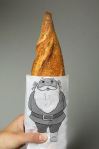
Cool Packaging

Cool packaging for your enjoyment.

Leave a comment

Filed under Humor and Observations

Reptile death match: Snake devours crocodile

Reptile death match: Snake devours crocodile

By Megan Gannon

Published March 05, 2014

  • snake-eating-croc

    A python was caught on camera as it swallowed a crocodile whole in northern Australia in March 2014. (YouTube | Barcroft TV)

A python was caught on camera devouring a crocodile after an epic battle on the shores of an Australian lake.

Amazing footage of the incident shows the snake constricting its prey and slowly stretching its mouth over the crocodile’s scaly body during the course of five hours.The reptile death match captured the attention of people at Lake Moondarra, near Mount Isa in the state of Queensland, over the weekend.

“You could see the crocodile in the snake’s belly which I think was probably the more remarkable thing,” local resident Tiffany Corlis told Australia’s ABC News.”You could actually see its legs and see its scales and everything, it was just amazing.” [Beastly Feasts: See Other Amazing Animals Devouring Prey]

Though the stomach-turning meal may look incredible, some animal experts say the incident isn’t all that uncommon.

‘You could see the crocodile in the snake’s belly, which I think was probably the more remarkable thing.’

– local resident Tiffany Corlis

“The big eat the smaller,” Lindsey Hord, a biologist with the Florida Fish and Wildlife Conservation Commission (FWC), wrote in an email to Live Science, noting that big snakes regularly eat crocodile relatives known as caiman in South America.

The combatants in this case are thought to be an olive python and a freshwater Johnston’s crocodile, both native to northern Australia. Terry Phillip, of South Dakota’s Reptile Gardens, told National Geographic that olive snakes are “known for being phenomenally powerful, pound for pound, and for feeding on large food items.”

Phillip added that snakes regularly swallow prey 75 to 100 percent their size. But footage of their amazing eating abilities continues to astound.

A sensational YouTube video from 2012 showed an anaconda regurgitating the carcass of a goat. And an engorged Burmese python was picked up in the Florida Everglades in 2011 after it had swallowed a 76-lb. deer. But sometimes snakes can bite off more than they can chew. Back in 2005, pictures circulated of another python that burst after it apparently tried to eat an American alligator in Florida.

Snakes don’t “unhinge” their jaw to eat; rather their two lower jaws are not actually connected so they can move independently of one another while the snakes eat their large prey. Scientists recently decoded the genome of Burmese pythons and found the snakes’ impressive snacking skills arise from a genetic capacity to alter their metabolism and their organs (which sometimes double in size) after a meal. That research was published in December in the journal Proceedings of the National Academy of Sciences.

3 Comments

Filed under Animals, Humor and Observations

Poachers targeting California’s redwoods to feed drug habits

Poachers targeting California’s redwoods to feed drug habits

Published March 06, 2014

FoxNews.com

California’s majestic redwood trees are in danger as poachers enter the sunshine state’s national parks to steal its wood to sell for furniture.

Rangers at Redwood National and State Park are taking extreme measures to protect the massacre of the national treasures, some of which are thousands of years old.

“It’s very disturbing, these trees are priceless,” Jeff Bomke, California State Parks Redwood Coast Sector acting superintendent, told Fox News Channel. The poachers are targeting burls, a knotted piece of wood that protrudes from the tree.

Only 5 percent of the remaining old growth redwoods since the time of western settlement still stand, Bomke said. “To see them injured in this way is very disturbing. These trees belong to everyone.”

Bomke said the poachers have generally been drug addicts or people with criminal records who look at the trees as an easy and alternative way to support themselves.

“The legitimate sources are becoming less available, private timberlands and private properties, for various reasons and the individuals that are supplying the materials to the vendors, are either drug addictions or have other criminal records,” he said. “So this is a way that they can get an income to support their needs and sell to these other sources.”

Although the trees can live when cut into, an open wound can cause pests and diseases to enter the redwoods. It can also destabilize the trees in the event of a windstorm, said Bomke.

“The redwoods are very resilient and they can heal but obviously the visual impact and also the adjacent impact to endangered species [is an issue].”

Bomke is working with local law enforcement agencies to help prevent the poaching.

“There’s an effort to close the roadway in the evening,” he said. “[It gives us] the ability to monitor closer this particular area.”

Rangers are also taking on extra shifts and patrols have increased.

“This is a very high priority for our law enforcement staff.”


1 Comment

Filed under Humor and Observations

Expansion planned at Maker’s Mark distillery

Expansion planned at Maker’s Mark distillery

Published February 28, 2014

Associated Press
  • markers_mark.jpg

    The producers of Maker’s Mark bourbon announced a distillery expansion  to pump up production and keep pace with growing demand for the Kentucky whiskey. (Maker’s Mark)

Thursday to pump up production and keep pace with growing demand for the Kentucky whiskey, known by its distinctive bottles sealed in red wax.

The $67 million expansion comes barely a year after the brand created a backlash by saying it was cutting the amount of alcohol in each bottle to stretch its whiskey supplies. Producers quickly scrapped the idea.

The expansion — in the works well before the watered-down whiskey flap — comes amid strong sales across the whiskey sector. Bourbon and Tennessee whiskey revenues rose a projected 10.2 percent last year in the U.S., and exports surpassed $1 billion for the first time, according to the Distilled Spirits Council.

Maker’s shipped 1.4 million cases in 2013, up 10.7 percent from the prior year. It forecasts shipments to reach 2 million cases later this decade, after surpassing 1 million cases in 2011.

Bourbon makers in Kentucky, which produces 95 percent of the world’s supply, have invested more than $300 million in expansions in the last two years, said Eric Gregory, president of the Kentucky Distillers’ Association.

In a bow to tradition, the Maker’s addition will replicate the existing distillery in Loretto, a town about 45 miles south of Louisville where every drop of Maker’s has been produced. That continuity ensures “the DNA of Maker’s Mark is preserved as the brand grows,” said Maker’s Mark chief operating officer Rob Samuels, grandson of the brand’s founders.

“This investment is a continuation of the heritage, tradition and vision for this brand as Maker’s Mark continues to grow,” he said.

It’s the second major expansion of the Maker’s distillery. The newest update will add a replica of two existing stills, more fermenters and additional warehouses to store the whiskey. The addition will boost the distillery’s production capacity by 50 percent.

Groundbreaking is planned for next month. The first whiskey coming off the new still will go into barrels for aging in mid-2015 and will mature, on average, between six and seven years before being bottled.

The state said the brand’s producers will be eligible for up to $5 million in tax benefits as part of the project.

“We are very excited that this iconic Kentucky brand continues to grow in popularity,” Gov. Steve Beshear said.

The expansion comes as the ownership of Maker’s is changing hands. Suntory Holdings Ltd., a Japanese beverage company, announced a deal in January to acquire Beam Inc., parent of Jim Beam and Maker‘s Mark. The combined company would have annual sales topping $4.3 billion.

The Beam Inc. board approved the project Wednesday.

1 Comment

Filed under Humor and Observations

600 year old mystery manuscript decoded

600 year old mystery manuscript decoded by University of Bedfordshire professor

Page 68r of the Voynich manuscript, with the seven stars of the �Pleiades� and the proposed word for Taurus
    <!–

  • Live chat
  • –><!–

  • Tweet
  • –>

Fri 14th February, 2014

AN award-winning professor from the University has followed in the footsteps of Indiana Jones by cracking the code of a 600 year old manuscript, deemed as ‘the most mysterious’ document in the world.

Stephen Bax, Professor of Applied Linguistics, has just become the first professional linguist to crack the code of the Voynich manuscript using an analytical approach.

The world-renowned manuscript is full of illustrations of exotic plants, stars, and mysterious human figures, as well as many pages written in an unknown text.

Up until now the 15th century cryptic work has baffled scholars, cryptographers and codebreakers who have failed to read a single letter of the script or any word of the text.

Over time it has attained an infamous reputation, even featuring in the latest hit computer game Assassin’s Creed, as well as in the Indiana Jones novels, when Indiana decoded the Voynich and used it to find the ‘Philosopher’s Stone’.

However in reality no one has come close to revealing the Voynich’s true messages.

Many grand theories have been proposed. Some suggest it was the work of Leonardo da Vinci as a boy, or secret Cathars, or the lost tribe of Israel, or most recently Aztecs … some have even proclaimed it was done by aliens!

Professor Bax however has begun to unlock the mystery meanings of the Voynich manuscript using his wide knowledge of mediaeval manuscripts and his familiarity with Semitic languages such as Arabic. Using careful linguistic analysis he is working on the script letter by letter.

“I hit on the idea of identifying proper names in the text, following historic approaches which successfully deciphered Egyptian hieroglyphs and other mystery scripts, and I then used those names to work out part of the script,” explained Professor Bax.

“The manuscript has a lot of illustrations of stars and plants. I was able to identify some of these, with their names, by looking at mediaeval herbal manuscripts in Arabic and other languages, and I then made a start on a decoding, with some exciting results.”

Among the words he has identified is the term for Taurus, alongside a picture of seven stars which seem to be the Pleiades, and also the word KANTAIRON alongside a picture of the plant Centaury, a known mediaeval herb, as well as a number of other plants.

Although Professor Bax’s decoding is still only partial, it has generated a lot of excitement in the world of codebreaking and linguistics because it could prove a crucial breakthrough for an eventual full decipherment.

“My aim in reporting on my findings at this stage is to encourage other linguists to work with me to decode the whole script using the same approach, though it still won’t be easy. That way we can finally understand what the mysterious authors were trying to tell us,” he added.

“But already my research shows conclusively that the manuscript is not a hoax, as some have claimed, and is probably a treatise on nature, perhaps in a Near Eastern or Asian language.”

Find out more about his work at the University’s Centre for Research in English Language Learning and Assessment (CRELLA) and also on his personal website www.stephenbax.net

Professor Bax, who was recently awarded the 2014 TESOL International Distinguished Researcher Award for his work on eye-tracking and reading, will discuss this and other research at his inaugural professional lecture at the University’s Luton campus on Tuesday 25 February at 6pm.

For a complimentary ticket visit: sbax.eventbrite.com

Notes to editor

  • Journalists wishing to attend the lecture are asked kindly to first contact the press office on 01582 743499 or via simon.wesson@beds.ac.uk
  • To interview Professor Bax, please also use the above contact details.
  • Professor Bax will be presented with the 2014 TESOL International Distinguished Researcher Award in Portland, Oregon, in March.
  • Find out more about Professor Bax’s work at www.beds.ac.uk/crella and also on his personal website www.stephenbax.net
  • Picture shows: Page 68r of the Voynich manuscript, with the seven stars of the ‘Pleiades’ and the proposed word for Taurus
  • For a photo of Professor Bax, contact Simon Wesson.

Leave a comment

Filed under Humor and Observations

Steampunk Short Wins Oscar

Two of my favorites in one film – steampunk and a dog.  The short animated film Mr. Hublot won the Oscar.  It is only 11 minutes long.  You can watch it here:

https://www.youtube.com/watch?v=UakrGPHrlcw

  • Mr Hublot
    2013 Film
  • Mr Hublot is a French-Luxembourgish animated short film by Laurent Witz with/after the characters of Stephane Halleux. It won the Academy Award for Best Animated Short in 2014.
  • Genres: Short Film, Fantasy, Animation, Comedy, Family
    untitled (4)

3 Comments

Filed under Humor and Observations

Cute Dogs for Your Monday Blues

Cute dogs for those Monday blues…

Leave a comment

Filed under Animals, Humor and Observations

Movie Line Humor

I went to the movies with my wife Friday night to see Monuments Men.  On the way to the theater, I walked by this line set up with a sign “Line to See the Son of God”.  There was no one in line, but about eight theater workers standing around nearby.  I said, “Kind of sad of Phoenix, here is a line to see the Son of God and it’s empty.  I’d hate to see the line to Hell, I bet it’s packed.”  They looked at me blankly.  One young girl said, “we just let them in to the movie a few minutes ago.”  They looked at me weird.  I tried to explain.  They looked at me uncomfortably, so I just ambled along…  Religious ironic humor – lost on the young…


untitled


Leave a comment

Filed under Humor and Observations

Greenpeace co-founder: No scientific proof humans are dominant cause of warming climate

Greenpeace co-founder: No scientific proof humans are dominant cause of warming climate

Published February 26, 2014

FoxNews.com
  • icebergs_antartica2.jpg
    Reuters

A co-founder of Greenpeace told lawmakers there is no evidence man is contributing to climate change, and said he left the group when it became more interested in politics than the environment.

Patrick Moore, a Canadian ecologist and business consultant who was a member of Greenpeace from 1971-86, told members of the Senate Environment and Public Works Committee environmental groups like the one he helped establish use faulty computer models and scare tactics in promoting claims man-made gases are heating up the planet.

“There is no scientific proof that human emissions of carbon dioxide (CO2) are the dominant cause of the minor warming of the Earth’s atmosphere over the past 100 years,” he said.

Even if the planet is warming up, Moore claimed it would not be calamitous for men, which he described as a “subtropical species.”

Skeptics of manmade climate change say there is no evidence the Earth is warming. A UN report on the scientific data behind global warming released in September indicated that global surface temperatures have not increased for the past 15 years, but scientists who believe climate change due to man is occurring say it has merely paused because of several factors and will soon resume.

The 2,200-page new Technical Report attributes that to a combination of several factors, including natural variability, reduced heating from the sun and the ocean acting like a “heat sink” to suck up extra warmth in the atmosphere.

Moore said he left Greenpeace in the 1980s because he believed it became more interested in politics than science.

“After 15 years in the top committee I had to leave as Greenpeace took a sharp turn to the political left, and began to adopt policies that I could not accept from my scientific perspective,” he said. “Climate change was not an issue when I abandoned Greenpeace, but it certainly is now.”

7 Comments

Filed under Humor and Observations