Monthly Archives: November 2014

Ancient Virus Revived From 700-Year-Old Caribou Feces

Sounds like something stupid to start a zombie apocalypse movie…

October 28, 2014 | by Janet Fang

photo credit: An ice core containing ancient caribou feces. Caribou DNA, digested plants, and viruses were frozen within layers of ice for thousands of years, enabling researchers to detect the genomes of ancient viruses / Brian Moorman

Researchers have reconstituted a viral genome from centuries-old caribou feces frozen in the subarctic, and they’ve used the ancient viruses to infect lab plants. The findings, published in Proceedings of the National Academy of Sciences this week, offer a rare glimpse of viral evolution.

Ancient viruses provide snapshots of past diversity and a way to trace viral evolution, but their concentrations are low and intact samples are rarely successfully isolated from the environment. Cryogenically preserved samples in nature may be an untapped repository of preserved ancient viral genetic material.

A team led by Eric Delwart from the University of California, San Francisco, analyzed viral genetic material contained in an ice core obtained by drilling through layers of accumulated caribou feces up to 4,000 years old in a permanent ice patch in the Northwest Territories of Canada. Caribou gather on ice patches to escape pesky flying insects and heat in the summertime. After eating nearby veggies, they deposit feces that contain their DNA, partially digested plant material, as well as viruses—which can remain frozen for millennia. Here’s an aerial photograph of one such caribou congregation:

From a 700-year-old layer of the ice core, the team isolated the complete small circular genome of a DNA virus that was distantly related to plant and fungi-infecting viruses today. They named it aCFV, for ancient caribou feces associated virus. They also isolated a partial viral RNA genome that was related to an insect-infecting virus. They call this one Ancient Northwest Territories cripavirus, or aNCV.

These never-before-seen viruses either originated in plants eaten by caribou or insects attracted to fecal matter, and they were preserved at constant freezing temperatures within protective viral capsids.

The team used a “reverse genetic approach” to reconstitute the genome of the DNA virus. Then, to confirm that the virus infects plants, they inoculated the tobacco relative Nicotiana benthamianawith the ancient viral DNA. The inoculated plants displayed evidence of infection: The DNA virus replicated and systemically spread in the inoculated leaves (orange arrow) as well as their newly emerging leaves (white arrow).

As far as Delwart can tell, these viruses aren’t dangerous, NPR reports. But as the climate warms and more ice melts, more caribou poo infected with ancient viruses might be making its way into the modern ecosystem.

Images: Brian Moorman (top), Glen MacKay (middle), Li-Fang Chen (bottom)


Leave a comment

Filed under Animals, Humor and Observations

Cute Dog Pictures for Your Monday Blues!

Hopefully, these cute dogs will cheer you up for the start of the week.

Leave a comment

Filed under Animals

Ancient city ruled by Genghis Khan’s heirs revealed

golden-horde-treasures-1

Archaeologists with the Saratov Regional Museum of Local Lore have uncovered part of the city of Ukek. Built by a khanate (a kingdom) called the “Golden Horde” the city flourished between AD 1250 and 1395. Today much of it is covered by modern (Photo courtesy Dmitriy Kubankin)

Remains of a 750-year-old city, founded by the descendents of Genghis Khan, have been unearthed along the Volga River in Russia.

Among the discoveries are two Christian temples one of which has stone carvings and fine ceramics.

The city’s name was Ukek and it was founded just a few decades after Genghis Khan died in 1227. After the great conqueror’s death his empire split apart and his grandson Batu Khan, who lived from 1205 to 1255, founded the Golden Horde (also called the Kipchak Khanate).The Golden Horde kingdom stretched from Eastern Europe to Central Asia and controlled many of the Silk Road trade routes that connected China to Medieval Europe.

This city of Ukek was built close to the khan’s summer residence along the Volga River, something which helped it become prosperous. The name “Golden Horde” comes from the golden tent from which the khan was said to rule. [See Photos of the Medieval ‘Golden Horde’ City and Artifacts]

Christian quarter

Archaeologists with the Saratov Regional Museum of Local Lore have discovered the Christian quarter of Ukek, shedding light on the Christian people who lived under the Khan’s rule. Ukek was a multicultural city, where a variety of religious beliefs were practiced including Islam, Christianity and Shamanism.

While Christians did not rule the Golden Horde, the discoveries archaeologists made show that not all the Christians were treated as slaves, and people of wealth frequented the Christian quarter of the city.

“Some items belonging to local elite were found in the Christian district,” Dmitriy Kubankin, an archaeologist with the Saratov Regional Museum of Local Lore, told Live Science in an e-mail. “Among other things, there is a Chinese glass hair pin, with a head shaped as a split pomegranate, and a fragment of a bone plate with a carved dragon image.”

Stone temples

Among the discoveries are the basements of two Christian temples. In eastern Christianity churches are sometimes called temples.

One of the temples was built around 1280 and was destroyed in the early 14th century. “It was roofed with tiles and decorated with murals and stone carving[s], both, from the outside and inside,” Kubankin said.

“The best-preserved bas relief (a type of stone carving) features a lion being clawed by a griffin,” said Kubankin, noting that another carving depicts a cross.

Within the basement of the temple, archaeologists found the remains of goods that may have been stored by local merchants, including fine plates and bottles that were imported from the Byzantine Empire, Egypt or Iran. “Any church cellar was considered a safe place to store goods in it, therefore, merchants from the nearest neighborhood used to keep (objects) of sale there,” Kubankin said.

After the first Christian temple was destroyed in the early 14th century, a second temple was built in 1330 and remained in use until about 1350. “Most probably, it was stone-walled and had a tile roof. A part of its foundation with the apse has been unearthed,” Kubankin said.

The fall of Ukek

The city of Ukek did not last for long. During the 14th century, the Golden Horde began to decline, and in 1395 Ukek was attacked by a ruler named Tamerlane, a man out to build an empire of his own. He destroyed Ukek and took over much of the territory formerly ruled by the Golden Horde, dealing them a blow from which they would never recover.

Today modern-day buildings cover much of Ukek. “This hampers any research and prevents complete unearthing of the entire [site], because it extends over several private land plots,” Kubankin said.

Nevertheless, digging just in one site may lead to significant discoveries. Archaeological expeditions from the Saratov Regional Museum of Local Lore [have made] yearly excavations since 2005,” said Kubankin, adding that these discoveries will soon be featured in a museum exhibition.

Kubankin presented the team’s finds recently at the European Association of Archaeologists’ annual meeting in Istanbul. The study is supported by the Saratov Regional Ministry of Culture, Russian Humanitarian Research Foundation grant (project 12-31-01246) and by the RIMKER Company.


Leave a comment

Filed under Humor and Observations

Cosplay Pictures for Your Weekend

Cosplay pictures for your enjoyment!

Leave a comment

Filed under Humor and Observations

Random Humor

Random humor to cheer up the end of the work week…

2 Comments

Filed under Humor and Observations

Bronze Age Palace & Royal Burial Unearthed in Spain

Bronze Age Palace & Royal Burial Unearthed in Spain

Wednesday, October 08, 2014


(Courtesy the Universitat Autònoma de Barcelona)

BARCELONA, SPAIN—Science Daily reports that an audience hall has been found in the Bronze Age palace at La Almoloya, located in southeastern Spain. Archaeologists Vicente Lull, Cristina Huete, Rafael Micó, and Roberto Risch of the Universitat Autònoma de Barcelona suggest that the hall is the oldest-known building constructed specifically for political use in continental Europe. It features a ceremonial fireplace and a podium, and benches lining its walls would have seated 64 people. Other buildings at the site are well-constructed with eight to twelve rooms in each residence. Some of the stucco-covered walls were decorated with geometric and naturalistic motifs in what has been dubbed the Argaric style. A tomb discovered near the political hall contained the remains of a man and a woman, whose skull was encircled with a silver diadem. She had also been buried with four ear dilators, two of silver and two of gold. Rings, earrings, and bracelets made of silver were among the grave goods. Other items include a bronze dagger held together with silver nails, and a small ceramic cup decorated with silver rims.  To read about Bronze Age shipwrecks, see ARCHAEOLOGY’s “Cape Gelidonya and Uluburun.”

1 Comment

Filed under Humor and Observations

Bizarre Human Brain With No Wrinkles Discovered

October 31, 2014 | by Kristy Hamilton

photo credit: An adult human brain with no folds. Image Credit: Adam Voorhes. http://www.voorhes.com/

Share on facebook94.7K Share on twitter455 Share on reddit Share on google_plusone_share More Sharing Services

While photographing shelves of human brains stored away in a closet at the University of Texas for his next book, Adam Voorhes happened upon a truly unique find: a brain with no folds.

David Dexter, scientific director at Parkinson’s UK Brain Bank, told New Scientist that he had never seen an adult brain like this before: “We do get the odd individual where certain sulci are missing but nothing to the extent of this brain.”

The lack of grooves (sulci) and folds (gyri) that characterize a human brain are due to a rare condition called lissencephaly. The disorder is caused by abnormal neuronal migration during embryonic development.

Image Credit: Adam Voorhes. Book: Malformed: Forgotten Brains of the Texas State Mental Hospital. The smooth brain is on the bottom, second to the right.

To learn more about this rare find, Voorhes spent over a year trying to hunt down the details of this and the approximately 100 other human brains in the collection. He sifted through a century’s worth of documents and found a history rife with battle for ownership of the collection. However, nothing about the specific individual came to light.

People with similar though less extensive forms of lissencephaly often experience difficulty swallowing, muscle spasms, seizures, and learning difficulties. Many individuals with this condition die before the age of 10.

All the brains in the collection are from patients at the Austin State Mental Hospital and were subsequently preserved in jars of formaldehyde. For more than 20 years, the brains were forgotten about in a dark closet somewhere in the back of an animal lab. While all the rediscovered brains are considered disfigured or abnormal in some way, a brain with so few folds and grooves is a rarity amongst the rare.

Image Credit: Adam Voorhes. Book: Malformed: Forgotten Brains of the Texas State Mental Hospital

Currently, the University of Texas is working on documenting the brains in more detail with an MRI scanner. Upon conclusion, the brains will be put on display at the Imaging Research Center on campus.

Leave a comment

Filed under Humor and Observations

90-year-old among first charged under Fort Lauderdale’s strict rules against feeding homeless

Just another example of the atrocities of big government…

Abbottpic1.jpg

Arnold Abbott plans to defy Fort Lauderdale’s ordinance against feeding the homeless again on Wednesday. (Courtesy: Sun-Sentinel)

Fort Lauderdale police say Arnold Abbott violated a new city law, but the 90-year-old homeless advocate says his only crime was to “love thy neighbor.”

Abbott was charged Sunday along with two local pastors with violating the city’s new ordinance that effectively bans giving out food in public. He faces 60 days in jail and a $500 fine, and he intends to get cited again Wednesday night, when he sets out to feed some of the Florida city’s estimated 10,000 homeless on a public beach.

“The homeless people come here for the weather. They know they won’t freeze to death in Fort Lauderdale.”- Arnold Abbott, homeless advocate

“I know that I will be arrested again, and I am prepared for that,” Abbott said by phone from his office at Love Thy Neighbor, Inc., a nonprofit he established in honor of his wife, Maureen, after her death in a car accident 23 years ago. “I am my brother’s keeper, and what they are doing is just heartless.”

Fort Lauderdale passed an ordinance late last month that included a slate of new regulations on where and how groups can provide food to homeless people.  The vote made the city the 13th in the nation since 2012 to pass restrictions on where people can feed the homeless, according to a report by the National Coalition for the Homeless.

The regulations enacted in Fort Lauderdale state that no two indoor feeding sites can be within 500 feet of one another or on the same block; outdoor feeding programs require a permit or permission of the property owner and must provide portable toilets; and outdoor stations cannot be within 500 feet of residential properties.

Abbott, whose charity has battled city officials for years in court and on the streets of the southern Florida city, said the toilet requirement was too much for his group.

“I have tried to abide by their regulations, but we just are not able to provide a port-a-potty,” he said. “I believe that is the job of the municipality, anyway.”

Cited along with Abbott were Dwayne Black, pastor of The Sanctuary Church in Fort Lauderdale, and Mark Sims of St. Mary Magdalene Episcopal Church in Coral Springs, according to the Fort Lauderdale Sun-Sentinel. Although the three were not handcuffed or taken to jail, they were cited and must appear in court or face a bench warrant.

Fort Lauderdale officials defended the ordinance, saying it does not bar people from helping the hungry.

“The ordinance allows for legal, clean and safe distribution of food to the homeless,” said Fort Lauderdale Police Department Det. DeAnna Greenlaw. “For example, if a minister, priest or member of clergy wishes to provide food to the homeless at their establishment (I.e community hall, church or gathering place) they can do so if the proper facilities, as listed in the ordinance, are in place.”

Supporters of the strict laws say that allowing programs like Abbott’s encourages homelessness. Cal Deal, a 65-year-old former journalist who videotapes homeless people in the city and says they commit crimes, cause sanitation problems and need more help than simply food.

“The people feeding them are enablers, and they enable the homeless by making their lives easier,” Deal told the New Times of Broward County. “Hunger is a big motivator. Are people more likely to seek help when they’re hungry or when they’re fed and happy?”

Ron Book, chairman of the Miami-Dade County Homeless Trust, told city lawmakers at the raucous, Oct. 21 meeting at which the new laws were passed that they would have a positive effect.

“Feeding people on the streets is sanctioning homelessness,” Book said. “Whatever discourages feeding people on the streets is a positive thing.”

Sims acknowledged that Fort Lauderdale has a problem with homelessness, but said the answer isn’t laws that make it hard to feed people.

“It’s not an easy issue, not cut and dried,” Sims said. “But what is cut and dried is that people deserve to eat when they are hungry. And people of faith are compelled to reach out to people who are in need.

“We need to work harder to solve the problem, rather than just shutting it down,” he added.

Abbott said there is a simple explanation for Fort Lauderdale’s outsize homeless population.

“The homeless people come here for the weather,” he said. “They know they won’t freeze to death in Fort Lauderdale.”

Abbott, a World War II veteran who won two Purple Hearts as an infantryman, said he won’t stop the fight he has dedicated to his wife.

“She tried to help as many poor and homeless people as she could,” said Abbott, a retired jewelry salesman who grew up in Philadelphia. “When I lost her, I decided the best tribute to her would be a full-time program in her name.”

In addition to feeding the homeless, Love Thy Neighbor operates a culinary training program that Abbott says has helped more than 400 people learn food service skills.

But the food programs have gotten him in trouble for years. In 1999, the city tried to stop Abbott from feeding the homeless on Fort Lauderdale Beach, the same location he plans to go to Wednesday. Abbott sued and won, and says he will go back to court if necessary.

“I’ll go to court again and sue the city,” said Abbott. “They are doing the bidding of the very wealthy, and they are trying to sweep the poorest of the poor under the rug.”

Leave a comment

Filed under Humor and Observations

Abandoned Towns and Cities of the World

Standing as stark reminders of a people’s past endeavors and hopes for the future, thousands of abandoned towns and cities can be seen around the world–some like silent, dusty museums, some little more than markers left in remembrance.
Standing as stark reminders of a people’s past endeavors and hopes for the future, thousands of abandoned towns and cities can be seen around the world–some like silent, dusty museums, some little more than the wood or stone markers placed in remembrance.

Yet, each speaks volumes of another time.

War, superstition, famine, earthquakes,religion, man-made disasters, shifting values, fire, disease, failed economy, and hurricanes have all played their roles in reducing thriving, prosperous cities to mere rubble and models of waste.

From Hong Kong to France, Turkey to Chile, here are ten of the countless  abandoned towns and citiesthat still speak loudly of the people who once called them home.

> The Kowloon Walled City, Hong Kong: Abandoned 1993

Image credit

A former watchpost to guard against pirates, the Kowloon Walled City was built just outside Hong Kong, China during British rule. Occupied by Japan during World War II and subsequently taken over by squatters after Japan’s surrender, neither Britain nor China wanted responsibility for the deteriorating metropolis so it became its own lawless city. Flourishing for decades, it became a place where brothels,casinos, opium dens, cocaine parlors, vendors serving dog meat, and secret factories ran rampant.  It was finally torn down in 1993 after British and Chinese authorities grew wary of the out-of-control population living in filthy conditions.

> Pripyat, Ukraine: Abandoned 1986

Image credit

Now a mere ghost town near the Chernobyl Nuclear Power Plant in northern Ukraine (in the Kiev Oblast [province]), Pripyat was founded in 1970 specifically to house workers of the nuclear power plant. Officially proclaimed a city in 1979, it achieved a population of nearly 50,000 before being forced to abandon it in 1986 following the Chernobyl disaster.

> Oradour-sur-Glane, France: Abandoned late 1940s

Image credit

The site of one of the most horrific war atrocities in French history, the small village of Oradour-sur-Glane was the scene of a massacre perpetrated by the Germans who’d planned to punish members of the French Resistance. Intending to target nearby Oradour-sur-Vayres–instead of Oradour-sur-Glane–German soldiers marched in and disposed of 642 civilians on June 10th, 1944. According to a survivor’s account, “The men were herded into barns where they were shot in the legs so they would die more slowly. The women and children, who had been held in a church, all perished when their attempt to escape was met by machine-gun fire. The village was razed by the Germans afterward.” Today, the ruins at Oradour-sur-Glane stand as a memorial to the dead and as a reminder of that event.

> Sanzhi district, New Taipei City, Taiwan: Abandoned 1980

Image credit

With construction beginning in 1978, the Sanzhi UFO houses (also known as the Sanzhi pod houses or Sanzhi Pod City), were a set of pod-shaped buildings owned by Hung Kuo Group, marketed as a vacation resort for U.S. military officers coming from their East Asian postings. The project, however, was abandoned in 1980 due to investment losses and several car accident deaths occurring during construction, said to have been caused by the unlucky act of bisecting the Chinese dragon sculpture located near the resort gates during the widening the entrance road. (Another story pointed to the fact that the site was the former burial ground for Dutch soldiers.) Despite an online petition to retain one of the structures as a museum (and it becoming the location of an MTV film on the subject), demolition on the site began on December 29, 2008, with plans to redevelop the site into a tourist attraction with hotels and beach facilities at a later date.

> Kolmanskop, Namibia, Africa: Abandoned 1956

Image credit

Located a few miles inland from the port of Laderitz in Namibia, Africa, Kolmanskop was a wild and dangerous German-built diamond mining town which thrived until 1956 when diamond demand declined and richer sources of diamonds were discovered in other areas of Africa. Once offering a German style ballroom, theater, and the first tram system in Africa, the shifting sands have now filled the houses, covered the streets, and is slowly erasing most signs of civilization. Now nearly sand-bound, the abandoned city is said to be a habitat for birds, hyenas, and other wild and feral animals.

> Kayakoy, Turkey: Abandoned 1923

Image credit

Once a thriving Greek village dating to the 13th century with 25,000 inhabitants, the town was completely deserted when its entire population–along with millions of other Greeks in Turkey–were forced out of the country due to the Greek War of Independence in 1923. Since then, the village has stood empty and deteriorating. Kayakoy is cited as the largest and most well-preserved ghost village of Asia Minor.

> Craco, Basilicata, Italy: Abandoned 1960s

Image credit

The medieval village of Craco, Italy, was built on a very steep summit to utilize its natural defense against invaders. Over the centuries, however, the village lost residents due to a plague, French occupation, civil war, and finally, lost the majority of its population due to near-famine in 1892 and 1922. The final blows were earthquakes in the 1960s which forced the remaining occupants out of the city. It now sets completely uninhabited, with a number of old world churches such as Santa Maria della Stella standing as reminders of what once was.

>Tyneham, Isle of Purbeck, south Dorset England: Abandoned 1940s

Image credit

Referred to as “the village that Dorset lost,” the British Ministry of Defense commandeered this town on the Isle of Purbeck during World War II to use as an army base, with citizens promised they could return to their homes after the war ended. But they were never allowed back in. Lying now in ruins except for the schoolhouse and church that still stand relatively untouched, a poignant sign on the church still reads, “Please treat the church and houses with care; we have given up our homes where many of us lived for generations to help win the war to keep men free. We shall return one day and thank you for treating the village kindly.”

> Klomino, Poland: Abandoned 1992

Image credit

Built solely as living quarters for the Russian Army, Polish officials have been trying to dispose of the village of Klomino for years now–last on the market for 2 million dollars. Due to lack of interest, most of its remaining buildings have been demolished, with locals destroying the remainder. It has set quietly waiting repopulation since the Russian Red Army withdrew its forces in 1992.

> Humberstone, Chile: Abandoned 1961

Image credit

A booming town from the 1920s through the early 1940s, Humberstone enjoyed wealth and prosperity due to the mining and processing of nitrate, also known as “saltpeter.” Once synthetic saltpeter was invented, however, the town fell into economic decline until it was finally abandoned in 1961. Now encased in sand, the town has been named a World Heritage Site and will most likely be preserved as an historical monument.

References:

http://www.gadling.com/2011/04/27/the-worlds-ten-creepiest-abandoned-cities/?ncid=&a_dgi=aolshare_email

http://weburbanist.com/2008/07/06/20-abandoned-cities-and-towns/

http://www.perspectivaciudadana.com/contenido.php?itemid=24246

Leave a comment

Filed under Humor and Observations

Easter Islanders weren’t as isolated as we thought

Easter Islanders weren't as isolated as we thought

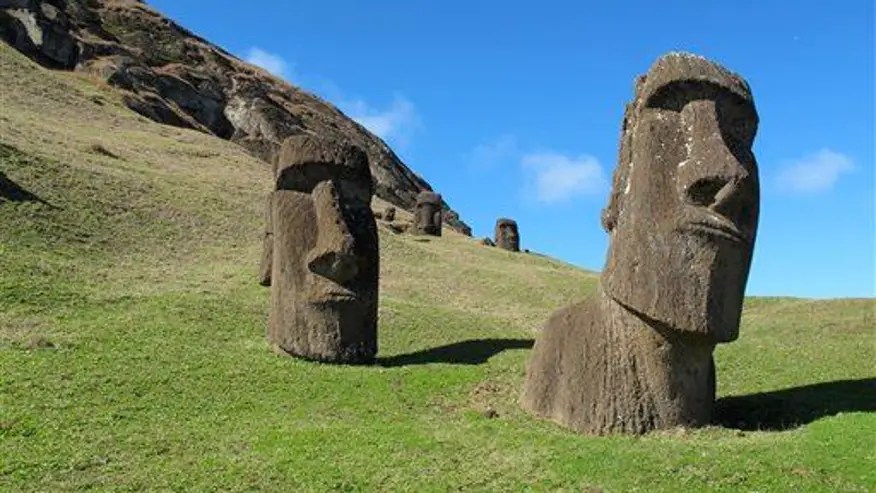
This August 2012 photo shows heads at Rano Raraku, the quarry on Easter Island. (AP Photo/Karen Schwartz)

Easter Island, or Rapa Nui, is such a remote speck of rock in the Pacific Ocean that it has been nicknamed “navel of the world.” Yet a review of genetic data of 27 natives suggests the islanders made contact with outsiders hundreds of years before the first Europeans arrived from Holland in 1722.

In fact, the Rapa Nui people appear to have had significant intermixing with Native Americans as far back as the late 13th century, researchers report in the journal Current Biology.

The findings indicate “an ancient ocean migration route between Polynesia and the Americas,” says the study’s lead author. Though the nearly 2,500-mile journey would have been perilous in their wooden outrigger canoes, the researchers say it’s more likely the islanders ventured to South America and back than others finding their way to Easter Island, reports Reuters.

Today’s Rapa Nui people are genetically about 76% Polynesian, 16% European, and 8% Native American, though the European intermingling dates back only to the 19th century, while the Native American intermingling appears to go back 19 to 23 generations.

A separate study also published in Current Biology this week details the genetic makeup of two ancient human skulls from Brazil’s indigenous Botocudo tribe. The skulls were genetically Polynesian without any Native American mixing, further suggesting that islanders traveled to the Americas.

(Check out the drug that scientists found in the island’s soil.)

This article originally appeared on Newser: Easter Islanders Not as Isolated as Thought

Leave a comment

Filed under Humor and Observations