Category Archives: Humor and Observations

Astronauts warn UN of threat to Earth from asteroids

Astronauts warn UN of threat to Earth from asteroids

By Laura Poppick

Published October 28, 2013

  • asteroid-impact

    An artist’s illustration of a massive asteroid impact on earth. Some single-celled organisms may be able to survive extreme impacts such as these, scientists say. (NASA/DON DAVIS)

  • potential-hazardous-asteroids-crop

    This NASA graphic shows the orbits of all the known Potentially Hazardous Asteroids (PHAs), numbering over 1,400 as of early 2013. Shown here is a close-up of the orbits overlaid on the orbits of Earth and other inner planets. (NASA/JPL-CALTECH)

NEW YORK –  Members of the United Nations met with distinguished astronauts and cosmonauts this week in New York to begin implementing the first-ever international contingency plan for defending Earth against catastrophic asteroid strikes.

Six of the space travelers involved in these U.N. discussions discussed the asteroid defense effort Friday in a news conference hosted by astrophysicist Neil deGrasse Tyson at the American Museum of Natural History. Their goal: to drive home the very-real threats posed by near-Earth objects (NEOs), or asteroids traveling within the radius of Earth’s orbit with the sun. You can see a video of the asteroid defense discussion here.

Scientists estimate that there are roughly 1 million near-Earth asteroids that could potentially pose a threat to the planet, but only a small fraction of these have actually been detected by telescopes. There are about 100 times more asteroids lurking in space than have ever been located, said Edward Lu, a former NASA astronaut and co-founder of the non-profit B612 Foundation advocating asteroid defense strategies. “Our challenge is to find these asteroids first, before they find us,” Lu said. [Photos: Potentially Dangerous Asteroids Up Close]

‘This decision of what to do, how to do it and what systems to use has to be coordinated internationally.’

– Former NASA astronaut and B612 co-founder Russell Schweickart

To help achieve this goal, Lu co-founded an organization called the B612 Foundation in 2002. Today, the group is developing a privately built infrared space telescope — called the Sentinel Space Telescope — with the sole purpose of locating threatening asteroids. The foundation hopes to launch the telescope by 2018.

The Sentinel telescope will help space agencies identify threatening near-Earth objects years before they hit Earth, providing governments and space agencies with enough time to take action, Lu and his colleagues said. Such action would entail deploying a spacecraft — or multiple spacecrafts, depending on the size of the space rock — toward the asteroid in order to smack it off course.

The technology and funds to deflect an asteroid in this way already exist, the panel explained, but the Association of Space Explorers, a group that includes active and retired astronauts, decided to involve the United Nations in their decision-making efforts to avoid nationally biased action in the event of an emergency.

“The question is, which way do you move [the asteroid]?” former NASA astronaut and B612 co-founder Russell Schweickart said in the news conference. “If something goes wrong in the middle of the deflection, you have now caused havoc in some other nation that was not at risk. And, therefore, this decision of what to do, how to do it and what systems to use has to be coordinated internationally. That’s why we took this to the United Nations.”

The panel hopes that the discussions with the United Nations this week —which extend from discussions dating back to 2008, when the panel presented the United Nations with the first draft of a report titled “Asteroid Threats: A Call for Global Response” —will improve public awareness of the threats at hand, and encourage policymakers to develop plans and appoint leaders to deal with threats in a timely manner.

The explosion of a truck-size asteroid over Chelyabinsk, Russia, this past February —which blew out windows throughout the entire city and injured more than 1,000 people —helped draw public attention to what the panelists described as the often-overlooked and underappreciated threat to the planet.

“It did make a difference in policymakers realizing that this is not just a science-fiction concept, or something that will happen in 100 or 500 years in the future,” Thomas Jones, former NASA astronaut and senior research scientist at the Florida Institute for Human and Machine Cognition, told SPACE.com at the news conference. “The fact that it happened right now, I think, enforced the reality.”

The recommendations that the group presented to the United Nations this week provide an outline of what governments will ultimately implement in the event of an emergency. However, the details of these recommendations are still in the works, Schweickart said.

Leave a comment

Filed under Humor and Observations

Random Humor

Some random humor to bring you into the weekend.  Enjoy!

1 Comment

Filed under Humor and Observations

The Forgotten Giant Arrows that Guide you Across America

The Forgotten Giant Arrows that Guide you Across America

In “don’t be a tourist” “Nostalgia” on November 15, 2013 at 6:58 pm

If you’re ever really lost on a road trip across America, and I’m talking really lost (let’s say the battery on your smartphone just died along with that compass application you downloaded for situations just like this), perhaps you might be lucky enough to find yourself next to one of the giant 70 foot concrete arrows that point your way across the country, left behind by a forgotten age of US mail delivery.

Directional Arrow

Photo by Clay Fraser

Certainly a peculiar site to come across in the middle of nowhere, 50 foot, possibly 70 foot long, with weeds crawling through its concrete cracks, abandoned long ago by whoever put it there. This arrow may point your way out of the desert but it’s also pointing to the past.

Photo via Core77

Long before the days of radio (and those convenient little smartphone applications), the US Postal service began a cross-country air mail service using army war surplus planes from World War I, many piloted by former army flyers. To get the planes and everybody’s mail safely across the country by air, the postman was going to need a little help.


In 1924, the federal government funded enormous concrete arrows to be built every 10 miles or so along established airmail routes to help the pilots trace their way across America in bad weather conditions and particularly at night, which was a more efficient time to fly.

Painted in bright yellow, they were each built alongside a 50 foot tall tower with a rotating gas-powered light and a little rest house for the folks that maintained the generators and lights. These airway beacons are said to have been visible from a distance of 10 miles high.

The Air Mail route from New York to San Francisco with beacon locations.

A model of one of the arrows and beacons at the IPMS (International Plastic Modelers Socity) Nationals contest in Loveland, CO, which you a pretty good idea of the layout.Photo via here.

By World War II, radio was king and the airway beacons were obsolete. Taking anything they could get, the government took down the towers and recycled them as scrap metal for the war effort.

It’s unknown exactly how many airway lighthouses remain (project anyone?) but one preservation program called Passport in Time has protected three beacon sites from falling into complete disrepair, saving the generator huts and a neighbouring 1930s cabin that served as a residence for the fire lookout.

There is also this fully restored restored tower and its generator shack in New Mexico.

While no one bothered to remove the concrete arrows, many have probably been caught up by development but an outline could still be visible from the air if they were just covered over by a grass lawn. Or maybe you might just come across some concrete remains that seem very out of place in the middle of a field…

Image by Henry Brean for Las Vegas Review

Here’s a link to one of the giant arrows on Google maps as well as a website listing the original locations of Eastern and Western beacons, siting which ones have been found/ destroyed/ preserved etc.

Anyone feel like getting lost on purpose to go on a treasure hunt for these giant arrows to the past?!

Sources: A very welcome tip from a reader! as well as Core77this forumThe History Mystery Exaxaminer.

3 Comments

Filed under Humor and Observations

Nurse reveals the top 5 regrets people make on their deathbed

Nurse reveals the top 5 regrets people make on their deathbed

By  | November 11, 2013

Nurse reveals the top 5 regrets people make on their deathbed

For many years I worked in palliative care. My patients were those who had gone home to die. Some incredibly special times were shared. I was with them for the last three to twelve weeks of their lives. People grow a lot when they are faced with their own mortality.

I learnt never to underestimate someone’s capacity for growth. Some changes were phenomenal. Each experienced a variety of emotions, as expected, denial, fear, anger, remorse, more denial and eventually acceptance. Every single patient found their peace before they departed though, every one of them.

When questioned about any regrets they had or anything they would do differently, common themes surfaced again and again. Here are the most common five:

1. I wish I’d had the courage to live a life true to myself, not the life others expected of me.
This was the most common regret of all. When people realize that their life is almost over and look back clearly on it, it is easy to see how many dreams have gone unfulfilled. Most people had not honoured even a half of their dreams and had to die knowing that it was due to choices they had made, or not made.

It is very important to try and honour at least some of your dreams along the way. From the moment that you lose your health, it is too late. Health brings a freedom very few realise, until they no longer have it.

2. I wish I didn’t work so hard.
This came from every male patient that I nursed. They missed their children’s youth and their partner’s companionship. Women also spoke of this regret. But as most were from an older generation, many of the female patients had not been breadwinners. All of the men I nursed deeply regretted spending so much of their lives on the treadmill of a work existence.

By simplifying your lifestyle and making conscious choices along the way, it is possible to not need the income that you think you do. And by creating more space in your life, you become happier and more open to new opportunities, ones more suited to your new lifestyle.

3. I wish I’d had the courage to express my feelings.
Many people suppressed their feelings in order to keep peace with others. As a result, they settled for a mediocre existence and never became who they were truly capable of becoming. Manydeveloped illnesses relating to the bitterness and resentment they carried as a result.

We cannot control the reactions of others. However, although people may initially react when you change the way you are by speaking honestly, in the end it raises the relationship to a whole new and healthier level. Either that or it releases the unhealthy relationship from your life. Either way,you win.

4. I wish I had stayed in touch with my friends.
Often they would not truly realise the full benefits of old friends until their dying weeks and it was not always possible to track them down. Many had become so caught up in their own lives that they had let golden friendships slip by over the years. There were many deep regrets about not giving friendships the time and effort that they deserved. Everyone misses their friends when they are dying.

It is common for anyone in a busy lifestyle to let friendships slip. But when you are faced with your approaching death, the physical details of life fall away. People do want to get their financial affairs in order if possible. But it is not money or status that holds the true importance for them. They want to get things in order more for the benefit of those they love. Usually though, they are too ill and weary to ever manage this task. It is all comes down to love and relationships in the end. That is all that remains in the final weeks, love and relationships.

5. I wish that I had let myself be happier.
This is a surprisingly common one. Many did not realise until the end that happiness is a choice. They had stayed stuck in old patterns and habits. The so-called ‘comfort’ of familiarity overflowed into their emotions, as well as their physical lives. Fear of change had them pretending to others, and to their selves, that they were content. When deep within, they longed to laugh properly and have silliness in their life again. When you are on your deathbed, what  others think of you is a long way from your mind. How wonderful to be able to let go and smile again, long before you are dying.

Life is a choice. It is YOUR life. Choose consciously, choose wisely, choose honestly. Choose happiness

– See more at: http://www.karenstan.net/2013/11/11/nurse-reveals-top-5-regrets-people-make-deathbeds/#sthash.KgPlwfG7.dpuf

Leave a comment

Filed under Humor and Observations

Are Kia Soul Ads Racist?

Is it only me that finds the Kia Soul commercials racist? First, they name it the Soul, then they had rats driving around an urban hood, dressed with hoodies and backward caps, listening to rap music. The recent commercials show them working out, then putting on the ritz. I don’t know…If I named a car Soul, and made it all about being cool in the hood, I would NOT use rodents to depict the people. And people had a problem with a Chihauhua as spokesman for Taco Bell? Just saying.

7 Comments

Filed under Animals, Humor and Observations

We Used to Be Tougher

We used to be tougher people.  I like looking at old movies, books and pictures to get a feel for how things were.  It is hard to get rid of our own lifestyles in our head and put ourselves in earlier times.  In 1893 the Industrial Revolution was well under way, America was connected by railroads across the continent, the Civil War had ended 28 years earlier, so it was the last generation’s war.  Oil, steel, and the Industrial barons were on the scene and big cities sprung up with hazardous conditions.

Still, you wore proper outfits.  Princeton, an Ivy league school of prestige, even then, was where gentlemen went to become the leaders and even Presidents of tomorrow.  But we were not a people who settled our quarrels through attorneys or played video games.  A man was expected to fight and take his licks.  The following is a picture of college students following a Freshman vs. Sophomore snowball fight.  It is remarkable to me because if you saw this picture today on TV with the caption – Princeton students after snowball fight – imagine the lawsuits, the TV coverage, the outrage, etc.  Back then, it was a picture they probably kept and showed their families with a chuckle.

Princeton students after a Freshman / Sophomore snowball fight. Princeton, NJ, 1893.

snowball fight

Leave a comment

Filed under Humor and Observations

Deformed, pointy skull from Dark Ages unearthed in France

Deformed, pointy skull from Dark Ages unearthed in France

By Tia Ghose

Published November 18, 2013

LiveScience
  • deformed-skull

    A woman’s deformed skull was found in one of the tombs, which dates to around 1,650 years ago. (© DENIS GLIKSMAN, INRAP)

The skeleton of an ancient aristocratic woman whose head was warped into a deformed, pointy shape has been unearthed in a necropolis in France.

The necropolis, found in the Alsace region of France, contains 38 tombs that span more than 4,000 years, from the Stone Age to the Dark Ages.

Rich valley
The Obernai region where the remains were found contains a river and rich, fertile soil, which has attracted people for thousands of years, Philippe Lefranc, an archaeologist who excavated the Stone Age burials, wrote in an email.

‘These deformed skulls appear in tombs rich in objects.’

– Archaeologist Philippe Lefranc

Archaeologists first found the tombs in 2011 while doing a preliminary excavation of the area prior to the start of a big industrial building project. This year, Lefranc and his colleagues went back to do a more in-depth excavation.

They found that the tombs were well preserved by the limestone rock in which they were buried. One of the burials contained 20 tombs of men, women and children. [See Images of the Tombs & Deformed Skull]

“The corpses are lying on their backs, with outstretched legs and heads turned westwards,” Lefranc said.

The tombs, which date to between 4900 B.C. and 4750 B.C., also contained a few stone vases and tools, along with ornaments such as mother-of-pearl elbow bracelets and collars. The small group may have been a family from a Neolithic farming and animal-herding culture that lived in long houses and buried their dead in cemeteries, Lefranc said.

Eastern transplants
In the second burial, which was in a separate area, they found 18 tombs from either the late Roman period or the early Dark Ages, about 1,650 years ago. One of the tombs held a woman, likely an aristocrat, who had a deformed, flattened forehead.

“The deformation of the skull with the help of bandages (narrow strips of cloth) and small boards is a practice coming from central Asia,” Lefranc said in an email. “It was popularized by the Huns and adopted by many German people.”

In those times, the deformed, alienlike skull was a privilege reserved for the aristocracy after death.

“In France, Germany and eastern Europe, these deformed skulls appear in tombs rich in objects,” Lefranc said.

The wealthy lady’s tomb also contained gold pins, belts known as chatelaines, pearls, a comb made of a stag antler, and a bronze mirror that likely came from the Caucasus region of central Asia, he said.

The team speculates that the 1,650-year-old graves held mercenary soldiers from the East and their families, who were employed by the Roman Army during the waning days of the Roman empire.

3 Comments

Filed under Humor and Observations

For College Students – Welcome to Cynicism 101

I know a lot of you young college students were all excited when President Obama was elected and re-elected on a message of hope and change.  I also know many of you were excited about “free health care coverage for all Americans” after all we live in such a rich country, why not?  You were probably also excited when President Obama decided to take over student loans and not allow banks to rip you off any more on the rate increases.

[I plan to post a few cynicism lessons from time to time and promise to skewer all political parties, etc.  I am not an anarchist but I believe in personal freedom and a small government.  Unfortunately, those concepts are under attack by all parties.]

Cynicism is an attitude or state of mind characterized by a general distrust of others’ apparent motives believing that they are selfish in nature and/or displaying that themselves.

I am sorry to start your long descent into the never ending layers of cynicism, but here is what really happened:

1)  Banks were making about $57 Billion per year off student loan interest.

2)  Student loans were federalized (taken away from private banks) as a clause in the Affordable Healthcare Act (AHA), not to help you, but to get that $57 Billion to help pay for “free health care” coverage.

3)  The Obama Administration put in automatic escalator calculations in your student loan rates that would have raised them to 7.5% from their former 1-2% range, raising the federal income off student loans from $57 Billion per year to about $350 Billion.

4) When students became outraged, Congress cut this percentage to 3.86 to 6.41% depending on the category of loan, basically still tripling the private bank rate, but telling you they ‘saved you money’ by a temporary one year cap.  (http://studentaid.ed.gov/types/loans/interest-rates)

5)  The evil banks meanwhile get loaned money from the federal reserve at the fed funds rate of 8/100 ths of a percent.  That’s right.  You pay at least 3.86% to get your education, while the evil banks get money from the Obama administration at 0.08%. (http://www.federalreserve.gov/releases/h15/current/)

6)  The evil banks were bailed out and posted record profits this year.

7)  Your current $54 per semester policies to cover your health while you go to college are now illegal under ACA.  Your new plans will cost you $1,800 per year, a 1500% increase, even though you are not going to be sicker than you were before.  This is so you can pay for the healthcare of older people through your premium, along with your higher cost student loans. (http://www.foxnews.com/politics/2013/11/18/students-suffer-sticker-shock-from-obamacare/)

8)  So you are going to tell them to take a hike?  Sorry, the IRS will cut off your student loans, bill you a fine and withhold your refunds if you do not participate.

9)  So far, less than 200,000 people have made it into AHA while over 15 million have had policies canceled.  Some estimates show up to 100 million policy cancellations this year, due to regulations put in place by Secretary Sebelius under AHA.

10) Evil insurance companies no longer have to take risk, sell you plans, or price things individually.  They just put three offerings on the exchanges and let the enrollees and profits roll in.

11)  The Obama Administration spent over $600 million on Healthcare.gov and it still does not function.

12)  The Obama Administration spent $4.4 Billion giving money to states for exchanges that do not work either.

Welcome to government run programs.  This is how bad and costly it is just to get started.  Just wait until they run short of money for the actual treatment of patients and see what happens then with waiting times and restriction of access to care and drugs.

cynicism2

Leave a comment

Filed under Humor and Observations

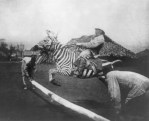
Zebra Carriages – 1890s all the Rage

Zebra Carriages – 1890s all the Rage

c.1890s-> :  Zebra Carriages

 Sources: Shopkins Fossick / Natural History Museum / Popular Science

2 Comments

Filed under Humor and Observations

Ancient city discovered beneath Biblical-era ruins in Israel

Ancient city discovered beneath Biblical-era ruins in Israel

By Tia Ghose

Digging History

Published November 19, 2013

LiveScience
  • tel-gezer

    Burned ruins and fired mudbrick collapse, as well as smashed pottery, reveal the late Bronze Age destruction at the city. On the left is the room where several pottery vessels, a scarab of Amenhotep III, a cache of cylinder seals, as well as s (SAMUEL WOLFF, TEL GEZER EXCAVATIONS)

Archaeologists have unearthed traces of a previously unknown, 14th-century Canaanite city buried underneath the ruins of another city in Israel.

The traces include an Egyptian amulet of Amenhotep III and several pottery vessels from the Late Bronze Age unearthed at the site of Gezer, an ancient Canaanite city.

Gezer was once a major center that sat at the crossroads of trade routes between Asia and Africa, said Steven Ortiz, a co-director of the site’s excavations and a biblical scholar at the Southwestern Baptist Theological Seminary in Fort Worth, Texas.

The remains of the ancient city suggest the site was used for even longer than previously known. [The Holy Land: 7 Amazing Archaeological Finds]

Biblical city
The ancient city of Gezer has been an important site since the Bronze Age, because it sat along the Way of the Sea, or the Via Maris, an ancient trade route that connected Egypt, Syria, Anatolia and Mesopotamia.

The city was ruled over many centuries by Canaanites, Egyptians and Assyrians, and Biblical accounts from roughly the 10th century describe an Egyptian pharaoh giving the city to King Solomon as a wedding gift after marrying his daughter.

“It’s always changed hands throughout history,” Ortiz told LiveScience.

The site has been excavated for a century, and most of the excavations so far date to the the 10th through eighth centuries B.C. Gezer also holds some of the largest underground water tunnels of antiquity, which were likely used to keep the water supply safe during sieges.

But earlier this summer, Ortiz and his colleague Samuel Wolff of the Israel Antiquities Authority noticed traces of an even more ancient city from centuries before King Solomon’s time. Among the layers was a section that dated to about the 14th century B.C., containing a scarab, or beetle, amulet from King Amenhotep III, the grandfather of King Tut. They also found shards of Philistine pottery.

During that period, the ancient site was probably a Canaanite city that was under Egyptian influence.

The findings are consistent with what scholars suspected of the site, said Andrew Vaughn, a biblical scholar and executive director of the American Schools of Oriental Research, who was not involved in the study.

“It’s not surprising that a city that was of importance in the biblical kingdoms of Israel and Judah would have an older history and would have played an important political and military role prior to that time,” Vaughn told LiveScience. “If you didn’t control Gezer, you didn’t control the east-west trade route.”

But once the location of that major road moved during the Roman period, the city waned in importance. It was later conquered and destroyed, but never fully rebuilt.

“Just like today when you have a ghost town where you move the train and that city goes out of use,” Ortiz said.

1 Comment

Filed under Humor and Observations