Extraterrestrials on Earth

Extraterrestrials on Earth: Scientists find outer space stuff at South Pole

By Gene J. Koprowski

Published November 21, 2013

FoxNews.com
  • IceCube South Pole 2.jpg

    The IceCube Laboratory sits on the surface of the ice on top of the detector, collecting data from sensors under the ice. All 5,160 sensors that make up the in-ice array are connected to the lab via cable. (SVEN LIDSTROM, ICECUBE/NSF)

  • IceCube South Pole.jpg
  • Greetings from the South Pole.jpg

    A researcher offers a hello and a weather forecast from the South Pole, where conditions are cold, white and bright. (JIM HAUGEN, ICECUBE/NSF)

  • IceCube South Pole 1.jpg

    IceCube âwinteroversâ pose under an aurora with the IceCube Laboratory in the background. (CARLOS POBES, ICECUBE/NSF)

  • IceCube South Pole 3.JPG

    An IceCube sensor is lowered into position beneath the ice at the South Pole. (ICECUBE COLLABORATION/NSF)

ET isn’t out there … he’s already here.

Scientists have discovered travelers from beyond our solar system buried under the ice of the South Pole — not living creatures or space beings but tiny, extra-terrestrial particles known as neutrinos.

“Extra-terrestrial in this context means coming from outside the solar system,” Olga Botner, a professor in the department of physics and astronomy at Uppsala University in Sweden, told FoxNews.com. “For the first time ever we now have evidence for a flux of high-energy neutrinos from outside the solar system.”

Neutrinos are elementary particles like electrons, but they lack an electric charge. These visitors were detected by a massive science telescope buried beneath the frozen Pole and aptly named the IceCube Neutrino Detector, Botner wrote in an article published Thursday in Science magazine.

‘This is the most important particle physics project in the world.’

– IceCube scientist Naoko Kurahashi-Neilson

The IceCube Neutrino Detector is a truly 21st century astronomical observatory — a neutrino telescope constructed at the Amundsen-Scott South Pole Station in Antarctica. Featuring thousands of sensors distributed over a half mile and buried under the ice, the telescope’s construction began in 2002 and was completed in 2010.

Naoko Kurahashi-Neilson, a scientist who joined the IceCube team as it started its operations, told FoxNews.com that the project is crucial to a deeper understanding of physics and the world around us.

“This is the most important particle physics project in the world. As we collect more data over the next 10 years, we may be able to figure out the source of the energy.”

Origin of cosmic rays a mystery
Neutrinos are a byproduct of cosmic rays, which contain high-energy matter and are of mysterious origin. Astrophysicists think these rays may come from exploding stars in other galaxies, but acknowledge that there could be other, unknown sources of the energy out there.

Such rays are hard to track, because these high-energy particles are electrically charged, and thus get deflected by magnetic fields, making them hard to track.

For decades, scientists have been interested in understanding their origins have needed is a messenger from the universe that was not impeded in its travel and that researchers could then track.

Researchers haven’t detected any neutrinos from outside our Solar System since a galactic explosion – a supernova — back in 1987. Neutrinos it emitted came not from Earth but outer space.

Last summer, IceCube scientists who had been scanning for high-energy neutrinos since 2010 reported two neutrinos with energies above what’s normally expected in the atmosphere.

These scientists, including  Kurahashi-Neilson and Botner, then started sifting through the rest of the data, looking for more high-energy neutrino events. The researchers found 26 more, including the most energetic neutrinos ever observed, and each with characteristics similar to those scientists predicted would be found in neutrinos with “extraterrestrial origins.”

This suggests that these 28 neutrinos came here from outside of the solar system.

“The highest neutrino energies we observe now are more than a hundred times higher than the highest energies that can be achieved by terrestrial accelerators,” Botner told FoxNews.com. “Observation of an extraterrestrial flux of high energy neutrinos gives us the possibility to study the universe in a new light.”

“I’d like to be able to say in 20 year’s time that this discovery marked the beginning of the era of neutrino astronomy,” she said.

The IceCube team has been working with ice in Antarctica since 1993, and developed a prototype device that looks for flashes of radiation emitted when charged products of neutrino interacted with the ice and move through it at superluminal speed. The prototype was small, Botner said, and the flux of high-energy neutrinos is very low.

“What we saw then were neutrinos from the Earth’s atmosphere. After 20 years we have now observed a flux of extraterrestrial neutrinos — a dream come true.”

Extra-terrestrials have visited the Earth, in other words — but they look nothing like little green men.

“This ET neutrino ‘rain’ has always been showering the Earth,” Botner said. “It’s only now that we have been able to discover it.”

Most of what science knows about the universe today it has learned by studying electromagnetic radiation, from radio waves to X-rays and gamma-rays. But at very high energies electromagnetic radiation is absorbed by interactions with matter, star light and the cosmic microwave background on its way to us from varied sources.

“There exist regions in the universe which are inaccessible in other ways than by studying high-energy neutrinos,” Botner said. “We are very excited by the possibility of exploring these unknown parts of the universe. However, before this dream can come true we need to improve our techniques. Up to now we have been unable to pinpoint the sources of our high-energy neutrinos. To do that we need to improve our angular resolution — and collect considerably more high energy events.”

Kurahashi-Neilson told FoxNews.com that the team will build, in essence, a map of grids in the sky from the Earth’s point of view, which will pinpoint the origins of these deep-space travelers.

“We have many questions to answer about neutrinos. Do they cluster? Do they come from all over the universe?” Kurahashi-Neilson said.  “The first indications are that they come from all over.”

2 Comments

Filed under Humor and Observations

The BEST Cyber Monday Deal EVER!

If you think this blog site has some cool stuff – wait till you read my awesome books!

At Kindle you can get the following awesome books for:

JUST  99 cents to read the novel The Travelers’ Club and the Ghost Ship – Book one in an historical adventure series.  It’s steampunk – that is science fiction adventure set in 1880.

http://www.amazon.com/The-Travelers-Club-Ghost-Ship-ebook/dp/B0060QYM2K/ref=pd_sim_kstore_1

JUST 99 cents will also get you Twisted Nightmares!  This is an awesome anthology of short poems and stories featuring horror and freaky plot lines with frightening twists.

http://www.amazon.com/Twisted-Nightmares-Michael-Bradley-ebook/dp/B00CNWVXLI/ref=sr_1_1?s=digital-text&ie=UTF8&qid=1385974310&sr=1-1&keywords=twisted+nightmares

JUST $2.99 will get you The Travelers’ Club – Fire and Ash – Book two in the series and my best written novel yet published.

http://www.amazon.com/gp/product/B00A467QKW/ref=s9_simh_gw_p351_d0_i1?pf_rd_m=ATVPDKIKX0DER&pf_rd_s=center-2&pf_rd_r=0C111VVGZFAWSAQZEGJC&pf_rd_t=101&pf_rd_p=1630083502&pf_rd_i=507846

Nothing makes a better Christmas present for both you, your friends and family, and for me as an author, than for you to reach in your pocket (figuratively) and buy these timeless literary treasures.

Thanks!


Leave a comment

Filed under Humor and Observations, Writing

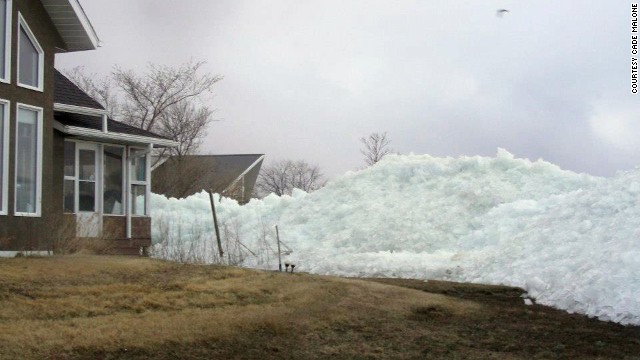
Video of Ice Moving Quickly Into Housing

This video shows ice formed on a lake being moved ashore by the waves and wind and a pretty rapid pace.  At first it is kind of cool looking, but then it starts to cave in the homes.

https://www.facebook.com/photo.php?v=218762171637718

lake ice 2 lake ice


1 Comment

Filed under Humor and Observations

Dog Shaming Pictures for Your Monday Blues

Finding dog shaming pictures is pretty difficult.  So far, I have posted around 300 of them.  If you have any out there for me, please email me with the attachment to eiverness@cox.net.  I hope these give you a chuckle and a smile for your Monday morning blues.  (For earlier dog shaming posts, please type “dog shaming” into the search block on my home page)

1 Comment

Filed under Animals, Humor and Observations

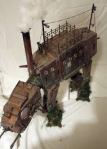
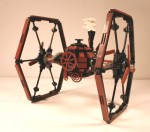
Steampunk Star Wars

Steampunk versions of Star Wars.   In an earlier post I already had steampunk AT-AT and other vehicles, so this one I focus more on other types.  I hope you enjoy them!

1 Comment

Filed under Humor and Observations

World’s oldest scorpion found

World’s oldest scorpion found

By Larry O’Hanlon

Published November 27, 2013

Discovery News
  • Permian scorpion by Mary Sundstrom.jpg
    MARY SUNDSTROM
  • scorpion-trace.jpg

    Photo of the rock with the imprint of what is believed to be a scorpion. (NEW MEXICO MUSEUM OF NATURAL HISTORY)

It may not look like much, but together with other tracks in the 280 million-year-old rocks of Prehistoric Trackways National Monument in southern New Mexico, this vague form has been identified as the one and only fossil impression of a scorpion body ever found. The scorpion rested here for a time, then scurried off, and the imprint of its body eventually turned to stone.

The age of the trace fossil, as body impressions and tracks are called, takes scorpions way back to the early Permian. That confirms that scorpions have survived a lot of gigantic mass extinction events between then and now. What’s more, seeing how the carbon dioxide levels in the Permian atmosphere were probably three times what they are today on Earth, it’s not likely anthropogenic climate change will stop these hardy arthropods either.

‘We gave it the name Alacranichnus, which means scorpion trace.’

– Spencer Lucas, curator at the New Mexico Museum of Natural History and Science

“We gave it the name Alacranichnus, which means scorpion trace (alacran is Spanish for scorpion and ichnos is Greek for trace),” said Spencer Lucas, curator at the New Mexico Museum of Natural History and Science (NMMNHS). The discovery was just published in the journal Ichnos: An International Journal for Plant and Animal Traces by scientist at the museum in Albuquerque.

In the paper Lucas, Allan Lerner and Sebastian Voigt describe the trace fossil as a “substantial addition to the poorly known Permian fossil record of scorpions that demonstrates that scorpions were present in the Early Permian coastal plain…. Unfortunately, there is nothing in the way of morphological characters evident from the resting trace that can help determine which particular type of scorpion made it.”

Scorpions are the oldest known arachnids, the researchers explain, with some fossils of probably aquatic scorpions dating back to the Silurian Periods about 430 million years ago. Later, in the Carboniferous (359 million to 299 million years ago), scorpions took to land. But then the fossils peter out.

“There is an extremely large gap in the North American scorpion fossil record following the Upper Carboniferous,” write Lucas and his colleagues. In fact, Permian scorpion fossils are rare worldwide, and only found in bits and pieces. There are no more North American scorpion fossils until the Middle Eocene (about 45 million years ago).

The unique new fossil will be displayed in the New Mexico museum’s upcoming Paleozoic Hall.

1 Comment

Filed under Animals, Humor and Observations

Two men save shark from choking on moose

Two men save shark from choking on moose

Published November 21, 2013

FoxNews.com

He’s going to need a bigger bite.

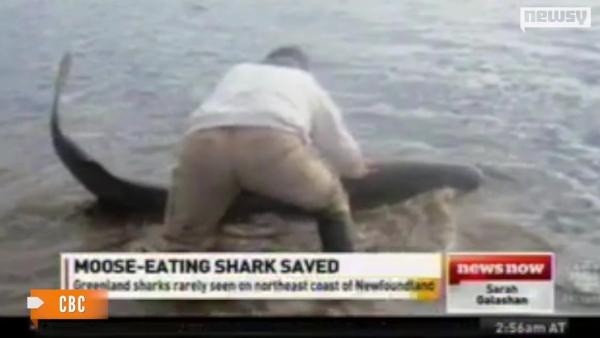
According to CBC.ca, two Newfoundland men saved a shark from choking on a moose.

shark

Derrick Chaulk was driving by the Norris Arm North harbor and thought he saw a beached whale. But when he went closer to investigate, Chaulk realized it was a Greenland shark.And it was choking.

“[The moose] had the fur and all the liner on it — it was about 2 feet long, maybe,” Chaulk said.

Chaulk and another man, Jeremy Ball, started pulling on the moose, CBS.ca reported.

“A couple yanks and it just came right out,” he said.

shark28n-6-web

Chaulk and Ball then pushed the shark back into the water. After being still for a few minutes, water starting coming off the shark’s gills and it headed back out to sea.

“It was a good feeling to see that shark swim out, knowing that you saved his life,” Chaulk said. “There was a few people up on the bank watching and once that shark swam out and lifted his tail, and then swam all the way out, everybody just clapped.”

Greenland sharks are rarely seen on the northeast coast of Newfoundland, CBC.ca reported.

Leave a comment

Filed under Humor and Observations

Cosplay Pictures for Your Saturday

Your every Saturday edition of cool cosplay outfits:

Leave a comment

Filed under Humor and Observations

Wine cellar found in ancient palace

Raising Canaan? Wine cellar found in ancient palace hints at a sophisticated drink for banquets

Published November 23, 2013

Associated Press
  • Ancient Israeli Wine Cellar.jpg

    3,700-year-old jars were found in the ruins of a recently discovered wine cellar in a Canaanite palace that dates back to approximately 1700 B.C., near the modern town of Nahariya in northern Israel. (AP PHOTO/GEORGE WASHINGTON UNIVERSITY, ERIC H. CLINE)

  • Ancient Israeli Wine Cellar 1.jpg

    George Washington alumnus Zach Dunseth carefully removes dirt and debris from ancient wine jars while excavating the ruins of a recently discovered wine cellar in a Canaanite palace in Israel that dates back to approximately 1700 B.C., near the modern town of Nahariya in northern Israel. (AP PHOTO/GEORGE WASHINGTON UNIVERSITY, ERIC H. CLINE)

  • Ancient Israeli Wine Cellar 2.jpg

    The ruins of a recently discovered wine cellar in a Canaanite palace that dates back to approximately 1700 B.C., near the modern town of Nahariya in northern Israel. Researchers found 40 ceramic jars, each big enough to hold about 13 gallons, in a single room.(AP PHOTO/GEORGE WASHINGTON UNIVERSITY, ERIC H. CLINE)

NEW YORK –  Scientists have uncovered a 3,700-year-old wine cellar in the ruins of a Canaanite palace in Israel, and chemical analysis shows this is where they kept the good stuff.

Samples from the ceramic jars suggest they held a luxurious beverage that was evidently reserved for banquets, researchers said.

“It’s not wine that somebody is just going to come home from a hard day and kick back and drink,” said Andrew Koh of Brandeis University. He found signs of a blend of ingredients that may have included honey, mint, cedar, tree resins and cinnamon bark.

The discovery confirms how sophisticated wines were at that time, something suggested only by ancient texts, said Eric Cline of George Washington University. He, Koh and Assaf Yasur-Landau of the University of Haifa in Israel spoke to reporters Thursday before their work was presented Friday at a meeting of the American Schools of Oriental Research.

The wine cellar was found this summer in palace ruins near the modern town of Nahariya in northern Israel. Researchers found 40 ceramic jars, each big enough to hold about 13 gallons, in a single room. There may be more wine stored elsewhere, but the amount found so far wouldn’t be enough to supply the local population, which is why the researchers believe it was reserved for palace use, Cline said.

The unmarked jars are all similar, as if made by the same potter, Yasur-Landau said. Chemical analysis indicates that the jars held red wine and possibly white wine, Koh said. No liquid was left, and he analyzed residues he had removed from the jars.

Patrick McGovern of the University of Pennsylvania, an expert in ancient winemaking, said the discovery “sheds important new light” on the development of winemaking in ancient Canaan, from which it later spread to Egypt and across the Mediterranean. He said the chemical analysis would have to be published before the ingredients of the wine could be assessed.

Curtis Runnels, an archaeologist at Boston University, called the finding significant not only in showing the sophistication of the wine, but also in suggesting that it was meant specifically for palace use. He noted that the chemical analysis showed each jar held wine from the same recipe, showing the “consistency and control you’d expect in a palace.”

1 Comment

Filed under Humor and Observations

ORIGINALITY IN MARKETING: THE TOP 20 “STREET” ADVERTISEMENTS

ORIGINALITY IN MARKETING: THE TOP 20 “STREET” ADVERTISEMENTS

Sometimes invasive and annoying, urban marketing does has the potential to be innovative in how the city’s objects are used to convey a message.

BY FLOYD (TOPITO) ON JANUARY 27, 2011

There is something interesting about ads that creatively take advantage of urban space (notably from Julian Beever’s optical illusions). Clearly this domain sparks the imagination and gives way to endless innovations. This list is devoted to streets and restricts the art to the ground, further cultivating an appreciation for urban space.

1-Vijay Sales’s barbecues


2-A musical crossing

3-An orthodontist can straighten that out

4-The South African tourism office

5-The pedestrian crossing bar-code

6-NGO Aseema for children’s rights

7-Mr. Clean makes it whiter

8-McDonald fries tries to take over the world

9-Opitical illusions by Julian Beever

10-A new security system for manholes

11-A hot cup of coffee…


12- The promotion for the children’s books “The Kids Who Could Fly”

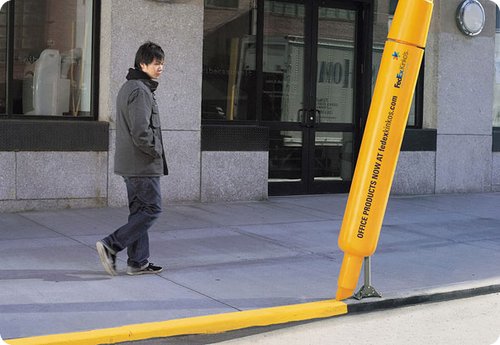
13-Fedex’s office supplies

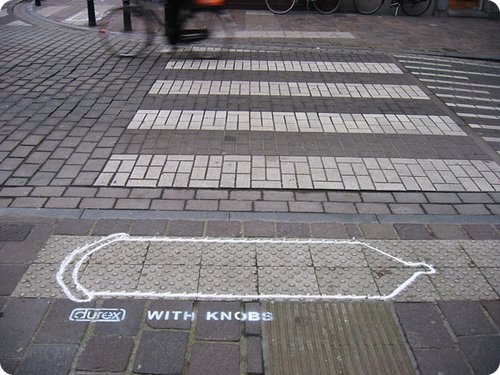
14-Durex condoms: with “knobs” :-)

15-The new Canon: with a bigger “zoom”

16-Your cigarette butts go in the trash…

17-Made by a creative hairdresser

18-Water is life


19-Amnesty International

20-A memorial for victims of the road

Source : boredpanda.com

This post was originally published on Topito

Follow us onTwitter and on Facebook.

Leave a comment

Filed under Humor and Observations