Random Humor for the Weekend

Here is some random humor to end the work week and start off the weekend with a laugh…

Leave a comment

Filed under Humor and Observations

Search for ‘White City’ uncovers lost civilization

Heard of the long-lost “White City” or “City of the Monkey God”? A group of experts who entered a Honduran rainforest in search of it emerged last Wednesday saying they have found a lost city—one that’s totally untouched,National Geographic reports.

As writer Douglas Preston explains, “Archaeologists no longer believe in the existence of … Ciudad Blanca, as described in the legends” but suspect there are many such cities secreted away in this rainforest, “which taken together represent something far more important—a lost civilization.” This find points to that: an unnamed, “scarcely studied” civilization that apparently flourished a thousand years ago and disappeared.

Among the exposed remains are an earthen pyramid, mounds, large plazas, sculptures, and ceremonial seats. More may be buried, and a team member dates what was found to AD 1000 to 1400.

“The undisturbed context is unique,” archaeologist Christopher Fisher tellsNational Geographic, which explains the found objects, many poking through the earth, have not been excavated. The hunt for the White City—the first recorded mention of which may lie in a 1526 letter from Hernán Cortés to Spain’s Charles V—allegedly made headway in 1940 when explorer Theodore Morde emerged from the Mosquitia rainforest with a huge cache of apparent White City artifacts, but he killed himself before divulging the location.

Documentary filmmakers spotted the current Mosquitia location (which remains secret) in 2012 by scanning a Honduran valley with a plane-mounted lidar scanner, reported a previous New Yorker article also by Preston.

Leave a comment

Filed under Uncategorized

Smallest Chihuahua…

Good things DO come in small packages: Tiny Toudi is smaller than a can of Coke, can fit in the palm of your hand and is the smallest Chihuahua in the world

  • Toudi from Wroclaw, Poland is 12 weeks old, 7cm tall and weighs just 300g
  • The adorable pooch is believed to be the smallest Chihuahua in the world
  • Tiny pup is smaller than a can of coke and can fit in the palm of your hand
  • It is hoped Toudi will soon appear in the Guinness World Records book 

The adorable pooch is smaller than a can of coke, a little bigger than a pear and can fit in the palm of your hand.

Scroll down for video 

Tiny Toudi: This little pup from Poland is shorter than a can of coke and can easily fit in the palm of your hand

Tiny Toudi: This little pup from Poland is shorter than a can of coke and can easily fit in the palm of your hand

Similar size: Toudi is so small he could be mistaken for a cuddly toy. His owner says they have to be careful because he is the same size as the floor

Some mock the little Chihuahua, claiming he looks more like a hamster

Others are mesmerised by him

Some mock the little Chihuahua, claiming he looks more like a hamster, while others are mesmerised by him

No comparison: Toudi's sister may be much bigger than he is, but he is arguably far more adorable

No comparison: Toudi’s sister may be much bigger than he is, but he is arguably far more adorable

The three-month-old, from Wroclaw, Poland is considerably smaller than his sister and eats very little food each day.

Toudi’s owner says he provides a lot of fun for the family but that they have to be careful where they stand because he is the same colour as the floor.

Some mock the little Chihuahua, claiming he looks more like a hamster, while others are mesmerised by him.

It is hoped Toudi will soon appear in the Guinness World Records book.

 Toudi is believed to be the smallest chihuahua in the world

Toudi's owner says he provides a lot of fun for the family. These sunglasses are maybe a little too big for this pup

Toudi’s owner says he provides a lot of fun for the family. These sunglasses are maybe a little too big for this pup

Perfect pear: Toudi is a only slightly bigger than a pear, but he can't even be described as 'pint-sized' because he's smaller than a can of coke

Perfect pear: Toudi is a only slightly bigger than a pear, but he can’t even be described as ‘pint-sized’ because he’s smaller than a can of coke

Fun and games: It is hoped little Toudi, from Poland, will soon appear in the Guinness World Records book

Fun and games: It is hoped little Toudi, from Poland, will soon appear in the Guinness World Records book

Toudi's owner doesn't have to spend too much on him because he only eats a very small amount of food each day

Read more: http://www.dailymail.co.uk/news/article-3011359/Tiny-Toudi-smaller-Coke-fit-palm-hand-smallest-Chihuahua-world.html#ixzz3VYbkbF68

Follow us: @MailOnline on Twitter | DailyMail on Facebook

Leave a comment

Filed under Animals

Why was a 9th century Viking woman buried with a ring that says ‘for Allah’ on it?

The Washington Post
Adam Taylor
A ring discovered in a Viking grave in Birka, a historic trading center in what is now Sweden.© Christer Ahlin/Statens historiska museum A ring discovered in a Viking grave in Birka, a historic trading center in what is now Sweden.In the modern-era, Scandinavian countries have become known for their sometimes awkward embrace of migrants from the Arab and Muslim world. But the history behind that relationship goes back far further than you might expect.

Consider the case of a ring discovered in a Viking grave in Birka, a historic trading center in what is now Sweden. The woman in the grave died in the 9th century and was discovered around a thousand years later by the famous Swedish archaeologist Hjalmar Stolpe, who spent years excavating the grave sites around Birka.

The ring is unique. Made of silver alloy, it contained a stone with an inscription written in the Kufic Arabic script widely used between the 8th and 10th centuries. “For/to Allah,” the inscription read. It was the only known Viking Age ring with an Arabic inscription to be found in the entire of Scandinavia. Exactly how the woman got the ring wasn’t clear — she was found wearing typical Scandinavian dress, so presumably the ring arrived through trade.

Now, new research from biophysicist Sebastian Wärmländer of Stockholm University and his colleagues has confirmed exactly how unique the ring was. In the journal Scanning, the researchers recount how they used a scanning electron microscope to investigate the origins of the ring. Notably, they discovered that the stone in the ring is actually colored glass — at the time an exotic material for the Vikings, though it had been made for thousands of years in the Middle East and North Africa.

© Bernard WalshEven more notably, the ring displayed a remarkable lack of wear, leading the authors to speculate that it had few — if any — owners in-between its creator and its Viking owner. Instead, Wärmländer and his colleagues suggest, it appears to show direct contact between Viking society and the Abbasid Caliphate that dominated much of the Middle East and North Africa. The authors write, “it is not impossible that the woman herself, or someone close to her, might have visited — or even originate from — the Caliphate or its surrounding regions.”

While physical evidence of it is unusual, there have been plenty of accounts of Scandinavians from this period crossing paths with the early Muslim world. By the 11th century Vikings had become known for their lengthy sea voyages, journeying as far west as the Americas and likely reaching Constantinople and even Baghdad when they traveled the other way. And while contemporary accounts of Vikings from Western Europe suggests terrifying invaders, most accounts suggest the Vikings, likely fearful of the more sophisticated warriors in the region, instead looked for trade when they went east.

“The Vikings were very interested in silver, not so much in gold,” Farhat Hussain, a historian,told the National newspaper of Abu Dhabi in 2008. “It was a status symbol for Viking men and women, they even wanted to be buried with silver.”

Still, the Scandinavians did raise some eyebrows on their journeys. In an otherwise complimentary description of people now believed to be Vikings, Ahmad ibn Fadlan, an emissary of the Abbasid Caliph, wasn’t so sure about their hygiene. “They are the filthiest of all Allah’s creatures,” the Arab writer wrote in the 10th century. “They do not purify themselves after excreting or urinating or wash themselves when in a state of ritual impurity after coitus and do not even wash their hands after food.”

Leave a comment

Filed under Uncategorized

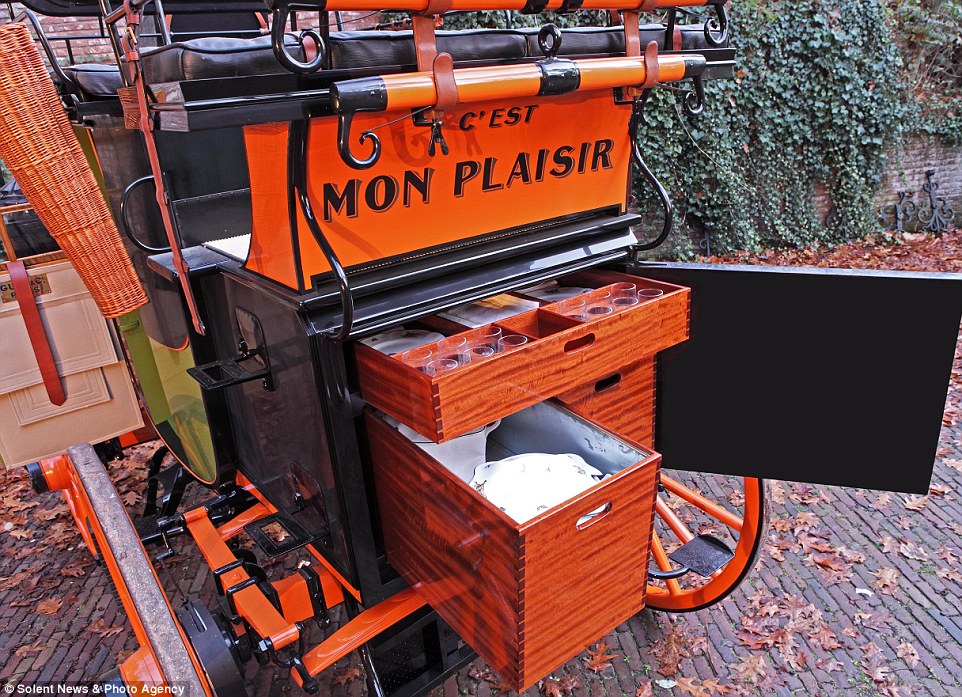
Not just any old iron: Collection of Victorian wrought-iron horse-drawn carriages set to sell for £1.5million

  • Group of 28 coaches have been amassed by a European-based collector over the past 30 years
  • An 1835 Traveling Landauer wagon that was commissioned by the Royal Mews is worth £300,000

The group of 28 coaches, which were built long before the invention of the automobile, have been amassed by a European-based collector over the past 30 years.

The pick of the group is an 1835 Traveling Landauer wagon that was commissioned by the Royal Mews worth £300,000.

A collection of Victorian wrought-iron horse-drawn carriages is to sell for an expected £1.5million. Pictured, the 1835 Traveling Landauer

The level of luxury that went into making the extravagant Traveling Landauer wagon is said to be beyond that of Rolls Royce standard of today

The extravagant coach was made by Adams & Hooper of London and used to carry King William IV on his Royal duties until his death just two years later.

The level of luxury and detail that went into making it is said to be beyond that of Rolls Royce standard of today.

And a carriage once owned by luxury champagne producers Veuve Clicquot to take clients to their vineyards is valued at £25,000.

As well as the 28 carriages, there are six children-sized coaches and more than 150 items of memorabilia, including period lamps, luggage, picnic sets, tack and photographs.

The 1892 Road Coach made by renowned coachbuilders Holland & Holland that is expected to sell for £150,000

As well as the carriages, there are six children-sized coaches and 150 memorabilia items for sale. Pictured, the 1910 German Mylord

Rob Hubbard, of London auctioneers Bonhams, said: ‘The owner is a Dutch collector but a lot of the carriages he has were made by English coachbuilders.

‘He has spent over 30 years collecting but he is now aged in his 80s and he no longer has any horses left and has decided now to pass it on to somebody else.

‘These carriages are all exceptional in quality, you rarely see them in such good condition.

‘The Royal Mews carriage is luxurious and has 50 yards of individually stitched cord. The attention to detail is beyond the Rolls Royce standard while the Veuve Clicquot carriage’s seats are made from pure silk.’

The auction takes place on March 7.

The interior of the 1880 Holland & Holland Drag, which has an estimated value of £90,000. The auction takes place on March 7

The group of 28 wrought-iron coaches that were built long before the invention of the automobile. Pictured, 1895 - 1898 Road Coach

Rob Hubbard, of London auctioneers Bonhams said the carriages are ‘exceptional in quality’. Pictured, the 1895 – 1898 Road Coach has an estimated value of £100,000
Mr Hubbard added that 'you rarely see them in such good condition'. Pictured, the 1908 Motor Buggy valued at £40,000

Read more: http://www.dailymail.co.uk/news/article-2905576/Not-just-old-iron-Collection-Victorian-wrought-iron-horse-drawn-carriages-set-sell-1-5million.html#ixzz3VMd7s0QO
Follow us: @MailOnline on Twitter | DailyMail on Facebook

Leave a comment

Filed under Uncategorized

Cute Dogs for Your Monday Blues

I’m in Washington, D.C. for a week for a conference, so I apologize for slow posts, including missing the cosplay weekend…

Nonetheless, here are some cute dog pictures to cheer up your week.

Leave a comment

Filed under Uncategorized

Scientists implant tiny robots inside live mice

mice1.jpg

File photo. (Reuters)

Can robots travel inside living animals? It sounds like science fiction, but scientists have just made it a reality by implanting tiny nano-robots inside living mice. Researchers from the Department of Nanoengineering at the University of California, San Diego, published their report on the first successful tests of implanting micro robots designed to disperse drugs within a body, reports SmithsonianMag.com.

As the research report states, these kinds of robots have been tested “in vitro,” or outside the body, in the past, while this is the first time that this technology has been studied “in vivo,” or inside the body. The zinc-based robots — only the width of a strand of human hair — were ingested orally by the mice. The zinc reacted with the animal’s stomach acid, producing hydrogen bubbles that propelled the robots into the stomach lining. As soon as the robots attached to the stomach, they dissolved, delivering the medicine into the stomach tissue, i09 reports.

For the researchers, this work could pave the way for implanting similar robots in humans. This could be an effective way of delivering drugs to the stomach in order to treat something like a peptic ulcer, the BBC reports.

“While additional ‘in vivo’ characterizations are warranted to further evaluate the performance and functionalities of various man-made micromotors in living organisms, this study represents the very first steps toward such a goal,” reads the research report. According to the researchers, this work moves toward “expanding the horizon of man-made nanomachines in medicine.”

Leave a comment

Filed under Animals, Humor and Observations

Cool Vehicles – If you could only pick one…

Which of the following vehicles would you pick if you could have only one?

Leave a comment

Filed under Uncategorized

Saint Patrick – What about the snakes and the shamrocks?

First, from Wikipedia:

Saint Patrick (Latin: Patricius; Proto-Irish: *Qatrikias;[2] Modern Irish: Pádraig [ˈpˠaːd̪ˠɾˠəɟ];[3] Welsh: Padrig[4]) was a 5th-centuryRomano-British Christian missionary and bishop in Ireland. Known as the “Apostle of Ireland”, he is the primary patron saint of Ireland, along with Saints Brigit and Columba.

The dates of Patrick’s life cannot be fixed with certainty but, on a widespread interpretation, he was active as a missionary in Ireland during the second half of the fifth century.[5] He is generally credited with being the first bishop of Armagh, Primate of Ireland.

According to the Confessio of Patrick, when he was about 16, he was captured by Irish pirates from his home in Britain, and taken as a slave to Ireland, where he lived for six years before escaping and returning to his family. After becoming a cleric, he returned to northern and western Ireland. In later life, he served as an ordained bishop, but little is known about the places where he worked. By the seventh century, he had already come to be revered as the patron saint of Ireland.

Saint Patrick’s Day is observed on 17 March, which is said to be the date of his death.[6] It is celebrated inside and outside Ireland as a religious and cultural holiday. In the dioceses of Ireland, it is both a solemnity and a holy day of obligation; it is also a celebration of Ireland itself.

st-patrick

The Shamrock – The shamrock was used as a metaphor to teach pagans the concept of the Trinity, how the Father, Son and Holy Ghost are separate, like the three parts of the shamrock leaf, but one, in that they all form a single leaf or entity.

download

The Snakes – The story of St. Patrick driving the snakes out of Ireland is an allegory.  Like a metaphor, it uses one thing to represent another, but instead of a single object, it is a story.  In the case of snakes, St. Patrick actually was credited with driving out paganism, the form of the serpent or snake a metaphor for the Devil and evil, as in the Garden of Eden.  By bringing Catholic Christian beliefs to Ireland and spreading them quickly, he “drove the snakes out of Ireland.”

So there you have it.

Erin go bragh!

Leave a comment

Filed under Uncategorized

How to drink a perfect whisky

I am doing it wrong…  I like a whisky stone in mine.  It chills it without diluting it.  First though, the spelling is important:

The difference between whiskey and whisky is simple but important: whisky usually denotes Scotch whisky and Scotch-inspired liquors, and whiskey denotes the Irish and American liquors.

The word itself (both spellings) is of Celtic origin, and modern whisky/whiskey distillation practices originated in Ireland and Scotland. Using whiskey to refer to Scotch whisky can get you in trouble in Scotland.

Now for the story written by Ali Rosen…

whisky_istock.jpg

There are very few hard and fast rules when drinking whisky. (iStock)

There are few drinks in life enjoyed as simply and purely as a glass of Scotch – and equally as few that have as much history and as many opinions contained in a single glass.

But is there a proper way to drink your whisky?

The perfect pour: “preferably more than a gnat could consume and less than an elephant would. “

With so many claims of right and wrong surrounding the beloved drink, we went straight to the Scottish experts to make sure we’re drinking whisky as perfectly as possible.

And the one thing we learned straightaway is that throwing out your rule book is a perfect place to begin.

No perfect pour

For starters, there isn’t even a standard pour.  Most experts recommend between one and two ounces should be served to you or a guest, but there are no hard and fast rules.

“A dram of whisky – the measurement we use to describe a pour – is an amount of whisky that the person pouring is happy to share from their bottle, and the person receiving is grateful to be given,” Nicholas Pollacchi, the founder of Whisky Dog and the whisky category director for Anchor Distilling Company says.

David Cox, the rare malts director for The Edrington Group – which includes The Macallan and Highland Park – concurs. His estimation is that you should pour, “preferably more than a gnat could consume and less than an elephant would,” but he does note that whatever you pour there should be head space in the glass for the whisky to breathe.

Don’t compromise on the glassware

There’s a common misconception that whisky should go in a rocks glass – or worse, in a shot glass. But the most commonly agreed upon vessel is the nosing glass. The tulip shaped glass help to concentrate the aromas in one point.

“Alcohol rises from the glass at different times,” Pollacchi explains. “They have weight to them, so the lighter, floral and sweeter notes will rise first, followed by heavier, darker and richer aromas. By using a glass that pulls these aromas to one point, you can fully appreciate the complexities within each dram.”

But Carl Reavey, from Bruichladdich Scotch whisky, maintains that for social drinking, you can use a wine glass or brandy balloon because “it is essential to have the ability to swirl the spirit in the glass and for the glass to have a bowl capable of retaining the aroma.”

Neat and water are okay, but no rocks

Once you have your whisky in hand – with the right glassware – there is agreement that whisky should probably be enjoyed without the rocks, since it dulls flavors.

Most recommend starting with it neat (without any additions) and then slowly adding water. The Balvenie distillery’s David Laird explains that this “is essential for detecting aromas as well as flavor on the pallet. This will allow you to open up the whisky and enjoy all of the flavor and aromas.”

Cox concurs, noting that “spring water at room temperature is the best accompaniment to allow the character to shine through, reducing some of the stronger alcoholic volatiles on the nose.”

But unlike glassware, this is an area that all the whisky-lovers admit needs to be a personal choice. Pollacchi insists that despite expert preferences it’s important to not be precious about how to drink whisky. It should instead be about, “allowing every person to find a path that allows them to find the most enjoyment from every whisky they try.”

But whether you’re defying the experts by adding ice or slowly adding water, it’s important that when it comes to drinking you take your time and whatever choice of Scotch you’ve made.

Sipping in steps

If you want to truly appreciate a great whisky – the process can involve many steps.

For example, when Bruichladdich master distiller Jim McEwan tastes, he starts by looking at the color, swirling and then looking at the legs on the glass. He looks at the color again, swirls, and then noses again followed by a first taste, usually by dipping a finger in. Then after another taste he adds some water carefully down the side of the glass, swirls and tastes again.

“You are looking for flavor and aromas, not alcohol. Introducing your nose to the whisky gradually will allow you to judge the perfect distance from the glass you prefer, so that you savor the most aromas without the alcohol desensitizing your senses,” Laird explains.

No matter the routine, all the experts stress that the key is in taking your time and enjoying when you have a great whisky in your hand without a feeling that there is a specific routine that must be followed.

“I have sometimes sat with a glass and just enjoyed intermittently nosing it for 5 to 10 minutes, savoring the complexities before rewarding myself with an eventual sip,” Pollacchi says.

Cox concurs noting that tasting your whisky is inexact, and should take long “enough for the aromas and flavors to envelope you.”

And if you’re sharing whisky with friends, don’t forget to toast.

The Scottish phrase Slàinte Mhath – Gaelic for ‘good health’ – is traditional, but just ensuring that the moment is savored is essential.

If you’re drinking a great whisky whose tradition has been honed over decades and aged to perfection the key element is to take your time and enjoy. And, as Cox points out, to stay upright.

Slàinte mhath!

2 Comments

Filed under Humor and Observations