Tag Archives: foxnews.com

Futuristic cargo vessel looks to revolutionize shipping

  • Vindskip2.jpg

     (Copyright Lade AS)

Norwegian ship designer Lade AS has unveiled a futuristic new design for cargo vessels, which uses the ships’ hulls as a sail.

Inspired by sailboats and aerospace, the ‘Vindskip,’ with its hull shaped like a symmetrical air foil, is designed to use the wind for propulsion.  Lade AS says that the ship’s hull will generate aerodynamic lift, giving a pull in the ship’s direction.

The hybrid merchant vessel will also use a Liquid Natural Gas electric propulsion system, which takes the ship to the necessary speed to generate aerodynamic lift on its hull. Additionally, the Vindskip will employ a specialized computer program to analyze meteorological data and calculate the best sailing route based on available wind energy.

Terje Lade, manager of Lade AS, told FoxNews.com that the Vindskip concept is being tested using wind tunnels and computational fluid dynamics. Testing of a model in a water tank is scheduled to begin in April, he explained in an email. Lade AS plans to eventually license the Vindskip concept to shipping companies, ship consultants, and shipyards.

The Alesund-based company has already been awarded two patents for the hull’s ability to generate aerodynamic lift, which it describes as its Wind Power System.

Lade told FoxNews.com that the Vindskip development project will be finished by the fourth quarter of 2015, and estimates that engineering and construction will take approximately 2 to 3 years. “Our estimate is that it should be sailing in 2019,” he added.

The project has already attracted the attention of at least one shipping industry heavyweight. A spokesman for Wilhelmsen, one of Norway’s largest shipowners, told FoxNews.com that the company’s technical department has been involved in brainstorming related to the Vindskip, although there has been no formal involvement or investment in the project. “Some years back, our technical team developed our concept vessel (Orcelle) — and based on this we were invited into the Vindskip project,” he explained in an email.”Our vision is ‘shaping the maritime industry,’ and we value sharing some ‘futuristic’ thoughts and ideas on how shipping can develop some years ahead.”

LadeVindskip

Lade AS estimates that the Vindskip design could generate fuel savings of 60% and reduce carbon dioxide emissions by 80% compared to a traditional ship. The designer says that the design is particularly well suited to a number of passenger and container vessels.

However, Chris Cheetham, founder of Soter Advisors, a fuel and energy risk management consultancy specializing in the shipping industry, said that a number of factors could impact potential savings. “What these designs will come down to is ‘how much does it really cost?'” he told FoxNews.com. “You have to relate that to the cost of building and charter rates for shipping.”

Cheetham cited the huge pullback in oil prices and the “inventory” of traditional ships that are already scheduled to be built as factors that companies will need to consider before licensing a revolutionary design such as the Vindskip.

Story updated from Jan. 19 with comments from Lade AS, Wilhelmsen, and Soter Advisors.

Follow James Rogers on Twitter @jamesjrogers

Leave a comment

Filed under Humor and Observations

Mummy mask papyrus may reveal oldest-known gospel

egyptian.jpg

File photo. (REUTERS/Mohamed Abd El Ghany)

A team of researchers made a surprising find when examining a papyrus-wrapped mummy mask — they found what they believe to be the oldest-known copy of a gospel in existence. The researchers found a fragment of the Gospel of Mark that dates back to about 90 A.D., Live Science reports. Previously, the oldest surviving copies of Biblical gospel texts date back to 101 to 200 A.D.

The text was written on a papyrus sheet that was later reused for the mummy mask. While the stereotypical image of ancient mummies involves bejeweled golden masks, that level of finery was only reserved for the wealthy. The mummy mask for the average person would have been made out of recycled material like papyrus, according to SmithsonianMag.com.

In order to retrieve the text without damaging it, the research team applied a method of ungluing the papyrus without obscuring the paper’s ink. About three-dozen researchers are using this technique to analyze hundreds of texts from mummy masks.

“We’re recovering ancient documents from the first, second and third centuries,” Craig Evans, a professor of New Testament studies at Acadia Divinity College in Wolfville, Nova Scotia, told Live Science.

Evans is part of a large team of researchers working on the project, which is based in Oklahoma City. “The scholars involved are from all over the world,” he told FoxNews.com.

The academic said that the team has uncovered documents from a range of eras. These include not just Christian texts, but classical Greek texts like copies of stories by Homer and even personal letters.

Some of the personal documents and business papers found within the masks have dates on them, Evans said. This particular gospel was dated partly by looking at the other documents found within the same mask.

This technique is not without controversy. The ancient masks are destroyed in order to retrieve the documents. However, Evans asserted that “we’re not talking about the destruction of any museum-quality piece.”

Roberta Mazza, lecturer in classics and ancient history at the University of Manchester, wrote a blog post critical of the work of Evans and his research team. In reference to a speech Evans made about the gospel text discovery, Mazza wrote that “the audience who attend their talks are told fantasy stories on the retrieval of papyrus fragments and their date … apologists’ speeches are not only misinformed, but can even encourage more people to buy mummy masks on the antiquities market and dissolve them in Palmolive soap.”

Last year Mazza found a 1,500-year old piece of papyrus in the university’s John Rylands library that contains some of the earliest documented references to the Last Supper and ‘manna from heaven.’

For the researchers examining the mummy mask, the text’s discovery marks a significant achievement. Evans said that the text could offer clues about how the Gospel of Mark might have changed over time.

A first volume of the various texts found on the mummies will be published by the researchers later this year.

1 Comment

Filed under Humor and Observations

Does ‘Blue Hole’ hold secret to Mayan collapse?

Does 'Blue Hole' hold secret to Mayan collapse?

This undated image provided by the Belize Tourist Board shows an aerial view of the Great Blue Hole, a popular diving site that’s part of Belize���s barrier reef. (AP Photo/Belize Tourist Board)

Everything from overhunting and a peasant uprising to deforestation and an alien invasion has been proposed to explain why the Mayan civilization collapsed,Smithsonian notes. But one theory has been gaining ground in recent years: extreme drought.

Now more evidence has surfaced to support the drought postulation—and the proof may just lie in Belize’s most famous underwater cave. Rice University professor Andre Droxler’s team analyzed sediment found in the “Great Blue Hole,” a 410-foot-deep sinkhole in the middle of Lighthouse Reef, LiveSciencereports.

Not only did the chemical composition of the silt indicate periods of sparse rainfall during the Mayan decline (likely between AD800 and AD1000): It also showed that a second huge drought probably occurred between AD1000 and AD1100—right around the time the Mayans’ relocation site of Chichen Itza is said to have fallen.

Over thousands of years, runoff from rivers and streams during periods of ample rainfall deposited layers of sediment in the Blue Hole’s lagoon, offering scientists a geological timeline to examine.

“It’s like a big bucket,” Droxler tells LiveScience. “It’s a sediment trap.” Excessive rain also erodes volcanic rock, which contains titanium. Droxler’s team found that the sediment’s mineral composition—specifically, the low ratio of titanium to aluminum—in the lagoon indicated periods of low rainfall during the times when the Mayas, for the most part, disappeared.

Scientists surmise that due to a climate glitch, monsoons may have skipped over the Yucatan Peninsula during these periods, leading to eventual catastrophe all around. “When you have major droughts, you start to get famines and unrest,” Droxler explains.

(A “lost” Mayan city with 15 pyramids was discovered in Mexico last year.)

This article originally appeared on Newser: ‘Blue Hole’ May Hold Secret to Mayan Collapse

Leave a comment

Filed under Humor and Observations

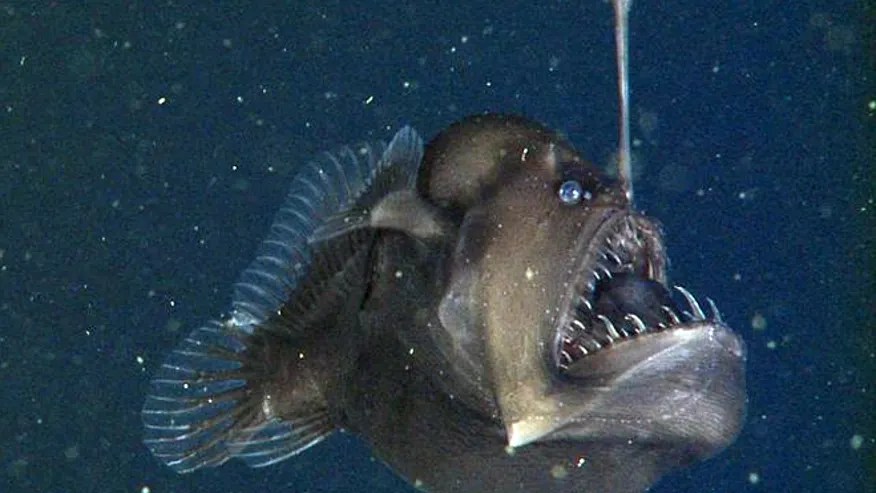
Monterey researchers take first-ever known video of mysterious black seadevil

angler4.jpg

Research team captured first-ever video of a rarely-seen denizen of the deep called the black seadevil while conducting a dive in Monterey Bay, Calif. (Monterey Bay Aquarium Research Institute)

A research team conducting a dive in Monterey Bay off the coast of California have captured first-ever video of a rarely-seen denizen of the deep called the black seadevil.

The creature was spotted this week in the dark, deep waters 1,900 feet below the surface by researchers with the Monterey Bay Aquarium Research Institute.

“We’ve been diving out here in the Monterey Canyon regularly for 25 years, and we’ve seen three,” MBARI Senior Scientist Bruce Robinson told the San Jose Mercury News Friday.

Robinson said a luminescent “fishing pole” projecting from the anglerfish’s head is a glowing lure to attract prey.

Robinson told the paper they captured the fish to study, but don’t know how long it will survive.
MyFox Los Angeles posted the institute’s two-minute-long video on its website, while pointing out that although the black seadevil seems menacing as its swims towards the camera, it is only about 3.5 inches long.

Little is known about the fish. Male black seadevils have a much shorter life span than females and are much tinier in comparison. Their sole purpose is to attach themself to a female, living as a parasite.


“If they don’t find a female, they drown,” University of Washington professor and deep-sea anglerfish expert Ted Pietsche told the Mercury News. “They’re not even properly equipped to eat.”

Leave a comment

Filed under Animals, Humor and Observations

Jules Verne was Right Again!

Jumbo squid attack submarine

Squidimage.jpg

Screen shot from a Vine video. (Greenpeace USA)

It is like a scene from an old wives’ tale about the giant, tentacled kraken dragging shipping vessels to their doom — two Humboldt squid, flashing an angry red, attack a Dual Deep Worker submersible containing two Greenpeace USA divers on an expedition in the Bering Sea. In a Vine video shot by one of the divers, the two large cephalopods, also commonly referred to as “jumbo squid” or “red devils,” rush at the submersible while spewing vision-obscuring clouds of ink.

The video feeds the perception that the large mollusks – smaller than the elusive giant squid, but still weighing up to 100 pounds and measuring as long as 6.2 feet — are aggressively violent and dangerous to humans. The creatures typically range from 660 to 2,300 feet below the surface of the water, and roam off the coasts of British Columbia all the way down to Chile. In fact, its name is derived from the Humboldt Current off the western coast of South America.

https://vine.co/v/OAJ6vp3D9i6/embed/simple<script async src=”//platform.vine.co/static/scripts/embed.js” charset=”utf-8″></script>

Much feared by fishermen and divers alike, the animals are said to be more aggressive than many of their calmer mollusk brethren like the octopus. The color-producing chromatophores in their skin generate a brilliant color display – switching from white to blood red — and many scientists believe the changes in hue are how the squid communicate with one another. Adding to their fearsome image, the animals possess over 100 suckers on their tentacles, each lined with sharp “teeth” used to dig into their prey.

The creatures have long inspired writers and explorers alike. In a 2006 article for Outside Magazine, Tim Zimmermann describes an underwater encounter with the squid.

To watch the video:

https://v.cdn.vine.co/r/videos/C06A9455921132360196870787072_238cb91db02.5.1.9942513653753261824.mp4?versionId=dSSVIK7ZPjbl0809eIMwlUCucSX5xa1m

“I see a jig rising past me, and the hooked squid is flashing red and white like a neon sign. It’s a stunning display, and another extraordinary aspect of Humboldt squid behavior,” Zimmermann writes of a just-caught squid. “You can almost feel the squid’s emotion being transmitted through the water. In this case, it appears to be fear – or at least a vain plea for mercy,”

As with Zimmerman’s description of the ocean dwellers, many scientists believe that the animals are not necessarily aggressive until provoked. The squids’ response in the video might have been instigated by the submarine’s bright lights. While Greenpeace has not released any more information on the encounter, the video has been making the rounds on social media. On Twitter, some users reveal their fear of the animals like @logan607 who writes, “this is why I never leave #Manhattan,” while others share their fascination with the creatures, with @crave even tweeting that the squid are “pretty cute actually.”

Leave a comment

Filed under Animals, Humor and Observations

90-year-old among first charged under Fort Lauderdale’s strict rules against feeding homeless

Just another example of the atrocities of big government…

Abbottpic1.jpg

Arnold Abbott plans to defy Fort Lauderdale’s ordinance against feeding the homeless again on Wednesday. (Courtesy: Sun-Sentinel)

Fort Lauderdale police say Arnold Abbott violated a new city law, but the 90-year-old homeless advocate says his only crime was to “love thy neighbor.”

Abbott was charged Sunday along with two local pastors with violating the city’s new ordinance that effectively bans giving out food in public. He faces 60 days in jail and a $500 fine, and he intends to get cited again Wednesday night, when he sets out to feed some of the Florida city’s estimated 10,000 homeless on a public beach.

“The homeless people come here for the weather. They know they won’t freeze to death in Fort Lauderdale.”- Arnold Abbott, homeless advocate

“I know that I will be arrested again, and I am prepared for that,” Abbott said by phone from his office at Love Thy Neighbor, Inc., a nonprofit he established in honor of his wife, Maureen, after her death in a car accident 23 years ago. “I am my brother’s keeper, and what they are doing is just heartless.”

Fort Lauderdale passed an ordinance late last month that included a slate of new regulations on where and how groups can provide food to homeless people.  The vote made the city the 13th in the nation since 2012 to pass restrictions on where people can feed the homeless, according to a report by the National Coalition for the Homeless.

The regulations enacted in Fort Lauderdale state that no two indoor feeding sites can be within 500 feet of one another or on the same block; outdoor feeding programs require a permit or permission of the property owner and must provide portable toilets; and outdoor stations cannot be within 500 feet of residential properties.

Abbott, whose charity has battled city officials for years in court and on the streets of the southern Florida city, said the toilet requirement was too much for his group.

“I have tried to abide by their regulations, but we just are not able to provide a port-a-potty,” he said. “I believe that is the job of the municipality, anyway.”

Cited along with Abbott were Dwayne Black, pastor of The Sanctuary Church in Fort Lauderdale, and Mark Sims of St. Mary Magdalene Episcopal Church in Coral Springs, according to the Fort Lauderdale Sun-Sentinel. Although the three were not handcuffed or taken to jail, they were cited and must appear in court or face a bench warrant.

Fort Lauderdale officials defended the ordinance, saying it does not bar people from helping the hungry.

“The ordinance allows for legal, clean and safe distribution of food to the homeless,” said Fort Lauderdale Police Department Det. DeAnna Greenlaw. “For example, if a minister, priest or member of clergy wishes to provide food to the homeless at their establishment (I.e community hall, church or gathering place) they can do so if the proper facilities, as listed in the ordinance, are in place.”

Supporters of the strict laws say that allowing programs like Abbott’s encourages homelessness. Cal Deal, a 65-year-old former journalist who videotapes homeless people in the city and says they commit crimes, cause sanitation problems and need more help than simply food.

“The people feeding them are enablers, and they enable the homeless by making their lives easier,” Deal told the New Times of Broward County. “Hunger is a big motivator. Are people more likely to seek help when they’re hungry or when they’re fed and happy?”

Ron Book, chairman of the Miami-Dade County Homeless Trust, told city lawmakers at the raucous, Oct. 21 meeting at which the new laws were passed that they would have a positive effect.

“Feeding people on the streets is sanctioning homelessness,” Book said. “Whatever discourages feeding people on the streets is a positive thing.”

Sims acknowledged that Fort Lauderdale has a problem with homelessness, but said the answer isn’t laws that make it hard to feed people.

“It’s not an easy issue, not cut and dried,” Sims said. “But what is cut and dried is that people deserve to eat when they are hungry. And people of faith are compelled to reach out to people who are in need.

“We need to work harder to solve the problem, rather than just shutting it down,” he added.

Abbott said there is a simple explanation for Fort Lauderdale’s outsize homeless population.

“The homeless people come here for the weather,” he said. “They know they won’t freeze to death in Fort Lauderdale.”

Abbott, a World War II veteran who won two Purple Hearts as an infantryman, said he won’t stop the fight he has dedicated to his wife.

“She tried to help as many poor and homeless people as she could,” said Abbott, a retired jewelry salesman who grew up in Philadelphia. “When I lost her, I decided the best tribute to her would be a full-time program in her name.”

In addition to feeding the homeless, Love Thy Neighbor operates a culinary training program that Abbott says has helped more than 400 people learn food service skills.

But the food programs have gotten him in trouble for years. In 1999, the city tried to stop Abbott from feeding the homeless on Fort Lauderdale Beach, the same location he plans to go to Wednesday. Abbott sued and won, and says he will go back to court if necessary.

“I’ll go to court again and sue the city,” said Abbott. “They are doing the bidding of the very wealthy, and they are trying to sweep the poorest of the poor under the rug.”

Leave a comment

Filed under Humor and Observations

Earth’s magnetic field could flip in our lifetime

magnetic-swap

Earth’s magnetic poles could flip sooner than originally expected. (UC Berkeley)

A pilot looking down at her plane controls and realizing magnetic north is hovering somewhere over Antarctica may sound like a scene from a science-fiction movie, but new research suggests the idea isn’t so far-fetched in the relatively near future.

A magnetic field shift is old news. Around 800,000 years ago, magnetic north hovered over Antarctica and reindeer lived in magnetic south. The poles have flipped several times throughout Earth’s history. Scientists have estimated that a flip cycle starts with the magnetic field weakening over the span of a few thousand years, then the poles flip and the field springs back up to full strength again. However, a new study shows that the last time the Earth’s poles flipped, it only took 100 years for the reversal to happen.

The Earth’s magnetic field is in a weakening stage right now. Data collected this summer by a European Space Agency (ESA) satellite suggests the field is weakening 10 times faster than scientists originally thought. They predicted a flip could come within the next couple thousand years. It turns out that might be a very liberal estimate, scientists now say. [Infographic: Explore Earth’s Atmosphere Top to Bottom]

“We don’t know whether the next reversal will occur as suddenly as this [previous] one did, but we also don’t know that it won’t,” Paul Renne, director of the Geochronology Center at the University of California, Berkeley,said in a statement.

Geologists still are not sure what causes the planet’s magnetic field to flip direction. Earth’s iron core acts like a giant magnet and generates the magnetic field that envelops the planet. This helps protect against blasts of radiation that erupt from the sun and sometimes hurtle toward Earth. A weakening magnetic field could interrupt power grids and radio communication, and douse the planet in unusually high levels of radiation.

While the ESA satellite studied the magnetic field from above, Renne and a team of researchers studied it from below. The researchers dug through ancient lake sediments exposed at the base of the Apennine Mountains in Italy. Ash layers from long-ago volcanic eruptions are mixed into the sediment. The ash is made of magnetically sensitive minerals that hold traces of Earth’s magnetic field lines, and the researchers were able to measure the direction the field was pointing.

Renne and colleagues then used a technique called argon-argon dating which works because radioactive potassium-40 decays into argon-40 at a known rate to determine the age of the rock sediment. The layers built up over a 10,000-year period, and the researchers could pinpoint where the poles flipped in the rock layers. The last flip happened around 786,000 years ago.

Sudden swap

The sediment layers also showed the magnetic field was unstable for about 6,000 years before the abrupt flip-flop. The period of instability included two low points in the field’s strength, each of which lasted about 2,000 years.

Geologists don’t know where the magnetic field is now in that reversal timescale or if this flip will even follow the same pattern as the last. The bottom line is that no one is sure when it’s coming.

“We don’t really know whether the next reversal is going to resemble the last one, so it’s impossible to say whether we’re just seeing the first of possibly several excursions (slight movements), or a true reversal,” Renne told Live Science in an email.

Magnetic doomsday?

While a pole flip could cause a few technical issues, there’s no need to panic. Scientists have combed the geological timeline for any evidence of catastrophes that might be related to a magnetic flip. They haven’t found any.

The only havoc that a reversal would wreak is interference in the global electric grid. No direct evidence remains of past catastrophes triggered by a magnetic flip.

However, if the magnetic field weakens enough or temporarily disappears during the flip, then the Earth could be hit with dangerous amounts of solar radiation and cosmic rays. The exposure could mean that more people develop cancer, Renne said, though there’s no scientific proof this could happen.

Renne said more research is needed to understand the possible consequences of a shifting magnetic pole.

The new study will be published in the November issue of the Geophysical Journal International.

1 Comment

Filed under Humor and Observations

World’s Largest Spider Found – Ack!

Goliath encounter: Puppy-sized spider surprises scientist in rainforest

theraphosa4

The South American Goliath birdeater (Theraphosa blondi) is the world’s largest spider, according to Guinness World Records. Its legs can reach up to one foot and it can weight up to 6 oz.. (Piotr Naskrecki)

Piotr Naskrecki was taking a nighttime walk in a rainforest in Guyana, when he heard rustling as if something were creeping underfoot. When he turned on his flashlight, he expected to see a small mammal, such as a possum or a rat.

“When I turned on the light, I couldn’t quite understand what I was seeing,” said Naskrecki, an entomologist and photographer at Harvard University’s Museum of Comparative Zoology.

A moment later, he realized he was looking not at a brown, furry mammal, but an enormous, puppy-size spider.

Known as the South American Goliath birdeater (Theraphosa blondi), the colossal arachnid is the world’s largest spider, according to Guinness World Records. Itsleg span can reach up to a foot (30 centimeters), or about the size of “a child’s forearm,” with a body the size of “a large fist,” Naskrecki told Live Science. And the spider can weigh more than 6 oz., about as much as a young puppy, the scientist wrote on his blog. [See Photos of the Goliath Birdeater Spider]

Some sources say the giant huntsman spider, which has a larger leg span, is bigger than the birdeater. But the huntsman is much more delicate than the hefty birdeater comparing the two would be “like comparing a giraffe to an elephant,” Naskrecki said.

The birdeater’s enormity is evident from the sounds it makes. “Its feet have hardened tips and claws that produce a very distinct, clicking sound, not unlike that of a horse’s hooves hitting the ground,” he wrote, but “not as loud.”

Prickly hairs and 2-inch fangs

When Naskrecki approached the imposing creature in the rainforest, it would rub its hind legs against its abdomen. At first, the scientist thought the behavior was “cute,” he said, but then he realized the spider was sending out a cloud of hairs with microscopic barbs on them. When these hairs get in the eyes or other mucous membranes, they are “extremely painful and itchy,” and can stay there for days, he said. [Creepy-Crawly Gallery: See Spooky Photos of Spiders]

But its prickly hairs aren’t the birdeater’s only line of defense; it also sports a pair of 2-inch-long  fangs. Although the spider’s bite is venomous, it’s not deadly to humans. But it would still be extremely painful, “like driving a nail through your hand,” Naskrecki said.

And the eight-legged beast has a third defense mechanism up its hairy sleeve. The hairs on the front of the spider’s body have tiny hooks and barbs that make a hissing sound when they rub against each other, “sort of like pulling Velcro apart,” Naskrecki said.

Yet despite all that, the spider doesn’t pose a threat to humans. Even if it bites you, “a chicken can probably do more damage,” Naskrecki said.

Bird eater or mostly harmless?

Despite its name, the birdeater doesn’t usually eat birds, although it is certainly capable of killing small mammals. “They will essentially attack anything that they encounter,” Naskrecki said.

The spider hunts in leaf litter on the ground at night, so the chances of it encountering a bird are very small, he said. However, if it found a nest, it could easily kill the parents and the chicks, he said, adding that the spider species has also been known to puncture and drink bird eggs.

The spider will eat frogs and insects, but its main prey is actually earthworms, which come out at night when it’s humid. “Earthworms are very nutritious,” Naskrecki said.

Birdeaters are not very common spiders. “I’ve been working in the tropics in South America for many, many years, and in the last 10 to 15 years, I only ran across the spider three times,” Naskrecki.

After catching the specimen he found in Guyana, which was female, Naskrecki took her back to his lab to study. She’s now deposited in a museum.


Leave a comment

Filed under Animals, Humor and Observations

‘Love’ hormone oxytocin regulates female sexual behavior, study suggests

660love.jpg

Previous research shows that the hormone oxytocin stimulates social behavior in humans, but a study published Thursday in the journal Cell suggests the hormone plays an especially strong role in regulating female sexual behavior.

Scientists at The Rockefeller University in New York City genetically modified female mice so that they no longer had an oxytocin response in the prefrontal cortex. As a result, the females no longer approached male mice for mating during the sexually receptive stage of their estrous cycle. In fact, with reduced oxytocin, the female mice showed about as much interest in males as they did in a LEGO block.

The researchers manipulated only a small amount of the neurons— less than 1 percent in the prefrontal cortex, an area known to trigger behavior in mammals, lead author Miho Nakajima, a graduate student at The Rockefeller University, told FoxNews.com.

Senior study author Nathaniel Heintz, a James and Marilyn Simons professor at The Rockefeller University, said the female mice were still interested in males and other females when oxytocin was reduced, but they didn’t show sexual interest.

“When [female] mice are sexually active, this small population [of neurons] is required for female mice to show interest in the male mice,” Heintz, an investigator at Howard Hughes Medical Institute, told FoxNews.com.

Researchers found that the change in interest among the male mice was less pronounced than the females’ response when researchers manipulated their oxytocin levels.

“There’s a functional difference in how male mice and female mice responded,” Heintz said.

Past research has shown that oxytocin plays a strong role in partner and mother-child bonding.

A study previously published in the journal Psychoneuroendocrinology showed that oxytocin levels skyrocket when people fall in love, and that a higher amount of oxytocin is correlated with longer relationships. Another study, in the journal Social Cognitive and Affective Neuroscience, suggested that oxytocin improved communication and lowered cortisol, a stress hormone, in both men and women. Many scientists have consequently nicknamed oxytocin the “love” or “pro-social” hormone.

The study authors said further research should explore what oxytocin does at a molecular level, and which brain areas and what types of cells respond to the hormone. Their study explores how oxytocin behaves in just one context.

Other studies have examined whether oxytocin levels can be modified to enhance the social behaviors of people with autism spectrum disorder (ASD). The mental condition impacts 1 in 68 children, and its hallmark is impaired social interaction.

Heintz said his team’s findings could help advance treatment development for ASD.

A study published last year in the journal Proceedings of the National Academy of Sciences suggested that a single dose of oxytocin can increase brain functions responsible for social interaction in children and adolescents with autism. In their research, Yale University scientists found that brain centers associated with reward and emotional cognition responded more during social tasks when the study participants were giving an oxytocin nasal spray rather than a placebo nasal spray.

“Each study gives us more insight into how this [oxytocin] might be acting in humans,” Heintz said.

Leave a comment

Filed under Humor and Observations

Dozens of police agencies report loss of Pentagon-supplied military weapons

Missoyri2_riots.jpg

FILE: Aug. 18, 2014: Police in suburban St. Louis after the shooting of Michael Brown by a police officer started rancorous protests in Ferguson, Mo. (AP)

Images showing high-powered military rifles in the hands of law enforcement in Ferguson, Mo., after the police shooting of an unarmed black man focused attention on a controversial Pentagon program that supplies that kind of weaponry to local police departments. Now reports reveal how some of those guns have been lost by law enforcement officials who received the weapons.

Take Huntington Beach, Calif., which was given 23 M-16 rifles and has reported one missing.

“Bottom line is the gun is not here and we were suspended from the program, haven’t received anything since 1999,” Huntington Beach Police Department Lt. Mitchell O’Brien told ABC News Friday.

O’Brien told the network the lost weapon could have been melted down, but that’s uncertain.

“Bottom line is the gun is not here and we were suspended from the program.”- Huntington Beach Police Department Lt. Mitchell O’Brien

“Probably, [it was] one of those things where we used it for parts and the spare parts probably got discarded at some point — but again, it’s inconclusive,” he said. “But we are pretty confident nobody got into our armory and took it.

The program O’Brien was referencing is the Pentagon’s 1033 program, which gives away surplus military weapons to local police departments. In a report Friday the Cox Washington Bureau said Huntington Beach is one of 145 local law enforcement agencies across the country that has been suspended from the program.  Three states — Alabama, North Carolina and Minnesota — also have been suspended.

Cox named some of the banned agencies.

The Daytona Beach Police Department was suspended after reporting a lost M-16 in January.

“We still have not been able to find it,” Daytona Beach Police spokesman Jimmie Flynt told Cox.

The Napa County Sheriff’s Office was banned after someone stole a rifle from an employee’s personal vehicle.

“If I knew where it was, I’d go get it,” Undersheriff Jean Donaldson told Cox. “It’s equipment we can obtain at no cost to our budget, so the taxpayers don’t get taxed twice.”

KARK-TV in Arkansas said three law enforcement agencies in the state have been suspended for losing weapons or having weapons stolen: the Lawrence County Sheriff’s Office, the Woodruff County Sheriff’s Office and the Judsonia Police Department.

James Ray, who oversees the 1033 program in Arkansas, told the station officials are worried the missing weapons could end up in the wrong hands.

“I have no reason to believe that, but if we don’t know where they are then hopefully we can get them back,” he said. “I mean they’ve been reported stolen by the law enforcement agencies….”

“It just appears that the Pentagon’s not minding the store, that once the inventory is gone, it’s out of sight, out of mind—and we can’t afford to have weapons of this type walking around the streets,” Steve Ellis, vice president of Tax Payers for Common Sense, told ABC.

A Pentagon spokesman told the station that 8,000 law enforcement agencies participate in the 1033 program and that 98 percent remain in good standing.

Leave a comment

Filed under Humor and Observations