Tag Archives: futurism

Use Your Laptop With Gestures Instead of Keyboard and Mouse?

Leap Motion, Gesture-Control Gadget For Your Laptop, Will Be Released This May For $80

The Huffington Post  |  By Posted: 02/27/2013 11:59 am EST

Leap Release
Turns out that 2013 is, indeed, a Leap Year.

Leap Motion, the company that makes the hotly anticipated gesture-control device of the same nameannounced Wednesday morning that the first Leap Motion units would ship to pre-orderers around the world on May 13, and that everyone could get their hands (and fingers) on one on May 19.

If you want one, you can order on Leap Motion’s website here or, somewhat curiously, on BestBuy.com right here. The Leap Motion Controller costs $80 at either outlet.

For a refresher, the Leap Motion controller plugs into almost any newer laptop and allows you to manipulate the screen via a series of hand and finger movements in the air. It’s sort of like having a touchscreen computer, but without actually touching the screen. Watch this video below, made by Leap Motion, to get an idea of how the small device can wholly transform your computer:

Previously, Leap Motion announced that it was sending 10,000 of its controllers to developers, so that there would be apps specifically built for gesture control; earlier this year, the company announced its app store, Airspace, and we’ve already seen one of those apps, by the developers behind the to-do list Clear, shown off.

In general, though, Leap Motion works with your existing operating system (Windows 7 or 8, or OS X 10.7 and 10.8), via zoom, scroll and zoom functions baked into the hardware, which you plug into your USB port. Wired’s Roberto Baldwin wrote that the Leap probably works best as a secondary controller, after your trackpad or mouse, and for specific apps or games written for it; but, like most reviewers, he came away very impressed by the little gizmo’s accuracy and speed.

For more on the Leap Motion Controller, and to pre-order, you can visit the official website right here.

1 Comment

Filed under Humor and Observations, Uncategorized

Israel’s Moon Program

SpaceIL: Israel’s race to the moon  ‘If you will it, it is no dream’

BY TOM TUGEND

February 19, 2013

Follow JewishJournal.com on 

The challenge is to become the first team to successfully launch, fly and land an unmanned spacecraft on the Moon. Photo courtesy SpaceIL

The challenge is to become the first team to successfully launch, fly and land an unmanned spacecraft on the Moon. Photo courtesy SpaceIL

One day in 2015, a small Israeli spacecraft will land on and reconnoiter the moon, joining the United States and former Soviet Union in the world’s most exclusive extraterrestrial club.

That vision is not fantasy or chauvinistic braggadocio, but the sober prediction of Israel’s most experienced engineers and space scientists.

According to the leaders of the SpaceIL (for Israel) project, the unmanned micro-spaceship will pack more instrumentation into a smaller and lighter capsule than ever achieved before.

During a visit to Los Angeles in mid-February, Yariv Bash, founder and CEO of SpaceIL, and Ronna Rubinstein, the chief of staff, outlined the genesis, scope and anticipated impact of the moon mission.

In late 2010, Bash heard about the Google Lunar X competition, which offered awards up to $30 million for the first team to land a robotic craft on the moon that would perform several complex missions. For one, the craft had to move 500 meters (1,640 feet) from its landing site to explore the moon’s surface – or send out a search vehicle to do so – and beam high-definition videos back to earth.

Bash, an electronics and computer engineer, said that SpaceIL will traverse the distance in one spectacular jump. SpaceIL, by the way, is only an interim name and when the time comes will be replaced with an official designation.

Initial names suggested by the project staff include Golda, for the former Israeli prime minister, Ramon, for Israeli astronaut Ilan Ramon, who perished in the Columbia shuttle disaster, and Hatikvah, Hebrew for “hope” and the title of the Israeli national anthem.

As soon as Bash absorbed the details of the Google competition, he posted one sentence on Facebook, asking, “Who is coming with me to the moon?” Among the first respondents was Rubinstein, a lawyer who now oversees the project’s organization, marketing and fundraising.

The total estimated cost for the project will be $30 million, of which $20 million has been raised so far, primarily from industry and private contributors. The Israeli government has allotted funds for 10 percent of the total cost, the maximum a government can put up under the contest rules.

Shimon

Israeli President Shimon Peres visits SpaceIL. Photo courtesy SpaceIL

According to Israeli statistics, the government money will be well spent, since for every $1 invested in Israel’s 10 satellites and other high-tech research, $7 are returned in civilian and commercial applications.

The prize for the winning entry is $20 million, with another $10 million available in bonus prizes for accomplishing different aspects of the mission.

But it’s not the prize money that is driving the 11 full-time staff members and some 300 professionals who are volunteering their services evenings and weekends, after finishing their regular day jobs. In any case, any money won will go to schools to enhance math and technology programs.

“What counts for us is the impact the moon landing will have on Israelis and Jews around the world, to show what Israel is and what it can do,” Bash said.

Most important is to instill both pride and scientific curiosity in Israeli youngsters, Bash added. Together with the Weizmann Institute of Science, the project has launched a nationwide program of high school visits, which so far has involved 27,000 students.

Plans also call for lectures and exhibits in Diaspora communities, and Bash and Rubinstein will address a plenary session at the AIPAC Policy Conference in Washington, DC during the first week of March.

Other key partners in the project are Israel Aerospace Industries, Tel Aviv University, Technion, Israeli Space Agency, Ramon Foundation and private companies like Rafael and Bezeq.

The Israeli spacecraft, whatever its final name, will compete against 24 other entries, of which 11 will be launched by various U.S. teams. Other competitors will come mainly from Europe and some from South American countries, but none from China, or, for that matter, Iran.

Early favorites are entries from the United States, Israel and Spain, Bash said.

Israel’s main strength, he noted, “lies in its nano-miniaturized technology, and SpaceIL will be the smallest craft ever sent into space.”

At liftoff, it will weigh 120 kilograms (264 pounds), but on landing, after burning off its fuel, it will weigh less than 40 kilograms (88 pounds). To get into orbit, SpaceIL will piggyback onto a commercial rocket, either American or Russian, at a cost of between $3 million to $5 million.

To Israelis watching the moon landing from 239,000 miles away, “it will be the most exciting reality show of all,” Bash hopes.

The impact on Israelis, especially young people, would be similar to that created in 1969 by astronaut Neil Armstrong as he descended from the Apollo spacecraft to the moon’s surface, proclaiming, “That’s one step for man, one giant leap for mankind.”

Israeli supporters of SpaceIL already have their own inspirational motto, taken from Theodor Herzl’s words as he prophesized the future creation of a Jewish state.

“Im Tirzu Ein Zo Agada” – “If you will it, it is no dream.”

For additional information, visit www.spaceil.com.

Tracker Pixel for Entry


Leave a comment

Filed under Humor and Observations

Zombie Update – Brain cells can outlive the body

Brain cells can outlive the body

By Tia Ghose

Published February 26, 2013

LiveScience

  • neurons

    Mouse neurons implanted into a rat brain can live twice as long as the mice from which they were taken, new research suggests. (iDesign, Shutterstock)

Brain cells can live at least twice as long as the organisms in which they reside, according to new research.

The study, published Monday, Feb. 25, in the journal Proceedings of the National Academy of Sciences, found that mouse neurons, or brain cells, implanted into rats can survive with the rats into old age, twice as long as the life span of the original mice. The findings are good news for life extension enthusiasts.

‘We are slowly but continuously prolonging the life of humans.’

– Dr. Lorenzo Magrassi, a neurosurgeon at the University of Pavia in Italy 

“We are slowly but continuously prolonging the life of humans,” said study co-author Dr. Lorenzo Magrassi, a neurosurgeon at the University of Pavia in Italy.

So if the human life span could be stretched to 160 years, “then you are not going to lose your neurons, because your neurons do not have a fixed lifetime.”

Long-lived cells
While most of the cells in the human body are being constantly replaced, humans are born with almost all the neurons they will ever have. [10 Odd Facts About the Brain]

Magrassi and his colleagues wanted to know whether neurons could outlive the organisms in which they live (barring degenerative diseases like Alzheimer’s).

To do so, the researchers took neurons from mice and implanted them into the brains of about 60 rat fetuses.

The team then let the rats live their entire lives, euthanizing them when they were moribund and unlikely to survive for more than two days, and then inspected their brains. The life span of the mice was only about 18 months, while the rats typically lived twice as long.

The rats were found to be completely normal (though not any smarter), without any signs of neurological problems at the end of their lives.

And the neurons that had been transplanted from mice were still alive when the rats died. That means it’s possible the cells could have survived even longer if they were transplanted into a longer-lived species.

Life extension
The findings suggest that our brain cells won’t fail before our bodies do.

“Think what a terrible thing it could be if you survive your own brain,” Magrassi told LiveScience.

While the findings were done in rats, not humans, they could also have implications for neuronal transplants that could be used for degenerative diseases like Alzheimer’s disease or Parkinson’s disease, Magrassi said.

But just because brain cells may be able to live indefinitely doesn’t mean humans could live forever.

Aging is dependent on more than the life span of all the individual parts in the body, and scientists still don’t understand exactly what causes people to age, Magrassi said.

Read more: http://www.foxnews.com/science/2013/02/26/brain-cells-can-outlive-body/?intcmp=features#ixzz2M9COJANr

1 Comment

Filed under Humor and Observations

Space Elevator Development

The space elevator once a laughed at theory included in future tech in the game Civilizaton is now becoming possible.  First, some artists’ rendering of possible space elevators, then the story.

LEARN in Universe and Environment

October 2, 2008 at 8:53 PM

The Space Elevator Gets a Lift

The fabled elevator to space is a surprisingly pragmatic idea. In November, the Japanese give it a timeline.

Imagine, if you will, a new kind of space travel-one with no launch pads or booster rockets. No risky ocean landings in charred, cramped Soyuz orbital modules; no money-sucking Space Shuttles. No explosions, no “Houston, we have a problem.” Instead of strapping themselves onto the noses of massive rockets and hoping for the best, astronauts would nimbly step into an elevator and ride for a few hours, smoothly and safely, out of the Earth’s atmosphere and into a waiting space station.

Meet the space elevator, probably the most revolutionary idea in the history of aeronautics. Because it’s exactly what it sounds like: an elevator. To space. And, although it’s been a pipe dream of armchair theorists since the 1800s, it just made one giant leap into a whole new world of plausibility. Why? Because the Japanese, perhaps afraid of being eclipsed by the mighty progress of commercial space travel companies, or the showboating of the nascent Chinese space program, have decided to build one, for real.It’s a smart pairing. Japan is a pioneer in the kind of precision engineering that a space elevator requires, and their space program, JAXA, is a small but powerful operation, excelling in X-Ray astronomy, satellite-based Earth observation, and building smart modules and components for the International Space Station. Plunging headlong into this unlikely project, Japanese scientists have founded an organization called the Japan Space Elevator Association, and they plan to host an international conference in November to draw up a timetable for the machine, discuss its impact on the world, and, according to their site, “Organize races with climbers made of Lego Blocks.”Yes, it sounds like fun, but surely this is a folly in a moment of global economic upheaval?
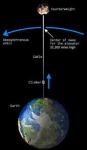
Unbelievably, the space elevator is in fact a totally pragmatic idea, and ultimately a cheap one, too-or rather, it’s cheaper than the fuel-guzzling rigmarole we’re currently faced with every time we need to wrest something from the steely grip of our planet’s escape gravity.The idea is simple, as most good ideas are: a super-strong tether made of carbon nanotubes, held taut by the inertia of the planet’s rotation, spanning from the surface of the Earth to a point beyond geosynchronous orbit, serving as a kind of  22,000 mile-long cosmic freeway (or, as the Japanese have already dubbed it, a bullet train to space) shuttling “lifters” out of the planet’s gravity and into orbit. To boot, the Japanese Space Elevator Association estimates it would only cost a paltry 1 trillion yen (about $9 billion) to build, which is pocket change if you consider the amount of money that NASA has indiscriminately poured into its programs over the years-not to mention compared to a certain Wall Street bailout.
What’s so elegant about the space elevator is that it draws a clean line between our centuries-old conception of “down here” and the newly approachable “up there.” While rockets retain a certain abstract quality-off they blast, in a florid burst of flame and noise, the mechanics of the whole thing still pretty mystical-the space elevator is concrete, as though humankind were reaching its own tentative arm into the great beyond. Besides, rocket fuel is so expensive, and launching rockets such a fuss, that it will probably always keep the democratization of space travel at bay. So what have we been waiting for?
There are a handful of groups in the U.S. working on space elevator policy and components-one being the Liftport Group in Bremerton, Washington-but no one has made plans as bold as those of the Japanese.Building the space elevator involves massive engineering challenges, but they’re not as impossible as they may seem. One of the most stunning things about the elevator, in fact, is that we have all the technology needed to implement it already. The only thing missing is a strong enough material to build the tether-the long cord connecting Earth and Space. Carbon nanotubes, which are the strongest man-made materials on Earth, seem to fit the bill, although the director of the JSEA, Yoshi Aoki, estimates they need to get a little stronger yet: about 180 times the tensile strength of steel.Arthur C. Clarke, perhaps the most ardent and famous promoter of the space elevator, was often asked when he thought the first one might be built. A little flippantly, he noted, “my answer has always been: about 50 years after everyone has stopped laughing.” Stop laughing, everyone: it looks like it might be even sooner than that.


2 Comments

Filed under Humor and Observations, Uncategorized

Future Internet/Smartphones/Ipads

The future of internet, pads and smartphones may look like the following:  (pretty amazing stuff)

  • Future of Internet Search: Mobile version
  • Part1: Looking Glass Concept
    This is what I wish the internet search will be able to do with a mobile device in the NEAR future. Touch screen, built in camera, scanner, WiFi, google map (hopefully google earth), google search, image search… all in one device. Like this way, when you can see a building through it, it gives you the image search result right on the spot.
  • Part2: Future of Mobile Internet Search: Applications

    Many applications like these will be developed that have never been possible.Indoor guide

    Works in a building, airport, station, hospital, etc.

    Automatic simultaneous translation
    Search keyword
    Helpful when you want to find out a word from a lot of text
  • Part3: Look at What You Don’t See Through Glass

    You can even see flowers that are not actually blooming.

    There are a lot more ideas drawn in my Moleskine, so I’ll introduce them later.
    Also visit other posts of this gadget.

  • Part4: Future of Mobile Search for Diet


    Mainly because I don’t usually care about nutrition when I eat, this kind of function would be helpful for people like me.
  • Part5: Future of Mobile Search- Search Beyond Time

    Getting data of a weather forecast, maybe this might be possible.

    When you wonder what the scene you’re looking at was like in the past, you can see it.

    It would be nice if it could work in sync with Google Maps like this.
  • Part6: Future of Mobile Search- Power of Visualization

    Visual aid for any book. It means any book can be a picture book.

    If it could be wirelessly in sync with your mobile phone or other mobile devices, visualized data exchange could be done like
  • Looking Glass for iPhone

    petitinvention.wordpress.com/2008/07/26/looking-glass-for-iphone/
  • Part7: Future of Mobile Search: Virtual Shopping #1

    I’m pretty sure companies like Ikea would quickly start to use this device this way if it became really available.
  • Part8: Speech Balloons for the Hearing-Impaired

    Speech balloons in comic books show very well how the characters speak. If we could instantly visualize how people speak, wouldn’t it be nice for the hearing-impaired? It means they can SEE our voices.

    Stressed words are rendered larger than those spoken less loudly.Arrows of the balloons show from where it’s spoken (of course).

    A scream is shown in a balloon with jags.

    Imitation sounds are also rendered, but with other colors than spoken words.

    When spoken to from out of the screen, it shows the words with the direction the voice is from.


    A pair of glasses with the same functions could replace the device if we could figure out a good way not to block visual information.

1 Comment

Filed under Humor and Observations, Uncategorized

Airless Car Tires

This is an older article from a nearly over a year ago, but I thought pretty cool anyway.

bridgestoneg

Bridgestone goes airless in tire concept for Tokyo show December 3, 2011 by Nancy Owano (PhysOrg.com) —

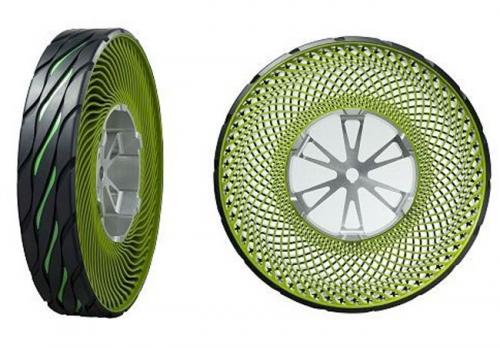
Visitors to the 42nd Tokyo Motor Show are to witness a new breed of airless tires from Bridgestone. Interest in the general press is already humming because of the material, design, and features of the Bridgestone debut on show. The concept tires use recycled thermoplastic, outside tread included. Fittingly colored green, the tires are being promoted for their green advantage of being completely recyclable.

The spokes are made of reusable thermoplastic resin. In design, interest is drawn toward the thermoplastic fins, staggered so that connections to the hub and the rim do not torque and there is no structural breakdown. The tires’ resin spokes radiate from rim to tread. They curve to the left and right to support vehicle loads. Bridgestone is not the first to experiment with an airless tire concept. Observers point to Michelin’s debut in 2005 of its airless Tweel tires. These were seen with much interest as a novel departure from the traditional wheel hub assembly, though concerns were raised in some quarters about their being noisy and vibrations at high speeds.

The name Tweel is a combination of the words tire and wheel. Michelin used polyurethane spokes arrayed in a wedge pattern. In describing differences between the Michelin and Bridgestone concept, observers say a key contrast is in size of the ribs. Michelin’s tires were viewed as more suitable for military applications—this is not like the Bridgestone concept, which is suited for something more consumer-driven. Another tire concept innovator has been Yokohama Rubber Co. Ltd. The company announced in October this year its airless tire concept which relies on mechanical rather than pneumatic support.

Yokohama introduced its tire concept earlier this year at a design expo in Japan. Bridgestone’s airless tires have a deeper structure of plastic ribs than either of the other two approaches, and it has a higher aspect ratio, according to Plastics News. Obviously, the key benefit for the consumer will be seen in the fact that the Bridgestone tires cannot suffer punctures. On the other hand, these have a way to go before seeing car commercialization. The tires are in prototype stage only and due for further evaluations. The company has tested the tires, nine inches across, on single-seater electric carts in Japan. Observers see similar uses, at this earlier level, as potential for use in motorized golf carts, lawnmowers and vehicles for the elderly.

Read more at: http://phys.org/news/2011-12-bridgestone-airless-concept-tokyo.html#jCp


Leave a comment

Filed under Humor and Observations

Human Ear Made by 3D Printer

3D-printed ear created in lab

By Tanya Lewis

Published February 21, 2013

LiveScience

  • 3d-printed-ear1

    Mechanical engineer Larry Bonassar holds a fabricated ear printed with a 3D printer in his lab at Cornell University’s Weill Hall. (Lindsay France/Cornell University Photography)

  • 3d-printed-ear2.jpg

    A 3D printer fabricating an ear. (Lindsay France/Cornell University Photography)

With 3D printing, it seems the things you can make are limited only by your imagination. The latest innovation: a 3D-printed artificial ear. 
SUMMARY

Ear looks and functions like a normal human ear

Created by squirting a gel made of living cow ear cells and collagen into an injection mold

Current replacement ears often made from a patient’s harvested rib — a difficult and painful process


The ear, which looks and functions like a normal human ear, was created by squirting living cells into an injection mold. Over the course of three months, each ear grew cartilage in the shape of its mold. These ersatz ears could replace the ears of children with congenital deformities, researchers report online today (Feb. 20) in the journal PLOS ONE.

“A bioengineered ear replacement like this would also help individuals who have lost part or all of their external ear in an accident or from cancer,” co-lead author Jason Spector, a plastic surgeon at Weill Cornell Medical College in New York City, said in a statement. If the ears prove safe and successful, it could be possible to implant one in a human in as few as three years, Spector said.

Children with a deformity called microtia have an intact inner ear but an external ear that fails to develop fully, causing hearing loss. The prevalence ranges from slightly fewer than one to as many as four babies per 10,000 births, depending on the country. [The 9 Most Bizarre Medical Conditions]

The artificial ears were made by producing a digital 3D image of a child’s intact ear and feeding that into a 3D printer to produce an ear-shaped mold. Then the scientists injected a gel made of living cow ear cells and collagen (a substance used to make gelatin) into the mold, and out popped an ear.

The whole process took less than two days: half a day to design the mold, a day to print it, half an hour to inject the gel, and 15 minutes to allow it to set.

Then the researchers implanted the fabricated ears on the backs of rats, where the ears grew for one to three months. Creepy as it sounds, it isn’t the first time scientists have grown ears on rodents, as a model for naturally growing ears.

In medicine, current replacement ears are made from a Styrofoam-like material or by an Eve-like genesis out of a patient’s harvested rib. The latter is difficult and painful, and rarely produces an ear that works well or looks natural.

The advantage of 3D-printed replacement ears is that they could be made-to-order, using molds from the patient’s normal ear (if they have one) or from one of a person of similar size. The researchers are now working on growing human ear cartilage cells in the lab, which would reduce the chances of tissue rejection.

Read more: http://www.foxnews.com/science/2013/02/21/3d-printed-ear-created-in-lab/?intcmp=features#ixzz2LbJH8CJ2

Leave a comment

Filed under Humor and Observations, Uncategorized

3D Pen – Draw 3D Art!

The world’s first 3D printing pen: Yours for just $75

The 3Doodler, 3D printing pen

Come September, if everything goes to plan, the world’s first 3D printing pen will go on sale for $75. The pen, called the 3Doodler, essentially allows you to lift your flat sketches off the paper — or, if you wish, to actually draw in three dimensions.

3Doodler is a Kickstarter project, and in under 24 hours it has obtained more than $500,000 in pledges — significantly more than its $30,000 target. As you can see in the video below, the inventors have already created an impressive prototype — and now it’s time to bring the 3Doodler to market. The target price is $75 for a September 2013 release. The inventors say they have already located a Chinese manufacturer who is capable of meeting these targets. The final device should 24mm (1in) thick and weigh less than 200g, with an external power brick that accepts 110-240V.

In essence, 3Doodler is a standard 3D printer, but your hand controls the print head instead of a bunch of computer-controlled motors. (See: What is 3D printing?) Inside the 3Doodler is a filament feeder (which accepts ABS or PLA plastic), a heating element, and an extruder — and that’s about it. The melted plastic comes out of the extruder and very quickly sets. As far as we can tell, the plastic oozes out of the extruder at a set rate — so depending on whether you want a thin (weak and flexible) or thick (strong and rigid) line, you move the 3Doodler quickly or slowly. For strength and flexibility, you just go back and forth over the same section, building up a web of plastic tendrils (like in the Eiffel Tower above).

Judging by the massive support for 3Doodler on Kickstarter, it’s safe to assume that people are really excited at the concept of a freehand 3D printer. It’s not hard to see why, though, if you were a child who dreamt of drawing sketches that literally jump off the paper. The actual reality of freehand 3D printing might be a little more complex than most users bargain for, but to that end the inventors have teamed up up with professional artists to provide 3Doodler backers with templates/stencils that you can simply fill in. The Kickstarter page also seems to lack any evidence that 3Doodler is capable of drawing straight lines, but hopefully it’s just a matter of using a ruler.

A collection of 3Doodler objects

Moving forward, this could be a very exciting stepping stone for inventors and hobbyists alike. While 3D printers have revolutionized rapid prototyping tool, the 3Doodler is even faster; it adds a whole new dimension (!) to back-of-the-napkin brainstorming. To begin with, I suspect it will be quite hard to create meaningful sketches with a 3Doodler, but in time — and with a whole range of usability tweaks and add-on accessories that I’m sure will follow — the 3D printing pen might become as ubiquitous as the 2D Bic ballpoint. (See: 3D printing: a replicator and teleporter in every home.)

1 Comment

Filed under Humor and Observations, Uncategorized

3d printing of guns – update

As followers know, I have said that 3d printing will change everything as we know it.  In an earlier post, I discussed how guns can be printed, and another post talks about how the military uses 3d printing for making knives and other tools.  Here is an update on this revolutionary technology:

Print and fire: 3D printing could muzzle new gun laws

By 

Published February 13, 2013

FoxNews.com

  • gunclip2.jpg

    Cody Wilson of Defense Distributed testing out the “Cuomo Clip” (DefenseDistributed.com)

  • gunclip3.jpg
    DefenseDistributed.com
  • gunclip4.jpg
    DefenseDistributed.com
  • gunclip1.jpg

    A computer rendering of a “Cuomo Clip”, a 30-round ammo magazine for the AR-15 rifle. (DefenseDistributed.com)

Gun owners who can’t buy high capacity ammo magazines because of new laws have another option: Print them.

Gun control measures passed or proposed in the wake of the Sandy Hook school massacre have targeted magazines that can feed 30 rounds or more into the firing chambers of AR-15s and other semi-automatic guns. New York has banned magazines holding more than seven rounds, and a federal bill proposed by Sen. Dianne Feinstein, D-Calif., would ban magazines holding more than 10 rounds.

But the laws are at least one step behind technology. Using 3D printers and schematics available on the Internet, gun owners can manufacture a fully functional, plastic magazine clip. Plans are free, although getting access to a 3D printer may prove expensive, at least for now.

“If you can download it, you can have it.”

– Cody Wilson, Defense Distributed/Wiki Weapons Project 

“If you can download it, you can have it,” said University of Texas law student Cody Wilson, who is part of Defense Distributed, a group that has created the design for what they refer to as a “Cuomo Clip” along with other gun parts. It is all under an initiative they refer to as the Wiki Weapon Project.

“It’s basically to head them [legislators] off at the pass, which we have,” Wilson added, noting that “hundreds of thousands” of visitors have gone to his group’s site to download the CAD file for the ammo magazine since it was first posted in mid-January.

The “Cuomo Clip,” named for New York Gov. Andrew Cuomo, who pushed the high-capacity clip ban through the Legislature, is made from a plastic filament similar to the type of material used to manufacture LEGO building blocks. It is also loaded with a large spring that helps to push rounds of ammo into the gun chamber.

The ammo magazine clip appears to be durable; Defense Distributed test-fired 86 rounds from a 30-round prototype last month, and the clip showed no signs of damage.

The cutting edge technology, in which three-dimensional objects can be manufactured from melted plastic thread, is likely to complicate efforts to control firearms. No such ability existed in 1994, when large-capacity clips were first banned in an initial federal assault weapons ban that lasted a decade.

Although the new ban proposed by Feinstein would prohibit the manufacture of magazines, it focuses on traditional arms makers and sellers. How the law might be enforced against individuals making their own magazines — and possibly even guns in the future — is unclear.

Rep. Steve Israel, D-N.Y., has called for amending the Undetectable Firearms Act of 1988, which initially sought to ban guns that could be sneaked through metal detectors, to include a ban on “homemade, 3-D printed, plastic high-capacity magazines.”

“Congress passed a law banning plastic guns for two decades when they were just a movie fantasy,” Israel told FoxNews.com. “With the advent of 3-D printers, these guns are suddenly a real possibility, and the law Congress passed is set to expire this year.

“We should act now to give law enforcement authorities the power to stop the development of these weapons before terrorists and criminals can easily bring them on planes. We need to be proactive and keep ahead of the technology. When the legislation was originally passed in 1988, no one would have imagined that parts of a gun and a magazine could be made with a printer — imagine what the technology will be even five years down the road.”

Defense Distributed and the Wiki Weapons Project also has made schematics of other parts of the AR-15 and other weapons and modifications, including pistol grips, but has avoided attempting to design and distribute plans for a fully-functional gun.

Read more: http://www.foxnews.com/tech/2013/02/13/print-draw-fire-3d-printing-could-muzzle-new-gun-laws/#ixzz2KoiE5x24

Leave a comment

Filed under Humor and Observations

Bionic Man Created

Meet Rex: the $1m bionic man with working heart, set of lungs and human face

Most human body parts can be replaced,  say scientists, and here’s the evidence

TUESDAY 05 FEBRUARY 2013


view gallery VIEW GALLERY

When Luke Skywalker received a perfect bionic replacement for the hand that was cut off in Star Wars Episode V, the idea of replicating human organs and body parts seemed far-fetched.

Thirty years later, the idea is no longer just science fiction. Scientists, among them the creators of “Rex” – the world’s most complete bionic man, unveiled in London this week – believe they can now replicate about two-thirds of the human body.

“We were surprised how many of the parts of the body can be replaced,” said Rich Walker, managing director of the robotics team Shadow, who built Rex. “There are some vital organs missing, like the stomach, but 60 to 70 per cent of a human has effectively been rebuilt.” This is heralded, then, as the dawn of the age of bionic man – although specialists caution that we are still feeling our way.

Social psychologist Bertolt Meyer, who also worked on Rex, has an interesting perspective: he was born without his left hand and has a prosthesis. “I have looked for new bionic technologies out of personal interest for a long time and I think that until five or six years ago nothing much was happening,” he said. “Suddenly we are at a point where we can build a body that is great and beautiful in its own special way.”

Not everyone in the field believes the recent progress, impressive as it is, places us on the road to complete replication of human limbs, organs and tissue. “We have motors which can lift things but, if you want to mimic the dexterity of a hand, we are not there yet,” said Professor Steven Hsiao of the John Hopkins University in Baltimore.

“What we are beginning to achieve is building prostheses which look like human body parts, but we are a long way away from making ones which relay sensory information the way the human body does.”

Professor Hsiao drew the comparison between Star Wars and real life, saying: “The goal is the scene in the film where Luke Skywalker gets his new hand tested and is able to feel pain: we are not there. In 10 years, we will be able to build a robot which has the dexterity to pick up a pen and write with it, but it will not be able to send back sensory information.”

Rex, billed as the pinnacle of robotics achievement to date, will meet his public from tomorrow at the Science Museum in London. Dubbed the Million-Dollar Man (that’s how much he cost to make), he consists of a prosthetic face, hips, knees, feet and hands, all of which are commercially available. Other off-the-shelf items include an artificial retina, cochlea and heart.

Rex’s other internal organs, among them a pancreas, a set of artificial lungs and bladder, are still in development. Some of the technology cannot work without human input; bionic hands, for example, need muscles and signals from the brain to function. Other parts, such as the heart and pancreas, are designed to work on their own.

Other body parts remain out of the reach of scientists. Mr Walker says: “The only artificial stomach we have seen is very large and generates electricity, so you couldn’t use it to replace a human stomach, but I am sure there are people in the regenerative medicine community working on that.”

And replication of the human brain, the most complex structure known to man, was not even on the radar, Mr Walker said. “This is a showcase for prosthetic parts, it shows exactly where we’ve got to in being able to replace parts of a human.”

Bertolt Meyer adds: “I’d say it’s highly unlikely that, in our lifetimes or in that of our grandchildren, we will see a fully articulate human body with an artificial intelligence.”

Mr Meyer said there would be ethical issues surrounding prostheses if they began to outperform human body parts. “Should I be allowed to cut off my real hand and replace it with something, does that gives me an unfair advantage over people who cannot afford this? I’m not saying that is going to happen but these are questions that should be on the table before that technology becomes available.”


Leave a comment

Filed under Humor and Observations