
1890: The 25 Stages From Courtship to Marriage


Via Public Domain Review / Anorak
Via Public Domain Review / Anorak
Filed under Humor and Observations
By Rob Quinn
Published February 27, 2014

Three armored railroad cars arrive on a car ferry at the United States Penitentiary on Alcatraz Island, San Francisco in August 1934. (AP Photo/File)
A surprising find under what used to be America’s most notorious prison: Texas A&M researchers using ground-penetrating radar have discovered the remains of an old military fortress long believed to have been completely destroyed, reports the BBC .
.
The San Francisco Bay island was once the home of Fort Alcatraz, built upon the discovery of gold in the area and transformed into a line of defense during the Civil War.
The fort never fired a shot during the war, though it did house Confederate sympathizers jailed for denouncing the federal government. The radar has revealed old fortifications along with buried magazine buildings and tunnels dating from long before the main prison building was erected in 1915.
“From 1850 to 1907 was the era of Fortress Alcatraz,” explains Texas A&M professor of geology and geophysics Mark Everett. Much of the remaining fortress is inaccessible under prison buildings, but archeologists hope to start excavations soon on what they believe is an important find under the prison’s parade ground.
“It is called a caponier, and it is a large structure that juts out into the bay and provides defensive cover. We have seen it in the old photographs but it has completely disappeared from present view,” says Everett.
He told the Houston Chronicle last month that the National Park Service had asked his team to search for Civil War-era structures at the site, using equipment that scans under the earth in a way “similar to the way people look for oil deposits.” One other find of note: what is believed to be some of the oldest concrete in the US, which was likely imported from Europe.
(Historians are trying to locate another long-lost US fort, but it turns out they may have been looking in the wrong state.)
Filed under Humor and Observations

The Arctic had much more diverse flora than previously thought during the Pleistocene Era (Mauricio Anton)
Woolly mammoths, rhinos and other ice age beasts may have munched on high-protein wildflowers called forbs, new research suggests.
And far from living in a monotonous grassland, the mega-beasts inhabited a colorful Arctic landscape filled with flowering plants and diverse vegetation, the study researchers found.
The new research “paints a different picture of the Arctic,” thousands of years ago, said study co-author Joseph Craine, an ecosystem ecologist at Kansas State University. “It makes us rethink how the vegetation looked and how those animals thrived on the landscape.”
The ancient ecosystem was detailed Wednesday in the journal Nature.
Pretty landscape In the past, scientists imagined that the now-vast Arctic tundra was once a brown grassland steppe that teemed with wooly mammoths, rhinos and bison. But recreations of the ancient Arctic vegetation relied on fossilized pollen found in permafrost, or frozen soil. Because grasses and sedges tend to produce more pollen than other plants, those analyses produced a biased picture of the landscape. [Image Gallery: Ancient Beasts Roam an Arctic Landscape]
To understand the ancient landscape better, researchers analyzed the plant genetic material found in 242 samples of permafrost from across Siberia, Northern Europe and Alaska that dated as far back as 50,000 years ago.
They also analyzed the DNA found in the gut contents and fossilized poop, or coprolites, of eight Pleistocene beasts woolly mammoths, rhinos, bison and horses found in museums throughout the world.
The DNA analysis showed that the Arctic at the time had a varied landscape filled with wildflowers, grasses and other vegetation.
And the shaggy ice age beasts that roamed the landscape took advantage of that cornucopia. The grazers supplemented their grassy diet with a hefty helping of wildflowerlike plants known as forbs, the stomach content analysis found.
These forbs are high in protein and other nutrients, which may have helped the grazers put on weight and reproduce in the otherwise sparse Arctic environment, Craine told Live Science.
Vanishing wildflowers Between 10,000 and 15,000 years ago, forbs declined in the Arctic,study co-author Mary E. Edwards, a physical geographer at the University of Southampton in England, wrote in an email.
Though it’s not exactly clear why, “we do know from much other evidence that the climate changed at this time,” Edwards said.
The ice age was ending and warmer, wetter weather was prevailing. That climate “allowed trees and shrubs to flourish and these would have outgrown forbs by shading them for example,” Edwards said.
It’s also possible that the vanishing of these high-protein plants hastened the extinction of ice age beasts such as the woolly mammoth. For example, grasslands may have been delicately balanced, with poop from the grazers nourishing the plants, which in turn kept the animals alive. If a big jolt in climate disrupted one part of the chain for instance by depleting the forbs that may have led the whole system to collapse, Edwards speculated.
The findings also raise questions about modern grazers such as bison, Craine said. If the ancient beasts dined on forbs, it’s possible these wildflower-like plants play a bigger role in the diet of modern bison as well, he said.
Filed under Humor and Observations

To all whom it may concern –
Be it known that I, JAS. ALEXANDER WILLIAMS, 0f Fredonia, in the county of San Saba and State of Texas, have invented certain new and useful Improvements in Animal Traps; and 1 do hereby declare the following to be a full, clear, and exact description of the invention, such as will enable others skilled in the art to which it pertains to make and use it, reference being had to the accompanying drawing, which forms part of this specification.
My invention relates to an improvement in animal-traps; and it consists in the combination of a suitable frame upon which a revolver or pistol is secured, a treadle which is secured to the front end of this frame, and a suitable spring and levers, by which the fire arm is discharged when the animal steps upon the treadle.
The object of my invention is to provide a means by which animals which burrow in the ground can be destroyed, and which trap will give an alarm each time that it goes off, so that it can be reset.
The accompanying drawing represents the side elevation of my invention complete.
This invention may also be used in connection with a door or window, so as to kill any person or thing opening the door or window to which it is attached.
I am aware that burglar-alarms of various kinds have been used, and which have been connected to windows and doors in such a manner that the’opening of the window or door causes a pressure upon a lever which discharges a fire-arm; but in no case have the parts been arranged and combined as here shown and described.

Filed under Animals, Humor and Observations

“Image with consent of the descendants of Robert Hasler.
“The Darby Steam-Digger, a light traction engine, was invented circa 1879 by farmer Thomas Darby and built at Lodge Farm Pleshey, near Chelmsford in Essex, England. Robert Hasler, seen driving the Digger, helped to build this first prototype.
“In effect the machine was an early tractor designed mainly for ploughing, and could accomplish 1-acre (4,000 m2) an hour (1 m²/s) to a maximum depth of 14 inches (360 mm). This first digger was constructed on pedestrian principles and had six “feet” and really did walk over the fields. Unfortunately it jumped too much to be really successful. The digger was later modified to have wheels in place of the legs.”
Filed under Humor and Observations
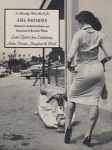
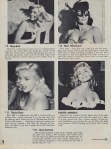
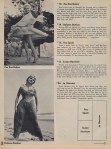
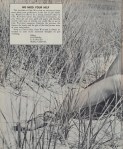
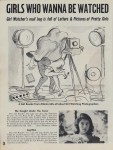
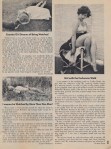
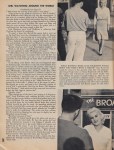
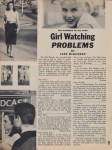
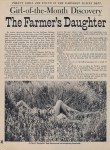
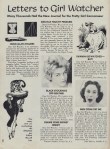
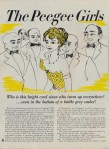
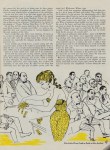
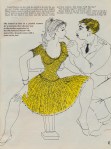
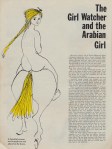
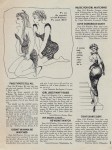
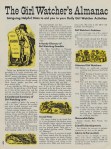
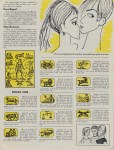
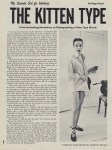
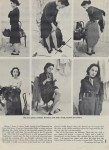
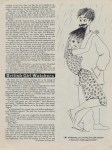
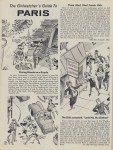
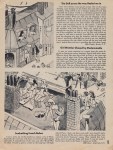
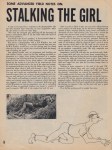
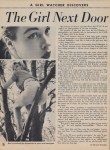
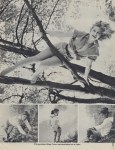
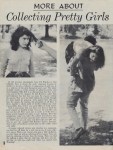
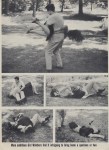
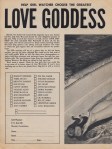
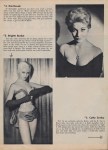
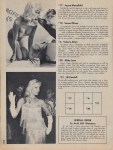
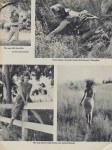
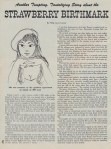
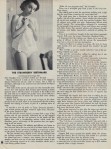
The June 1959 issue of Girl Watcher Magazine – the equivalent to today’s Maxim Magazine. This is from 54 years ago, which means people who are in their 70’s now were reading this for risque enjoyment. Your grandparents were indeed sexual beings and that is how your parents and then you got here. We tend to think that modern America is more sexualized, which it is, but even in Ancient Rome the walls of ruins are covered with sexual graffiti. There have always been men who always want to stare at pretty women. I reposted this here because I think it is part of our ‘history’ that people forget. The more things change, the more they stay the same.


















Filed under Humor and Observations

The Bressingham roll. (NORFOLK RECORD OFFICE)

The Bressingham Roll as unrolled as possible. The section to the right of the image is stuck together. (NORFOLK RECORD OFFICE)
Now using 3D X-ray technology typically used in dentistry, the scroll is set to be read virtually.
“Having the chance to unlock a part of Norfolk history which has been closed to us for maybe hundreds of years feels very special,” Gary Tuson from the Norfolk Records Office (NRO) told the BBC.
The X-ray system scanned the scroll and created approximately 40,000 images which when pieced together will reveal the text.
The process, called microtomography, process scans the iron and copper in the text’s ink to create a high contrast image of the scroll.
“We have documents from Bressingham Manor dating back to 1273, but when you get to the 15th Century you just can’t get at what it says on the inside of this roll,” said Tuson.
Researchers hope the document, which has been under the supervision of the Apocalypto Project, an effort between the NRO, experts at Queen Mary University of London and Cardiff University, will shed light on everyday life for Norfolk villagers in the 1400s.
“To be able to unlock documents like this, to be the first person to read them in hundreds of years, is fascinating,” David Mills, from the Apocalypto Project said. “As you start to delve through the image you start to see the outline of letters come together – it’s a great feeling.”
The results are expected to be released by Christmas.
Filed under Humor and Observations
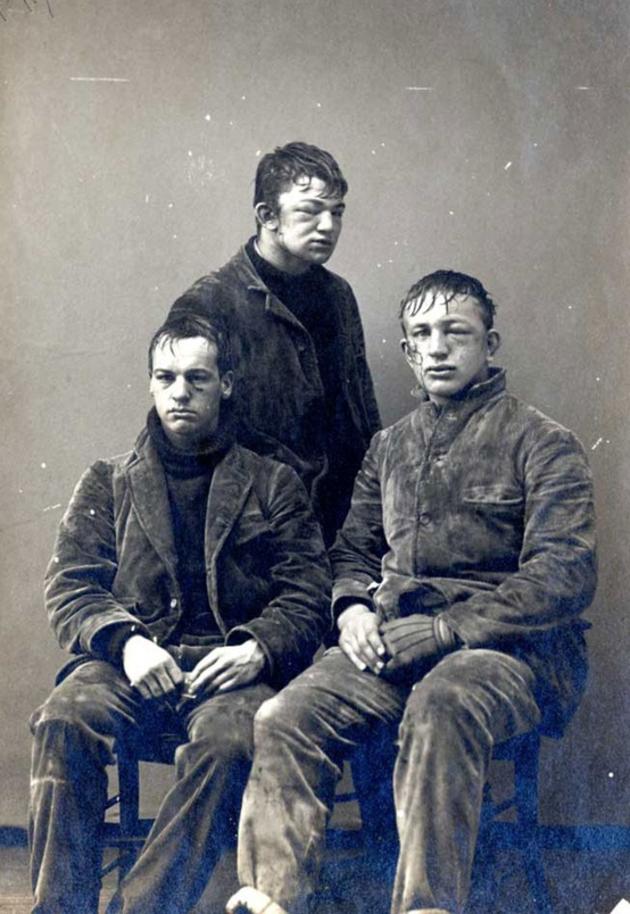
We used to be tougher people. I like looking at old movies, books and pictures to get a feel for how things were. It is hard to get rid of our own lifestyles in our head and put ourselves in earlier times. In 1893 the Industrial Revolution was well under way, America was connected by railroads across the continent, the Civil War had ended 28 years earlier, so it was the last generation’s war. Oil, steel, and the Industrial barons were on the scene and big cities sprung up with hazardous conditions.
Still, you wore proper outfits. Princeton, an Ivy league school of prestige, even then, was where gentlemen went to become the leaders and even Presidents of tomorrow. But we were not a people who settled our quarrels through attorneys or played video games. A man was expected to fight and take his licks. The following is a picture of college students following a Freshman vs. Sophomore snowball fight. It is remarkable to me because if you saw this picture today on TV with the caption – Princeton students after snowball fight – imagine the lawsuits, the TV coverage, the outrage, etc. Back then, it was a picture they probably kept and showed their families with a chuckle.
Princeton students after a Freshman / Sophomore snowball fight. Princeton, NJ, 1893.
Filed under Humor and Observations
Learning to Drive a Car in 1898
1898: How to Become a Driver
Source: Bibliotheque Nationale de France
Through Retronaut


Filed under Humor and Observations

 Michael Bradley - Time Traveler