Is this proof the Virgin Queen was an imposter in drag? Shocking new theory about Elizabeth I unearthed in historic manuscripts
By CHRISTOPHER STEVENS
The bones of Elizabeth I, Good Queen Bess, lie mingled with those of her sister, Bloody Mary, in a single tomb at Westminster Abbey. But are they really royal remains — or evidence of the greatest conspiracy in English history?
If that is not the skeleton of Elizabeth Tudor, the past four centuries of British history have been founded on a lie.
And according to a controversial new book, the lie began on an autumn morning 470 years ago, when panic swept through a little group of courtiers in a manor house in the Cotswold village of Bisley in Gloucestershire.

Cate Blanchett as Queen Elizabeth in the film ‘Elizabeth: The Golden Age’. Could the virgin queen be a part of the biggest deception in British history?
The king, Henry VIII, was due at any hour. He was travelling from London, in great discomfort — for the 52-year-old monarch was grossly overweight and crippled by festering sores — to visit his daughter, Elizabeth.
The young princess had been sent there that summer from the capital to avoid an outbreak of plague. But she had fallen sick with a fever and, after weeks of bleeding, leeches and vomiting, her body was too weak to keep fighting. The night before the king’s arrival, his favourite daughter, the only child of his marriage to Anne Boleyn, had been dangerously ill. In the morning, Elizabeth lay dead.
Elizabeth’s governess, Lady Kat Ashley, and her guardian, Thomas Parry, had good reason to fear telling the king this awful news. It would cost them their lives. Four of Henry’s children had died in infancy and, of the survivors, one — Edward — was a sickly boy of five and the other an embittered, unmarried woman in her late 20s.
The ten-year-old Elizabeth was Tudor England’s most valuable child in many ways. She could surely be married to a French or Spanish prince to seal an international alliance — and her own children would secure the Tudor dynasty Henry so desperately craved.
Now she was dead, and when the king discovered it, Parry and Lady Ashley would surely be executed. Their sole duty had been to keep the princess safe: failure was treason. The penalty would not even be beheading, but death by the most gruesome torture imaginable.
They would be bound and dragged through the mud for a mile to the scaffold. There they would be hanged, cut down and disembowelled. Their entrails would be hauled from their bodies and held in front of their faces as they died, and then their limbs would be hacked off and displayed on spikes, to be picked bare by the birds.
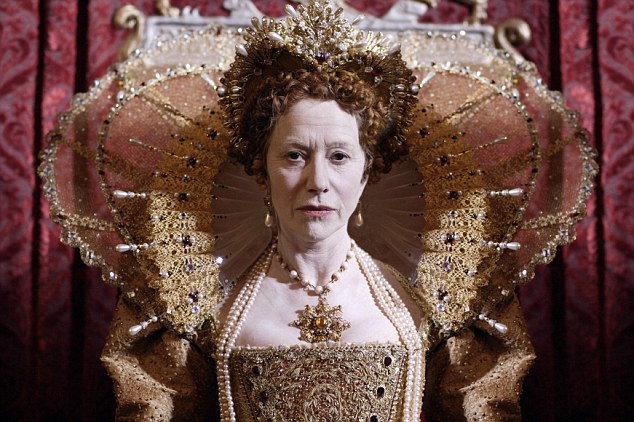
Helen Mirren pictured as Elizabeth I in a Channel Four mini-series
Their only chance of concealing the truth, and perhaps buying themselves a few days to flee the country, was to trick the king.
Kat Ashley’s first thought was to find a village girl and dress her up in the princess’s robe, with a mantle, to fool the king. Bisley was a tiny hamlet, however, and there were no female children of Elizabeth’s age.
But there was a boy, from a local family called Neville. He was a gawky, angular youth a year or so younger than Elizabeth, who had been the princess’s companion and fellow pupil for the past few weeks. And with no time to look further afield for a stand-in, Parry and Lady Ashley took the desperate measure of forcing the boy to don his dead friend’s clothes.
Remarkably, the deception worked. Henry saw his daughter rarely, and was used to hearing her say nothing. The last time she had been presented in court, meeting the new Queen Catherine Parr, she had been trembling with terror.
The princess was known as a gentle, studious child, and painfully shy — not a girl to speak up in front of the king who had beheaded her mother.
So when ‘she’ stood at Bisley manor, in the dimness of an oak-beamed hall lit by latticed windows, it was not so surprising that the king failed to realise he was being duped. He had no reason to suspect his daughter had been ill, after all, and he himself was tired and in pain.
But after he left later that afternoon, the hoax began in earnest. Parry and Lady Ashley realised that if they ever admitted what they had done, the king’s fury would be boundless. They might get out of the country to safety, but their families would surely be killed.
On the other hand, few people had known the princess well enough to be certain of recognising her, especially after an interval of many months. This boy had already fooled the king, the most important deception.
Meanwhile, there was no easy way to find a female lookalike, and replace the replacement. As the courtiers buried the real Elizabeth Tudor in a stone coffin in the manor grounds, they decided their best hope of protecting themselves and their families was to teach this Bisley boy how to be a princess.

Attributed to painter William Scrots, this portrait is of Elizabeth I as a Princess in 1546-7
Of course this entire theory sounds absurd, given that every child grows up with tales of our glorious Virgin Queen, celebrated by Shakespeare and venerated in innumerable plays, songs and films over the centuries.
And yet the many corroborating details around this extraordinary tale about the Bisley boy were enough to convince the 19th-century writer Bram Stoker, most famous as the author of Dracula. He included the story as the final chapter in his book, Imposters.
Stoker had heard persistent stories that a coffin had been discovered by a clergyman at Bisley during the early 1800s, with the skeleton of a girl dressed in Tudor finery, even with gems sewn onto the cloth.
It seemed to chime with local legends persisting for centuries that an English monarch had been, in reality, a child from the village.
Above all, Stoker believed, it was the most plausible explanation why Elizabeth, who succeeded to the throne in 1558, aged 25, never married.
Her most urgent duty, as the last of the Tudor line, was to provide an heir — yet she described herself as a Virgin Queen, and vowed she would never take a husband, even if the Emperor of Spain offered her an alliance with his oldest son.
She stayed true to that oath, provoking a war which almost ended in Spanish invasion in 1588. But Elizabeth did not waver — and never even took an acknowledged lover.
She was fond of proclaiming that she was more of a king than a queen. ‘I have the heart of a man, not a woman, and I am not afraid of anything,’ she declared.
Her most famous speech, to her troops at Tilbury as the Spanish Armada approached, was cheered to the skies as she roared: ‘I have the heart and stomach of a king, and of a king of England, too.’
American author Steve Berry believes Elizabeth could have been telling the literal truth — that she had the heart of a man, because her body was male. He has spent 18 months researching the conspiracy for his novel The King’s Deception, a Dan Brown-style thriller set in 21st-century London.

Could the real reason the ‘Virgin Queen’ never married was that she was secretly a man?
For Berry, who has written 12 thrillers, the trail began with a chance question during a tour of Ely Cathedral in Cambridgeshire three years ago. ‘I always ask if there are any secrets or mysteries, and the guide told me: “There’s nothing at Ely but I’ve heard an incredible rumour in the Cotswolds.” ’
Sceptical at first, Berry uncovered tantalising hints and references in books and ancient manuscripts.
When the ‘princess’ reached her teens, for instance, she was assigned a tutor named Roger Ascham, who was puzzled by her behaviour.
‘The constitution of her mind,’ he wrote, ‘is exempt from female weakness, and she is embued with a masculine power of application … In the whole manner of her life she rather resembles Hippolyte than Phaedra.’
That last, classical allusion was quite venomous: Phaedra was an ancient princess driven mad by her lust for men, while Hippolyte was queen of the Amazons, who lived without any need for men at all. Most convincing to Berry were the contemporary portraits, which are reproduced in his novel.
One picture exists of Elizabeth as a child, attributed to the court painter William Scrots. She had slender shoulders, a delicate neck and a heart-shaped face with ginger hair and eyebrows.
In the next known portrait, shortly after she was crowned queen, her broad shoulders and neck are disguised with heavy furs. She is wearing a wig, and her eyebrows are plucked bare. Her jaw is heavy and square.
All subsequent pictures of the queen were painted to an ideal, showing Elizabeth as she wished to be seen, not as she was.
Even the official portrait commissioned after her death by her chief adviser, Sir Robert Cecil, conformed to what was known as ‘The Mask Of Youth’ — the idealised face of the monarch, which never aged.
Many Tudor courtiers suspected that Elizabeth had a deep secret. Lord Somerset was the power behind the boy king Edward VI’s throne, after Henry VIII died in 1547 when Elizabeth was just 13.
One of his spies, Sir Robert Tyrwhitt, wrote to him: ‘I do verily believe that there hath been some secret promise between my Lady, Mistress Ashley, and the Cofferer [Thomas Parry, the principal officer of the court] never to confess to death, and if it be so, it will be never gotten of her, unless by the King’s Majesty or else by your Grace.’
In modern English: ‘I am certain Lady Ashley and Thomas Parry have a secret, and that there is a pact between them to take it to the grave. If that’s the case, the only people who could force them to divulge this secret are you and the King.’
Those were ominous words: only Somerset and the King had the right to put a suspect to the rack, using torture to extract information.
Bram Stoker believed it was the sheer scale of the deception that made it possible. When Elizabeth returned to London from Bisley, more than a year after she first left the court, it would have been treason for any sceptics to suggest ‘she’ was not the king’s daughter.
‘It is conceivable,’ Stoker remarked drily, ‘that in the case of a few individuals, there might have been stray fragmentary clouds of suspicion.

This portrait of Queen Elizabeth I is by an unknown artist and is from the period 1580-1590
‘After a time, even suspicion became an impossibility. Here was a young woman growing into womanhood whom all around her had known all her life — or, what was equivalent, believed they had.’
Any differences in her appearance were dismissed as the natural effects of growing up. Elizabeth had been a timid child — now she was a bold and imperious adolescent.
As a little girl, she was exceptionally bright, poring over her books and learning as quickly as her tutors could teach her; now she was slower at her lessons and, though far from stupid, more academic plodder than prodigy.
Her tutor was warned to make her lessons shorter. Roger Ascham commented that the girl who had been said to soak up facts like a sponge was now more like a shallow cup — if wine was poured in too quickly, it would simply splash out again.
Kat Ashley and Thomas Parry — the pair who are suspected of carrying out the deception — remained loyal to the sovereign throughout their lives, as England’s political pendulum swung wildly after the death of Henry VIII.
During Edward VI’s reign, they were Elizabeth’s closest friends, and they stood by ‘her’ during her years of imprisonment in the Tower when her Catholic sister Mary was queen and decided the safest place for Elizabeth was under lock and key, where she could not threaten the throne.
When Mary died at the age of 42, one of Elizabeth’s first acts as queen was to make Lady Ashley her First Lady of the Bedchamber.
For the next seven years, she controlled all access to the young monarch. Elizabeth was devastated when Ashley died in 1565, and went into heavy mourning. Thomas Parry was knighted, and made a Privy Counsellor and Comptroller of the Household — the richest rewards Elizabeth could bestow.
He was a bad-tempered man who made many enemies, and few at court grieved when he died in 1560 — one wag said he expired ‘from mere ill-humour’.
Steve Berry believes the queen must have confessed her secret to her chief minister, William Cecil. The politician had a reputation for an almost supernatural ability to read people and discover facts: she needed Cecil to understand that a marriage would not just have been pointless, it would have been ruinous.

This painting by an unknown artist is known as the ‘Darnley portrait’ after a previous owner, and is from around 1575
If her secret was betrayed, the country could be plunged into civil war. There was no obvious heir, and Mary’s former husband was now Britain’s greatest enemy, Philip II of Spain. Certainly, Cecil was surprisingly stoic about the queen’s determination never to wed.
Publicly, Elizabeth sometimes claimed that people needed to feel their monarch was wedded to the whole country, rather than one man. On other occasions, she hinted that the debacle of her father’s six wives, and her mother’s death at the block, had put her off marriage for life.
If those reasons sound flimsy, the queen’s determination to control her image was iron.
She wore thick make-up and heavy wigs at all times: no one was permitted to see her without them. And she controlled her succession with equal ruthlessness.
On her deathbed, she commanded that the crown must go to her cousin’s son — James VI of Scotland, whose mother was Mary Queen of Scots. But the command itself was cryptically worded: ‘I will have no rascal to succeed me, and who should succeed me but a king?’
Was there a hint in those words that for 45 years the figure on the throne had herself been a ‘rascal’, playing a part? Author Steve Berry believes there is only one way to discover the truth. After Elizabeth died in 1603, there was no autopsy.
Instead of a magnificent state funeral for the monarch the nation called ‘Gloriana’, the queen’s bones were interred with those of her sister in Westminster Abbey.
Berry points to the recent DNA analysis that proved that remains discovered under a Leicester car park were those of Richard III, who ruled a century before Elizabeth.
Such high-tech methods would not even be necessary to establish whether the bones in the Abbey tomb were all female, or whether a male skeleton was buried there.
‘Elizabeth’s grave has never been breached,’ Berry says. ‘Now it’s time to open it up and see what’s in there.’
Read more: http://www.dailymail.co.uk/news/article-2337774/Is-proof-Virgin-Queen-imposter-drag-Shocking-new-theory-Elizabeth-I-unearthed-historic-manuscripts.html#ixzz2VrJ2vkiy
Follow us: @MailOnline on Twitter | DailyMail on Facebook


 To drive the Mallard, driver Joseph Duddington would have squeezed the release handle on top of the reverser (D) lever and pushed it forward from the floor. He then would have then opened the cylinder drain cock (L) by turning the valve clockwise. Duddington would then have blown the whistle (C) a couple of times using the whistle handle to announce the train was about to move forward. To start moving, he would have released the brakes (B) using the brake gauge (G). The top lever would have been moved from right to left to release the brakes on the engine and then he would have opened the throttle (A). During the journey, Duddington would have monitored the train using the main boiler pressure gauge (E) and the steam chest pressure gauge (F). The injector steam and boiler water gauges are at (H) and (I), the manifold isolation valve is shown at (J) and the fire hole is pictured at (K)




 .
.


 Michael Bradley - Time Traveler
