Tag Archives: nature

Lunar Craters Covering Moon’s Near Side Are Bigger Than Far Side

Lunar Craters Covering Moon’s Near Side Are Bigger Than Far Side Due To Hemisphere Differences

natureheader  |  By Davide CastelvecchiPosted: 11/08/2013 9:07 am EST  |  Updated: 11/08/2013 9:43 am EST

 
lunar craters

When the Soviet probe Luna 3 sent back the first shots of the dark side of the Moon, they showed that it was noticeably more pockmarked by craters than the near side. The nearside crust, by contrast, had more large, shallow basins. More than 50 years after those images first baffled researchers,a study published today in Science explains the observations.

Some theories suggest that the large basins on the near side were caused by impacts from asteroids bigger than those that caused the craters on the far side. But the latest study suggests that the observed basins do not accurately reflect the size of the initial impact, because as asteroids battered the lunar surface in the early history of the Solar System, the Moon’s warmer and softer nearside crust melted like butter, producing giant lava flows that filled the impact craters and transformed them into basins.

To improve on previous estimates of the size and distribution of basins, the team behind the study used data from NASA’s Gravity Recovery and Interior Laboratory mission (GRAIL), two satellites that since 2011 have been orbiting the Moon and mapping subtle variations in the strength of its gravitational field. Basins are characterized by thinner crust, says first author Katarina Miljković, a planetary scientist at the Paris Institute of Earth Physics. The team used GRAIL’s gravity mapsto find such thin crust and measure the true size of the basins.

“We didn’t have to look at topography nearly at all, just at the crust thickness,” says Miljković. The researchers found that although both sides of the Moon had the same total number of impact craters, the near side had eight basins larger than 320 kilometers in diameter, whereas the far side had only one.

 Hot hit

 The asteroid bombardment should have battered both sides equally, Miljković points out. The asymmetry could have arisen from comparatively small objects punching above their weight on the near side, producing basins more easily than on the far side.

Simulations showed that if the largest dark area on the near side — the plain of volcanic rock known as Oceanus Procellarum — was hundreds of degrees hotter than crust on the far side, impacts there would produce basins up to twice as large as impacts from similar-sized bodies on the far side (see video above).

And indeed, around 4 billion years ago, or 500 million years after the Moon formed, the near side could have been warmer than the far side. Researchers looking at the near side have detected the presence of radioactive isotopes; their decay would have heated up the rock, explains study co-author Maria Zuber, a planetary scientist at the Massachusetts Institute of Technology in Cambridge and principal investigator of GRAIL.

The findings fit well with the observations, but “there is no consensus” as to what caused the startling asymmetry in isotope content between the near side and the far side, says Jeffrey Taylor, a lunar scientist at the University of Hawaii in Honolulu. One leading theory posits that material rich in radioactive elements rose in a gigantic volcanic plume and formed a magma basin; another that it came from a collision with a sister moon around 1,000 kilometers in diameter.

William Bottke, a lunar scientist at the Southwest Research Institute in Boulder, Colorado, says that the work could lead researchers to revise just how dramatic asteroid bombardments were in the early Solar System. “This can be used to more accurately derive what the small-body populations were like four billion years ago.”

This story originally appeared in Nature News.
Leave a comment

Filed under Humor and Observations

Could Wind Farms Be Adding to Global Warming?

I personally don’t believe in man-made global warming (yet, thought I will in the future), though I DO believe in global warming.  I think the Earth cools and heats and we’re not altogether sure why all the reasons are, or if changing the cycle would be good or bad.  I simply don’t think man has outstripped nature’s ability to control temperatures – YET.  I might be wrong, or I might be right, time will tell.  I wrote an earlier post on the topic and I certainly understand both points of view.

Nonetheless, in the area of unintended consequences, I found this excerpt of an article quite fascinating:


BOLDED sections are taken verbatim from the article.

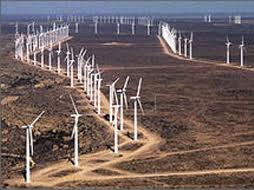
New research finds that wind farms actually warm up the surface of the land underneath them during the night, a phenomenon that could put a damper on efforts to expand wind energy as a green energy solution.

Researchers used satellite data from 2003 to 2011 to examine surface temperatures across as wide swath of west Texas, which has built four of the world’s largest wind farms. The data showed a direct correlation between night-time temperatures increases of 0.72 degrees C (1.3 degrees F) and the placement of the farms.

“Given the present installed capacity and the projected growth in installation of wind farms across the world, I feel that wind farms, if spatially large enough, might have noticeable impacts on local to regional meteorology,” Liming Zhou, associate professor at the State University of New York, Albany and author of the paper published April 29 in Nature Climate Change said in an e-mail to Discovery News.

FAA data shows that the number of wind turbines over the study region has risen from 111 in 2003 to 2358 in 2011, according to the study.The warming could hurt local farmers, who have already suffered through a killer drought over the past few years. Texas agriculture contributes $80 billion to the state’s economy, second only to petrochemicals, according to the Texas Department of Agriculture.

West Texas is a dry area that uses irrigation to grow wheat, cotton and other crops, as well as raise cattle. But increased warming can play havoc with plant growth, as well as change local rainfall patterns.

Texas wind farms produce more than 10,000 megawatts of electricity, more than double the capacity of the nearest state, Iowa, and enough to power three million average American homes, according to the American Wine Energy Association.

Again, my overall position is that the Earth is way more complicated than we understand and that temperature if effected by so many different factors, only a small portion of which is mankind.  I strongly believe in seeking alternative sources of energy to petroleum and I strongly believe in reducing pollution.  I think though that too many of us jump onto a particular theory and oversell it, often finding later we were wrong.’

The flat Earthers still have a few adherents, Earth as the center of the Universe was certainly popular.  Mankind would dissintegrate if we went over 50 miles per hour scared people from riding trains when they first came out.  As with most science, time will tell.  With global climatology, I think a lot more time will pass than we think before we KNOW anything for certain.  I doubt it will happen in my lifetime.

What do you think?

2 Comments

Filed under Humor and Observations

Monday Morning Pick Me Up from Cute Dogs

It’s Monday morning, a hard time for most of us.  To ease your day, here are some cute animal pics.  I threw in two cat pictures for the cat people out there…and two animals that are neither cat nor dog…  Enjoy!

7 Comments

Filed under Animals