Tag Archives: technology

MIT students develop wearable cooling device that could make air conditioning obsolete

MIT students develop wearable cooling device that could make air conditioning obsolete

By Drew Prindle

Published November 03, 2013

Digital Trends
  • wristify-mit
    MIT

We come across quite a lot of cool technology, but it’s not every day that we find something that can literally cool you down.

Developed by four engineering students at MIT, Wristify is a prototype wearable device that leverages the physical phenomenon known as the Peltier effect to reduce your body temperature.

The Peltier effect, named for French physicist Jean Charles Athanase Peltier who discovered it in 1834, describes the phenomenon of heating or cooling caused by an electric current flowing across the junction of two different conductors. As the current moves from one conductor to another, the transfer of energy causes one side to heat up and the other to cool down.

Wristify is basically a series of these junctions (called a Peltier cooler) powered by a small battery and attached to a wrist strap. When placed against the skin, the device makes you feel cooler by reducing the temperature of your wrist a few fractions of a degree per second for a couple seconds at a time. Over the course of a few minutes, this process will cause you to perceive a whole-body cooling of a couple degrees Celsius.

The team developing the device is still tinkering with it to figure out the optimal cooling cycle, but at this point in time they say the most effective method is to cool your wrist by 0.4 degrees Celsius (0.7F) per second for five seconds, and then turn off for 10 seconds.

The chief benefit of this device is that it offers a more personalized approach to temperature control, one that’s vastly more efficient than current heating and cooling methods. It takes millions of watts to raise or lower the temperature of an entire building, but Wristify can run on a small lithium battery. If everybody had one of these things on their wrist instead of relying on air conditioning or heaters all the time, the potential energy savings could be massive.

Of course, it’s still just a prototype, but the idea recently won the $10,000 top prize in MIT’s annual Making And Designing Materials Engineering Competition, and the team plans to put all that cheddar toward further development of the device.

Leave a comment

Filed under Humor and Observations

U.S. Military begins rolling on airless tires

U.S. Military begins rolling on airless tires

Published September 19, 2013

FoxNews.com
  • terrainarmor-mv850.jpg
    Polaris
  • terrainarmor2.jpg
    Polaris
  • terrainarmor1.jpg
    Polaris
  • airless-ford-660.jpg

Air compressor manufactures take note.

Polaris has begun production of a non-pneumatic tire for all terrain vehicles.

The company has begun deliveries of its MV850 ATV fitted with the flat-proof TerrainArmor tires to the U.S. Special Operations Forces, and plans to introduce a retail version soon.

The innovation is more of a wheel/tire combination that features a rubber tread band supported by a polymeric web for structure that is also able to deform like an air-filled tire as it rolls over obstacles to provide cushioning.

Polaris says the tires can take a shot from a .50 caliber round without failing, and one was driven on for over 1,000 miles off-road after it was punctured by a railroad spike. They’ve been tested up to 5,000 miles on ATVs packed with a full combat load.

Earlier this year, the company donated several of the vehicles to the Salvation Army to assist with relief efforts in the wake of the Moore tornado in Oklahoma, and says they performed perfectly while traversing the debris left by the storm.

A Polaris representative tells FoxNews.com that they are working on versions that will fit additional vehicles in the company’s lineup, including some of its side-by-side UTVs.

An official date hasn’t been announced, but he added that consumer sales could begin within six months.

Read more: http://www.foxnews.com/leisure/2013/09/19/us-military-begins-rolling-on-airless-tires/?intcmp=features#ixzz2fPFr6wbG

1 Comment

Filed under Humor and Observations

After Watson, IBM Looks to Build ‘Brain in a Box’

After Watson, IBM Looks to Build ‘Brain in a Box’

By Jennifer Booton

Your World Tomorrow

Published August 22, 2013

FOXBusiness
  • IBM Watson Supercomputer, IBM
    REUTERS

Imagine Watson with reason and better communication skills.

The Watson supercomputer may be able to beat reigning Jeopardy champions, but scientists at IBM (IBM) are developing new, super-smart computer chips designed from the human brain — and that might ultimately prove much more impressive.

These new silicon “neurosynaptic chips,” which will be fed using about the same amount of energy it takes to power a light bulb, will fuel a software ecosystem that researchers hope will one day enable a new generation of apps that mimic the human brain’s abilities of sensory perception, action and cognition.

It’s akin to giving sensors like microphones and speakers brains of their own, allowing them to consume data to be processed through trillions of synapses and neurons in a way that allows them to draw intelligent conclusions.

IBM’s ultimate goal is to build a chip ecosystem with ten billion neurons and a hundred trillion synapses, while consuming just a kilowatt of power and occupying less than a two-liter soda bottle.

“We want to create a brain in a box.”

– IBM’s Dharmendra Modha 

“We are fundamentally expanding the boundary of what computers can do,” said Dharmendra Modha, principal investigator of IBM’s SyNAPSE cognitive computing project. “This could have far reaching impacts on technology, business, government and society.”

The researchers envision a wave of new, innovative “smart” products derived from these chips that would alter the way humans live in virtually all walks of life, including commerce, logistics, location, society, even the environment.

“Modern computing systems were designed decades ago for sequential processing according to a pre-defined program,” IBM said in a release. “In contrast, the brain—which operates comparatively slowly and at low precision—excels at tasks such as recognizing, interpreting, and acting upon patterns.”

These chips would give way to a whole new “cognitive-type of processing,” said Bill Risk, who works on the IBM Research SyNAPSE Project, marking one of the most dramatic changes to computing since the traditional von Neumann architecture comprised of zeros and ones was adopted in the mid-1940s.

“These operations result in actions rather than just stored information, and that’s a whole different world,” said Roger Kay, president of Endpoint Technologies Associates, who has written about the research. “It really allows for a human-like assessment of problems.”

It is quite a complex system, and it is still in early stages of development. But IBM researchers have rapidly completed the first three phases of what will likely by a multi-stage project, collaborating with a number of academic partners and collecting some $53 million in funding. They are hopeful the pace of advancement will continue.

Modha cautioned, however, this new type of computing wouldn’t serve as a replacement for today’s computers but a complementary sibling, with traditional analog architecture serving as the left brain with its speed and analytic ability, and the next era of computing acting as the right cortex, operating much more slowly but more cognitively.

“Together, they help to complete the computing technology we have,” Modha said.

Providing a real-life example of how their partnership might one-day work, Kay imagined a medical professional giving triage to a patient.

Digital computers would provide basic functions such as the patient’s vitals, while the cognitive computer would cross reference data collected at the scene in real-time with stored information on the digital computer to assess the situation and provide relevant treatment recommendations.

“It could be a drug overdose or an arterial blockage, a human might not know which is which [from the naked eye],” explains Kay. “But a [cognitive] computer could read the symptoms, reference literature, then vote using a confidence level that can kind of infer which one is more likely the case.”

Endless Possibilities Seen

The IBM researchers have put together building blocks of data to make cognitive applications easier to build and to create an ecosystem for developers. The data come in the form of “corelets” that each serve a particular function, such as the ability to perceive sound or colors.

So far they have developed 150 corelets with the intention to eventually allow third parties to go through rigorous testing to submit more. Eventually, corelets could be used to build “real-life cognitive systems,” researchers hope.

To help get the ball rolling, the researchers envisioned a slew of product ideas that would make perfect use of these genius chips in real-world functions.

Here are just a few:

-An autonomous robot dubbed “Tumbleweed” could be deployed for search and rescue missions in emergency situations. Researchers picture the sphere-shaped device, outfitted with “multi-modal sensing” via 32 mini cameras and speakers, surveying a disaster and identifying people in need. It might be able to communicate with them, letting them know help is on its way or directing them to safety.

-For personal use, low-power, light-weight glasses could be designed for the near blind. Using these chips, which would recognize and analyze objects through cameras, they’d be able to plot a route through a crowded room with obstacles, directing the visually-impaired through speakers.

-Putting these chips to use in a business function, the researchers foresee a product they’ve dubbed the “conversation flower” that could process audio and video feeds on conference calls to identify specific people by their voice and appearance while automatically transcribing the conversation.

-Giving a glimpse into its potential use in the medical world, a thermometer could be developed that could not only measure temperature, but could also be outfitted with a camera that would be able to detect smell and recognize certain bacterial presence based on their unique odor, giving an alert if medical attention is needed.

-In an environmental function, researchers could see this technology being outfitted on sensor buoys, monitoring shipping lanes for safety and environmental protection.

Given the fluid motion of the project, it’s unclear how long it will take for the first generation of cognitive computers to begin applying themselves in real-world applications, but Modha and his team are optimistic they will be crafted sooner than later.

“We need cognitive systems that understand the environment, can deal with ambiguity and can act in a real-time, real-life context,” Modha said. “We want to create a brain in a box.”

Read more: http://www.foxbusiness.com/technology/2013/08/22/after-watson-ibm-looks-to-build-brain-in-box/#ixzz2dagDD2vE

Leave a comment

Filed under Humor and Observations

Researchers control each others’ body movements using only their brains

Researchers control each others’ body movements using only their brains

Published August 28, 2013

FoxNews.com
  • TMS1.JPG

    Andrea Stocoo, or subject 2 (the “Receiver”) with his right hand resting slightly above the “fire” key on the keyboard. The screen behind the subject shows the Sender’s game screen which is not seen by the Receiver. (University of Washington)

There’s still no cure for the common cold, but soon we may be able to control each others’ body movements.

Researchers at the University of Washington have successfully completed an experiment where one researcher was able to send a brain signal over the Internet to control the hand movements of his colleague.

“The Internet was a way to connect computers, and now it can be a way to connect brains,” experiment participant and researcher Andrea Stocco told ScienceNewsDaily. “We want to take the knowledge of a brain and transmit it directly from brain to brain.”

Stocco and fellow researcher Rajesh Rao donned swim caps with electrodes hooked up to an electroencephalography machine that reads electrical activity in the brain. The two men sat in separate labs and a Skype connection was set up so they could communicate during the experiment, although Rao and Stocco could not see each other.

Rao sat before a computer screen and played a video game using only his mind. When he wanted to fire a cannon, he imagined moving his hand to hit the “fire” button without actually moving any part of his body.

Almost simultaneously, Stocco involuntarily moved his hand to push the space bar on his keyboard as though to hit the “fire” button.

“It was both exciting and eerie to watch an imagined action from my brain get translated into actual action by another brain,” Rao said. “This was basically a one-way flow of information from my brain to his. The next step is having a more equitable two-way conversation directly between the two brains.”

Stocco likened the feeling of having Rao move his finger through thought to that of a twitch.

“I think some people will be unnerved by this because they will overestimate the technology,” assistant professor in psychology at the UW’s Institute for Learning & Brain Sciences and Stocco’s wife Chantel Prat said. “There’s no possible way the technology that we have could be used on a person unknowingly or without their willing participation.”

The University of Washington experiment sounds like something out of a science fiction movie. Stocco jokingly likened the results to the “Vulcan mind meld.”

Stocco explains that should they continue to be successful in their research, it could eventually result in helping a flight attendant land a plane should the pilot become incapacitated.

Read more: http://www.foxnews.com/science/2013/08/28/researchers-control-each-other-body-movements-using-only-their-brains/?intcmp=features#ixzz2dQekawI0

Leave a comment

Filed under Humor and Observations

No Wire, No Power Source – New Devices Work in Thin Air

Devices Connect with Borrowed TV Signals and Need No Power Source

Devices that can make wireless connections even without an on-board battery could spread computing power into everything you own.

 WHY IT MATTERS

A novel type of wireless device sends and receives data without a battery or other conventional power source. Instead, the devices harvest the energy they need from the radio waves that are all around us from TV, radio, and Wi-Fi broadcasts.

These seemingly impossible devices could lead to a slew of new uses of computing, from better contactless payments to the spread of small, cheap sensors just about everywhere.

“Traditionally wireless communication has been about devices that generate radio frequency signals,” says Shyam Gollakota, one of the University of Washington researchers who led the project. “But you have so many radio signals around you from TV, Wi-Fi, and cellular networks. Why not use them?”

Gollakota and colleagues have created several prototypes to test the idea of using ambient radio waves to communicate. In one test, two credit-card-sized devices—albeit with relatively bulky antennas attached—were used to show how the technique could enable new forms of payment technology. Pressing a button on one card caused it to connect with and transfer virtual money to a similar card, all without any battery or external power source.

Here is a video of the prototypes:
“In that demonstration, the LEDs, touch sensors, microcontrollers, and the wireless communication are all powered by those ambient TV signals,” says Gollakota.

The devices communicate by varying how much they reflect—a quality known as backscatter—and absorb TV signals. Each device has a simple dipole antenna with two identical halves, similar to a classic “rabbit ears” TV aerial antenna. The two halves are linked by a transistor, which can switch between two states. It either connects the halves so they can work together and efficiently absorb ambient signals, or it leaves the halves separate so they scatter rather than absorb the signals. Devices close to one another can detect whether the other is absorbing or scattering ambient TV signals. “If a device nearby is absorbing more efficiently, another will feel [the signals] a bit less; if not, then it will feel more,” says Gollakota. A device encodes data by switching between absorbing and not absorbing to create a binary pattern.

The device gets the power to run its electronics and embedded software from the trickle of energy scavenged whenever its antenna is set to absorb radio waves.

In the tests, the devices were able to transfer data at a rate of one kilobit per second, sufficient to share sensor readings, information required to verify a device’s identity, or other simple tidbits. So far the longest links made between devices are around 2.5 feet, but the University of Washington team could extend that to as much as 20 feet with some relatively straightforward upgrades to the prototypes. The researchers also say the antennas of backscatter devices could be made smaller than those in the prototypes.

Gollakota says the devices could be programmed to work together in networks in which data travels by hopping from device to device to cover long distances and eventually connect to nodes on the Internet. He imagines many of a person’s possessions and household items being part of that battery-free network, making it possible to easily find a lost item like your keys. “These devices can talk to each other and know where it is,” he says.

The researchers tested that scenario by placing tags on cereal boxes lined up on a shelf to mimic a grocery store or warehouse. Each tag communicated with its nearest neighbor to check if it was in the correct place, and blinked its LED if it was not.

That demonstration impresses Kristofer Pister, a professor at the University of California, Berkeley, whose work on tiny devices dubbed “smart dust,” which gather data from just about anywhere, helped spawn many research projects on networked sensors. Using TV signals to enable such applications without batteries is “a really clever idea,” he says.

While Pister and others around the world—including the Washington group—have spent years creating the technology needed to make cheap, compact sensors practical (see “Smart Specks”), such networks are relatively scarce. Josh Smith, a University of Washington professor who led the backscatter project with Gollakota, says that being able to do without onboard power could help.

Bhaskar Krishnamachari, who works on sensor networks at the University of Southern California, notes that in some rural areas and indoor environments, there may not be enough ambient radio waves to support the battery-free approach. “For many practical implementations, an onboard battery may be unavoidable,” he says. “However, the proposed approach may go some way in extending the time between battery-charging events.”

The backscatter communication technology was developed by Gollakota with Smith and David Wetherall, also a University of Washington professor, along with grad students Vincent LiuAaron Parks, and Vamsi Talla. A paper on the technology won best paper award at the ACM Sigcomm conference in Hong Kong this week.

3 Comments

Filed under Humor and Observations

Magnetic, levitating ‘sky trains’ may be coming to a city near you

Magnetic, levitating ‘sky trains’ may be coming to a city near you

Published August 01, 2013

FoxNews.com
  • skytran.jpg

    SkyTran’s levitating transit pods will carry passengers over street traffic to their destinations. (www.skytran.us)

Flying cars may sound like something out of “The Jetsons,” but Israel’s Tel Aviv is soon set to be the first city to welcome SkyTran’s futuristic transportation trains.

The mass transit system of magnetically levitating pods was co-developed by engineers from NASA’s Ames Research Center and the privately held SkyTran company.

Plagued by heavy traffic, the city of Tel Aviv is hoping to use SkyTran’s pods in order to offer energy and environmentally-friendly alternatives to cars and buses, The Times of Israel reported.

According to the planners, “sky trains” are a cheaper and faster transportation system and will help reduce congestion and pollution.

The city of Tel Aviv recently hired US consultant company Jenkins Gales & Martinez to help speed up the process in building the SkyTran track but no official timetable has been announced.

Read more: http://www.foxnews.com/tech/2013/08/01/magnetic-levitating-sky-trains-may-be-coming-to-city-near/#ixzz2bOsZYx67

4 Comments

Filed under Humor and Observations

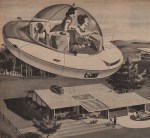
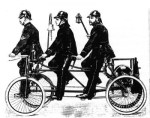
What People Thought Vehicles Would Like Today

These are all pictures and illustrations of what people predicted future vehicles would be like today.  To me, beyond the coolness of the pictures, is the analysis of where they went wrong. You see, predicting the future does not usually work, because we are too fixed on how things are right now.  For instance, the clothing in the pictures is the most wrong.  Men don’t dress nice in suits all the time like they used to.  It is a way for futurists such as myself to look at the mistakes in predicting made before and try to avoid them.  Society, dress and appearance is likely to change just as much as technology.  The pictures also do not reflect a change in urban buildings or lifestyle as technology changes.  With that added thought, enjoy!

6 Comments

Filed under Humor and Observations

China’s new doughnut-shaped hotel

A look at China’s new doughnut-shaped hotel

Published July 23, 2013

FoxNews.com
  • donuthotel.jpg
    Starwood Hotels & Resorts

It’s the newest concept building to mark China’s skyline.

Following the opening of the world’s largest building where the sun shines 24/7, and the construction of a five-star ‘groundscaping’ hotel built into a former mine, this hotel has a unique shape all its own: a glowing doughnut.

Officially known as Sheraton Huzhou Hot Spring Resort, this 27-story building is located in the city of Huzhou, near Shanghai.  Designed by Beijing-born architect Ma Yansong, the hotel appears to give off the appearance of a horseshoe, though the bottom ends are connected by two underground floors.

According to Sheraton’s website, the resort offers 321 spacious guest rooms, including 44 suites and 39 villas, all with private balconies.  The opulent lobby has 20,000 Swarovski and European natural crystal lamps on its ceiling which are arranged in a wave-like formation, and the  floor is paved with Afghanistan White Jade and Tiger’s Eye Stone from Brazil.

The hotel also features the company’s “Shine Spa for Sheraton,” with facilities including a steam room, saunas, and a hydrotherapy pool in each locker room.  For dining options, guests can choose from three restaurants and two lounges for an array of domestic and international food.

Currently in a soft-open phase, the hotel will officially open to the public in October 2013, and rooms are expected to cost about $400 per night.

Read more: http://www.foxnews.com/travel/2013/07/23/donut-shaped-hotel/?intcmp=features#ixzz2aJnx2Q7m

Leave a comment

Filed under Humor and Observations

The Future – Part One

I plan to write about the future for a few blog posts – I’m not sure how many.  This is not so much to predict the future as to extrapolate it.  With a graduate degree in Economics, it is hard not to employ that training to other things, like the future.  In Economics we use the latin term ceteris paribus, meaning “all other things held equal.”  For instance, if you change the monetary supply but everything else stays the same, what happens to the economy?  The thing is, nothing ever stays the same, but you have to pretend it will to isolate various factors.  It is also true that no economic model can consistently beat the ‘no change’ scenario.  If you simply predict things will be the same next period as they are this period, you will be correct most of the time.  A group of economists, making predictions and taking the mean results can beat this curve, even though individuals cannot.

Future

So, my prediction of the future is based on ceteris paribus and the no change scenario.  I simply continue the line with the same slope as we currently see it.  If you start back in 1800 and track technological innovations, absorption by society, and societal and political changes, we seem to be on a pretty steady line.  If we keep on that developmental line, then predicting the future is not as difficult as you might think.

To take one variable at a time – which never happens of course – I will address only certain aspects of the future, as I see it happening, in each post.  Here goes:

Religion – Religion is on a steady diminishing curve.  Even many religions themselves predict the eventual falling away of mankind from the path of righteousness.  These trends will lead to immense conflicts in the near future.  Those who are willing to die to restore faith will increasingly feel compelled to act to stave off atheism and moral relativism.  To be clear, I do not support such violence and conflict, I simply see it on the horizon.  The Arab Summer is a good example, where theologically based groups strive against secular groups for the control of Egypt, Syria, Libya and Turkey, even as a I write this.  There will likely be persecution of believers and persecution by believers.  Last year, over 100,000 Christians world-wide were killed for their beliefs.  If you look at all religions, millions are currently persecuted and jailed for their beliefs.  At the same time, theological groups like the Taliban torture and kill those who do not follow their version of belief.

believer vs non-believer

Government – Governments are increasing in size, cost and control daily.  Record amounts of the gross national product of countries go the government.  In the United States, in the last ten years alone, the government has taken control of banking, auto manufacturing, healthcare, student loans, welfare and education.  Increasingly the 10th Amendment is ignored and the “patchwork” of state laws are replaced by federal laws.  Internationally, the movement is to control people, resources and the economy through large centralized governments.  The private sector will get smaller and more regulated resulting in slower economic growth, higher unemployment and larger welfare roles.  Historically, these trends will continue until either an economic collapse, a war, or civil uprising.  I do not know how much longer the world can sustain rapidly growing central governments.  In this technological age, the new secret police to enforce government will are cameras, drones, email, electronic searches, phone records, gps and the fact that none of us have “real money.”  Our entire identity, wealth and liberty is kept in the hands of the government through our electronic signatures.

big government

Technology – Nothing we know now will count in twenty years.  People will have either a chip in their head, or a flexible plastic screen that has all phone, email, computing, movies and TV on it.  They can do virtually anything, anywhere.  That means they won’t drive to work, to theaters, to stores, to libraries or anyplace else they can access at home.  3d printing will allow them to produce their own products and even food at home.  They will only leave to be ‘live’ with others.  Any brick and mortar locations will be gone in the next generation.  Why have libraries?  Why have physical schools?  Why build anything if you can deliver the same product or service digitally?

When I was young there were no ATM machines.  You had to go to a bank between 10 am and 3 pm with a passbook.  If you lost your passbook, you were screwed.  We froze water and used ice picks to break it up for drinks.  There were no cell phones, no microwave ovens, no internet.  Computers came out while I was in junior high school and only us nerds could use them.  TV screens were heavy cathode ray tubes and there were three channels – ABC, CBS, and NBC.  Theaters had only one screen and one movie they would show for weeks.  Cars used leaded gasoline for 23 cents per gallon and you got savings stamps with them.  Cigarette ads were all over TV, magazines and billboards.  The number one selling magazine was TV Guide and people got their news at 6 pm or from the newspaper.  We burned leaves in our front yards, went shooting squirrels with shotguns unsupervised as children, and only the rich could fly by airplane.

future-tech-class-1

I bring up this nostalgic look because the world today with the power of a super computer in your smart fun or computer pad happened virtually overnight.  The trend for technology is to speed up, not slow down, in its advance.  Look for 3d printed organs, cloning, spare parts for human, and other ethic laden medical issues.  Half of us die from heart disease, another fourth from cancer.  As those are treated, the incidence of Alzheimers’ and dementia will grow astronomically.  What will the world be like when people live past 100 routinely?  What will the layered generations do with technology absorption issues?

Toddlers today can be seen tapping their coloring books and picture books and looking puzzled.  Why?  They are so used to I-pads and other devices being interactive that the concept of a book is strange to them.  At just two years old they have already grasped what many of us cannot.  Things are different.  They are going to get much MORE different and very quickly.


That ends part one.  I hope you enjoyed it and it proved to be thought provoking.  I will do part two soon…

2 Comments

Filed under Humor and Observations, Writing

NASA Tests 3D Printed Rocket Engine Injector

NASA Successfully Tests First 3-D Printed Rocket Engine Injector

Another step toward the day when 3-D printers spit out entire spacecraft.
By Shaunacy FerroPosted 07.12.2013 at 1:00 pm3 Comments

Rocket Engine Injector NASA Glenn Research Center

We’ve seen 3-D printed aircraft and drone parts, and even plans for a printable private jet. Now NASA has demonstrated another 3-D printing first: The agency has just finished successful tests of a 3-D printed rocket engine injector at the Glenn Research Center in Cleveland, Ohio, marking one of the first steps in using additive manufacturing for space travel.

In conjunction with rocket manufacturer Aerojet Rocketdyne, NASA built the liquid-oxygen and gaseous-hydrogen rocket injector assembly using laser melting manufacturing. This sci-fi-sounding technique involves melting metallic powders down with high-powered laser beams, then fusing them into shape. Previous manufacturing methods for these type of injectors required more than a year. Being able to 3-D print the parts reduces the time frame to four months, at a 70 percent price reduction.


Installation In The Rocket Combustion Laboratory

Installation In The Rocket Combustion Laboratory:  NASA Glenn Research Center 

Eventually, 3-D printing is likely become a staple of the aerospace industry, as Davin Coburn describes in our July issue.

NASA has already expressed interest in putting 3-D printers in space, so astronauts could have easier access to spare parts and, most importantly, pizza.

Michael Gazarik, the associate administrator for space technology at NASA, even suggested entire spacecraft could one day be made with 3-D printing, calling it “game-changing for new mission opportunities.”

2 Comments

Filed under Humor and Observations