Tag Archives: technology

Space Elevator Development

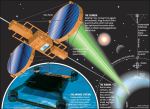
The space elevator once a laughed at theory included in future tech in the game Civilizaton is now becoming possible.  First, some artists’ rendering of possible space elevators, then the story.

LEARN in Universe and Environment

October 2, 2008 at 8:53 PM

The Space Elevator Gets a Lift

The fabled elevator to space is a surprisingly pragmatic idea. In November, the Japanese give it a timeline.

Imagine, if you will, a new kind of space travel-one with no launch pads or booster rockets. No risky ocean landings in charred, cramped Soyuz orbital modules; no money-sucking Space Shuttles. No explosions, no “Houston, we have a problem.” Instead of strapping themselves onto the noses of massive rockets and hoping for the best, astronauts would nimbly step into an elevator and ride for a few hours, smoothly and safely, out of the Earth’s atmosphere and into a waiting space station.

Meet the space elevator, probably the most revolutionary idea in the history of aeronautics. Because it’s exactly what it sounds like: an elevator. To space. And, although it’s been a pipe dream of armchair theorists since the 1800s, it just made one giant leap into a whole new world of plausibility. Why? Because the Japanese, perhaps afraid of being eclipsed by the mighty progress of commercial space travel companies, or the showboating of the nascent Chinese space program, have decided to build one, for real.It’s a smart pairing. Japan is a pioneer in the kind of precision engineering that a space elevator requires, and their space program, JAXA, is a small but powerful operation, excelling in X-Ray astronomy, satellite-based Earth observation, and building smart modules and components for the International Space Station. Plunging headlong into this unlikely project, Japanese scientists have founded an organization called the Japan Space Elevator Association, and they plan to host an international conference in November to draw up a timetable for the machine, discuss its impact on the world, and, according to their site, “Organize races with climbers made of Lego Blocks.”Yes, it sounds like fun, but surely this is a folly in a moment of global economic upheaval?
Unbelievably, the space elevator is in fact a totally pragmatic idea, and ultimately a cheap one, too-or rather, it’s cheaper than the fuel-guzzling rigmarole we’re currently faced with every time we need to wrest something from the steely grip of our planet’s escape gravity.The idea is simple, as most good ideas are: a super-strong tether made of carbon nanotubes, held taut by the inertia of the planet’s rotation, spanning from the surface of the Earth to a point beyond geosynchronous orbit, serving as a kind of  22,000 mile-long cosmic freeway (or, as the Japanese have already dubbed it, a bullet train to space) shuttling “lifters” out of the planet’s gravity and into orbit. To boot, the Japanese Space Elevator Association estimates it would only cost a paltry 1 trillion yen (about $9 billion) to build, which is pocket change if you consider the amount of money that NASA has indiscriminately poured into its programs over the years-not to mention compared to a certain Wall Street bailout.
What’s so elegant about the space elevator is that it draws a clean line between our centuries-old conception of “down here” and the newly approachable “up there.” While rockets retain a certain abstract quality-off they blast, in a florid burst of flame and noise, the mechanics of the whole thing still pretty mystical-the space elevator is concrete, as though humankind were reaching its own tentative arm into the great beyond. Besides, rocket fuel is so expensive, and launching rockets such a fuss, that it will probably always keep the democratization of space travel at bay. So what have we been waiting for?
There are a handful of groups in the U.S. working on space elevator policy and components-one being the Liftport Group in Bremerton, Washington-but no one has made plans as bold as those of the Japanese.Building the space elevator involves massive engineering challenges, but they’re not as impossible as they may seem. One of the most stunning things about the elevator, in fact, is that we have all the technology needed to implement it already. The only thing missing is a strong enough material to build the tether-the long cord connecting Earth and Space. Carbon nanotubes, which are the strongest man-made materials on Earth, seem to fit the bill, although the director of the JSEA, Yoshi Aoki, estimates they need to get a little stronger yet: about 180 times the tensile strength of steel.Arthur C. Clarke, perhaps the most ardent and famous promoter of the space elevator, was often asked when he thought the first one might be built. A little flippantly, he noted, “my answer has always been: about 50 years after everyone has stopped laughing.” Stop laughing, everyone: it looks like it might be even sooner than that.


2 Comments

Filed under Humor and Observations, Uncategorized

Future Internet/Smartphones/Ipads

The future of internet, pads and smartphones may look like the following:  (pretty amazing stuff)

  • Future of Internet Search: Mobile version
  • Part1: Looking Glass Concept
    This is what I wish the internet search will be able to do with a mobile device in the NEAR future. Touch screen, built in camera, scanner, WiFi, google map (hopefully google earth), google search, image search… all in one device. Like this way, when you can see a building through it, it gives you the image search result right on the spot.
  • Part2: Future of Mobile Internet Search: Applications

    Many applications like these will be developed that have never been possible.Indoor guide

    Works in a building, airport, station, hospital, etc.

    Automatic simultaneous translation
    Search keyword
    Helpful when you want to find out a word from a lot of text
  • Part3: Look at What You Don’t See Through Glass

    You can even see flowers that are not actually blooming.

    There are a lot more ideas drawn in my Moleskine, so I’ll introduce them later.
    Also visit other posts of this gadget.

  • Part4: Future of Mobile Search for Diet


    Mainly because I don’t usually care about nutrition when I eat, this kind of function would be helpful for people like me.
  • Part5: Future of Mobile Search- Search Beyond Time

    Getting data of a weather forecast, maybe this might be possible.

    When you wonder what the scene you’re looking at was like in the past, you can see it.

    It would be nice if it could work in sync with Google Maps like this.
  • Part6: Future of Mobile Search- Power of Visualization

    Visual aid for any book. It means any book can be a picture book.

    If it could be wirelessly in sync with your mobile phone or other mobile devices, visualized data exchange could be done like
  • Looking Glass for iPhone

    petitinvention.wordpress.com/2008/07/26/looking-glass-for-iphone/
  • Part7: Future of Mobile Search: Virtual Shopping #1

    I’m pretty sure companies like Ikea would quickly start to use this device this way if it became really available.
  • Part8: Speech Balloons for the Hearing-Impaired

    Speech balloons in comic books show very well how the characters speak. If we could instantly visualize how people speak, wouldn’t it be nice for the hearing-impaired? It means they can SEE our voices.

    Stressed words are rendered larger than those spoken less loudly.Arrows of the balloons show from where it’s spoken (of course).

    A scream is shown in a balloon with jags.

    Imitation sounds are also rendered, but with other colors than spoken words.

    When spoken to from out of the screen, it shows the words with the direction the voice is from.


    A pair of glasses with the same functions could replace the device if we could figure out a good way not to block visual information.

1 Comment

Filed under Humor and Observations, Uncategorized

3d printing of guns – update

As followers know, I have said that 3d printing will change everything as we know it.  In an earlier post, I discussed how guns can be printed, and another post talks about how the military uses 3d printing for making knives and other tools.  Here is an update on this revolutionary technology:

Print and fire: 3D printing could muzzle new gun laws

By 

Published February 13, 2013

FoxNews.com

  • gunclip2.jpg

    Cody Wilson of Defense Distributed testing out the “Cuomo Clip” (DefenseDistributed.com)

  • gunclip3.jpg
    DefenseDistributed.com
  • gunclip4.jpg
    DefenseDistributed.com
  • gunclip1.jpg

    A computer rendering of a “Cuomo Clip”, a 30-round ammo magazine for the AR-15 rifle. (DefenseDistributed.com)

Gun owners who can’t buy high capacity ammo magazines because of new laws have another option: Print them.

Gun control measures passed or proposed in the wake of the Sandy Hook school massacre have targeted magazines that can feed 30 rounds or more into the firing chambers of AR-15s and other semi-automatic guns. New York has banned magazines holding more than seven rounds, and a federal bill proposed by Sen. Dianne Feinstein, D-Calif., would ban magazines holding more than 10 rounds.

But the laws are at least one step behind technology. Using 3D printers and schematics available on the Internet, gun owners can manufacture a fully functional, plastic magazine clip. Plans are free, although getting access to a 3D printer may prove expensive, at least for now.

“If you can download it, you can have it.”

– Cody Wilson, Defense Distributed/Wiki Weapons Project 

“If you can download it, you can have it,” said University of Texas law student Cody Wilson, who is part of Defense Distributed, a group that has created the design for what they refer to as a “Cuomo Clip” along with other gun parts. It is all under an initiative they refer to as the Wiki Weapon Project.

“It’s basically to head them [legislators] off at the pass, which we have,” Wilson added, noting that “hundreds of thousands” of visitors have gone to his group’s site to download the CAD file for the ammo magazine since it was first posted in mid-January.

The “Cuomo Clip,” named for New York Gov. Andrew Cuomo, who pushed the high-capacity clip ban through the Legislature, is made from a plastic filament similar to the type of material used to manufacture LEGO building blocks. It is also loaded with a large spring that helps to push rounds of ammo into the gun chamber.

The ammo magazine clip appears to be durable; Defense Distributed test-fired 86 rounds from a 30-round prototype last month, and the clip showed no signs of damage.

The cutting edge technology, in which three-dimensional objects can be manufactured from melted plastic thread, is likely to complicate efforts to control firearms. No such ability existed in 1994, when large-capacity clips were first banned in an initial federal assault weapons ban that lasted a decade.

Although the new ban proposed by Feinstein would prohibit the manufacture of magazines, it focuses on traditional arms makers and sellers. How the law might be enforced against individuals making their own magazines — and possibly even guns in the future — is unclear.

Rep. Steve Israel, D-N.Y., has called for amending the Undetectable Firearms Act of 1988, which initially sought to ban guns that could be sneaked through metal detectors, to include a ban on “homemade, 3-D printed, plastic high-capacity magazines.”

“Congress passed a law banning plastic guns for two decades when they were just a movie fantasy,” Israel told FoxNews.com. “With the advent of 3-D printers, these guns are suddenly a real possibility, and the law Congress passed is set to expire this year.

“We should act now to give law enforcement authorities the power to stop the development of these weapons before terrorists and criminals can easily bring them on planes. We need to be proactive and keep ahead of the technology. When the legislation was originally passed in 1988, no one would have imagined that parts of a gun and a magazine could be made with a printer — imagine what the technology will be even five years down the road.”

Defense Distributed and the Wiki Weapons Project also has made schematics of other parts of the AR-15 and other weapons and modifications, including pistol grips, but has avoided attempting to design and distribute plans for a fully-functional gun.

Read more: http://www.foxnews.com/tech/2013/02/13/print-draw-fire-3d-printing-could-muzzle-new-gun-laws/#ixzz2KoiE5x24

Leave a comment

Filed under Humor and Observations

Chronology of Events in Science, Mathematics, and Technology

I am sorry for the small print below.  However, these are links to an amazing site for researchers and the generally curious.  By category below, find out the timeline for inventions and breakthroughs in major fields of science and human endeavor.  Very helpful for us historical fiction writers.

The Chronology of Events in Science, Mathematics, and Technology


Chronology of Biology and Organic Chemistry
Chronology of Medicine and Medical Technology 
Chronology of General Technology
Chronology of Pure and Applied Mathematics
Chronology of Geology
Chronology of Geography, Meteorology, Paleontology, Science Philosophy and Publishing
Chronology of Agriculture and Food Technology
Chronology of Clothing and Textiles Technology
Chronology of Motor and Engine Technology
Chronology of Transportation Technology
Chronology of Underwater Technology
Chronology of Communication Technology
Chronology of Photography Technology
Chronology of Calculator and Computer Technology
Chronology of Time Measurement Technology
Chronology of Temperature and Pressure Measurement Technology
Chronology of Microscope Technology
Chronology of Low Temperature Technology
Chronology of Rocket and Missile Technology
Chronology of Materials Technology
Chronology of Lighting Technology
Chronology of Classical Mechanics
Chronology of Electromagnetism and Classical Optics 
Chronology of Thermodynamics, Statistical Mechanics, and Random Processes 
Chronology of States of Matter and Phase Transitions 
Chronology of Quantum Mechanics, Molecular, Atomic, Nuclear, and Particle Physics
Chronology of Particle Physics Technology
Chronology of Gravitational Physics and Relativity
Chronology of Black Hole Physics
Chronology of Cosmology
Chronology of Cosmic Microwave Background Astronomy
Chronology of Background Radiation Fields
Chronology of Galaxies, Clusters of Galaxies, and Large Scale Structures
Chronology of Interstellar and Intergalactic Medium
Chronology of White Dwarfs, Neutron Stars, and Supernovae
Chronology of Stellar Astronomy 
Chronology of Solar Astronomy
Chronology of Solar System Astronomy 
Chronology of Astronomical Maps, Catalogs, and Surveys 
Chronology of Telescopes, Observatories, and Observing Technology
Chronology of Artificial Satellites and Space Probes


2 Comments

Filed under Humor and Observations

Printing Food

3D printers are the technology that will change everything ab0ut our lives.  I was just having dinner with friends and said if you can put polymers in a 3d printer and print out three dimensional objects, why not put food paste, texture, flavor packets and coloring and print food?  In essence, you could transmit a “recipe” to a printer as easily as a structural diagram, and food is just as easy to layer as polymer.  I had no idea it would be tried so soon.  Get drunk late at night and want to head to Taco Bell?  Want a pizza delivered during the big game?  Why not print one out?  Go to pizzarecipe.com, pick out your favorite, download to the printer, voila!  Star Trek Replicators now.

A single 3D-printed burger currently costs over $300,000 to make

Jan. 22, 2013 (3:00 pm) By: 

Cheeseburgers

3D printing might be the wave of the future, or it might just end up a niche hobby that’s pretty cool but ultimately too expensive and complicated to ever take off. Whatever that fate may be, startup Modern Meadow is throwing its hat into the 3D printing ring, but rather than printing plastic trinkets or gun parts, it plans to print edible meat.

We’ve mentioned Modern Meadow – a company that is practicing a variant of 3D printing, called 3D bioprinting — before. Instead of using resin like standard 3D printing, or a material more easily sent through a printer for food-printing like melted chocolate that then hardens, Modern Meadow uses material somewhat creepily called “bioink”.

In order to print live cells, the engineers perform biopsies on animals and collect stem cells, or other special cells. Because stem cells are basically magical (this not a technical term), they can not only turn into other cells, but replicate themselves. Once they replicate enough times, the engineers load them into a bioprinter cartridge, which creates something of a bioink — a material made of many live cells. When the bioink is printed, the living cells link together and form living tissue.

Modern MeadowWhen using 3D bioprinting a hamburger as an example, Professor Gabor Forgacs — part of the father and son founders of Modern Meadow — notes that the actual shape of the food isn’t too much of a hurdle, as it’s simply a round, relatively 2D patty. Another benefit to producing edible meat is that the live tissue can die afterward, as consumable meat normally isn’t living tissue, so a method of preserving the tissue’s life isn’t really required.

Though it might be easier to print edible, dead-tissue meat, Modern Meadow is facing a couple fairly large hurdles. For one, convincing the world to eat lab-grown meat might not be so easy. Another significant hurdle is that though Modern Meadow hasn’t grown something like a burger or steak as of yet, the price of one would be astronomically high. Another team of researchers at Maastricht University in the Netherlands has been growing animal cells to produce strips of lean muscle, with the goal of creating an artificial hamburger. Though the team doesn’t use bioprinting, they do use a somewhat related process of having stem cells replicate and create live tissue in a mold. Unfortunately, creating an entire burger would currently cost over $300,000.

If this all seems a little nutty, Modern Meadow has managed to raise some backing from prominent figures, such as Peter Thiel, who was one of Facebook’s early investors. There’s no word yet on when the company will be able to print a burger (or even a slider!), but if it can, it will be interesting to see how much it’ll cost, and if people can be convinced that “synthetic” meat is truly edible.

1 Comment

Filed under Humor and Observations

Robots

I just finished a short story for the upcoming anthology – Twisted Nightmares, that involves robots, so I had robots on the mind.  As a result, here are some thought provoking pictures of robots for your Tuesday enjoyment:

Leave a comment

Filed under Humor and Observations

12 of the World’s Most Annoying Technologies

12 of the World’s Most Annoying Technologies

Leave a comment

Filed under Humor and Observations

10 Ways the Next 10 Years Are Going To Be Mind-Blowing

Reposted from


at High Existence


10 Ways the Next 10 Years Are Going To Be Mind-Blowing

10 Ways the Next 10 Years Are Going To Be Mind-Blowing

StumbleUponWe are living in an extremely exciting time in terms of science and technology. Things that have always been considered science fiction are becoming normal day-to-day components of our lives. And while we have been seeing invention after breakthrough over and over in the last couple of decades, this next ten years is going to blow everything else out of the water.

The awesome thing about all these scientific discoveries it that they create technology that allows us to make more breakthroughs even faster. Our ability to innovate is increasing exponentially as the years go by. To give you an idea of the magnitude of this reality, here are 10 amazing innovations to different sectors of life. They should give you a pretty good idea of what changes will be made by 2020.

1) Bio Technology

Maxriter_pro-digits-bionic-fingersBionic Hand controlled by brain signals

Okay, it doesn’t let you crush rocks like you would think, BUT it does allow people without fingers to have fully functional hands that can pick up and handle delicate objects. It is completely controlled by the brain and requires no surgery. Touch Bionics, the company the produces the Pro Digits hand, is able to install the hand complete with “living skin,” a plastic covering resembling human skin, for under $50,000. A small price to pay for a new hand I think.

2) Architecture

021_DUBAIRevolving Tower in Dubai

While Dubai is currently known for it’s ridiculous extravagance, developers in the region are building a tower that has fancy andextremely practical applications.

This beautiful building is going to be made of 59 independently rotating modules/floors so that inhabitants will have a constantly shifting view of the outside world. Each floor will rotate at approximately 6 meters per minute so that the inhabitants will not notice the movement. The independent rotations will also give the building an ever-changing exterior that can warp into very complex designs.

All of that aesthetic stuff is great and all, but the real innovation comes from the wind turbines built in between each floor. The resulting pollution-free energy will be enough to power the tower and several buildings in the surrounding area. Just Wow.

3) Computer Speed, Size and Usability

Speed

Most people tech-nerds know of Moore’s Law from 1965 (the number of transistors we are able to cheaply put in computer chips doubles every year, thereby doubling the speed).  However, most people don’t know that Moore, himself, came out and said his law will most likely fail finally in 2020 where the number of transistors we can put on chips will be limited by the laws of physics. Does this mean the exponential rise in computer processing speed will come to a halt in ten years?

Not a chance, says Jim Tully, chief of research for semi-conductors at Gartner. “The technology which will replace this is a bottom-up approach, where chips will be assembled using individual atoms or molecules, a type of nanotechnology.”

Ray Kurzweil, a well-respected Futurist, stated in 2008 that when this molecular computing technology comes out in 2020, computers will have the intellectual capability of human beings. You might want to digest that for a minute before moving onto the next section.

Size and Usability

computer_timeline

That Macbook Air is pretty damn thin. So thin, in fact, that it makes you wonder if physical computers will even exist in 2020. Well according to developers at Intel, the keyboard and mouse surely won’t. Who needs QWERTY when you can control a computer with your mind?

“We’re trying to prove you can do interesting things with brain waves,” said Intel researcher Dean Pomerleau. “Eventually people may be willing to be more committed … to brain implants. Imagine being able to surf the Web with the power of your thoughts.”

Pomerleau and countless research groups around the world are working with brain scanning devices to map blood flow in the brain. They have found that when different individual focus on the same image, they have very similar patterns of blood flow in their brains. For example, oneBritish group announced that they could discern where subjects where in a computer generated virtual environment by looking at where blood flowed in their brains.

4) Cars and Fuel

There are tons of different fuel-types for the “automobiles of tomorrow” but the only kind that seems to have any realistic chance of actually being used by the masses in the next ten years is electric. We still can’t figure out how to make hydrogen fuel cells efficient, safe and practical and hybrids/deisal cars are yesterday’s news. Fossil fuels are so 2009…

Picture 5Picture 4

This is the Tesla Model S sedan that will be coming out in 2011 for the modest price of $57,000 (very good for a luxury, electric car).

Besides the sexy curves, you get 160, 230 or 300 miles per charge depending on the battery size you choose. And another small detail, it goes from 0 to 60 mph in 5.5 seconds while seating 7 people.

So despite all of the automaker’s best attempts at making alternative-fuel cars so hideous that no one would ever buy them, it looks like market competition will soon push some very attractive and efficient cars onto the market.

5) How We Interact With the World

The way in which we interact with the outside world has changed SO much since the introduction of the internet, smart phones, etc. In the very near future, another huge jump will be made: integrating the information on the internet with our surroundings.

By that I mean being able to look at a building, product or place and immediately seeing information about the subject on our devices and eventually just with our eyes.

If you’re still confused as to what I mean, check out the earliest innovation of this concept, Goggles by Google. This app allows you to take a picture of whatever you are looking at and instantly receive info about it on your Android phone.

Like the video says, Goggle is only scratching at the surface of this technology. Kurzweil says that “By 2020 we’ll routinely have pop ups in our visual field of view that give us background about the people and places that we’re looking at.” Your memory and the vast information bank of the internet will be one at all times.

Until we can do this with a chip in our brain, a new device has come out that overlays video onto our normal vision using special glasses. It’s called the Vuzix display Wrap 920AR and it goes on sale soon for around $800.

6) Energy

Solar energy will soon leave fossil fuels and inefficient wind farms in the dust. According to Kurzweil, “the cost per watt of solar energy is coming down rapidly and the total amount of solar energy is growing exponentially. It has in fact been doubling every two years for the past  20 years and is now only eight doublings away from meeting all of the world’s energy needs.”

Emerging technology from a company called Sandia is making the reality that much closer:

Picture 11

Sandia’s solar cells are made of 100 times less material than the current top solar cells while operating at the same efficiency. Since the biggest hurdle in the path of solar power is the expensive and large nature of solar panels, these new microscopic cells will make a huge difference. For example, current panels are massive and require large motors to move them to track the sun. Sandia’s cells, on the other hand, would only need to be moved a fraction of a millimeter to track the sun efficiently while weighing next to nothing.

Even more amazing, they can be suspended in liquids and printed on flexible materials, allowing the cells to be places on any surface. What if your entire car was covered in these powerhouses? Bye bye, Chevron.

7) Health

While we still can’t cure the common cold, custom-made organs are just around the corner.

Picture 12

A company called Organovo has developed the first commercial 3-D bio printer that builds custom organs cell-by-cell. Each individual cell is based upon sample cells from the body of the customer. Organovo reports that veins and arteries will be available in 5 years, and more complex organs like hearts and livers in 10.

On a more general note, nanotechnology is revolutionizing the health world. The awesome combination of a higher understanding of how DNA works and the ability to create very small cellular parts is painting a very bright future for medicine.

Scientists are finding specific sequences of DNA that code for conditions like schizophrenia, autism and even aging. The cures are actually in sight.

8) Success and Popularity Accessibility

By that, I mean the ability of a Joe Nobody to come from nowhere and suddenly gain recognition and become a well known someone. The internet has been continually leveling the playing field so that you don’t need million in capital or marketing to get your ideas, creations and business into the spotlight.

10 year-olds are making thousands off their viral YouTube videos. Anyone with a business idea can start a website and get going for little to no capital. Even Twitter (which I am not a big fan of) can launch people into the spotlight if they can work the system in the right way.

Many people are getting huge jobs because companies are seeing how well their content does on the web. For example, Fede Alvarez, a director from Uruguay, recently had this short film go viral and was offered $30 million from a Hollywood company to direct a film for them.

The internet is the perfect tool for capitalism, entrepreneurship, and dreaming. Whatever you can dream up, you can make possible on the World Wide Web.

9) Robots

The first decade of the 21st century has been a remarkable time for innovation in robotics. While we’re still far away from having bots helping around the house or doing our construction, big strides have been made towards that future.

Recently a robot was able to teach itself human facial expressions by randomly contorting its face and receiving feedback on what resembled real expressions.

Here’s another robot called BigDog that came out a couple of years ago, but if you haven’t seen the video, you really should. It’s a 4-legged robot that can navigate difficult terrain and correct its balance when shoved. If you can’t watch the whole video, at least fast-forward to 1:50 where the robot can be seen running and jumping.
And finally here is the bipedal version of BigDog that walks heel-to-toe just like humans do. Again, it can regain balance when shoved.
10) Clothing

Nanotechnology in Clothing

– Nano-fibres will make garments tremendously more comfortable and durable. “By this process the textile products can be made more attractive, strong and responsive to customers’ choice.”

dn16126-2_300– Fiber-based nanogenerators will build up electrical energy in clothing from physical movement, ultrasonic waves and even blood flow. “If we can combine many of these fibers in double or triple layers in clothing, we could provide a flexible, foldable and wearable power source that, for example, would allow people to generate their own electrical current while walking.”

– Extremely hydrophobic (water-resistant) nanofilaments allow for completelywaterproof clothing. It can be submerged in water for two months and still remain dry to the touch. “The water comes to rest on the top of the nanofilaments like a fakir sitting on a bed of nails.” (Whatever that means…)


1 Comment

Filed under Humor and Observations

Predictions of Future Technology

I found this chart on StumbleUpon and thought it was pretty cool and thought provoking.  Hopefully, you will as well.

http://www.stumbleupon.com/su/2FWuDt


Leave a comment

Filed under Humor and Observations