Monthly Archives: December 2012

Miss USA wins Miss Universe

‘Merica – One for the home team.  Having the best looking women is much better than gold in the Olympics!

Miss USA wins Miss Universe pageant

Published December 19, 2012

Associated Press

  • Miss Universe Finalists.jpg

    Dec. 19, 2012: The five Miss Universe finalists were, from left, Miss Brazil Gabriela Markus, Miss USA Olivia Culpo, Miss Australia Renae Ayris, Miss Philippines Janine Tugonon and Miss Venezuela Irene Sofia Esser Quintero. (AP)

  • Miss Universe USA.jpg

    Dec. 19, 2012: Miss USA Olivia Culpo was crowned Miss Universe pageant in Las Vegas. (AP)

  • miss usa culpo 660 reuters.jpg
  • miss brazil australia 660 split reuters.jpg
  • miss universe 2012 reuters.JPG
LAS VEGAS –  A 20-year-old beauty queen from Rhode Island was crowned the new Miss Universe on Wednesday, beating out 88 other women during a televised competition at the Planet Hollywood casino on the Las Vegas Strip.

Olivia Culpo took the crown from Leila Lopes of Angola after strutting in a purple and blue bikini and a red velvet gown.

In the final stages of the competition, she answered a question about her regrets by saying she wished she hadn’t picked on her siblings.

Miss Philippines, Janine Tugonon, came in second, while Miss Venezuela, Irene Sofia Esser Quintero, placed third.

Contestants from 89 countries on six continents spent the past two weeks in Sin City, where they posed in hardhats at a hotel groundbreaking, took a painting lesson, and pranked hotel guests by hiding in their rooms.

The beauty queens took the stage in tight, pleated mini-dresses with glittering sequin bodices and sky high platform shoes, strutting to the hit “Live While We’re Young,” by English-Irish boy band One Direction.

Later in the two-hour show, they walked a stage decked with white Christmas trees and snow flurry effects, throwing off gauzy white wraps to show off tie-dye bikinis in purples, pinks and blues.

For the third elimination round, they strutted in evening gowns as band Train and Australian singer Timomatic performed. Miss Venezuela’s straight-cut, emerald-colored gown was perhaps the most distinct, its long sleeves virtually invisible but for the navy blue, garland-like trim encircling them. Miss USA’s red velvet number was full-skirted and wintery, except for the deep, plunging neckline. Miss Australia’s gown evoked a wedding dress — pure white with sparkles at the waist and a corset-style bodice.

Culpo, from Rhode Island, was trying to end a long losing spell for the U.S. in the competition. An American had not won the right to be called Miss Universe since Brook Lee won the title in 1997.

The contestants voted to give the Miss Congeniality crown to Miss Guatemala.

The pageant aired live on NBC and was streamed to more than 100 countries.

Andy Cohen of the Bravo network and Giuliana Rancic of E! News returned to host the pageant, which was back in Las Vegas after being held in Sao Paulo last year.

The panel of 10 judges included singer Cee Lo Green, “Iron Chef” star Masaharu Morimoto and Pablo Sandoval of the San Francisco Giants.

Asked on the red carpet whether he found playing in the World Series or judging the beauty pageant to be more difficult, Sandoval said both were hard.

Angola sported a low-cut sequined gown and said she expected this night to be the worst part of her year. The 2011 winner offered some advice to the women vying for her crown.

“Be calm and smile,” she said. “Smiling helps a lot. Even though they are not relaxed, the judges will think that they are.”

Sharply dressed women and men, including a large contingent from South America, held banners and cheered on their favorite contestants.

“I’ve seen them and they are absolutely gorgeous,” said Donald Trump, a co-owner of the Miss Universe Organization. “They’re very nervous and they should be. It’s a billion people (watching).”

Organizers had considered holding the 61st annual Miss Universe in the popular Dominican Republic tourist city of Punta Cana, but Miss Universe Organization President Paula Shugart said that country’s financial crisis proved to be too much of an obstacle.

Contestants in the pageant cannot have been married or have children. They must be younger than 27 and older than 18 by Feb. 1 of the competition year.

The winner of the crown receives an undisclosed salary, a wardrobe fit for a queen, a limitless supply of beauty products, and a luxury apartment in New York City.

The pageant started as a local revue in Long Beach, Calif., organized by Catalina Swimwear. It is not affiliated with the Miss America pageant and unlike that contest, does not include a talent section.

Read more: http://www.foxnews.com/entertainment/2012/12/19/miss-usa-wins-miss-universe-pageant/?intcmp=trending#ixzz2Fc2fIUkt

Leave a comment

Filed under Humor and Observations

Nerd Gingerbread Art

Being a penultimate nerd myself, I would love any of these.  I also love gingerbread, so eating them would be nice too.

20 Deliciously Geeky Pieces Of Gingerbread Art

All I want for Christmas is to stuff these all in my face.

Donna Dickens BuzzFeed Staff
1. AT-AT – “Star Wars”
AT-AT - "Star Wars"

2. The Weasley’s Home – “Harry Potter”

The Weasley's Home - "Harry Potter"

3. Beginner House – “Minecraft”

Beginner House - "Minecraft"

4. Flynn’s Arcade – “Tron”

Flynn's Arcade - "Tron"

5. Minas Tirith – “Lord Of The Rings”

Minas Tirith - "Lord Of The Rings"

6. Bruce Wayne Manor – “Batman”

Bruce Wayne Manor - "Batman"
Source: hendelopticon

7. Ewok Village – “Star Wars’

Ewok Village - "Star Wars'

8. Hogwarts – “Harry Potter”

Hogwarts - "Harry Potter"

9. Companion Cube – “Portal”

Companion Cube - "Portal"

10. Emperor Arrives – “Star Wars”

Emperor Arrives - "Star Wars"

11. Steampunk Dragon – None

Steampunk Dragon - None

12. Peach’s Castle – “Super Mario 64”

Peach's Castle - "Super Mario 64"

13. Hobbit Hole – “Lord Of The Rings”

Hobbit Hole - "Lord Of The Rings"

14. Jack’s House – “The Nightmare Before Christmas”

Jack's House - "The Nightmare Before Christmas"

15. TARDIS and Dalek – “Doctor Who”

TARDIS and Dalek - "Doctor Who"

16. Aperture Science Test Chamber – “Portal”

Aperture Science Test Chamber - "Portal"

17. Sandcrawler – “Star Wars”

Sandcrawler - "Star Wars"

18. Hagrid’s Hut – “Harry Potter”

Hagrid's Hut - "Harry Potter"

19. K-9 – “Doctor Who”

K-9 - "Doctor Who"

20. Serenity – “Firefly”

Serenity - "Firefly"

5 Comments

Filed under Humor and Observations

Plague Doctors

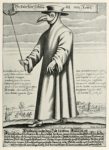
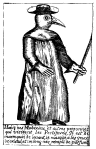
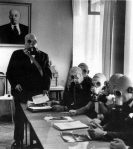
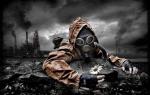
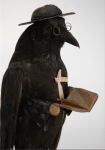
Plague Doctors were physicians during the middle ages that took care of those with the Black Plague.  They mistakenly thought they would be safe if they covered themselves in robes and wore a bird-like mask that contained a variety of scents including myrrh and other rare materials thought to insulate them from the “deadly humours in the air” like a gas mask.  Unfortunately, plague was spread by fleas from rats that came off ships in ports, so most plague doctors died.  Despite their self-sacrificing efforts to help those infected when everyone else fled, their outfits remain one of the creepiest and scariest in history.

reposted from Doctors’ Review

Doctors of the Black Death

The infamous plague doctors of the Middle Ages were a fearsome sight

by JACKIE ROSENHEK • October 2011

Being born in Medieval Europe was like losing the historical lottery — superstition reigned, feudalism flourished and misery was the rule, not the exception, among the long-suffering serfs. Yes, to live in the Dark Ages was to know disease and hunger intimately, to fear the wrath of a vengeful God (courtesy of His almighty Church), and to die young or on the battlefield. And yet, among those countless cold winters and violent wars fought for cruel lords, few could argue that 1348 was probably the single worst year be alive in pre 20th-century Europe.

When the rats and fleas carrying Yersinia pestis surreptitiously hitched a ride down the Silk Road with merchants and soldiers, no one could have predicted the toll this taste for spices and the latest in luxury goods would have on the population of Europe. After decimating tens of millions starting in China, it raced though central Asia and northern India. The bubonic plague made official landfall in Sicily in 1347. Within five years, it had spread to virtually all of Europe, Russia and the Middle East.

THE PERFECT PLAGUE

The first wave was the worst, killing some 25 million in Europe alone. By 1400 — a mere 50 years after the pandemic began — various epidemics and resurgence had reduced the world’s population from about 450 million to between 350 and 300 million, maybe less. Roughly 150 million individuals succumbed to the nightmarish symptoms of the Black Plague.

First, swollen lymph nodes would signal infection. Within days, these painful buboes would blacken and then burst, spewing forth pus and blood. Dark purplish patches all over the body were par for the course. The lucky ones would recover, while others would soon go on to suffer high fever and agonizing episodes of spasmodic pain, vomiting and retching while blood sometimes filled their lungs. For the fortunate, death would come quickly; others lingered in a state of delirium for days.

Panic, desperation and grief reigned supreme, from the humblest burgs to the most vibrant cities throughout Europe. All manner of prayers and bargains and cures were attempted, but to no avail. With no antibiotics available to fight the dreaded bacteria, the plague would simply have to run its course. The plague did not entirely disappear from European soil until the 19th century as smaller but still deadly outbreaks occurred continuously in the decades that followed.

Once the plague’s full force was felt, it didn’t take long for most reputable and well-trained doctors to recognize its vicious and virulent nature. Moreover, any physician with even a lick of sense soon realized that the “cures” being employed were anything but, and sometimes even accelerated the death spiral. And so, most of them ran away. It was really the only sensible thing to do.

Those who took their place — the so-called plague doctor or Medico della Peste — were often little more than paid hacks and second-rate physicians hired by desperate municipalities. These eerily clad public servants would become an iconic symbol of the plague that we easily recognize to this very day… harbingers of doom in a very dark chapter in the history of human suffering.

DESPERATE TIMES

To say people didn’t know much about the plague was an understatement. From its origins, to its spread, to its cure, the physicians whose sole purpose was to treat this infamous killer knew little more than those whom they were treating. They did, however, understand one thing with perfect clarity: the fact that it spread quickly and easily. Desperate times called for desperate measures.

Poultices of onion and butter, sprinklings of dried frog, arsenic, floral compounds and even a generous bloodletting or two were no match for this killing machine. The closer the patient was to dying, the more desperate the cures became. Accounts exist of coating sufferers in mercury and baking them for a while in the oven, though this was likely not as unpleasant as some of the creative means by which diarrhea was induced to relieve the patient’s system of the invading demons. Those with no medical training were often even more creative in their attempts to cure.

Nothing worked to halt the spread. The bodies piled up quickly and were carted away, dumped unceremoniously into mass graves. Hundreds were burned at a time. Entire villages succumbed and simply ceased to exist. Coping the best they could, the living often went crazy with fear, committed suicide, threw themselves into all-consuming religious devotion or indulged in a Bacchanalian end-of-days-style orgies that would have made Caligula blush. Murderers and thieves were let out of jail on the condition they agree to help with the removal and incineration of bodies.

PUBLIC SERVICE, PLAGUE-STYLE

Presumably, their principal task of the plague doctors was to help treat and cure plague victims, and some did give it their best shot. In actual fact, however, the plague doctors’ duties were far more actuarial than medical. Most did a lot more counting than curing, keeping track of the number of casualties and recorded the deaths in log books.

Plague doctors were sometimes requested to take part in autopsies, and were often called upon to testify and witness wills and other important documents for the dead and dying. Not surprisingly, many a dishonest doc took advantage of bereaved families, holding out false hope for cures and charging extra fees (even though they were supposed to be paid by the government and not their patients).

Then, as now, it seems a life of public service was occasionally at odds with the ambitions of some medically minded entrepreneurs. Whatever their intentions, whatever their failings, plague doctors were thought of as brave and highly valued; some were even kidnapped and held for ransom.

CREEPY COSTUME

By the 1600s, the plague doctor was a terror to behold, thanks to his costume — perhaps the most potent symbol of the Black Death. The protective garment was created by the 17th-century physician Charles de l’Orme (1584-1678). De l’Orme had been the physician of choice for several French kings (one Henri and a Louis or two), and was also a favourite of the Medici family in Italy. In 1619 — as a carefully considered way to protect himself from having to visit powerful, plague-infested patients he couldn’t say no to — de l’Orme created the iconic uniform. Its dramatic flair certainly made it seem like a good idea, and the costume quickly became all the rage among plague doctors throughout Europe.

Made of a canvas outer garment coated in wax, as well as waxed leather pants, gloves, boots and hat, the costume became downright scary from the neck up. A dark leather hood and mask were held onto the face with leather bands and gathered tightly at the neck so as to not let in any noxious, plague-causing miasmas that might poison the wearer. Eyeholes were cut into the leather and fitted with glass domes.

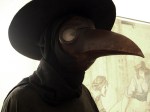
As if this head-to-toe shroud of foreboding wasn’t enough, from the front protruded a grotesque curved beak designed to hold the fragrant compounds believed to keep “plague air” at bay. Favourite scents included camphor, floral concoctions, mint, cloves, myrrh and basically anything that smelled nice and strong. In some French versions of the costume, compounds were actually set to smolder within the beak, in the hopes that the smoke would add an extra layer of protection. A wooden stick completed the look, which the plague doctor used to lift the clothing and bed sheets of infected patients to get a better look without actually making skin-to-skin contact.

USELESS OUTFIT?

Despite the fact that de l’Orme himself lived to the ripe old age of 96 — an impressive feat for a physician living in the plague years — his famous contribution to medicine probably did very little to quell the actual spread of the disease. The beak doctors, as they came to be know, dropped like flies or pretty much lived under constant quarantine, wandering the countryside and city streets like pariahs… until of course desperate families needed them.

As a tribute to your fallen brothers from eras gone, why not encourage your kids to try on something a little different for Halloween this year? Explain some of the history behind these death doctors, and they’re sure to find the Medico della Peste every bit as terrifying as any vampire, witch, ghost or ghoul…

3 Comments

Filed under Humor and Observations

Diesel Punk Pictures

So what is Diesel Punk?  It is alternative history or science fiction from 1900 to 1940, or the Age of Diesel, where Steampunk is from the Age of Steam, roughly 1820 to 1900.  Diesel punk is popularized in Indiana Jones’ movies, Skymaster’s of the Universe, the darker Sucker Punch movie, and the recent animated Tin Tin.  Here are some random diesel punk pictures for your enjoyment:

1 Comment

Filed under Humor and Observations, Uncategorized

More Random Humor

As it says, more random humor:

2 Comments

Filed under Humor and Observations

McRib FAQ

The down low on the McRib sandwiches at McDonalds…
The history and mystery surrounding the McRib

  • mcrib.jpg

As of today, McDonald’s famous and much-loved McRib is back on the national scene. For a limited time, you can enjoy the barbecue pork sandwich without going on a search reminiscent of those for Big Foot and Nessie. Whether you are currently wiping that savory sauce off of your face, are planning on venturing out to pick up a sandwich, or are just curious about what the big deal is, check out these fun facts on the McRib.

Nutritional value

At 500 calories and 26 grams of fat, the McRib isn’t the most diet-friendly of sandwiches. For the same number of calories, you can eat two classic McDonald’s hamburgers and save 8 grams of fat. However, you don’t have to worry about the hamburger disappearing from the menu, so the indulgence may be worth it.

Cult-like following

Over the last three decades, the McRib has become something of a legend. It transcended the realm of fast food fans and made its way into pop culture, earning mentions in “The Simpsons” (as the Ribwich) and on David Letterman’s Top 10 lists.

The sandwich itself contains pork shaped like a rack of ribs that is doused with barbecue sauce and then topped with picked and onions and served on a bun.

If you aren’t convinced that the McRib is for you, McDonald’s has put together 101 reasons why you should eat one.

The history of the McRib

The McRib was introduced in 1982, according to the 101 reasons to eat a McRib interactive promotion, although sources have previously listed its inaugural year as 1981. Either way, it was removed from the menu in 1985 and was reintroduced in the 90’s.

Back in 2005, the sandwich went on a farewell tour.

“Our customers will have the last chance to experience the savory taste of the McRib Sandwich and pay tribute to a part of McDonald’s 50-year history,” McDonald’s spokesperson Jennifer Smith said in a press release in 2005.

But this was not the end of the McRib. It went on two more so-called farewell tours, one in 2006 and one in 2007. It then became available sporadically and regionally in the U.S. The McRib Locator website reported its first McRib sighting on Oct. 3, 2008 in Winner, S.D. Since then, McRibLocator.com has been helping fellow fanatics track down the sandwich across the country. The website even has an Android app, so you can continue your search for the McRib on the go if necessary. Luckily, you won’t have to look very far for the next couple of weeks.

The bone-less rack of ribs

If you have eaten or seen a McRib, you know that the meat of the sandwich looks like a rack of ribs, even though it neither contain bones nor a whole lot of rib meat. It starts out as pork meat, mostly from the shoulder, in a large processing plant, according to a 2009 Maxim article. The meat is chopped up, seasoned, molded into its famous shape and then they flash-freeze it.

An urban legend of sorts says that the McRib was first made at the University of Nebraska, but that isn’t exactly true. In 1972, the National Pork Producers Council gave University of Nebraska’s Professor Roger Mandingo a grant to work on restructuring meats. Mandingo came up with a process that used salt and mechanical action to compress small pieces of meat, so we have him to thank for the McRib’s unusually shaped patty.

Read more: http://www.foxnews.com/leisure/2012/12/17/history-and-mystery-surrounding-mcrib/?intcmp=features#ixzz2FLvgjnhh

Leave a comment

Filed under Humor and Observations, Uncategorized

Domestic Spying

One of the few times the ACLU, the Wall Street Journal, and I will agree on anything…  We are quickly becoming a police state, in which you will be observed, documented, studied, investigated, and even found guilty – all without prior cause or trial.

tech_tunnel_by_jurvetson_500x280

Vast New Spying Program Was Started in Secret on a Bogus Pretext

By Chris Calabrese, Legislative Counsel, ACLU Washington Legislative Office at 11:25am

The Wall Street Journal today published (alternate link) an in-depth review of a new, relatively unknown program run by the National Counterterrorism Center (NCTC). Although we have been warning about the dangers of the program for months, and I testified before Congress about the issue in July, the Journal’s story conveys how controversial the program was even inside the government. It also describes the broad scope of new authority the government is granting itself.

As the Journal reports, under new guidelines issued by the Attorney General back in March,

The rules now allow the little-known National Counterterrorism Center to examine the government files of U.S. citizens for possible criminal behavior, even if there is no reason to suspect them. That is a departure from past practice, which barred the agency from storing information about ordinary Americans unless a person was a terror suspect or related to an investigation.

Now, NCTC can copy entire government databases—flight records, casino-employee lists, the names of Americans hosting foreign-exchange students and many others. The agency has new authority to keep data about innocent U.S. citizens for up to five years, and to analyze it for suspicious patterns of behavior. Previously, both were prohibited.

The changes also allow databases of U.S. civilian information to be given to foreign governments for analysis of their own. In effect, U.S. and foreign governments would be using the information to look for clues that people might commit future crimes.

The program is striking in so many ways. Innocent people can be investigated and their data kept for years. It can be shared with foreign governments. All of this in service of not just terrorism investigations but also investigations offuture crimes. In effect, the U.S. government is using information it gathers for its ordinary business to turn its own citizens into the subjects of terrorism investigations.

Meanwhile, all of this is supposed to be against the law. The Privacy Act of 1974 says that information collected by the federal government for one purpose is not supposed to be used for another. However, agencies are attempting to circumvent these rules by publishing boilerplate notices in the Federal Register. Sadly, that practice has become far too common.

Government officials who have a firsthand look at how the program works are stunned by it:

“It’s breathtaking” in its scope, said a former senior administration official familiar with the White House debate.

And from Mary Ellen Callahan, then the Chief Privacy Officer at the Department of Homeland Security:

the rules would constitute a “sea change” because, whenever citizens interact with the government, the first question asked will be, are they a terrorist?

Worse, all of this happened in secret, approved by National Security Advisor John Brennan and signed off on by Attorney General Eric Holder. No public debate or comment and suddenly, every citizen can be put under the terrorism microscope.

Ironically, all of these changes to the rules came in response to an attempted attack that had nothing to do with information collection or a U.S. citizen. Thegovernment cites the attempted 2009 Christmas bombing by Umar Farouk Abdulmutallab as the impetus for the changes. However, as the Journal story makes clear, Abdulmutallab wasn’t a U.S. citizen, and collecting information on him wasn’t a problem. Instead, his own father had identified him to the U.S. government as a potential terrorist. In short, an attack by a known foreign terror suspect was used to justify changes to rules about collecting information on U.S. citizens.

Finally, credit must be given to those who fought the program. It’s clear that DHS, especially the Privacy Officer, Mary Ellen Callahan, and the Office of Civil Rights and Civil Liberties pushed back hard against this. Nancy Libin, the chief privacy officer at the Department of Justice, also expressed serious reservations and fought an internal battle against the changes. It’s probably not a surprise that none of them are still in government.

If you want to learn more here is a simple guide to the main changes created by the 2012 NCTC guidelines. And here are the Freedom of Information Act documents that we have gathered on NCTC—we will post more as we receive additional records.

Leave a comment

Filed under Humor and Observations, Uncategorized

Dog Messes for Monday

This edition of Monday dog pictures is based on one theme – When dogs make a mess of things.  Every dog owner has their stories, here are a few in pictures for your enjoyment, and to be glad it did not happen to you.

1 Comment

Filed under Animals

19th Century Book Ads

These are all advertisements for books put out in the nineteenth century in France.

19th Century:
Book ads from 19th-century France

Ads for well-known French novels from the 19th century by Victor Hugo, Eugène Sue, and Emile Zola. Like most novels from this period, they were first published in serialized form.

Leave a comment

Filed under Humor and Observations, Uncategorized, Writing

Must See On Global Warming

I have an earlier post on global warming in which I express my personal views on the topic.  I believe the Earth cools and warms and has dramatic shifts, but do not believe we have reached the point where as humans are we are able to significantly impact this.  Others I respect totally believe in a crisis, while others think climate change is a myth created to help form a global government.  Every show I have seen, except one, takes one extreme or the other.

It was with surprise I saw a very balanced documentary and discussion of the issue:

http://www.imdb.com/title/tt1694015/

cool it

It is called “Cool It”.  The documentarians believe in global warming and that it is man-made.  They also believe we need to take immediate action.  So, given I disagree, why would I like it? Well, quite frankly, it is upbeat and talks about all the current and future technology underway in a very sensible and optimistic way I find refreshing.  I encourage everyone to watch the documentary, whatever your position on it is.

1 Comment

Filed under Humor and Observations