Monthly Archives: February 2013

Prayers to Those Injured by Meteorite Blast – 1,100 Injured and Counting

The largest meteorite strike in modern history was also in Russia in 1908.  A meteorite struck in Siberia and knocked down millions of trees.  Luckily it was in an un-populated area.  This one failed to burn up in the atmosphere and exploded while still the size of a mini-van over a city of nearly 1 million people.  Miraculously, no one is reported dead yet, though over 1,100 are injured, and over 100 seriously injured and in the hospital.  Most were injured by flying broken glass and debris.  My prayers go out to these people, going about their business, who were suddenly struck by such a random occurrence.

Gallery here, story below:

About 1,100 injured as meteorite hits Russia with force of atomic bomb

Published February 15, 2013

Associated Press 

 Fire in the sky: Nearly 1,100 injured as meteor falls in Russia

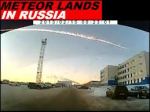
A 10-ton meteor streaked at supersonic speed over Russia’s Ural Mountains on Friday, setting off blasts that injured nearly 1,100 people and frightened countless more.

A meteor streaked across the sky and exploded over Russia’s Ural Mountains with the power of an atomic bomb Friday, its sonic blasts shattering countless windows and injuring about 1,100 people.

The spectacle deeply frightened many Russians, with some elderly women declaring that the world was coming to an end. Many of the injured were cut by flying glass as they flocked to windows, curious about what had produced such a blinding flash of light.

The meteor — estimated to be about 10 tons and 49 feet wide — entered the Earth’s atmosphere at a hypersonic speed of at least 33,000 mph and shattered into pieces about 18-32 miles above the ground, the Russian Academy of Sciences said in a statement. But even small asteroids pack a tremendous punch, explained Andrew Cheng of the Johns Hopkins Applied Physics Laboratory.

“It doesn’t take a very large object. A 10-meter size object already packs the same energy as a nuclear bomb,” Cheng, who led a 2000-2001 mission for NASA to orbit and land on an asteroid, told FoxNews.com.

‘It doesn’t take a very large object. A 10-meter size object already packs the same energy as a nuclear bomb.’

– Andrew Cheng of the Johns Hopkins Applied Physics Laboratory, who led a 2001 mission to orbit and land on an asteroid 

Amateur video showed an object speeding across the sky about 9:20 a.m. local time, just after sunrise, leaving a thick white contrail and an intense flash.

“There was panic. People had no idea what was happening,” said Sergey Hametov, a resident of Chelyabinsk, a city of 1 million about 930 miles east of Moscow.

“We saw a big burst of light, then went outside to see what it was and we heard a really loud, thundering sound,” he told The Associated Press by telephone.

The meteor hit less than a day before Asteroid 2012 DA14 is to make the closest recorded pass of an asteroid to the Earth for a rock of its size — about 17,150 miles. But the European Space Agency said its experts had determined there was no connection — just cosmic coincidence.

The meteor released several kilotons of energy above the region, the Russian science academy said. According to NASA, it was about 15 meters or 49 feet wide before it hit the atmosphere, about one-third the size of the passing asteroid.

SKY FALL: WHEN DO METEORITES STRIKE?

A meteor exploded in the sky above Russia on Friday, causing a shockwave that blew out windows and injured hundreds.

Meteor vs. meteorite: What’s the difference?
Meteors are pieces of space rock, usually from larger comets or asteroids, which enter the Earth’s atmosphere. Many burn up by the heat of the atmosphere; those that strike are called meteorites.

How fast do meteorites go?
They often hit the ground at tremendous speed — up to 18,642 mph. That releases a huge amount of force.

How common are they?
Smaller strikes happen five to 10 times a year. Large impacts are rarer but still occur about every five years. Most of these strikes happen in uninhabited areas where they don’t cause injuries to humans.

Source: AP

Some meteorite fragments fell in a reservoir outside the town of Chebarkul. The crash left a 26-foot-wide crater in the ice.

The shock wave blew in more than 1 million square feet of glass, according to city officials, who said 3,000 buildings in the city were damaged. At one zinc factory, part of the roof collapsed.

The Interior Ministry said about 1,100 people sought medical care after the shock wave and 48 of them were hospitalized. Most of the injuries were caused by flying glass, officials said.

There was no immediate word on any deaths or anyone struck by space fragments.

Meteors typically cause sizeable sonic booms when they enter the atmosphere because they are traveling so much faster than the speed of sound. Injuries on the scale reported Friday, however, are extraordinarily rare.

“I went to see what that flash in the sky was about,” recalled resident Marat Lobkovsky. “And then the window glass shattered, bouncing back on me. My beard was cut open, but not deep. They patched me up. It’s OK now.”

Another resident, Valya Kazakov, said some elderly women in his neighborhood started crying out that the world was ending.

Russian-language hashtags for the meteorite quickly shot up into Twitter’s top trends.

Lessons had just started at Chelyabinsk schools when the meteor exploded, and officials said 258 schoolchildren were among those injured. Amateur video footage showed a teacher speaking to her class as a powerful shockwave hit the room.

Yekaterina Melikhova, a high school student whose nose was bloody and whose upper lip was covered with a bandage, said she was in her geography class when a bright light flashed outside.

“After the flash, nothing happened for about three minutes. Then we rushed outdoors. I was not alone, I was there with Katya. The door was made of glass, a shock wave made it hit us,” she said.

Russian television ran footage of athletes at a city sports arena who were showered by shards of glass from huge windows. Some of them were still bleeding.

Other videos showed a long shard of glass slamming into the floor close to a factory worker and massive doors blown away by the shock wave.

The vast implosion of glass windows exposed many residents to the bitter cold as temperatures in the city were expected to plummet to minus 4 Fahrenheit overnight.

The regional governor immediately urged any worker who can pane windows to rush to the area to help out.

Meteroids are small pieces of space debris — usually parts of comets or asteroids — that are on a collision course with the Earth. They become meteors when they enter the Earth’s atmosphere. Most meteors burn up in the atmosphere, but if they survive the frictional heating and strike the surface of the Earth they are called meteorites.

The site of Friday’s spectacular show is about 3,000 miles west of Tunguska, which in 1908 was the site of the largest recorded explosion of a space object plunging to Earth. That blast, attributed to a comet or asteroid fragment, is generally estimated to have been about 10 megatons; it leveled some 80 million trees.

Scientists believe that a far larger meteorite strike on what today is Mexico’s Yucatan Peninsula may have been responsible for the extinction of the dinosaurs about 66 million years ago. According to that theory, the impact would have thrown up vast amounts of dust that blanketed the sky for decades and altered the climate on Earth.

The meteor could have produced much more serious problems. Chelyabinsk is an industrial town long held to be one of the world’s most polluted areas, and the area around it hosts nuclear and chemical weapons disposal facilities.

Vladimir Chuprov of Greenpeace Russia said the Russian government has underestimated potential risks of the region. He noted that the meteor struck only 60 miles from the Mayak nuclear storage and disposal facility, which holds dozens of tons of weapons-grade plutonium.

A chemical weapons disposal facility at Shchuchye also contains some 6,000 tons of nerve agents, including sarin and VX, about 14 percent of the chemical weapons that Russia is committed to destroy.

The panic and confusion that followed Friday’s meteorite crash quickly gave way to typical Russian black humor and entrepreneurial instincts.

Several people smashed in the windows of their houses in the hopes of receiving compensation, the RIA Novosti news agency reported.

Others quickly took to the Internet and put what they said were meteorite fragments up for sale.

One of the most popular jokes was that the meteorite was supposed to fall on Dec. 21 last year — when many believed the Mayan calendar predicted the end of the world — but was delivered late by Russia’s notoriously inefficient postal service.

The dramatic event prompted an array of reactions from prominent Russians.

Prime Minister Dmitry Medvedev, speaking at an economic forum in the Siberian city of Krasnoyarsk, said the meteor could be a symbol for the forum, showing that “not only the economy is vulnerable, but the whole planet.”

Vladimir Zhirinovsky, a nationalist leader noted for his vehement statements, blamed the Americans.

“It’s not meteors falling. It’s the test of a new weapon by the Americans,” the RIA Novosti news agency quoted him as saying.

Deputy Prime Minister Dmitry Rogozin said the incident showed the need for leading world powers to develop a system to intercept objects falling from space.

“At the moment, neither we nor the Americans have such technologies” to shoot down meteors or asteroids, he said, according to the Interfax news agency.

Jim Green, NASA’s director of planetary science, called the back-to-back celestial events an amazing display.

“This is indeed very rare and it is historic,” he said on NASA TV. “These fireballs happen about once a day or so, but we just don’t see them because many of them fall over the ocean or in remote areas.”


Read more: http://www.foxnews.com/science/2013/02/15/injuries-reported-after-meteorite-falls-in-russia-ural-mountains/?intcmp=trending#ixzz2L0Hecydx

Leave a comment

Filed under Humor and Observations

My Valentines, and 10 Reasons Your Dog is Your Valentine

My valentine is my gorgeous wife Becky of 28 plus years.  This is her on our cruise a few years ago to the Southern Caribbean.  Yes, I married above my station…

my wife


My next valentines are my kids:

Heather in a modeling shoot

Heather in a modeling shoot

Alex in a modeling shoot

Alex in a modeling shoot

Yes, both kids take after their mom for good looks, thank goodness!  Both doing great, both have been professional actors, models, singers and are now pursuing additional careers.

Finally, my dogs are my last three valentines:

tres amigos


Now for the story…

10 Reasons Why My Dog Is My Valentine

The following article was written by Keegan Baur.

Valentine’s Day is the day when we cherish our loved ones and shower them with affection. We each choose a valentine and make every effort to show that special someone just how much we truly appreciate him or her. But who says “that someone” has to be human? For everyone who’s “in love” with a furry, four-legged canine, let’s take a moment to reflect on why we’re so crazy about our dogs.

1. My dog joyously greets me every time I come home.


2. My dog is always in the mood to cuddle.

3. My dog never leaves the toilet seat up.


4. My dog enjoys long walks on the beach.

5. My dog never complains about my cooking.

6. My dog helps me clean up spills in the kitchen.

7. My dog keeps me warm at night and never steals the covers.


8. My dog shares my belief that there’s never a wrong time for a nap.

9. My dog doesn’t fight with me about what show we should watch on TV.


10. My dog loves me unconditionally.

If you’re looking for a “long-term relationship” with a furry friend, please visit your local animal shelter and save a life.

Leave a comment

Filed under Animals, Humor and Observations, Uncategorized

Work Out A Lot?

I know that exercise is good for you.  However, I am not sure how much of a good thing is too much.  Whether they use steroids or just food supplements, I believe these people might have crossed the line.  What do you think?  Pictures of both male and female body builder.  They have muscles I don’t even recognize.

2 Comments

Filed under Humor and Observations

Asteroid Worth $195 Billion!

Earth-buzzing asteroid worth $195 billion, space miners say

By Mike Wall

Published February 13, 2013

Space.com

  • asteroid-art-130211

    An artist’s conception of the Feb. 15 flyby of asteroid 2012 DA14. (NASA.)

  • asteroid-path-130211

    This graphic shows 2012 DA14’s path past Earth. (NASA.)

The space rock set to give Earth a historically close shave this Friday, Feb. 15, may be worth nearly $200 billion, prospective asteroid miners say.

The 150-foot-wide asteroid 2012 DA14 — which will zoom within 17,200 miles of Earth on Friday, marking the closest approach by such a large space rock that astronomers have ever known about in advance — may harbor $65 billion of recoverable water and $130 billion in metals, say officials with celestial mining firm Deep Space Industries. 

‘While this week’s visitor isn’t going the right way for us to harvest it, there will be others that are.’

– Deep Space chairman Rick Tumlinson 

That’s just a guess, they stressed, since 2012 DA14’s composition is not well known and its size is an estimate based on the asteroid‘s brightness.

The company has no plans to go after 2012 DA14; the asteroid’s orbit is highly tilted relative to Earth, making it too difficult to chase down. But the space rock’s close flyby serves to illustrate the wealth of asteroid resources just waiting to be extracted and used, Deep Space officials said. [Deep Space Industries’ Asteroid-Mining Vision in Photos]

“While this week’s visitor isn’t going the right way for us to harvest it, there will be others that are, and we want to be ready when they arrive,” Deep Space chairman Rick Tumlinson said in a statement Tuesday.

Deep Space Industries wants to use asteroid resources to help humanity expand its footprint out into the solar system. The company plans to convert space rock water into rocket fuel, which would be used to top up the tanks of off-Earth satellites and spaceships cheaply and efficiently.

Asteroidal metals such as iron and nickel, for their part, would form the basis of a space-based manufacturing industry that could build spaceships, human habitats and other structures off the planet.

The idea is to dramatically reduce the amount of material that needs to be launched from Earth, since it currently costs at least $10 million to send 1 ton of material to high-Earth orbit, officials said.

“Getting these supplies to serve communications satellites and coming crewed missions to Mars from in-space sources like asteroids is key if we are going to explore and settle space,” Tumlinson said.

Deep Space Industries is just one of two asteroid-mining firms that have revealed their existence and intentions in the past 10 months. The other is Planetary Resources, which has financial backing from billionaires such as Google execs Larry Page and Eric Schmidt.

Deep Space aims to launch a phalanx of small, robotic prospecting probes called Fireflies in 2015. Sample-return missions to potential targets would occur shortly thereafter, with space mining operations possibly beginning around 2020.

Planetary Resources also hopes its activities open the solar system up for further and more efficient exploration. The company may launch its first low-cost prospecting space telescopes within the next year or so.

Read more: http://www.foxnews.com/science/2013/02/13/earth-buzzing-asteroid-worth-195-billion/?intcmp=features#ixzz2KpTMk900

1 Comment

Filed under Humor and Observations

Extinct date palm sprouts after 2,000 years

Seed of extinct date palm sprouts after 2,000 years

Matthew Kalman, Chronicle Foreign Service
Published 4:00 am, Sunday, June 12, 2005
  • Kibbutz Katura, Israel: June 9, 2005: The date tree (center) that was succesfully germenated from a 2000 year old seed found on the ancient Jewish Archeological site of Masada. Photo by David Blumenfeld/Special to The Chronicle Photo: David Blumenfeld/Special To The
    Kibbutz Katura, Israel: June 9, 2005: The date tree (center) that was succesfully germenated from a 2000 year old seed found on the ancient Jewish Archeological site of Masada. Photo by David Blumenfeld/Special to The Chronicle Photo: David Blumenfeld/Special To The


2005-06-12 04:00:00 PDT Kibbutz Ketura, Israel — It has five leaves, stands 14 inches high and is nicknamed Methuselah. It looks like an ordinary date palm seedling, but for UCLA- educated botanist Elaine Solowey, it is a piece of history brought back to life.

Planted on Jan. 25, the seedling growing in the black pot in Solowey’s nursery on this kibbutz in Israel’s Arava desert is 2,000 years old — more than twice as old as the 900-year-old biblical character who lent his name to the young tree. It is the oldest seed ever known to produce a viable young tree.

The seed that produced Methuselah was discovered during archaeological excavations at King Herod‘s palace on Mount Masada, near the Dead Sea. Its age has been confirmed by carbon dating. Scientists hope that the unique seedling will eventually yield vital clues to the medicinal properties of the fruit of the Judean date tree, which was long thought to be extinct.

Solowey, originally from San Joaquin (Fresno County), teaches at the Arava Institute for Environmental Studies at Kibbutz Ketura, where she has nurtured more than 100 rare or near-extinct species back to life as part of a 10-year project to study plants and herbs used as ancient cures.

In collaboration with the Louis L. Borick Natural Medicine Center at Hadassah Hospital in Jerusalem, named in honor of its Southern California- based benefactor, Solowey grows plants and herbs used in Tibetan, Chinese and biblical medicine, as well as traditional folk remedies from other cultures to see whether their effectiveness can be scientifically proved.

In experiments praised by the Dalai Lama, for example, Borick Center Director Sarah Sallon has shown that ancient Tibetan cures for cardiovascular disease really do work.

The San Francisco Chronicle was granted the first viewing of the historic seedling, which sprouted about four weeks after planting. It has grown six leaves, but one has been removed for DNA testing so scientists can learn more about its relationship to its modern-day cousins.

The Judean date is chronicled in the Bible, Quran and ancient literature for its diverse powers — from an aphrodisiac to a contraceptive — and as a cure for a wide range of diseases including cancer, malaria and toothache.

For Christians, the palm is a symbol of peace associated with the entry of Jesus into Jerusalem. The ancient Hebrews called the date palm the “tree of life” because of the protein in its fruit and the shade given by its long leafy branches. The Arabs said there were as many uses for the date palm as there were days in the year.

Greek architects modeled their Ionic columns on the tree’s tall, thin trunk and curling, bushy top. The Romans called it Phoenix dactylifera — “the date-bearing phoenix” — because it never died and appeared to be reborn in the desert where all other plant life perished.

Now Solowey and her colleagues have brought this phoenix of the desert back to life after 2,000 years.

The ancient seeds were found 30 years ago during archeological excavations on Mount Masada, the mountaintop fortress on the shore of the Dead Sea where King Herod built a spectacular palace. When the Romans conquered Palestine and laid waste to the Temple in Jerusalem, Masada was the last stand of a small band of Jewish rebels who held out against three Roman legions for several years before committing mass suicide in A.D. 73.

Archaeologist Ehud Netzer found the seeds, which were identified by the department of botanical archaeology at Israel’s Bar-Ilan University. Then they were placed in storage, where they lay for 30 years until Sallon heard about the cache.

“When we asked if we could try and grow some of them, they said, ‘You’re mad,’ but they gave us three seeds,” she said.

Read more: http://www.sfgate.com/news/article/Seed-of-extinct-date-palm-sprouts-after-2-000-2628668.php#ixzz2KrQSUEBx

Leave a comment

Filed under Humor and Observations

More Cosplay Photos

This is a recurring post because I have so many friends in the cosplay community, and I too dress up in Steampunk attire, though none too well.  Hard to look good as a pudgy middle aged man, but what to do?  Anyway, enjoy the creativity below.  Again, if you do not know what cosplay is, it is Costume Play, which means anything from dressing up on non-Halloween nights, going to conventions, dressing as your favorite character, or even a subculture lifestyle.  It embraces everything from comics, manga, steampunk, sci-fi, video games, even to fetish themes, which I try not to put too much of on here to keep it PG.  Enjoy:

8 Comments

Filed under Humor and Observations

Metal Armor Suits from WW1

Hard to believe that in the age of mustard gas, maxim machine guns, trench warfare and heavy artillery, even the birth of the airplane, people still used armor.  However, not so different than our modern day helmets, kevlar and bullet proof vests, or modern bomb disposal gear.  Still, for some reason these old, authentic photos, hold a chill and a bit of the surreal dieselpunk feel to them.  Thanks to vio9, Chris Wild and the Retronaut for these pictures.

WWI:
Armour

Leave a comment

Filed under Humor and Observations

3d printing of guns – update

As followers know, I have said that 3d printing will change everything as we know it.  In an earlier post, I discussed how guns can be printed, and another post talks about how the military uses 3d printing for making knives and other tools.  Here is an update on this revolutionary technology:

Print and fire: 3D printing could muzzle new gun laws

By 

Published February 13, 2013

FoxNews.com

  • gunclip2.jpg

    Cody Wilson of Defense Distributed testing out the “Cuomo Clip” (DefenseDistributed.com)

  • gunclip3.jpg
    DefenseDistributed.com
  • gunclip4.jpg
    DefenseDistributed.com
  • gunclip1.jpg

    A computer rendering of a “Cuomo Clip”, a 30-round ammo magazine for the AR-15 rifle. (DefenseDistributed.com)

Gun owners who can’t buy high capacity ammo magazines because of new laws have another option: Print them.

Gun control measures passed or proposed in the wake of the Sandy Hook school massacre have targeted magazines that can feed 30 rounds or more into the firing chambers of AR-15s and other semi-automatic guns. New York has banned magazines holding more than seven rounds, and a federal bill proposed by Sen. Dianne Feinstein, D-Calif., would ban magazines holding more than 10 rounds.

But the laws are at least one step behind technology. Using 3D printers and schematics available on the Internet, gun owners can manufacture a fully functional, plastic magazine clip. Plans are free, although getting access to a 3D printer may prove expensive, at least for now.

“If you can download it, you can have it.”

– Cody Wilson, Defense Distributed/Wiki Weapons Project 

“If you can download it, you can have it,” said University of Texas law student Cody Wilson, who is part of Defense Distributed, a group that has created the design for what they refer to as a “Cuomo Clip” along with other gun parts. It is all under an initiative they refer to as the Wiki Weapon Project.

“It’s basically to head them [legislators] off at the pass, which we have,” Wilson added, noting that “hundreds of thousands” of visitors have gone to his group’s site to download the CAD file for the ammo magazine since it was first posted in mid-January.

The “Cuomo Clip,” named for New York Gov. Andrew Cuomo, who pushed the high-capacity clip ban through the Legislature, is made from a plastic filament similar to the type of material used to manufacture LEGO building blocks. It is also loaded with a large spring that helps to push rounds of ammo into the gun chamber.

The ammo magazine clip appears to be durable; Defense Distributed test-fired 86 rounds from a 30-round prototype last month, and the clip showed no signs of damage.

The cutting edge technology, in which three-dimensional objects can be manufactured from melted plastic thread, is likely to complicate efforts to control firearms. No such ability existed in 1994, when large-capacity clips were first banned in an initial federal assault weapons ban that lasted a decade.

Although the new ban proposed by Feinstein would prohibit the manufacture of magazines, it focuses on traditional arms makers and sellers. How the law might be enforced against individuals making their own magazines — and possibly even guns in the future — is unclear.

Rep. Steve Israel, D-N.Y., has called for amending the Undetectable Firearms Act of 1988, which initially sought to ban guns that could be sneaked through metal detectors, to include a ban on “homemade, 3-D printed, plastic high-capacity magazines.”

“Congress passed a law banning plastic guns for two decades when they were just a movie fantasy,” Israel told FoxNews.com. “With the advent of 3-D printers, these guns are suddenly a real possibility, and the law Congress passed is set to expire this year.

“We should act now to give law enforcement authorities the power to stop the development of these weapons before terrorists and criminals can easily bring them on planes. We need to be proactive and keep ahead of the technology. When the legislation was originally passed in 1988, no one would have imagined that parts of a gun and a magazine could be made with a printer — imagine what the technology will be even five years down the road.”

Defense Distributed and the Wiki Weapons Project also has made schematics of other parts of the AR-15 and other weapons and modifications, including pistol grips, but has avoided attempting to design and distribute plans for a fully-functional gun.

Read more: http://www.foxnews.com/tech/2013/02/13/print-draw-fire-3d-printing-could-muzzle-new-gun-laws/#ixzz2KoiE5x24

Leave a comment

Filed under Humor and Observations

The Immediate Impact of the Telephone on New York

The Immediate Impact of the Telephone on New York

“In 1875 Alexander Graham Bell invented the telephone and in 1878 the first telephone was installed in Madison by Richard Johnson. It connected his home, the Johnson Starch Factory and the J. M. & I Railroad depot. It was a convenience for him and, by all accounts, a source of amusement for his family, especially his young daughter who took every opportunity to sing to people on the other end of the line.” – History Rescue Project

So, new tech invented in 1875, installed three years later, first person to use it extensively was a young girl.  Sound familiar?  The amazing thing is what happened next.  One decade later, the pictures below show what New York City looked like with the telephone wires installed in less than ten years.

Telephone Wires over New York

c. 1887-1888:

Leave a comment

Filed under Humor and Observations

Sunken Cities Of The Ancient World

Sunken Cities Of The Ancient World

AUGUST 2, 2011

Though finding Atlantis may still be a pipe dream, these cities, long submerged in the depths of their surrounding oceans, provide enough mystery and wonder to whet your imaginations.

Cleopatra’s Kingdom, Alexandria, Egypt

we4Md Sunken Cities Of The Ancient World

Lost for 1,600 years, the royal quarters of Cleopatra were discovered off the shores of Alexandria. A team of marine archaeologists, led by Frenchman, Franck Goddio, began excavating the ancient city in 1998. Historians believe the site was submerged by earthquakes and tidal waves, yet, astonishingly, several artifacts remained largely intact. Amongst the discoveries were the foundations of the palace, shipwrecks, red granite columns, and statues of the goddess Isis and a sphinx. The Egyptian Government plans to create an underwater museum and hold tours of the site.

1uj3n Sunken Cities Of The Ancient World

dUZYr Sunken Cities Of The Ancient World

HAosg Sunken Cities Of The Ancient World

FZjVQ Sunken Cities Of The Ancient World

Bay of Cambay, India

XmnGi Sunken Cities Of The Ancient World

The Bay of Cambay was discovered by marine scientists in early 2002. The city is located 120 feet underwater in the Gulf of Cambay off the western coast of India. The city is five miles long and two miles wide, carbon dating estimates the site to be a whopping 9,500 years old, and, more amazingly, architectural and human remains are still intact. The discovery astounded scientists because it predates all other finds in the area by 5,000 years, suggesting a much longer history of the civilization than was first assumed. Marine scientists used sonar images and sum-bottom profiling to locate the lost ruins and it is believed the area was submerged when the ice caps melted in the last Ice Age. The Indian nationals have dubbed the find ‘Dwarka’ (The Golden City) in honor of ancient submerged city said to belong to Hindu god, Krishna.

Dpyxp Sunken Cities Of The Ancient World

Port Royal, Jamaica

NAs6L Sunken Cities Of The Ancient World

Once referred to as the ‘Wickedest City on Earth’ (because of its rampant piracy, prostitution and rum consumption), part of Port Royal sank after an earthquake in 1692. The ruins scattered in the Kingston Harbor, and currently, the remains of the city encompasses 13 acres at depths of up to 40 feet. Archaeological investigations of the site began in 1981, led by the Nautical Archaeology Program of Texas A&M University. The investigations unearthed historical documents, organic artefacts and vast amount of architectural debris.

YnukN Sunken Cities Of The Ancient World

Yonaguni-Jima, Japan

YXMyc Sunken Cities Of The Ancient World

Some 68 miles past the east coast of Taiwan, off the coast of Yonaguni Islands, a sunken ruin was discovered by a sport diver, in 1995. The ruins are estimated to be around 8,000 years old, however, it is still unclear which missing city they made up. The most spectacular discovery amongst the submerged ruins is a large pyramid structure, finely designed archways resembling the Inca civilization, staircases and hallways, and carved stones.

Nvw7n Sunken Cities Of The Ancient World

y8LS3 Sunken Cities Of The Ancient World

v0YLc Sunken Cities Of The Ancient World

Baiae and Portus Julius, Italy

gJ7nJ Sunken Cities Of The Ancient World

Baiae was an ancient Roman town overlooking the Bay of Naples, where rich Romans and emperors whiled away their time in their villas. It was also connected to the Roman Empire’s biggest naval base, Portus Julius. However, the town and port were built on a tract of volcanic land, the activity of which is said to have caused the structure to collapse into the ocean.

AXmaR Sunken Cities Of The Ancient World

w6Mvn Sunken Cities Of The Ancient World

Pavlopetri, Greece

5vM1k Sunken Cities Of The Ancient World

The ruins of the ancient Mycenaean town of Pavlopetri date back to the Neolithic period (2,800 BC), and unveil a cultural hub of ancient Greece. The submerged city was discovered three to four metres off the coast of southern Laconia, and has many intact buildings, courtyards, streets, chamber tombs and graves. Pavlopetri was believed to be a thriving harbour town and sheds light on many mysteries of the Mycenaean civilization.

YeSUj Sunken Cities Of The Ancient World

KlKb0 Sunken Cities Of The Ancient World

YZ7vg Sunken Cities Of The Ancient World

Leave a comment

Filed under Humor and Observations