Monthly Archives: May 2013

1850 Steampunk…

c. 1850:Ambrotype of an Ojibwa Man wearing western dress and snow goggles

1 Comment

Filed under Humor and Observations

Who Has The Fastest Space Vehicle?

Star Trek, Star Wars, Firefly, Dr. Who… Who has the fastest space travel?  Who indeed…

Science-Fiction-Spaceship-Comparison-Infographic-2

If you click this link, they let you race the various ships across space to find out.

http://www.slate.com/articles/arts/map_of_the_week/2013/05/star_trek_enterprise_vs_star_wars_millennium_falcon_which_ship_is_fastest.html

From Slate.com:

Star Trek is all about interstellar travel. It’s right there in the title. “Warp 6!” or “Warp 9!” captains bark, sometimes following with a pedantic “point four” and punctuating with a “do it!” or “punch it!” or “engage!”  The numbers give the impression of a well-defined system of speed, but that’s misleading, and in this regard Star Trek is a good example of a recurring theme in popular science fiction: the obfuscation of distance and speed. When characters need to get from Point A to Point B with a speed that seems to defy existing rules, science fiction invents wormholes or slipstreams or other anomalies or allows captains to “risk” the ship by pushing it to a speed at which “she can’t take much more of this!” Or, worse, writers simply ignore the rules and leave it to fans, struggling to make sci-fi as real as possible, to explain away the inconsistencies for themselves in so many forums and wiki discussion pages.

It’s a little odd that a genre about science, the field of precision, can be so imprecise. The truth is that spaceships almost always fly at the speed of the plot. But, for those who refuse to accept that, this is a definitive guide to ship speeds, based on highly scientific computer simulations and highly unscientific speculation.

Enterprise: Nerds at Memory Alpha, the Star Trek wiki, have already arrived at a sprawling explanation that employs multiple warp scales associated with different eras of Star Trek’s fictitious history. The short version: As determined by a writers’ guide for the original series, theEnterprise of the original series, going at maximum, slightly unsafe warp, can reach Alpha Centauri in about three days. Although this conflicts with the apparently short trip the ship takes from Earth to Vulcan in Star Trek (2009), we’ll defer to the original series on this one. Later ships are faster, but even Voyager, one of the fastest Federation ships in the Star Trek universe, expected to take several decades to cross the galaxy and return home.

Millennium Falcon:  When Luke and Obi Wan first meet Han Solo in Mos Eisely, the first thing the smuggler does is brag about his ship. “You’ve never heard of the Millennium Falcon?” Han asks. That’s when A New Hope makes its infamous technical blunder. “It’s the ship that made the Kessel Run in less than 12 parsecs,” Han says. A parsec is, of course, a unit of distance, not time. Unfortunately, even the elaborate explanationof later material offers no more clues about the Millennium Falcon’s actual speed than the original flub. “She’ll make point five past light speed,” Han will later brag, but what does that mean? It certainly doesn’t mean 1.5 times the speed of light speed, because it would still take the ship several years to move between stars.

The Skywalker gang travels from Tatooine to where Alderaan is supposed to be in a matter of hours at the most, and the two planets, if this star chart is to be believed, are half a galaxy apart—though that wouldn’t jibe with a Star Wars role-playing book that suggests it would take several months to cross the galaxy. Crossover comics notwithstanding, the characters never make voyages to other galaxies, though this is apparently due to a disturbance at the edge of the galaxy. And a question I posed to the Star Wars subreddit yielded mixed answers.

Here’s my conclusion: In the films, the characters travel among Tatooine, Alderaan, Yavin, Hoth, Dagobah, Bespin, Naboo, Coruscant, Mustafar, and Geonosis, and never does it seem as if months or even weeks have passed. Every time a Star Wars character travels, it appears no more than the Star Wars equivalent of a short road trip, so we’ll conclude, assuming Han can get the hyperspace engine working, that the Millennium Falcon could reach the galactic center in mere minutes.

TARDIS: “All of time and space; everywhere and anywhere; every star that ever was,” the Eleventh Doctor says in a trailer for Series 5. In the 797 episodes of all the series, the TARDIS is seen at times instantly rematerializing in new galaxies or universes or times, usually accompanied with its signature noise. At others, it hurtles through space or chases down cars. We’re going to stick with its fastest mode of travel and assume it can travel to any place and any time, virtually instantaneously.

Planet Express Ship: The Planet Express Ship’s dark matter drive, which pulls the universe around it at 200 percent fuel efficiency, allows it to routinely make trips to other galaxies, such as the Galaxy of Terror, as well as, on one “morning off,” the edge of the universe. Its regular intergalactic flights make it easily one of the speediest ships in science fiction.

Heart of Gold: The Heart of Gold runs on the infinite improbability drive, which, according to The Hitchhiker’s Guide to the Galaxy, is “a wonderful new method of crossing vast interstellar distances in a mere nothingth of a second.” The only caveat: “you’re never sure where you’ll end up or even what species you’ll be when you get there.”

Jupiter 2: The ship of the lost Robinson family was to reach Alpha Centauri in 5.5 years, according to the aired pilot.

Serenity: Travel in the Verse is strictly interplanetary. A production manual suggested Malcolm Reynolds’ Firefly-class ship takes 16 days to travel one astronomical unit, or the distance between the Earth and the sun, although whether this is canonical is debatable. Material tied to theSerenity Role Playing Game suggests the planets of the Verse are arrayed among four very close stars that span, if this “Complete and Official Map of the Verse” is to be believed, a couple of hundred AU. Even with Wash at the helm, Kaylee in the engine room, and Malcolm spouting Chinese curses the whole way, Serenity would need a few decades to travel to another star system.

Battlestar GalacticaGalactica travels through space skipping from one location to another in instant jumps of a few light-years. The maximum range of each jump is obscure, but seems to be about 16 “Colonial light-years,” which I’m going to equate to light-years over the objections of possibly hundreds of nerds. The duration of the cool-down period is similarly elusive, but it’s “brief,” so let’s say five minutes. That’s about 4,600 light-years in a day, which means, excluding any structural damage to the ship, Galactica can travel to center of the galaxy in about six days doing one jump after another, with Cylons on their heels the whole way.

Voyager 1: The real-world space probe, launched in 1977, is traveling away from the sun at 38,600 miles per hour. That’s about 0.00005 light-years per year. If the probe were heading in the direction of Alpha Centauri, it would take several thousand years to arrive.


4 Comments

Filed under Humor and Observations

Anniversary of the First U.S. Speeding Ticket in 1899

First U.S. speeder caught on this date in 1899

By Antony Ingram

Published May 20, 2013

High Gear Media

  • first-ticket-660.jpg

    Electric Vehicle Company taxis in NYC (NYPL)

Speeding is big business. There’s no money to be made from it as an individual of course, unless you subscribe to the theory “time is money”.

But the U.S. Census Bureau estimates 100,000 Americans are ticketed for speeding every day, at an average cost of $150 per ticket–$5.5 billion a year in revenue.

There’ll only ever be one “first” speeding offense though, and you might be surprised to learn that it was for an electric car.

It was also a taxi driver, which you’ll be less surprised about. And a taxi driver in New York at that. “Get outta here,” you shout at the computer screen, reaching for the Ritalin.

Way back on May 20, 1899, taxi driver Jacob German was caught doing a heady 12 mph down Lexington Street in Manhattan. Caught both figureatively and literally, as a bicycle-mounted police officer clocked Mr German at the illegal speed and set off in pursuit.

Today I Found Out says the limit at the time was a more sedate 8 mph, or 4 mph around corners. Perhaps, as many electric drivers today have discovered, the relative silence of electric running leads to rather higher speeds than you’re expecting.

Reports seem to suggest the reckless Mr German didn’t receive a paper ticket though–that honor going to a Mr Myers of Dayton, Ohio in 1904, according to Ohio History Central–and instead spent some time behind bars.

Mr German drove for the Electric Vehicle Company, which ran taxis throughout New York. In fact, electric taxis were incredibly common back in 1899–Today I Found Out also reveals that 90 percent of NYC taxis were electric back in those days.

The period holds other significance for electric cars, too. Just one year earlier the first land-speed record was set by Gaston de Chasseloup-Laubat in an electric car.

We can’t imagine what that police officer would have thought of Gaston’s 39.24 mph speed, though…

Read more: http://www.foxnews.com/leisure/2013/05/20/first-us-speeder-caught-on-this-date-in-18/?intcmp=features#ixzz2Ttrjfhpo

1 Comment

Filed under Humor and Observations

KWOD Radio Interview at Phoenix ComicCon 2013

Patti Hulstrand, the host of KWOD radio is broadcasting live from Phoenix ComicCon 2013.  She will be interviewing many bright stars among movie actors, TV actors, and great authors.  Then…after she interviews those people, she has been gracious enough to add me to the list as well.  I have appeared on her radio show once before and she was a gracious and captivating host.  I will likely be discussing the new anthology, Twisted Nightmares, just out last week in print form.

My new picture

Michael Bradley, Author

Remember, you can stop by booth #1629 at Phoenix ComicCon 2013 to say hello and get your autographed copy, right off the presses.  Thanks to Patti Hulstrand and all of you who give me your time and support.  It is much appreciated.

T-Nightmares-Cover

Leave a comment

Filed under Humor and Observations, Writing

Could humans be cloned?

Could humans be cloned?

By Rachael Rettner

Published May 19, 2013

LiveScience

  • Battlestar Galactica cylons.jpg

    Actresses Tricia Helfer (left) and Grace Park (right), who played humanoid Cylons with countless clones on the TV show “Battlestar Galactica.” (Syfy)

  • Egg nucleus transfer final.jpg

    The first step during SCNT is enucleation or removal of nuclear genetic material (chromosomal) from a human egg. An egg is positioned with holding pipette (on the left) and egg’s chromosomes are visualized under polarized microscope. A hole is made in the egg’s shell (zone pellucida) using a laser and a smaller pipette (on the right) is inserted through the opening. The chromosomes then sucked in inside the pipette and slowly removed from the egg. (Cell, Tachibana et al.)

The news that researchers have used cloning to make human embryos for the purpose of producing stem cells may have some people wondering if it would ever be possible to clone a person.
Although it would be unethical, experts say it is likely biologically possible to clone a human being. But even putting ethics aside, the sheer amount of resources needed to do it is a significant barrier.

Since the 1950s when researchers cloned a frog, scientists have cloned dozens of animal species, including mice, cats, sheep, pigs and cows.

‘It’s grossly unethical.’

– Dr. Robert Lanza, chief scientific officer at the biotech company Advanced Cell Technology 

In each case, researchers encountered problems that needed to be overcome with trial and error, said Dr. Robert Lanza, chief scientific officer at the biotech company Advanced Cell Technology, which works on cell therapies for human diseases, and has cloned animals.

With mice, researchers were able to use thousands of eggs, and conduct many experiments, to work out these problems, Lanza said. “Its a numbers game,” he said.

But with primates, eggs are a very precious resource, and it is not easy to acquire them to conduct experiments, Lanza said.

In addition, researchers can’t simply apply what they’ve learned from cloning mice or cows to cloning people.

For instance, cloning an animal requires that researchers first remove the nucleus of an egg cell. When researchers do this, they also remove proteins that are essential to help cells divide, Lanza said. In mice, this isn’t a problem, because the embryo that is ultimately created is able to make these proteins again. But primates aren’t able to do this, and researchers think it may be one reason that attempts to clone monkeys have failed, Lanza said. [See How Stem Cell Cloning Works (Infographic)]

What’s more, cloned animals often have different kinds of genetic abnormalities that can prevent embryo implantation in a uterus, or cause the fetus to spontaneously abort, or the animal to die shortly after birth, Lanza said.

These abnormities are common because cloned embryos have just one parent rather than two, which means that a molecular process known as “imprinting” does not occur properly in cloned embryos, Lanza said. Imprinting takes place during embryo development, and selectively silences certain genes from one parent or the other.

Problems with imprinting can result in extremely large placentas, which ultimately leads to problems with blood flow for the fetus, Lanza said. In one experiment, Lanza and colleagues cloned a species of cattle called banteng, and it was born at twice the size of a normal banteng. It had to be euthanized, Lanza said.

The extremely high rate of death, and the risk of developmental abnormities from cloning makes cloning people unethical, Lanza said.

“It’s like sending your baby up in a rocket knowing there’s a 50-50 chance it’s going to blow up. It’s grossly unethical,” Lanza said.

Read more: http://www.foxnews.com/science/2013/05/19/could-humans-be-cloned/#ixzz2TnzBJH7Y

Leave a comment

Filed under Humor and Observations

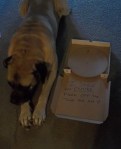
Dog Shaming for Your Monday Blues

I have posted these before and they seem to be very popular, so here we go again.  Pictures of a dog shaming, where people have the culprit with a sign describing their crime.  Enjoy!

1 Comment

Filed under Animals, Humor and Observations

Flags Made from Country’s Food

You will need to click the flags to see the complete picture.


1

AUSTRALIA - Meat pie, sauce
3
CHINA - Pittaya/dragon fruit and star fruit
4
FRANCE - Blue cheese, brie, grapes
5
GREECE - Kalamata olives and feta cheese
6
INDIA - Curries, rice, pappadum wafer
7
INDONESIA - Spicy curries and rice (Sambal)
8
ITALY - Basil, pasta, tomoatoes
9
JAPAN - Tuna and rice

10

LEBANON - Lavash, fattoush, herb spring
11
SOUTH KOREA - Kimbap and sauces
12
SPAIN - Chorizo and rice
13
VIETNAM - Rambutan, lychee, starfuit
14
SWITZERLAND - Charcuteries and emmental
15
THAILAND - Sweet chilli sauce, shredded coconut, blue swimmer crab
16
TURKEY - Turkish Delight (Lokum)
17
UNITED KINGDOM - Scone, cream, jams
18
UNITED STATES - Hot dogs, ketchup and mustard

3 Comments

Filed under Humor and Observations, Uncategorized

Teenager Finds Viking Coins

Danish teenager makes rare Viking-era find with metal detector

Published May 16, 2013

Associated Press

  • Denmark Viking Find 2013.jpg

    Coins from Bohemia, Germany, Denmark and England discovered during an archaeological dig last year, some of 365 items from the Viking era. Danish National Museum spokesman Jens Christian Moesgaard says the coins have a distinctive cross motif attributed to Norse King Harald Bluetooth, who is believed to have brought Christianity to Norway and Denmark. (AP Photo/Polfoto/Stokke Brothers)

  • Denmark Viking Find 2013 1.jpg

    A pendant necklace in silver of Thor’s Hammer discovered during an archaeological dig last year, one of 365 items from the Viking era, including 60 rare coins. (AP Photo/Polfoto/Stokke Brothers)

COPENHAGEN, Denmark –  Danish museum officials say that an archaeological dig last year has revealed 365 items from the Viking era, including 60 rare coins.
Danish National Museum spokesman Jens Christian Moesgaard says the coins have a distinctive cross motif attributed to Norse King Harald Bluetooth, who is believed to have brought Christianity to Norway and Denmark.

Sixteen-year-old Michael Stokbro Larsen found the coins and other items with a metal detector in a field in northern Denmark.

Stokbro Larsen, who often explores with his detector, said he is often laughed at because friends find him “a bit nerdy.”

Moesgaard said Thursday that it was the first time since 1939 that so many Viking-era coins have been found, calling them “another important piece in the puzzle” of history.

Read more: http://www.foxnews.com/science/2013/05/16/teenager-rare-viking-era-find-metal-detector/#ixzz2Tlao6A2i

1 Comment

Filed under Humor and Observations

Writing Realistic Injuries (warning: graphic images)

Don’t you hate seeing people in action movies always hit in the arm or the leg and they just soldier on and kill the bad guys?  Who among us can take a slug to the arm and leg and not react? Writing realistic injuries is very important to me.  I have a guy hit in the arm in one of my novels.  He gets infected and barely survives after an emergency amputation.  Real people, no matter how heroic, succumb to blood loss and shattered bones with shock or at least limited ability to function.

The so-called flesh wound is no fun at all.  If it hit bone or an organ, you will die right away, or slowly from infection and gangrene.  If it just hits flesh, you have a terrible jagged tear, full of bacteria, blood loss and pain.  Just think about the last time you had surgery, or even had a tooth filling.  Without any pain medicine or treatment would you just laugh that off?  I think not.  As an author, I have to be true to the scene.  Sometimes that means a favorite character loses a limb, an eye, has months to recuperate, or even gets vaporized.  It is not fun to realize your story needs carnage to those you have grown to love, but it is worse to have them miraculously survive.

Later I can talk about the .38 snub nose shooting someone off a ten story roof, or the machine gun firing 100 rounds at point blank and missing the hero…

There is a very helpful link below, but first, two pictures, a bit grisly, of real gunshot “flesh wounds” to demonstrate you might want to make them a bit more serious in your stories:

Shoulder Flesh Wound

Shoulder Flesh Wound

Forearm Flesh Wound

Forearm Flesh Wound


Here is a great link to very detailed analysis of properly writing realistic injuries:

http://www.stumbleupon.com/su/7RMh43/:16YPDdasi:Tj+VIpVd/www.users.totalise.co.uk/~leiafee/ramblings/realistic_injuries.htm/

Writing Realistic Injuries
By Leia Fee, with additions by Susannah Shepherd

Quick Contents

Introduction
General remarks
What’s  normal?
Reactions to injury – including emotional reactions, fainting and shock.
Minor injuries – such as bruises, grazes and sprains
Head injuries – from  black eyes to severe concussions
Broken bones
Dislocated joints
Cutting and Piercing – for various locations, including blood loss symptoms and figures.
Blunt trauma – getting hit, internal injuries.
Burns – including electrical burns
Hostile environments – such as extreme cold and heat, oxygen deprivation and exposure to vacuum.
References – useful websites.

4 Comments

Filed under Writing

1868 Steam Robot

Steampunk was just steam technology in the late 1800’s.   Many inventions are somewhat lost to us today.  The authors HG Wells and Jules Verne were writing science fiction, which is now steampunk science fiction.  The first rebirth of steampunk writing was a serial based on a boy who builds a steam powered man to pull a wagon to the west where they fight Indians and make their fortune, returning home in triumph.  These stories were very popular in the 1920’s and 1930’s in America.  This shows that as early as 1868, such an invention actually existed.  If petroleum was not discovered as an energy source, who knows what cool technology we would have developed with steam and hydraulics?

1868:

Steam Robot

“Zadoc P. Dederick, along with Isaac Grass, was the creator of a steam-powered human-like robot designed to pull a cart.”

7 Comments

Filed under Humor and Observations