Monthly Archives: October 2013

Astronauts see strange cloud in space

Astronauts see strange cloud in space, remnant of missile launch

By Miriam Kramer

Published October 15, 2013

  • hopkins-twitter-iss-photo-cloud.jpg

    Oct. 10, 2013: NASA Astronaut Mike Hopkins took this photo from the International Space Station. “Saw something launch into space today. Not sure what it was but the cloud it left behind was pretty amazing,” the Expedition 37/38 Flight Engineer tweeted.(MIKE HOPKINS (VIA TWITTER AS @ASTROILLINI))

  • missile-launch-parmitano-iss.jpg

    Oct. 11, 2013: Astronaut Luca Parmitano of Italy tweeted this photo of a missile launch seen from the International  Space Station.(LUCA PARMITANO (VIA TWITTER AS @ASTRO_LUCA))

Astronauts on the International Space Station have beamed home photos of an eerie space cloud outside their orbital home, a strange sight apparently created by a recent missile launch.

The astronaut photos were captured on Oct. 10 by NASA astronaut Mike Hopkins and European Space Agency astronaut Luca Parmitano who took to Twitter under their pen names (@AstroIllini and @astro_luca, respectively) to share the unnatural looking space cloud formation with Earth.

“Saw something launch into space today,” Hopkins wrote. “Not sure what it was but the cloud it left behind was pretty amazing.” At first, Hopkins wasn’t sure what created the odd looking cloud outside the window of the orbiting laboratory, but Parmitano cleared up the confusion with a Twitter post of his own. [Amazing Space Photos by Astronaut Luca Parmitano]

“A missile launch seen from space: an unexpected surprise!” Parmitano wrote in a post on Oct. 11. One of the Italian astronaut’s photos shows a curving contrail left in the missile’s wake and another features a wispy cloud formed in space after the missile disintegrated.

Russia’s Strategic Rocket Forces launched the missile, according to a blog post on RussianForces.org. The Topol/SS-25 missile launched from Kapustin Yar to the Sary Shagan test site in Kazakhstan.

“According to a representative of the Rocket Forces, the test was used to confirm characteristics of the Topol missile, to test the systems of the Sary Shagan test site, and ‘to test new combat payload for intercontinental ballistic missiles,'” RussianForces.org wrote on Oct. 10.

Russia also conducted a similar test from Kapustin Yar to Sary Shagan in June 2012, RussiaForces.org said.

Parmitano and Hopkins are joined by four other spaceflyers on the International Space Station. NASA’s Karen Nyberg and Russian cosmonauts Fyodor Yurchikhin, Oleg Kotov and Sergey Ryazanskiy round out the Expedition 37 crew. Ryazanskiy, Hopkins and Kotov launched to the station at the end of September. Current station commander Yurchikhin, Nyberg and Parmitano are scheduled to fly back to Earth on Nov. 11.

Although NASA is currently closed due to the government shutdown, astronauts on the station are apparently still able to post photos on social media websites.

Twitter is just one of the ways that astronauts are able to communicate with people on the ground. Nyberg actively posts post photos on the website Pinterest and Parmitano blogs about his adventures in spaceflight through ESA. The station astronauts can also video chat with their loved ones on the surface of Earth.

The $100 billion orbiting laboratory is the size of a five-bedroom house with the wingspan of a football field. It is the largest structure ever built in space and has been continually staffed by a rotating crew of astronauts and cosmonauts since 2000.

Leave a comment

Filed under Humor and Observations

Saturday Cosplay Pictures

As usual, more cosplay pictures to enjoy on your Saturday!

1 Comment

Filed under Humor and Observations

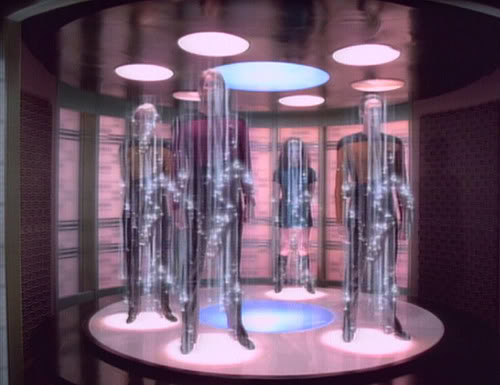
Death by Transporter

I had this published in a magazine article awhile back, thought you might enjoy it.

transporter1

Death by Transporter

by Michael Bradley

For Star Trek fans, the transporter is the key to most away teams.  In space dock you might use the shuttle and certainly if the transporter is blocked by shielding or other devices you would use the shuttle.  How many times have we seen the transporter used throughout the series, and the only one smart enough to question this was “Bones”, Doctor McCoy.  He complained that breaking a person down into individual atoms and beaming them across space and reassembling them was “unnatural.”

The sad truth is that the transporter is actually a death device that produces a clone.  Each person entering is disintegrated into nothing but a computer pattern duplicating their original mass.  Those actual particles are not sent through space, which could not happen at warp speed, much less sub-light.  The computer projects the image of the person into the destination and assembles atoms to reconstruct them.

Every time Captain Kirk, Spock, or anyone else stepped into the transporter, they died.  A perfect clone, which “thinks” it is still the same person, was then created.  Even under the best circumstances, repeated death and re-cloning will get some of the pieces wrong.  Theoretically, the more times you go through the transporter, the less you will be like the original.  There have been episodes where people were merged, mangled, or had the “anti-virus” program remove alien life and microbes from the new clone, leaving behind part of the original.

The official protectors of the Star Trek brand deny this is the way transporters work.  They say that it breaks down your molecules then converts them to a light beam, then reassembles them.  This cannot be true, given the Star Trek canon.  Every trekker knows you cannot beam someone through an active shield; however, lasers, photon torpedoes and phaser banks CAN go through a shield on the way out.  So if light, energy and matter can travel out, why not molecules in a light beam?

Further proof that the transporter disintegrates the occupant then creates a clone is found in Star Trek: The Next Generation episode entitled “Second Chances” in which Commander Riker is duplicated twice.  One version goes up to the ship, while the other is stranded behind.  After that, they diverge in personalities based on their experiences.  If in fact, a transporter only uses the original mass of the individual, then two Rikers would both only be half complete, and both would be dead.  If it disintegrates and kills the first Riker, then accidentally puts them together twice in different spots, that would explain the plot.

Star Trek has extensive usage of the replicators.  Captain Picard says, Earl Grey hot, and voila, there it is.  The replicators basically take inert mass and energy and remake it into whatever product is desired.  The transporters are simply replicators that project their product, destroying the original, encoding it, then using target mass to create a replica.

If you believe in souls, or even personal identity, this is of great concern.  If you understood how a transporter actually works, would you ever step into one?  Would you be willing to die each time, knowing a clone of you, who thinks they are you and acts like you, will be created on the other end?  Personally, there is no way I would do it.  Space is risky enough, and you could get me to serve on a ship.  Walk into a death chamber to die and be cloned?  I’ll pass, thank you very much.


1 Comment

Filed under Humor and Observations, Writing

Miley Cyrus Humor (Warning: Some Jokes Are R Rated)

Miley Cyrus Humor (Warning:  Some Jokes Are R Rated)

Ok, hope this Miley collection leaves you smiley, though many will probably just make you groan.

Leave a comment

Filed under Humor and Observations

Random Humor

Random Humor to bring you laughing into the weekend…

Leave a comment

Filed under Humor and Observations

Art Using Coins

Interlocked Coins Form Complex Geometric Sculptures

Source:  My Modern Art via StumbleUpon


When artist Robert Wechsler comes across a large number of coins, he doesn’t just trade them in for dollar bills like everybody else. Instead, he sees an opportunity for art. Using quarters, dimes, and pennies, Wechsler recently developed this series of complex geometric forms, simply called Money, as a commission for The New Yorker‘s October 14, 2013 money-themed issue.

Whether electronic or material, we all use currency on a daily basis. Through his work, Wechsler invites us to look at the highly valued metal and paper forms with a different perspective. From fresh, shiny, and new, to aged and completely worn, Wechsler uses not just US currency, but also coins from places including Canada, Belize, and Hong Kong. He carefully cuts notches into each coin and manually joins them together to create the fascinating variety of shapes and patterns.

In all of his art, the artist reworks objects and shapes into creative shapes and structures, and he says, “My work seeks to awaken undiscovered virtue in everyday objects and spaces by challenging commonplace associations through careful intervention.”

Leave a comment

Filed under Humor and Observations

Arctic sea ice up 60 percent in 2013

Arctic sea ice up 60 percent in 2013

Published September 09, 2013

FoxNews.com
  • arctic sea ice 2012 vs 2013.jpg

    NASA satelite images show the changing Artic sea ice coverage. from August 2012 (left) to August 2013 (right) — a growth of about a million square miles. (NASA)

About a million more square miles of ocean are covered in ice in 2013 than in 2012, a whopping 60 percent increase — and a dramatic deviation from predictions of an “ice-free Arctic in 2013,” the Daily Mail noted.

Arctic sea ice averaged 2.35 million square miles in August 2013, as compared to the low point of 1.32 million square miles recorded on Sept. 16, 2012, according to the National Snow and Ice Data Center. A chart published Sept. 8 by NSIDC shows the dramatic rise this year, putting total ice cover within two standard deviations of the 30-year average.

Noting the year over year surge, one scientist even argued that “global cooling” was here.

“We are already in a cooling trend, which I think will continue for the next 15 years at least. There is no doubt the warming of the 1980s and 1990s has stopped,” Anastasios Tsonis of the University of Wisconsin told London’s Mail on Sunday.

The surge in Arctic ice is a dramatic change from last year’s record-setting lows, which fueled dire predictions of an imminent ice-free summer. A 2007 BBC report said the Arctic could be ice free in 2013 — a theory NASA still echoes today. 

“[An ice-free Arctic is] definitely coming, and coming sooner than we previously expected,“ Walt Meier, a glaciologist at NASA’s Goddard Space Flight Center in Greenbelt, Md, told LiveScience last month. “We’re looking at when as opposed to if.”

Noting the growth in ice, the Snow and Ice Data Center said that coverage was still well below the 30-year average. And the year over year growth in ice is “largely irrelevant,” argued The Guardian, noting that more ice is to be expected after the record low a year ago.

“We should not often expect to observe records in consecutive years. 2012 shattered the previous record low sea ice extent; hence ‘regression towards the mean’ told us that 2013 would likely have a higher minimum extent,” wrote Dana Nuccitelli.

Meanwhile, global surface temperatures have been relatively flat over the past decade and a half, according to data from the U.K.’s weather-watching Met Office.

A leaked draft of the next major climate report from the U.N. cites numerous causes to explain the slowdown in warming: greater-than-expected ash from volcanoes, a decline in heat from the sun, more heat being absorbed by the deep oceans, and so on.

Climate skeptics have spent months debating the weather pattern, some citing it as evidence that global warming itself has decelerated or even stopped.

“The absence of any significant change in the global annual average temperature over the past 16 years has become one of the most discussed topics in climate science,” wrote David Whitehouse of the Global Warming Policy Foundation in June. “It has certainly focused the debate about the relative importance of greenhouse gas forcing of the climate versus natural variability.”

3 Comments

Filed under Humor and Observations

Living relatives of iceman mummy found

Living relatives of iceman mummy found

By Rossella Lorenzi

Published October 14, 2013

Discovery News
  • otzireconstruction.jpg

    A reconstruction of Otzi the Iceman — a remarkably well preserved 5,300-year-old mummy sometimes lovingly called “Frozen Frit” — created by Dutch forensic experts. (HEIKE ENGEL-21LUX / SDTIROLER ARCHOLOGIEMUSEUM / NATIONAL GEOGRAPHIC DEUTSCHLAND)

Ötzi the Iceman has at least 19 living male relatives in the Austrian Tirol, according to a genetic study into the origins of the people who now inhabit the region.

Scientists from the Institute of Legal Medicine at Innsbruck Medical University analyzed DNA samples taken from 3,700 blood donors in the Tyrol region of Austria.

During their study, they discovered that 19 individuals share a particular genetic mutation with the 5,300-year-old mummy, whose full genome was published last year.

“These men and the Iceman had the same ancestors,” Walther Parson, the forensic scientist who carried out the study, told the Austrian Press Agency.

The researchers focused on parts of the human DNA which are generally inherited unchanged.

“In men it is the Y chromosomes and in females the mitochondria. Eventual changes arise due to mutations, which are then inherited further,” Parson explained.

People with the same mutations are categorized in haplogroups. Designed with letters, haplogroups allow researchers to trace early migratory routes since they are often associated with defined populations and geographical regions.

Indeed, Ötzi’s haplogroup is very rare in Europe.

So far the 19 individuals have not been informed of their genetic relationship to Ötzi. 

“The Iceman had the haplogroup G, sub category G-L91. In our research we found another 19 people with this genetic group and subgroup,” Parson said.

Having carried Y chromosome haplogroup analysis, Parson was able to trace only the male descendants of the Neolithic man.

So far the 19 individuals have not been informed of their genetic relationship to Ötzi.

Found in 1991 in a melting glacier in the Ötztal Alps (hence the name), the mummy is one of the most heavily investigated human corpses of all time.

Scientists discovered that Ötzi had brown eyes and very bad teeth, was lactose intolerant, had a genetic predisposition for an increased risk for coronary heart disease and probably had Lyme disease.

It’s certain he died a violent death: In 2007, CT scans showed that an arrowhead had lacerated his left subclavian artery, leading to fast bleeding.

CAT scan of the mummy’s brain and a paleoproteomic study have recently pointed to a cerebral trauma — a violent blow to the head — as the cause of death.

As investigation into the mummy continues, new relatives, alive and well, could be added to the list of the 19 descendants.

According to Parson, the genetic mutation might be also found in the nearby Swiss region of Engadine and in Italy’s South Tyrol region.

“We have already found Swiss and Italian partners so that we can continue our research,” he said.

Leave a comment

Filed under Humor and Observations

Top 15 Converted Hotels

Top 15 Converted Hotels

Posted by  – August 28, 2013
Source:  www.travelycia.com via StumbleUpon

Everyone loves a great vacation, including you. Whether it’s enjoying the scenery, exploring the culture or partying in the night scene, you come to love the dream destination because of your experience of enjoyment and luxurious comfort while visiting the place. Do you want to stay somewhere a little bit different on your next holiday? Converted hotels is another growing trend: buildings that were once used as something completely different, now renovated and refurbished as a hotel. These unconventional buildings have been wonderfully converted into hotels, retaining the spirit of the original structure, while offering luxurious accommodations and modern amenities.

1. Hotel Im Wasserturm, Cologne, Germany – a former water tower

Hotel Im Wasserturm Top 15 Converted Hotels

2. Four Seasons Hotel Gresham Palace, Budapest, Hungary – a former palace

Four Seasons Hotel Gresham Palace Top 15 Converted Hotels

3. K+K Hotel Central, Prague, Czech Republic – a former theatre

K+K Hotel Central Top 15 Converted Hotels

4. Chateau de Trigance, Trigance, France – previously a medieval fortress

Chateau de Trigance Top 15 Converted Hotels

5. The Lighthouse, Llandudno, North Wales

The Lighthouse Llandudno Top 15 Converted Hotels

6. Old Bank Hotel, Oxford, England

Old Bank Hotel Top 15 Converted Hotels

7. Hotel Pulitzer, a Luxury Collection Hotel, Amsterdam, Holland – converted from two canal houses

Hotel Pulitzer Top 15 Converted Hotels

8. Krolewski Hotel, Gdansk, Poland – an ex-granary

Krolewski Hotel Top 15 Converted Hotels

9. Langholmen Hotel and Hostel, Stockholm, Sweden – formerly a prison

Langholmen Hotel Top 15 Converted Hotels

10. Mandarin Oriental, Prague, Czech Republic – converted from a 14th-century Dominican monastery

Mandarin Oriental Top 15 Converted Hotels

11. Quinta Real Zacatecas, Zacatecas, Mexico – former use: bullring

Quinta Real Zacatecas Top 15 Converted Hotels

12. Neemrana, Rajasthan, India – former fort palace

neemrana Top 15 Converted Hotels

13. Het Arresthuis, Roermond, Netherlands – former jail

het arresthuis Top 15 Converted Hotels

14. Clink 78, London – former use: Courthouse

clink78 Top 15 Converted Hotels

15. Blow Up Hall 5050, Poznan, Poland – former Brewery

Blow Up Hall 5050 Top 15 Converted Hotels


1 Comment

Filed under Humor and Observations

Sophia Loren and Jayne Mansfield – The Story Behind the Picture

Sophia vs Jayne: The OTHER Photos behind that Sideways Glare

In “Boys click here” “Featured” “Nostalgia” on April 1, 2013 at 3:18 pm

Source: http://www.messynessychic.com

I had always thought Sophia’s disapproving look in this iconic photograph taken by Delmar Watson was a perfectly captured moment of female jealousy. Mansfield to me was the carefree blonde and Loren, the feisty brunette. But of course, most of us have only seen this moment from one angle. There were other photographs taken that night in 1957 that give a little more context to Sophia’s infamous sideways glare…

In April 1957, Hollywood was hosting a dinner party in honour of the Italian actress, Sophia Loren at the Romanoff’s. American actress, Jayne Mansfield had been invited and was sitting between Loren and Clifton Webb. At one point she leaned over the table, allowing her breasts to spill over her low neckline, exposing one nipple. From where Sophia was sitting, she had quite a view…

Sophia’s face below is also priceless!

Alas, the slip was absolutely intentional and became the feature of a notorious publicity stunt intended to deflect attention from the Italian star. The press dubbed it, ‘the Battle of the Bulge’. But this wasn’t the first ‘nipple slip’ publicity stunt for the Hollywood star. Two years earlier she had posed for Playboy and her carefully staged public accidents became a rather expected occurrence. She had nevertheless, come a long way from the times when the prominence of her breasts led her to lose professional roles…

Oh Jayne…!

6 Comments

Filed under Humor and Observations