
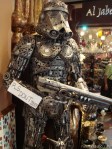
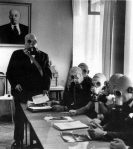
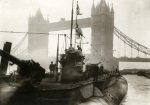
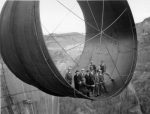
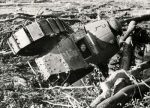
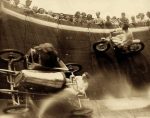
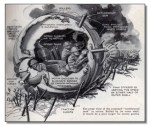
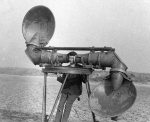
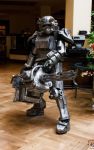
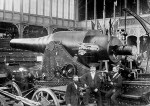
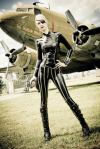
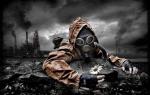
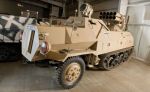
So what is Diesel Punk? It is alternative history or science fiction from 1900 to 1940, or the Age of Diesel, where Steampunk is from the Age of Steam, roughly 1820 to 1900. Diesel punk is popularized in Indiana Jones’ movies, Skymaster’s of the Universe, the darker Sucker Punch movie, and the recent animated Tin Tin. Here are some random diesel punk pictures for your enjoyment:
Category Archives: Humor and Observations
























McRib FAQ
The down low on the McRib sandwiches at McDonalds…
The history and mystery surrounding the McRib

As of today, McDonald’s famous and much-loved McRib is back on the national scene. For a limited time, you can enjoy the barbecue pork sandwich without going on a search reminiscent of those for Big Foot and Nessie. Whether you are currently wiping that savory sauce off of your face, are planning on venturing out to pick up a sandwich, or are just curious about what the big deal is, check out these fun facts on the McRib.
Nutritional value
At 500 calories and 26 grams of fat, the McRib isn’t the most diet-friendly of sandwiches. For the same number of calories, you can eat two classic McDonald’s hamburgers and save 8 grams of fat. However, you don’t have to worry about the hamburger disappearing from the menu, so the indulgence may be worth it.
Cult-like following
Over the last three decades, the McRib has become something of a legend. It transcended the realm of fast food fans and made its way into pop culture, earning mentions in “The Simpsons” (as the Ribwich) and on David Letterman’s Top 10 lists.
The sandwich itself contains pork shaped like a rack of ribs that is doused with barbecue sauce and then topped with picked and onions and served on a bun.
If you aren’t convinced that the McRib is for you, McDonald’s has put together 101 reasons why you should eat one .
.
The history of the McRib
The McRib was introduced in 1982, according to the 101 reasons to eat a McRib interactive promotion, although sources have previously listed its inaugural year as 1981. Either way, it was removed from the menu in 1985 and was reintroduced in the 90’s.
Back in 2005, the sandwich went on a farewell tour.
“Our customers will have the last chance to experience the savory taste of the McRib Sandwich and pay tribute to a part of McDonald’s 50-year history,” McDonald’s spokesperson Jennifer Smith said in a press release in 2005.
But this was not the end of the McRib. It went on two more so-called farewell tours, one in 2006 and one in 2007. It then became available sporadically and regionally in the U.S. The McRib Locator website reported its first McRib sighting on Oct. 3, 2008 in Winner, S.D. Since then, McRibLocator.com has been helping fellow fanatics track down the sandwich across the country. The website even has an Android app, so you can continue your search for the McRib on the go if necessary. Luckily, you won’t have to look very far for the next couple of weeks.
The bone-less rack of ribs
If you have eaten or seen a McRib, you know that the meat of the sandwich looks like a rack of ribs, even though it neither contain bones nor a whole lot of rib meat. It starts out as pork meat, mostly from the shoulder, in a large processing plant, according to a 2009 Maxim article. The meat is chopped up, seasoned, molded into its famous shape and then they flash-freeze it.
An urban legend of sorts says that the McRib was first made at the University of Nebraska, but that isn’t exactly true. In 1972, the National Pork Producers Council gave University of Nebraska’s Professor Roger Mandingo a grant to work on restructuring meats. Mandingo came up with a process that used salt and mechanical action to compress small pieces of meat, so we have him to thank for the McRib’s unusually shaped patty.
Filed under Humor and Observations, Uncategorized
Domestic Spying
One of the few times the ACLU, the Wall Street Journal, and I will agree on anything… We are quickly becoming a police state, in which you will be observed, documented, studied, investigated, and even found guilty – all without prior cause or trial.

Vast New Spying Program Was Started in Secret on a Bogus Pretext
By Chris Calabrese, Legislative Counsel, ACLU Washington Legislative Office at 11:25am
The Wall Street Journal today published (alternate link) an in-depth review of a new, relatively unknown program run by the National Counterterrorism Center (NCTC). Although we have been warning about the dangers of the program for months, and I testified before Congress about the issue in July, the Journal’s story conveys how controversial the program was even inside the government. It also describes the broad scope of new authority the government is granting itself.
As the Journal reports, under new guidelines issued by the Attorney General back in March,
The rules now allow the little-known National Counterterrorism Center to examine the government files of U.S. citizens for possible criminal behavior, even if there is no reason to suspect them. That is a departure from past practice, which barred the agency from storing information about ordinary Americans unless a person was a terror suspect or related to an investigation.
Now, NCTC can copy entire government databases—flight records, casino-employee lists, the names of Americans hosting foreign-exchange students and many others. The agency has new authority to keep data about innocent U.S. citizens for up to five years, and to analyze it for suspicious patterns of behavior. Previously, both were prohibited.
The changes also allow databases of U.S. civilian information to be given to foreign governments for analysis of their own. In effect, U.S. and foreign governments would be using the information to look for clues that people might commit future crimes.
The program is striking in so many ways. Innocent people can be investigated and their data kept for years. It can be shared with foreign governments. All of this in service of not just terrorism investigations but also investigations offuture crimes. In effect, the U.S. government is using information it gathers for its ordinary business to turn its own citizens into the subjects of terrorism investigations.
Meanwhile, all of this is supposed to be against the law. The Privacy Act of 1974 says that information collected by the federal government for one purpose is not supposed to be used for another. However, agencies are attempting to circumvent these rules by publishing boilerplate notices in the Federal Register. Sadly, that practice has become far too common.
Government officials who have a firsthand look at how the program works are stunned by it:
“It’s breathtaking” in its scope, said a former senior administration official familiar with the White House debate.
And from Mary Ellen Callahan, then the Chief Privacy Officer at the Department of Homeland Security:
the rules would constitute a “sea change” because, whenever citizens interact with the government, the first question asked will be, are they a terrorist?
Worse, all of this happened in secret, approved by National Security Advisor John Brennan and signed off on by Attorney General Eric Holder. No public debate or comment and suddenly, every citizen can be put under the terrorism microscope.
Ironically, all of these changes to the rules came in response to an attempted attack that had nothing to do with information collection or a U.S. citizen. Thegovernment cites the attempted 2009 Christmas bombing by Umar Farouk Abdulmutallab as the impetus for the changes. However, as the Journal story makes clear, Abdulmutallab wasn’t a U.S. citizen, and collecting information on him wasn’t a problem. Instead, his own father had identified him to the U.S. government as a potential terrorist. In short, an attack by a known foreign terror suspect was used to justify changes to rules about collecting information on U.S. citizens.
Finally, credit must be given to those who fought the program. It’s clear that DHS, especially the Privacy Officer, Mary Ellen Callahan, and the Office of Civil Rights and Civil Liberties pushed back hard against this. Nancy Libin, the chief privacy officer at the Department of Justice, also expressed serious reservations and fought an internal battle against the changes. It’s probably not a surprise that none of them are still in government.
If you want to learn more here is a simple guide to the main changes created by the 2012 NCTC guidelines. And here are the Freedom of Information Act documents that we have gathered on NCTC—we will post more as we receive additional records.
Filed under Humor and Observations, Uncategorized
19th Century Book Ads
These are all advertisements for books put out in the nineteenth century in France.
19th Century:
Book ads from 19th-century France


Ads for well-known French novels from the 19th century by Victor Hugo, Eugène Sue, and Emile Zola. Like most novels from this period, they were first published in serialized form.
Filed under Humor and Observations, Uncategorized, Writing
Must See On Global Warming
I have an earlier post on global warming in which I express my personal views on the topic. I believe the Earth cools and warms and has dramatic shifts, but do not believe we have reached the point where as humans are we are able to significantly impact this. Others I respect totally believe in a crisis, while others think climate change is a myth created to help form a global government. Every show I have seen, except one, takes one extreme or the other.
It was with surprise I saw a very balanced documentary and discussion of the issue:
http://www.imdb.com/title/tt1694015/

It is called “Cool It”. The documentarians believe in global warming and that it is man-made. They also believe we need to take immediate action. So, given I disagree, why would I like it? Well, quite frankly, it is upbeat and talks about all the current and future technology underway in a very sensible and optimistic way I find refreshing. I encourage everyone to watch the documentary, whatever your position on it is.
Filed under Humor and Observations
The Hobbit Bar
reposted from thechive.com
New Zealand opens a real-life Hobbit bar (12 Photos)
DECEMBER 14, 2012
 FOLLOW
- Located in the tourist village of Hobbiton — a town that has been open to the public since 2002 — the new pub is intended to make the visiting experiences all the more Hobbit-like. The pub manager, Russell Alexander, estimates that the release of the new Hobbit film will bring in at least 100,000 visitors over the next year. That would be quite an increase, as Hobbiton has been visited by 300,000 people over the past decade. The bar, named The Green Dragon, opened to the public in late November after New Zealand Prime Minister John Key conducted a “chain cutting” ceremony.
Located near Matamata, the Hobbit village was built in 1998 by Peter Jackson and New Line Cinema as a set for the films. But now, in preparation for the upcoming Hobbit trilogy, it has been expanded to include 44 “Hobbit Holes,” or dwellings, which feature the characteristic circular doors made famous in the movies. Hobbiton Board director and former Tourism New Zealand boss George Hickton said that in future it may be possible to convert the facility to allow for overnight stays. I, for one, think that would be an amazing time and would sign up in a heartbeat.

3

4

5

6

7

8

9

10

11

12

Read more at http://thechive.com/2012/12/14/new-zealand-opens-a-real-life-hobbit-bar-12-photos/#Trs6je5Gw0qCp37u.99
Filed under Humor and Observations
Write Your Name In Elvish for The Hobbit Opening!
Write Your Name in Elvish in Ten Minutes
| You want to write your name in Elvish, but every place you go seems to make it harder than it ought to be. Elvish writing looks beautiful and mysterious, but does it really have to be impossible to understand? Why doesn’t somebody just spell out the alphabet so you can simply substitute the letters and get straight to the result? That’s exactly what I’ve done here. Learn to write your name in Elvish in ten minutes. It’s not very hard. |
Here’s the alphabet.
 |
That’s it. (If you want details about where this all comes from, look at the bottom of this page.) You only need to know a few more things and you’re ready to go. The most important thing is that vowels go above (or below) the consonants. That’s what the gray arrows signify in the alphabet shown above. You can put the vowels above the letter they follow (Quenya style) or above the letter they precede (Sindarin style). Take your pick. I do the Quenya style. Look at this example.
| 1. Write the name: ROBERT.2. Shift the vowels up and to the left, so they are above the letters they follow.
3. Substitute the letters using the alphabet provided above. Notice there are two forms for the letter R. One is for the R sound as in RED. The other is for the R sound as in CAR. The name ROBERT starts with the R-as-in-RED sound and near its end it has the R-as-in-CAR sound. 4. Here’s the text notation. I find it useful to use a plain text representation of the characters when I’m explaining things via email. The underscores at the beginning and end show where the baseline is. O E _ R B R T _ 5. All the examples on this page are use the Quenya style, but here’s the text notation for Sindarin (not shown in calligraphy) so you can see how the vowel positions shift to the right. O E _ R B R T _ |
 |
Generally the vowels go above the consonants, but sometimes, in the case of Y and silent E, they go below. Here’s another example. This one includes a special symbol, a straight line underneath the consonant, that indicates a doubled consonant. Use this “doubling symbol” with any consonant.
| 1. Write the name: LYNNE.2. Shift the vowels down and to the left, so they are below the letters they follow.
3. Make letter combinations. Doubled consonants can be combined into one space. 4. Substitute the letters using the alphabet provided above. Use the bar underneath the N to signify it is doubled. 5. Here’s the text notation. Most of the action occurs below the baseline. I’m using square brackets to indicate letter combinations that result in a single letterform. _ L [NN] _ Y E |
 |
The straight line underneath is just one way to make one character do the work of two. There are a number of Elvish letters that stand for two letters of our alphabet. Think of this as a supplementary alphabet.

The line above a consonant means that a nasal N or M precedes the consonant in question. In the next example, we use the nasal modifier and we see what to do with vowels when there’s no consonant in the right place to put it above.
| 1. Write the name: ANDY.2. Shift the vowels. The Y goes down and to the left. Since the letter A has no consonant to slide above, it goes on a carrier, which is just a straight line that fills in for the job a consonant would normally do. Note that the carrier is just a graphical convention and has no bearing on pronunciation.
3. Make letter combinations using the supplementary letters: N + D = ND. 4. Substitute the letters. The vowel placeholder is a short straight line. The nasal N preceding D is denoted by a straight line above the D. 5. Here’s the text notation. I’m using the colon symbol : for the vowel carrier symbol. A
_ : [ND] _
Y
|
 |
Here’s one last example with two different letter combinations.
| 1. Write the name: SHELDON.2. Shift the vowels.
3. Make letter combinations using the supplementary letters: S + H = SH. L + D = LD. 4. Substitute the letters. 5. Here’s the text notation. E 0 _ [SH] [LD] N _ |
 |
I am often asked how to handle double vowel situations. Remember to use the carrier as shown above in the ANDY example. Here are some examples that illustrate some of the situations that come up.
| Name: ADRIAN Text notation: A I A _ : D R : N _ |
 |
| Name: EILEEN Text notation: E I [EE] _ : : L N _ Comment: This is a dramatic example of doubled up vowels. The name starts with two vowels, leaving us no choice but to use two carriers in a row. We use a little artistic freedom with the double E at the end, since they fit nicely over the L. It would have been, however, perfectly reasonable to spell it like this. E I E E _ : : L : N _ |
 |
| Name: DIETRICH Text notation: I E I _ D : T R [CH] _ |
 |
| Name: AMELIE Text notation: A E I
_ : M L _
E
Comment: Here again we’re using a little expressive freedom for compactness. The silent E at the end is placed under the L and assumed to follow the voiced I above the L. You can always spell it like this if you want to be absolutely clear. A E I E _ : M L : _ |
 |
That’s all you need to get started. If you take a real interest in Elvish and want to learn more, there’s a lot of good information out there for you.
Please be aware that there are many ways to write English words in Elvish. This is just the one that I use. I have tried to keep it very simple here. There are dozens of sites that can lead you through the nitty-gritty details. The best one I have come across yet is Tolkien Script Publishing. You can learn about all details that I glossed over here.
Good luck!

Ned Gulley
Filed under Humor and Observations, Uncategorized, Writing
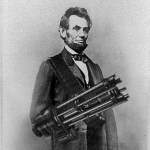
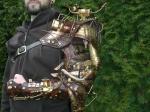
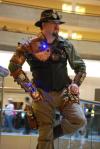
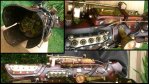
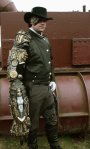
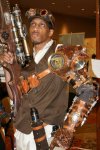
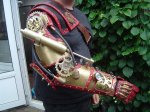
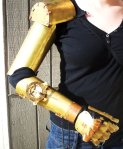
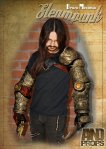
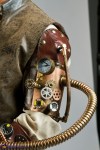
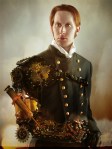
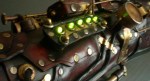
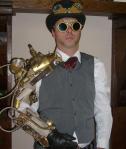
Arm Envy
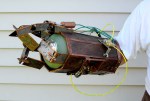
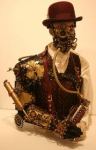
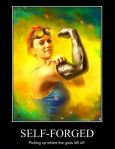
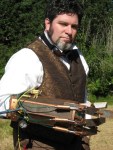
In Steampunk, it’s all about the arms… If you don’t believe me, check out the following gallery. (click to enlarge pictures). For those of you not familiar with “Steampunk” it is alternative historical fiction with a science fiction flair, set between 1800 and 1900, during the English Victorian period and the American Civil War and Wild West period. HG Wells, Jules Verne, The Wild Wild West, 20,000 leagues under the sea, Sherlock Holmes, Cowboys and Aliens, Abraham Lincoln Vampire Slayer are all “steampunk.” Enjoy!

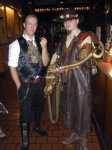
-

- Brian P. Miller and Mike Syfritt

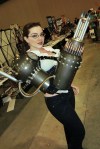
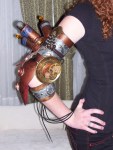


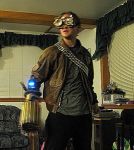



-
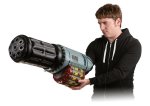
- Inflatable gun – Epic Fail


Filed under Humor and Observations, Uncategorized
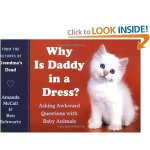
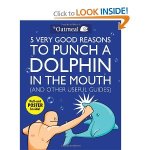
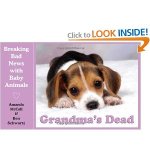
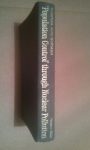
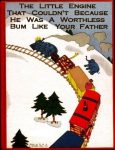
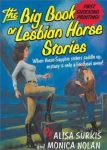
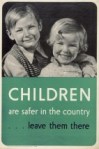
Still More Strange Book Covers
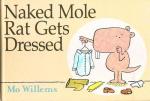
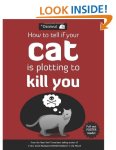
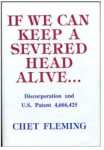
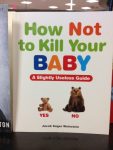
This is the third installment of strange book covers. You can search for the others by going to my home page and typing “book covers” into the search button. I try to confirm that each of these is a real book, but some photoshops might get through. Enjoy! (Click a picture to enlarge)






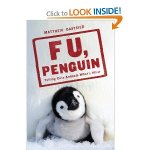



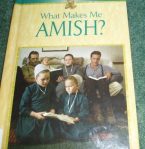


Filed under Humor and Observations, Uncategorized, Writing

