
Random humor to end your work week with a laugh or two…
-

- What does the fox say?
-

- Technically, the I is white…
-

- McDonalds, the sponsor of runners…
-

- Captain Obvious
Random humor to end your work week with a laugh or two…
































Filed under Animals, Humor and Observations


Filed under Humor and Observations

Perhaps this play sculpture from Moscow is meant to impart a lesson: never crawl into a hungry dragon’s mouth.
Filed under Humor and Observations
Fun cosplay pictures for your Saturday. (I get these pictures primarily off my own Facebook account and from pictures I take at events at which I am a vendor or guest. However, if you see yourself or work here, please email me at eiverness@cox.net and either 1) give me your photo, model, make-up, fanpage, etc so I can post it with the pictures; or 2) ask me to take it down and I will. I do not profit from this site and my only goal is to share cosplay I think is well done and cool. Enjoy!






























































Filed under Humor and Observations
Astronomers Have Found the First Earth-Sized, Habitable Zone Planet
Robert T. Gonzalez
4/17/14 12:05pm
Scientists today announced the discovery of Kepler-186f, a faraway planet that’s perhaps the most Earth-like yet discovered. It’s the same size as our home world, and at the right distance from its parent star to have liquid water. So, have we at last discovered Earth 2?

Above: An artist’s conception of Kepler-186f Credit: NASA Ames/SETI Institute/JPL-CalTech
“The ultimate goal of all this searching for exoplanets – the real reason we’re doing this – is to answer the question ‘are we alone?'” So says Tom Barclay, a research scientist working with NASA’s planet-hunting Kepler mission, and co-author of the paper recounting the discovery of Kepler-186f, published in today’s issue of Science.
Barclay says that the answer to that big, ultimate question is almost certainly contained in the answers to a host of smaller ones, starting with: Are there other places out there like Earth? Today, Barclay tells us, it’s clearer than ever that “the answer to that question is ‘Yes.'”
A Habitable World
Kepler-186f shares a number of key characteristics with our home planet. For starters, it’s roughly the same size. Size is important when it comes to planets. Astronomers suspect that smaller bodies tend to be more rocky, and less gaseous, than larger worlds. How does Kepler-186f rank relative to the exoplanets we’ve discovered to date? When Kepler scientists announced a year ago the discovery of Kepler-62f, a planet roughly 40% bigger than Earth, they called it one of the most similar objects to Earth yet discovered. Kepler-186f, by comparison, is a mere 10% bigger than Earth. In fact, of the five planets that make up the Kepler-186 system, not a single one of them possesses a radius more than 1.5-times that of our home planet.
But planets that are Earth-sized (and smaller) have been detected before. What really sets Kepler-186f apart is its distance from its parent star. The outermost planet in its solar neighborhood, Kepler-186f orbits at the edges of what astronomers call the “habitable zone” of its star, i.e. the region around a star within which planets can potentially host liquid water and, scientists believe, life.
For a planet to be habitable, it must engage in something of a balancing act. It needs enough solar radiation to keep its water in a liquid state, while still remaining distant enough to keep that water from vaporizing outright. There are other things that can dictate whether a planet can host water – how much radiation its atmosphere lets through, for example – but it’s this not-too-much, not-too-little business that astronomers see as the biggest key to habitability (and why the habitable zone is known colloquially as the “Goldilocks Zone”).
A Very Different Sun
Barclay says there’s one major characteristic Kepler-186f doesn’t share with Earth. In Kepler-186’s size and orbital distance, he says, “we have two things that we would need to call it an Earth twin,” but a true twin, Barclay says, would orbit a Sun-like star. Kepler-186f orbits an M-dwarf, a class of star cooler and dimmer than our own. If you want to get technical, Barclay says, Kepler-186f “isn’t so much an Earth-twin as it is an Earth cousin.”
But these two cousins could still look an awful lot alike. Barclay says that because Kepler-186f receives roughly one-third the energy that we do on Earth, the light it receives would appear redder, its sun a few shades oranger than our own. We don’t know if the planet has an atmosphere, but, assuming the gases surrounding it are similar to those enveloping Earth, its skies would appear slightly duller than what we’re used to here at home. A sunny day on Kepler-186f, he says, would look similar to a day here on Earth about an hour before sunset.
Two Out of Three Isn’t Bad
Kepler’s mission is to find planets that meet three criteria: they must be rocky, Earth-like worlds; they must be within habitable zones; and they must have stars like our own Sun. A find like Kepler-186f, which meets two of those three criteria, suggests the search for Earth 2.0 could be nearing its end. “What we’re seeing more and more is that there are places that do look like Earth out there, that remind us of home,” says Barclay.
So what’s the holdup on that third criterion? According to Barclay, Earth-like planets orbiting Sun-like stars take longer to identify and confirm than those orbiting relatively wimpy stars like M-dwarfs. There are two big reasons for this. The first is that Kepler detects exoplanets by measuring how much light they block when they orbit in front of their parent stars. Astronomers call this a “transit.”
When a planet transits its parent star, Kepler detects a brief dip in the star’s light – but the ratio of planet size to star size affects how obvious that signal is. Imagine a tennis ball flying across the face of one of those big, honking prison spotlights. Now imagine that same tennis ball flying across the face of a cheapo, handheld flashlight. Bigger, brighter stars are like the prison light, while smaller, cooler ones (like M-dwarfs) are more like the handheld; if you fix the size of the planet and shrink the the size of the star, the signal goes up, making its orbiting planets easier for Kepler to detect.
The second reason is that cooler stars tend to have planets with smaller orbits. A smaller orbit means you can spot more transits in a smaller window of time, and say with greater certainty that the signals you’re picking up are, in fact, attributable to orbiting planets. Kepler might expect to see an Earth-like planet transit a Sun-like star roughly once every 365 days. The scientists observing Kepler-186f saw it pass before its parent star at more than twice that frequency. Remember: Kepler’s only been in orbit since 2009. In a few years, we could be up to our ears in planets that meet all three of the criteria laid out above. In fact, astronomers have made it clear that they expect this. It’s really just a matter of time.
All that being said, it’s unlikely anyone reading this will ever set foot on Kepler-186f. At 500 light years away, it’s not exactly in our backyard, cosmically speaking. But it is a landmark discovery, nonetheless – and there’s no telling what we’ll find tomorrow.
Read the full details on Kepler-186f, and the rest of the Kepler-186 system, in today’s issue of Science.
Filed under Humor and Observations
1835: Mackintosh’s Aerial Ship “Drawn by Eagles”
Amanda
August 25, 2013
1800-1899, Transport
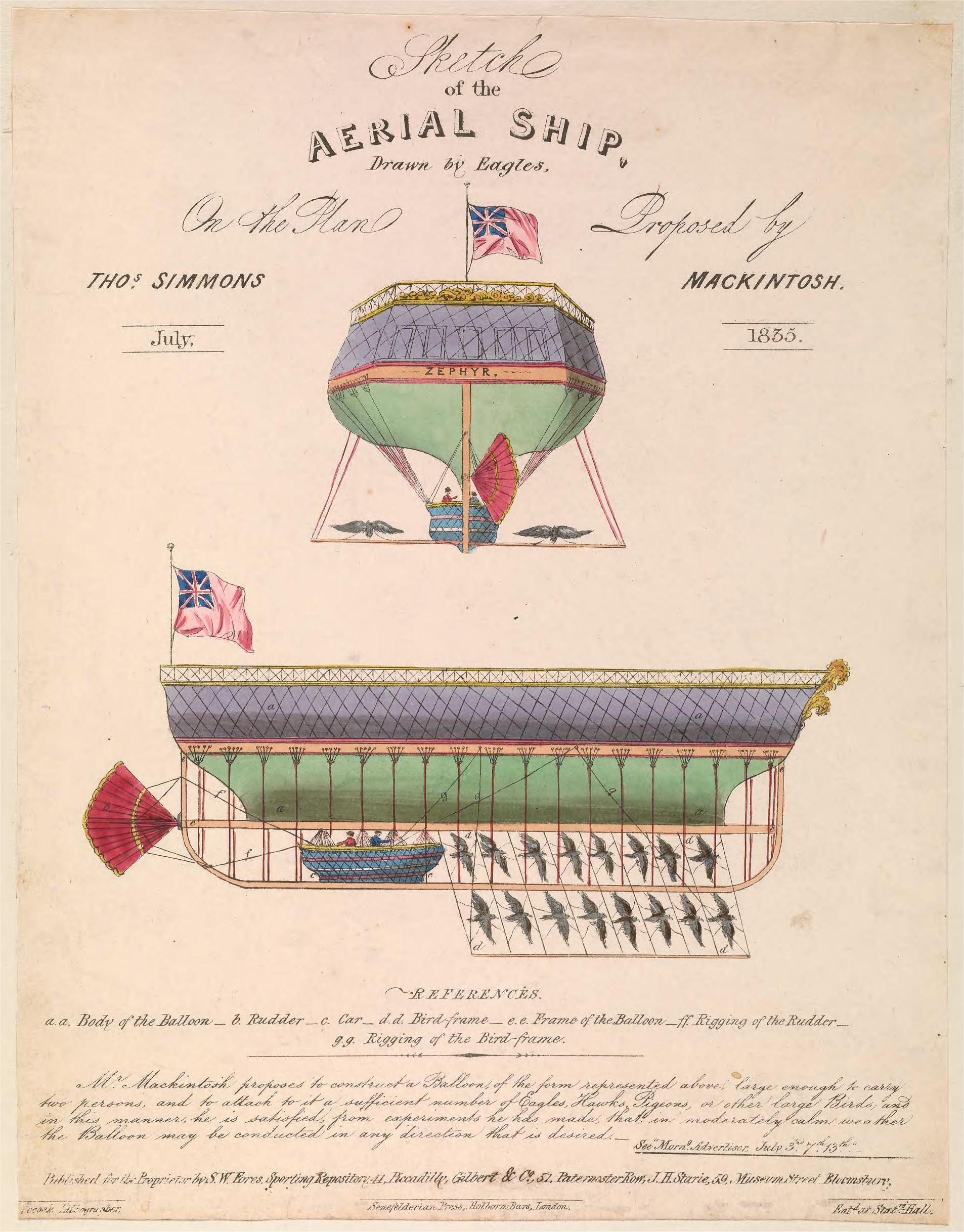
Source: The Internet Archive
Filed under Humor and Observations
“World’s Biggest Dinosaur” Discovered
May 17, 2014 | by Lisa Winter

Photo credit: José María Farfaglia, via MEF
A farmer in Chubut, Argentina made an incredible dinosaur discovery about three years ago. While working out in his fields, he stumbled across some fossilized dinosaur remains. Paleontologists from the nearby Museum of Paleontology Egidio Feruglio excavated the area and found about 150 incredibly well-preserved bones from seven individuals of a species that is likely the largest to ever walk the Earth.
The remains come from a newly-described species of titanosaur, which are large herbivorous sauropods. It lived in the late Mesozoic about 95 million years ago. This behemoth will not have a name until the findings are published in a scientific journal, but the researchers have claimed they will choose a title that pays tribute to the region, the farmer, and the dinosaur’s incredible size.
It is estimated to be an astonishing 40 meters (130 feet) long from head to tail and 20 meters (65 feet) tall. A creature this large would have likely weighed in at a hefty 77 tonnes (85 short tons), which is over eleven times more than Tyrannosaurs rex.
Researchers are currently comparing this species to Argentinosaurus, which is currently regarded as the largest dinosaur ever. However, Argentinosaurus is believed to weigh about 7 tonnes (7.7 tons) less than this new species, and has likely been officially dethroned as the largest terrestrial animal ever.
Understanding the true size of the dinosaurs is always open for some debate when there isn’t a complete skeleton. Assumptions must be made about the size and shape of missing bones, based on what they know about related species. However, there may be many more clues that have not yet been surfaced at the dig site.
José Luis Carballido, who is leading the dig has said in a press release on the museum’s website that the team is “[s]till working on this extraordinary site. We estimate that one fifth of the excavation process is completed, so there is still much work to do and probably much to discover.”
The researchers also found more than 60 teeth belonging to carnivorous species, who likely scavenged on the dead titanosaurs. Carballido claims that this opportunity came at a price, as the giant herbivores likely had incredibly thick skin that would have broken the carnivores’ teeth, though the teeth would have grown back.
Other fossils from the site indicate that when this giant dinosaur lived, the local landscape was quite green and lush with flowers and trees. The titanosaurs likely gathered near a source of water, and may have died after getting caught in mud.
The researchers note that the farmer’s family has been very accommodating during the excavation process as many pieces of large digging equipment have been brought in onto the land.

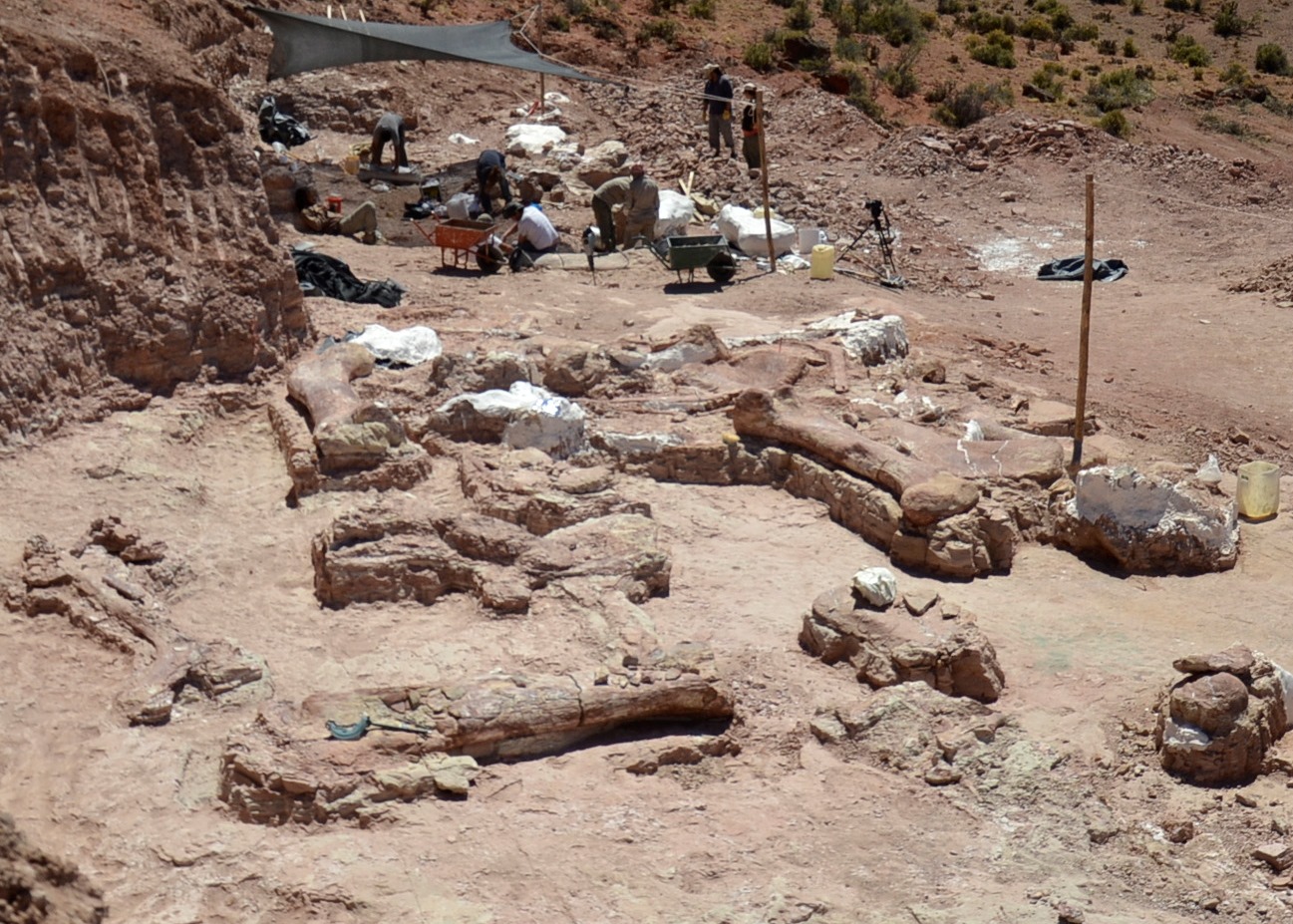
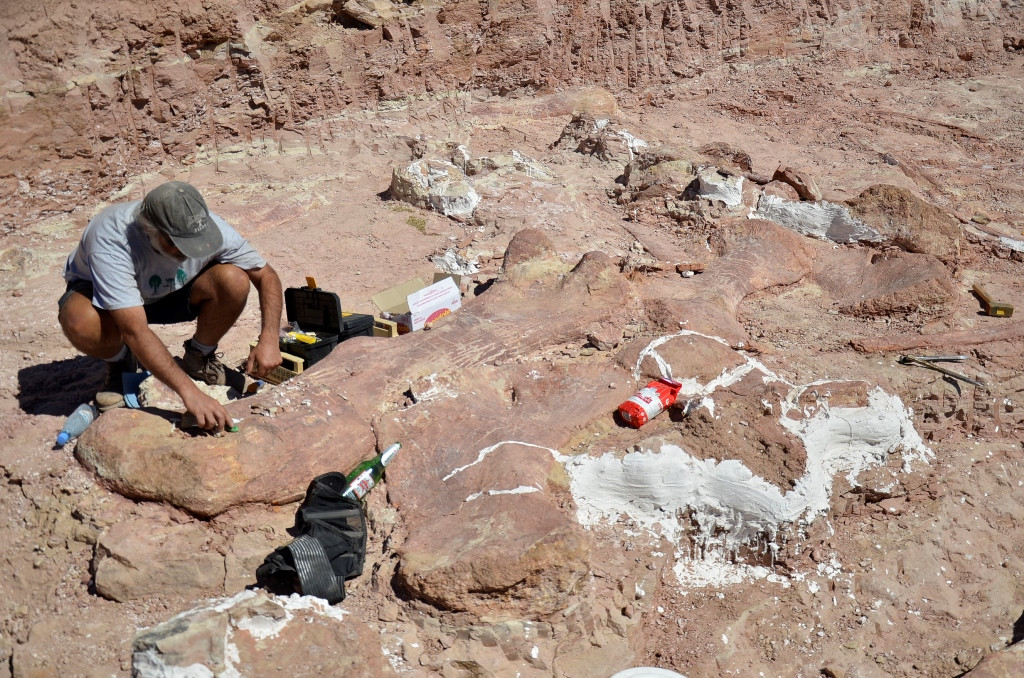
[All images credited to: Museum of Paleontology Egidio Feruglio]
Filed under Animals, Humor and Observations

1929 Ford Model A Wrecker VanDerBrink Auctions
The cars belonged to Oliver Jordan, who ran a salvage business in the city of Enid from 1945 to 1953, when he locked it up during a zoning dispute that lasted for years.





Jordan never relented, and the cars have sat idle since then, most of them left outside to rot. The majority are from the 1930s, and ’40s, but the oldest is a rare 1917 Maxwell.
Among the more notable finds are an aluminum-bodied 1937 seven-passenger Lincoln limo by Willoughby, believed to be one of five remaining of the 60 that were produced, and a 1937 Cord Model 812 Supercharged Beverly sedan.
Two 1942 “blackout specials” – a Ford and a Chevy – built during World War II, when the government put restrictions on the use of ornamental shiny metal parts, are fitting of the cache’s low profile.
A 1937 TerraPlane Super Six may sound like a flying car, but was from a short-lived brand produced by Hudson. It doesn’t come with a hood, and you’ll be hard-pressed to find an inch of it that’s not corroded.
The same can be said about pretty much all of the other vehicles.
Nevertheless, VanDerBrink Auctions is billing the event as a customizer’s dream, as many of the parts from the once-common cars are becoming rarer by the day.
Jordan sold a few of them himself over the years, but not many. According to auctioneer Yvette VanDerBrink, if he invited you inside to see his secret stash, and you were interested in one of the cars, he’d make you a take-it-or-leave-it offer on the spot. No haggling or second chances allowed.
Jordan died in 2003, and his widow died seven months ago. His grandson, who helped consolidate the cars from four different yards in recent years, is overseeing the sale of the estate, including the 1929 Ford Model A wrecker that was Jordan’s first tow truck.
The auction is scheduled to take place on June 7, both on site and online.
All sales are final, of course. Jordan wouldn’t want it any other way.
Filed under Humor and Observations

Try an online auction site.
Well, then L&L Classic Auto may have a deal for you.
The Wendell, Idaho, salvage yard is selling its stock of thousands of cars, as its 79-year-old owner considers finally retiring after over a half-century in the business.
And he’s throwing in the 80 acres of land they’re sitting on for free.
Or, maybe it’s the other way around.
“I will miss this place, but I won’t miss the stress of running it,” Larry Harms tells FoxNews.com.
Harms’ daily driver is a chunky, cerise 1937 Ford Coupe with thick whitewall tires, but he keeps a small collection of domestic gems for himself.
L&L, owned and operated by Harms and a staff fiercely loyal to vintage cars, began life as a body shop in a much smaller location close to town.
As the accumulated assortment of classic metal began to grow, the outfit moved to a more accommodating location that is large enough today to strike an impressive pose on Google Earth’s satellite view.
The land is populated with vehicles of all sizes and shapes, from derelict, parts-car specials to classics in running condition, some nearly a century old.
Conservative estimates put the total number between 8,000 and 10,000 vehicles, but the shop’s staff admits that it has been unable to catalog all of them.
Nevertheless, it maintains a thorough running tally of available parts for sale on its website.
As much as Harms is looking intently toward retirement, he’s not in a hurry to unload his trove.
Instead, he is firmly determined to find a buyer who is interested in preserving L&L’s cadre of historic vehicles, rather than someone who would prefer to destroy the cars and keep the land.
“I won’t [piecemeal] sell it,” Harms said. “I don’t want it crushed. I could do that myself.”
That’s right, unless you are planning to take – and take care of – the whole kit and caboodle, you’d better sit this one out.
The sum for the whole lot, including the land and the myriad cars scattered upon it, is listed at $3 million.
That’s anywhere between $300 and $375 per car, if you ever get around to counting them one by one.
“Is [that] a fair price? No, it’s low,” says one L&L employee. “It’s a great deal.”
L&L currently lists prices for some of the cars individually, including a gobsmacking 1974 AMC Matador “Oleg Cassini Edition” at $8,500, and what appears to be a pristine 1961 Pontiac Bonneville two-door for $29,000.
Most others are well picked-over and clearly past their prime.
Harms’ staff says it has already had several serious inquiries into the property, in addition to frequent calls from interested parties from as far away as South America, England, Norway, Australia and New Zealand.
Despite the apparent demand, Harms remains adamant that the cars end up in the hands of a serious buyer who understands their mettle.
“This is stuff you can’t get new,” he said. “Once it’s gone, it’s gone.”
Filed under Humor and Observations



























 Michael Bradley - Time Traveler
