Category Archives: Humor and Observations

Living relatives of iceman mummy found

Living relatives of iceman mummy found

By Rossella Lorenzi

Published October 14, 2013

Discovery News
  • otzireconstruction.jpg

    A reconstruction of Otzi the Iceman — a remarkably well preserved 5,300-year-old mummy sometimes lovingly called “Frozen Frit” — created by Dutch forensic experts. (HEIKE ENGEL-21LUX / SDTIROLER ARCHOLOGIEMUSEUM / NATIONAL GEOGRAPHIC DEUTSCHLAND)

Ötzi the Iceman has at least 19 living male relatives in the Austrian Tirol, according to a genetic study into the origins of the people who now inhabit the region.

Scientists from the Institute of Legal Medicine at Innsbruck Medical University analyzed DNA samples taken from 3,700 blood donors in the Tyrol region of Austria.

During their study, they discovered that 19 individuals share a particular genetic mutation with the 5,300-year-old mummy, whose full genome was published last year.

“These men and the Iceman had the same ancestors,” Walther Parson, the forensic scientist who carried out the study, told the Austrian Press Agency.

The researchers focused on parts of the human DNA which are generally inherited unchanged.

“In men it is the Y chromosomes and in females the mitochondria. Eventual changes arise due to mutations, which are then inherited further,” Parson explained.

People with the same mutations are categorized in haplogroups. Designed with letters, haplogroups allow researchers to trace early migratory routes since they are often associated with defined populations and geographical regions.

Indeed, Ötzi’s haplogroup is very rare in Europe.

So far the 19 individuals have not been informed of their genetic relationship to Ötzi. 

“The Iceman had the haplogroup G, sub category G-L91. In our research we found another 19 people with this genetic group and subgroup,” Parson said.

Having carried Y chromosome haplogroup analysis, Parson was able to trace only the male descendants of the Neolithic man.

So far the 19 individuals have not been informed of their genetic relationship to Ötzi.

Found in 1991 in a melting glacier in the Ötztal Alps (hence the name), the mummy is one of the most heavily investigated human corpses of all time.

Scientists discovered that Ötzi had brown eyes and very bad teeth, was lactose intolerant, had a genetic predisposition for an increased risk for coronary heart disease and probably had Lyme disease.

It’s certain he died a violent death: In 2007, CT scans showed that an arrowhead had lacerated his left subclavian artery, leading to fast bleeding.

CAT scan of the mummy’s brain and a paleoproteomic study have recently pointed to a cerebral trauma — a violent blow to the head — as the cause of death.

As investigation into the mummy continues, new relatives, alive and well, could be added to the list of the 19 descendants.

According to Parson, the genetic mutation might be also found in the nearby Swiss region of Engadine and in Italy’s South Tyrol region.

“We have already found Swiss and Italian partners so that we can continue our research,” he said.

Leave a comment

Filed under Humor and Observations

Top 15 Converted Hotels

Top 15 Converted Hotels

Posted by  – August 28, 2013
Source:  www.travelycia.com via StumbleUpon

Everyone loves a great vacation, including you. Whether it’s enjoying the scenery, exploring the culture or partying in the night scene, you come to love the dream destination because of your experience of enjoyment and luxurious comfort while visiting the place. Do you want to stay somewhere a little bit different on your next holiday? Converted hotels is another growing trend: buildings that were once used as something completely different, now renovated and refurbished as a hotel. These unconventional buildings have been wonderfully converted into hotels, retaining the spirit of the original structure, while offering luxurious accommodations and modern amenities.

1. Hotel Im Wasserturm, Cologne, Germany – a former water tower

Hotel Im Wasserturm Top 15 Converted Hotels

2. Four Seasons Hotel Gresham Palace, Budapest, Hungary – a former palace

Four Seasons Hotel Gresham Palace Top 15 Converted Hotels

3. K+K Hotel Central, Prague, Czech Republic – a former theatre

K+K Hotel Central Top 15 Converted Hotels

4. Chateau de Trigance, Trigance, France – previously a medieval fortress

Chateau de Trigance Top 15 Converted Hotels

5. The Lighthouse, Llandudno, North Wales

The Lighthouse Llandudno Top 15 Converted Hotels

6. Old Bank Hotel, Oxford, England

Old Bank Hotel Top 15 Converted Hotels

7. Hotel Pulitzer, a Luxury Collection Hotel, Amsterdam, Holland – converted from two canal houses

Hotel Pulitzer Top 15 Converted Hotels

8. Krolewski Hotel, Gdansk, Poland – an ex-granary

Krolewski Hotel Top 15 Converted Hotels

9. Langholmen Hotel and Hostel, Stockholm, Sweden – formerly a prison

Langholmen Hotel Top 15 Converted Hotels

10. Mandarin Oriental, Prague, Czech Republic – converted from a 14th-century Dominican monastery

Mandarin Oriental Top 15 Converted Hotels

11. Quinta Real Zacatecas, Zacatecas, Mexico – former use: bullring

Quinta Real Zacatecas Top 15 Converted Hotels

12. Neemrana, Rajasthan, India – former fort palace

neemrana Top 15 Converted Hotels

13. Het Arresthuis, Roermond, Netherlands – former jail

het arresthuis Top 15 Converted Hotels

14. Clink 78, London – former use: Courthouse

clink78 Top 15 Converted Hotels

15. Blow Up Hall 5050, Poznan, Poland – former Brewery

Blow Up Hall 5050 Top 15 Converted Hotels


1 Comment

Filed under Humor and Observations

Sophia Loren and Jayne Mansfield – The Story Behind the Picture

Sophia vs Jayne: The OTHER Photos behind that Sideways Glare

In “Boys click here” “Featured” “Nostalgia” on April 1, 2013 at 3:18 pm

Source: http://www.messynessychic.com

I had always thought Sophia’s disapproving look in this iconic photograph taken by Delmar Watson was a perfectly captured moment of female jealousy. Mansfield to me was the carefree blonde and Loren, the feisty brunette. But of course, most of us have only seen this moment from one angle. There were other photographs taken that night in 1957 that give a little more context to Sophia’s infamous sideways glare…

In April 1957, Hollywood was hosting a dinner party in honour of the Italian actress, Sophia Loren at the Romanoff’s. American actress, Jayne Mansfield had been invited and was sitting between Loren and Clifton Webb. At one point she leaned over the table, allowing her breasts to spill over her low neckline, exposing one nipple. From where Sophia was sitting, she had quite a view…

Sophia’s face below is also priceless!

Alas, the slip was absolutely intentional and became the feature of a notorious publicity stunt intended to deflect attention from the Italian star. The press dubbed it, ‘the Battle of the Bulge’. But this wasn’t the first ‘nipple slip’ publicity stunt for the Hollywood star. Two years earlier she had posed for Playboy and her carefully staged public accidents became a rather expected occurrence. She had nevertheless, come a long way from the times when the prominence of her breasts led her to lose professional roles…

Oh Jayne…!

6 Comments

Filed under Humor and Observations

The Mysterious Cones of the Egyptian Desert

Source:  I09 via StumbleUpon

The Mysterious Cones of the Egyptian Desert

These strange cones and holes look like a bizarre wind formation in the Egyptian desert, until you see the pattern they make from the air.

Created by Greek artist Danae Stratou and the DAST art team in the mid-1990s, this earthwork art is called “Desert Breath.” It covers 100,000 square meters in the Egyptian desert near the Red Sea, and took several years to create. At its center was a fairly deep pool of water, and the whole project was designed to slowly erode over time. Which is exactly what’s happened

The Mysterious Cones of the Egyptian Desert

This is a view of the project via a satellite photo taken shortly after it was created.

The Mysterious Cones of the Egyptian Desert

And this is what it looks like today. It is eroding beautifully.

For more information, and more photos, check out Stratou’s gallery.

The Mysterious Cones of the Egyptian Desert


Leave a comment

Filed under Humor and Observations

Top 10 Most Beautiful Places to Read Books

Top 10 Most Beautiful Places to Read Books

FEBRUARY 24, 2013  Source:  Educationbash.com

Mark Twain said ““In a good book room you feel in some mysterious way that you are absorbing the wisdom contained in all the books through your skin, without even opening them.” I am sure Mark Twain will be more than amazed with look of those beautiful libraries around the world. Today’s article combine the top 10 most beautiful old, rustic and vintage looking libraries around the world. Every one of us will be more than happy to spend just few moments reading books at those beautiful libraries…

The Libreria Acqua Alta in Venice

0HFTHSw Top 10 Most Beautiful Places to Read Books

Shakespeare and Company in Paris

FOpi8S6 Top 10 Most Beautiful Places to Read Books

House on the Rock in Wisconsin

r2pUGA8 Top 10 Most Beautiful Places to Read Books

New York Public Library

CtLF6yK Top 10 Most Beautiful Places to Read Books

The Royal Portuguese Reading Room

KZFxjIm Top 10 Most Beautiful Places to Read Books

The Bodleian Libraries at Oxford University

xJCwQiT Top 10 Most Beautiful Places to Read Books

The Biltmore House Library

ykQi0SF Top 10 Most Beautiful Places to Read Books

The Hearst Castle Library

2UopATv Top 10 Most Beautiful Places to Read Books

The University of Coimbra General Library

q0FCmKg Top 10 Most Beautiful Places to Read Books

The Library of Congress

W4nklFH Top 10 Most Beautiful Places to Read Books

1 Comment

Filed under Humor and Observations

Oops! Etruscan warrior prince really a princess

By Tia Ghose

Published October 21, 2013

LiveScience
  • incinerated-skeleton

    A 2,600-year-old tomb unearthed in Tuscany, thought to hold a warrior prince actually contains the remains of a middle-age warrior princess holding a lance. (MANDOLESI)

Last month, archaeologists announced a stunning find: a completely sealed tomb cut into the rock in Tuscany, Italy.

The untouched tomb held what looked like the body of an Etruscan prince holding a spear, along with the ashes of his wife. Several news outlets reported on the discovery of the 2,600-year-old warrior prince.

But the grave held one more surprise.

A bone analysis has revealed the warrior prince was actually a princess, as Judith Weingarten, an alumna of the British School at Athens noted on her blog, Zenobia: Empress of the East. [See Photos of the Unsealed Etruscan Tomb]

Etruscan tomb
Historians know relatively little about the Etruscan culture that flourished in what is now Italy until its absorption into the Roman civilization around 400 B.C. Unlike their better-known counterparts, the ancient Greeks and the Romans, the Etruscans left no historical documents, so their graves provide a unique insight into their culture.

The new tomb, unsealed by archaeologists in Tuscany, was found in the Etruscan necropolis of Tarquinia, a UNESCO World Heritage site where more than 6,000 graves have been cut into the rock.

“The underground chamber dates back to the beginning of the sixth century B.C. Inside, there are two funerary beds carved into the rock,” Alessandro Mandolesi, the University of Turin archaeologist who excavated the site, wrote in an email.

When the team removed the sealed slab blocking the tomb, they saw two large platforms. On one platform lay a skeleton bearing a lance. On another lay a partially incinerated skeleton. The team also found several pieces of jewelry and a bronze-plated box, which may have belonged to a woman, according to the researchers.

“On the inner wall, still hanging from a nail, was an aryballos [a type of flask] oil-painted in the Greek-Corinthian style,” Mandolesi said.

Initially, the lance suggested the skeleton on the biggest platform wasa male warrior, possibly an Etruscan prince. The jewelry likely belonged to the second body, the warrior princes wife.

But bone analysis revealed the prince holding the lance was actually a 35- to 40-year-old woman, whereas the second skeleton belonged to a man.

Given that, what do archaeologists make of the spear?

“The spear, most likely, was placed as a symbol of union between the two deceased,” Mandolesi told Viterbo News 24 on Sept. 26.

Weingarten doesn’t believe the symbol of unity explanation. Instead, she thinks the spear shows the woman’s high status.

Their explanation is “highly unlikely,” Weingarten told LiveScience. “She was buried with it next to her, not him.”

Gendered assumptions
The mix-up highlights just how easily both modern and old biases can color the interpretation of ancient graves.

In this instance, the lifestyles of the ancient Greeks and Romans may have skewed the view of the tomb. Whereas Greek women were cloistered away, Etruscan women, according to Greek historian Theopompus, were more carefree, working out, lounging nude, drinking freely, consorting with many men and raising children who did not know their fathers’ identities.

Instead of using objects found in a grave to interpret the sites, archaeologists should first rely on bone analysis or other sophisticated techniques before rushing to conclusions, Weingarten said.

“Until very recently, and sadly still in some countries, sex determination is based on grave goods. And that, in turn, is based almost entirely on our preconceptions. A clear illustration is jewelry: We associate jewelry with women, but that is nonsense in much of the ancient world,” Weingarten said. “Guys liked bling, too.”

Leave a comment

Filed under Humor and Observations

Song River – A Lifetime of Creativity

Song River – A Lifetime of Creativity.

Leave a comment

Filed under Humor and Observations

Ancient kingdom discovered beneath mound in Iraq

Ancient kingdom discovered beneath mound in Iraq

By Owen Jarus

Published October 01, 2013

LiveScience
  • 1-ancienct-city

    A domestic structure, with at least two rooms, that may date to relatively late in the life of the new found ancient city, perhaps around 2,000 years ago when the Parthian Empire controlled the area in Iraq. (COURTESY CINZIA PAPPI.)

In the Kurdistan region of northern Iraq archaeologists have discovered an ancient city called Idu, hidden beneath a mound.

Cuneiform inscriptions and works of art reveal the palaces that flourished in the city throughout its history thousands of years ago.

Located in a valley on the northern bank of the lower Zab River, the city’s remains are now part of a mound created by human occupation called a tell, which rises about 32 feet above the surrounding plain. The earliest remains date back to Neolithic times, when farming first appeared in the Middle East, and a modern-day village called Satu Qala now lies on top of the tell.

The city thrived between 3,300 and 2,900 years ago, said Cinzia Pappi, an archaeologist at the Universitt Leipzig in Germany. At the start of this period, the city was under the control of the Assyrian Empire and was used to administer the surrounding territory. Later on, as the empire declined, the city gained its independence and became the center of a kingdom that lasted for about 140 years, until the Assyrians reconquered it. [See Photos of Discoveries at the Ancient City of Idu]

The researchers were able to determine the site’s ancient name when, during a survey of the area in 2008, a villager brought them an inscription with the city’s ancient name engraved on it. Excavations were conducted in 2010 and 2011, and the team reported its findings in the most recent edition of the journal Anatolica.

“Very few archaeological excavations had been conducted in Iraqi Kurdistan before 2008,” Pappi wrote in an email to LiveScience. Conflicts in Iraq over the past three decades have made it difficult to work there. Additionally archaeologists before that time tended to favor excavations in the south of Iraq at places like Uruk and Ur.

The effects of recent history are evident on the mound. In 1987, Saddam Hussein’s forces attacked and partly burnt the modern-day village as part of a larger campaign against the Kurds, and “traces of this attack are still visible,” Pappi said.

Ancient palaces
The art and cuneiform inscriptions the team uncovered provide glimpses of the ancient city’s extravagant palaces.

When Idu was an independent city, one of its rulers, Ba’ilanu, went so far as to boast that his palace was better than any of his predecessors’. “The palace which he built he made greater than that of his fathers,” he claimed in the translated inscription. (His father, Abbi-zeri, made no such boast.)

Two works of art hint at the decorations adorning the palaces at the time Idu was independent. One piece of artwork, a bearded sphinx with the head of a human male and the body of a winged lion, was drawn onto a glazed brick that the researchers found in four fragments. Above and below the sphinx, a surviving inscription reads, “Palace of Ba’auri, king of the land of Idu, son of Edima, also king of the land of Idu.”

Another work that was created for the same ruler, and bearing the same inscription as that on the sphinx, shows a “striding horse crowned with a semicircular headstall and led by a halter by a bearded man wearing a fringed short robe,” Pappi and colleague Arne Wossink wrote in the journal article.

Even during Assyrian rule, when Idu was used to administer the surrounding territory, finely decorated palaces were still built. For instance, the team discovered part of a glazed plaque whose colored decorations include a palmette, pomegranates and zigzag patterns. Only part of the inscription survives, but it reads, “Palace of Assurnasirpal, (king of the land of Assur).” Assurnasirpal refers to Assurnasirpal II (883-859 B.C.), the researchers said, adding that he, or one of his governors, must have built or rebuilt a palace at Idu after the Assyrians reconquered the city. [The 10 Biggest Battles for the Control of Iraq]

A hero facing a griffon
Another intriguing artifact, which may be from a palace, is a cylinder seal dating back about 2,600 years. When it was rolled on a piece of clay, it would have revealed a vivid mythical scene.

The scene would have shown a bow-wielding man crouching down before a griffon, as well as a morning star (a symbol of the goddess Ishtar), a lunar crescent (a symbol of the moon god) and a solar disc symbolizing the sun god. A symbol called a rhomb, which represented fertility, was also shown.

“The image of the crouching hero with the bow is typical for warrior gods,” Pappi wrote in the email. “The most common of these was the god Ninurta, who also played an important role in the [Assyrian] state religion, and it is possible that the figure on the seal is meant to represent him.”

Future work
Before conducting more digs, the researchers will need approval from both the local government and the people of the village.

“For wide-scale excavations to continue, at least some of these houses will have to be removed,” Pappi said. “Unfortunately, until a settlement is reached between the villagers and the Kurdistan regional government, further work is currently not possible.”

Although digging is not currently possible, the artifacts already excavated were recently analyzed further and more publications of the team’s work will be appearing in the future. The archaeologists also plan to survey the surrounding area to get a sense of the size of the kingdom of Idu.

1 Comment

Filed under Humor and Observations

Art Made Out of Colored Pencils – Not With Them

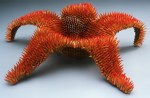
As you know, I look for unusual and/or bizarre things that I like in the world of art.  My favorites are using different materials – such as street art, the finger art, dots, nails, etc.  In this case I came across the work of Jennifer Maestre who used colored pencils not too color, but as the materials for some sculpting.  See if you like them as well. – MB

Art Made Out of Colored Pencils – Not With Them

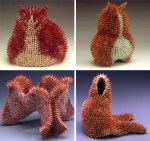
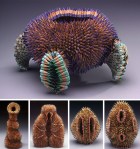
From a very first look at these wonderfully detailed colored pencil sculptures by Jennifer Maestre, it should come as no surprise that her artwork was initially inspired by spiny sea urchins – beautiful be dangerous to the touch.  For each sculpture, Jennifer hacks apart hundreds of colored pencils, cores them perpendicular to their length and turns them into beads, essentially, which she then meticulously stitches back together and slowly shapes into solid sculptures.  Though her beginnings were with creatures of the water, Jennifer quickly expanded her subject matter to cover other organic objects – from plants and flowers to house pets and more abstract animals.

While some of her work has a planned form from the very beginning, other pieces morph and shift as they take shape into something completely unplanned but nonetheless compelling.  While her work continues to evolve, this incredible artist has had dozens of exhibitions over the past decade and has also won numerous awards, pushing herself in new directions while exploring the limits of her unique approach.


Source:  http://www.stumbleupon.com/su/54z5ll/:ZD_qMAK9:SGoAX8rL/dornob.com/beyond-drawing-creative-colored-pencil-art-sculpture/

Leave a comment

Filed under Humor and Observations, Uncategorized

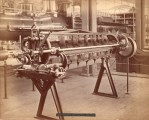
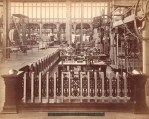
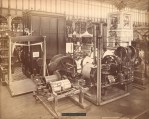
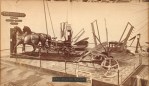
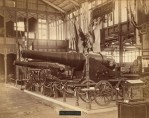
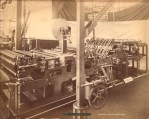
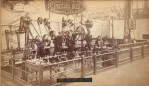
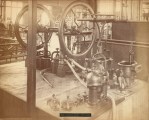
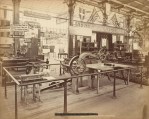
1876: Cutting Edge Machinery

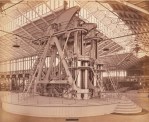
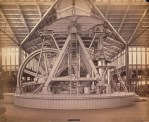
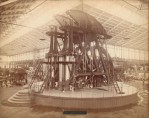
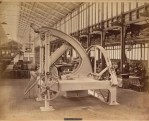
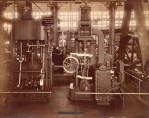
The Centennial in 1876 included the showcase of modern machinery in Philadelphia.  Remember, there were no machines to speak of just 50 years earlier.  Manpower, supplemented by horse power, was all there had been.  The Age of Steam brought about the Industrial Revolution, created larger cities, factories and changed everything we know.  The Civil War had ended just 12 years earlier and the Indian Wars were still going on.  Every picture you see of a machine was made without machining tools, computers or even the ability to improve on earlier designs.  The cross country railroad was being built but rails still suffered from a lack of standard gauge tracks.  Electricity and oil had yet to prove themselves as the energy of the future and were just beginning to be explored.

1876:  The Machinery Hall at the Centennial Exhibition Philadelphia

“During the Centennial year of 1876, Philadelphia was host to a celebration of 100 years of American cultural and industrial progress. Officially known as the “International Exhibition of Arts, Manufactures and Products of the Soil and Mine,” the Centennial Exhibition, the first major World’s Fair to be held in the United States, opened on May 10th.”

Click a photo to enlarge, then you can arrow left or right to see the rest in full screen.

Leave a comment

Filed under Humor and Observations