
Here are a list of some rare books and their prices. Just a reminder, you can buy my books today instead of waiting years until they cost millions.












Actors, Models and Filmmaker Needed
A friend of mine who is a fellow novelist in the Phoenix, Arizona area is looking to do a book cover and a small promo film for their book. This is their description of who they need:



I need 4 models/actors:
1) Girl, early to mid twenties, natural redhead (ginger). Long hair, thin.
2) Boy, early to mid twenties, light hair and light eyes. Thin.
3) Man, late twenties to early/mid thirties, built physique, long-ish hair. A little beard stubble (romance hero-type). Australian accent preferred, or at least the ability to fake it for 3 lines.
4) Man, mid to late thirties, African American, very built. Jamaican accent preferred, or the ability to fake it for just one line. There will be some acting, but not a lot of speaking.
Most of the speaking will be in voiceovers (mostly by the girl, who will also be the narrator). We’ll also do still shots with the girl (for the book cover).
I already have a still photographer (a friend) who has agreed to help.
Filmmaker – I need someone to film the video portions…a filmmaker with equipment (camera, lights, etc.) and with some know-how on setting up shots. I’d also need him/her to allow me to use the raw footage. My budget is tight, but I am willing to pay the actors and the crew, along with giving them credit on the trailer, and on my website, blog, Twitter, Facebook, and the novel, etc.
If you, or someone you know is interested, please contact me at eiverness@cox.net.
Filed under Uncategorized, Writing
Chinese Building One Million Strong ‘robot army’
Foxconn to Speed Up ‘robot Army’ Deployment; 20,000 Robots Already in its Factories
Foxconn also looking at the U.S. and Indonesia for expansion
By Michael Kan
Wed, June 26, 2013
Wed, June 26, 2013
IDG News Service (Beijing Bureau) — Manufacturing giant Foxconn Technology Group is on track with its goal to a create a “million robot army”, and already has 20,000 robotic machines in its factories, said the company’s CEO Terry Gou on Wednesday.
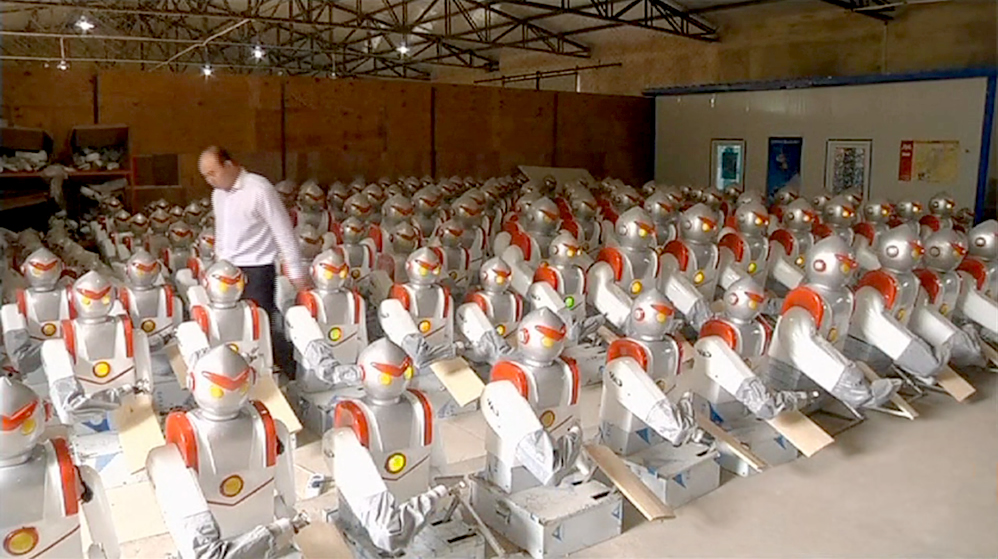
Workers’ wages in China are rising, and so the company’s research in robots and automation has to catch up, Gou said, while speaking at the company’s annual shareholder’s meeting in Taipei. “We have over 1 million workers. In the future we will add 1 million robotic workers,” he said. “Our [human] workers will then become technicians and engineers.”
Foxconn is the world’s largest contract electronics maker and counts Apple, Microsoft and Sony as some of its clients. Many of its largest factories are in China, where the company employs 1.2 million people, but rising Add a comment are threatening to reduce company profits.
To offset labor costs and improve its manufacturing, Foxconn has already spent three years on developing robots, Gou said. These machines are specifically developed to assemble electronics such as mobile phones, but it will take some time for Foxconn to fully develop the technology, he added.
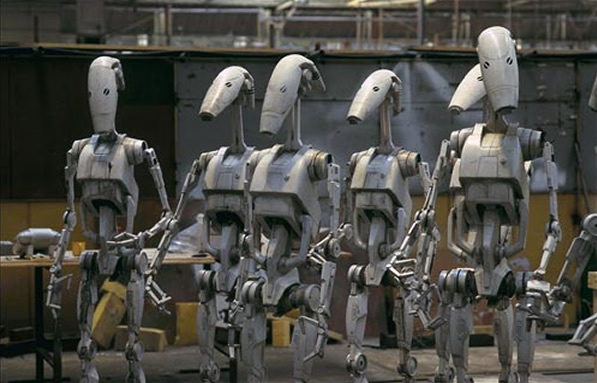
“It’s a middle to long-term goal,” Gou said. But already 20,000 robot arms and robotic tools are in use at the company’s factories.
Robotics have long been used to manufacture cars and large electronics. But currently, human workers are still the best choice to put together small consumer gadgets, many of which contain complicated wiring and small sockets that are best handled with human hands, according to experts.
In addition, Foxconn’s CEO said the company is prepared to expand its manufacturing in the U.S., but the move will depend on “economic factors.” The company already has factories in Indianapolis and Houston, and employs thousands of workers in the country, according to Gou.
Last December, Foxconn customer Apple said it would manufacture one of its Mac lines in the U.S. by the end of next year. Soon after, Foxconn said it was considering growing its existing manufacturing base in the country.
The Taiwanese company is also exploring building factories in Indonesia, a country with significantly lower labor costs than the U.S. or China. One possible plan is for Foxconn to build electronics for the local market, which is home to 240 million people.
“Indonesia has great potential and its a great market for my company,” Gou said. “Definitely we will put a lot of investment in Indonesia.”
The company, however, is waiting for the nation’s government to improve the regulations for its tech sector. Standards over electronics safety are so low that anyone can get away with selling shoddy mobile phones, said a Foxconn official in December.
“The direction is right, but we need to take time,” Gou added. “We think in one or two years this will happen.”
Filed under Humor and Observations
German Boy Finds Mummy In Grandmother’s Attic
Alexander Kettler, German Boy, Finds Mummy In Grandmother’s Attic
The Huffington Post | By Sara GatesPosted: 08/05/2013 7:35 pm EDT | Updated: 08/06/2013 11:34 am EDT
Alexander Kettler was playing in his grandmother’s home in Diepholz, Germany, last week when he stumbled across something unusual: a sarcophagus.
Alongside dust-covered boxes and clutter, the 10-year-old found a mummy in his grandmother’s attic, according to local reports. His family reportedly had never before come across the curious items.
“There was a huge sarcophagus and inside a mummy,” Kettler’s father Lutz Wolfgangtold Spiegel Online. “Then we opened the other cases and found an earthenware Egyptian death mask and a Canopic Jar.”

The elder Kettler suspects the ancient artifacts may have belonged to his late father, who traveled through North Africa during the 1950s. As the BBC notes, Kettler believes the sarcophagus and artifacts are replicas, but he said he thinks the mummy may be the real deal.
Testing will be required to confirm if the wrapped figure within the sarcophagus is an actual mummy. Kettler told the Bild newspaper that he plans to transport the mummy to Berlin for examination.
If the mummy is proven to be an authentic Egyptian antiquity, authorities in Egypt will seek to bring the relic back to the country.
“Diplomacy is a successful way to resolve these sorts of issues, and it is not costly,” Abdel Maqsoud, deputy director of the Antiquities Sector at Egypt’s Ministry of Antiquities, told Egypt Independent. “We should first check if the piece left the country legally and find out if it is registered at any museum.”
Filed under Humor and Observations
Random Humor
Random humor to bring you laughing into the weekend. Enjoy!












-

- Going to a new job cake









-

- Stork bringing a baby



-

- When posting selfies on the internet, it helps to leave out the screaming child






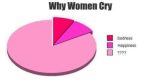


-

- Pet thing. Looks like bird water dispenser, but I guess it’s for dogs?
Filed under Humor and Observations
Magnetic, levitating ‘sky trains’ may be coming to a city near you
Magnetic, levitating ‘sky trains’ may be coming to a city near you
Published August 01, 2013
FoxNews.com
-

SkyTran’s levitating transit pods will carry passengers over street traffic to their destinations. (www.skytran.us)
Flying cars may sound like something out of “The Jetsons,” but Israel’s Tel Aviv is soon set to be the first city to welcome SkyTran’s futuristic transportation trains.
The mass transit system of magnetically levitating pods was co-developed by engineers from NASA’s Ames Research Center and the privately held SkyTran company .
.
Plagued by heavy traffic, the city of Tel Aviv is hoping to use SkyTran’s pods in order to offer energy and environmentally-friendly alternatives to cars and buses, The Times of Israel reported.
According to the planners, “sky trains” are a cheaper and faster transportation system and will help reduce congestion and pollution.
The city of Tel Aviv recently hired US consultant company Jenkins Gales & Martinez to help speed up the process in building the SkyTran track but no official timetable has been announced.
Filed under Humor and Observations
15-ton ball of fat removed from London sewer
15-ton ball of fat removed from London sewer
Published August 06, 2013
-

Picture taken on July 4, 2013 and released by waste management firm CountyClean Environmental Services shows a congealed ball of fat and waste in an underground sewer in Kingston, southwest London. The 15-tonne ball — dubbed Britain’s biggest ever ‘fatberg’ — was removed from a London sewer after a 10-day operation following complaints from local residents that they couldn’t flush their toilets. (CountyClean Environmental Services/AFP)
LONDON (AFP) – A 15-ton ball of congealed fat — dubbed Britain’s biggest ever “fatberg” — was removed from a London sewer after a 10-day operation following complaints from local residents that their toilets would not flush.
The monstrous lump of festering food fat mixed with wet wipes — the size of a bus — formed in drains under a major road in Kingston, southwest London, utility firm Thames Water said Tuesday.
Had it not been removed, the deposit could have led to sewage flooding homes, streets and businesses in the leafy London suburb, Thames Water said.
“While we’ve removed greater volumes of fat from under central London in the past, we’ve never seen a single, congealed lump of lard this big clogging our sewers before,” Gordon Hailwood, waste contracts supervisor for the company, said in a statement.
“Given we’ve got the biggest sewers and this is the biggest ‘fatberg’ we’ve encountered, we reckon it has to be the biggest such berg in British history.”
“The sewer was almost completely clogged with over 15 tonnes of fat. If we hadn’t discovered it in time, raw sewage could have started spurting out of manholes across the whole of Kingston.”
“It was so big it damaged the sewer and repairs will take up to six weeks.”
CCTV images from the sewer showed that the mound of fat had reduced the 27 by 19-inch drain to five per cent of its normal capacity.
CountyClean Environmental Services, the waste management company that removed the deposit, said it would go to good use.
“We recycle everything that we remove — the water is extracted and the remaining fats and oils are turned into products like soap, biodiesel and fuel,” a CountyClean spokesman told AFP.
“We have a very specialized piece of equipment — called a Kroll recycler — that we can use from the road and allows us to remove the fat without any workmen having to descend into the sewers.”
Thames Water warned homes and businesses needed to change their ways when it came to the disposal of fat and wet wipes, urging people to “Bin it — don’t block it.”
Filed under Uncategorized
Genetic ‘Adam’ and ‘Eve’ uncovered
I want to say that people often mistakenly think the Bible says that Adam and Eve were the first humans. It does not. In fact, when Cain, their son, kills another son, Abel, he is banished. He is in fear that other people will kill him, so a mark of protection is placed on him. He goes out to another land and marries. Where did the other people come from? To me, Adam and Eve were created and placed in a protected refuge – the Garden of Eden, protected from outside impacts. Creating Adam and Eve and animal life could be considered today as genetic engineering or an experiment in a lab. God created them, gave them free will and a few rules and saw what happened. The entire Bible is pretty much like that. From the chosen people of the Jews to the Christians of today, we are created by God but given free will, a set of standards to live by, and we get to choose.
You can explain things that they just happened, that ancient aliens experimented with us, or that a Creator made us. My son told me that he could create certain basic amino acid reactions in the laboratory where he is studying to become a bio-chemical engineer. Of course, it sometimes takes him many tries to get an experiment correct, even in laboratory conditions. I personally don’t believe that every major “it just happened” event could occur at precisely the right time and place so many times to create what we are now. I think just like my son doing a lab project, God created us in His lab of sorts.
So it is that information like the following fits in with my belief in God and my own personal theories of life on this planet and that it was created. It is ok if you disagree. That is your exercise of your own free will. 🙂
Genetic ‘Adam’ and ‘Eve’ uncovered
By Tia Ghose
Published August 02, 2013
LiveScience
-

Human sex-determining chromosomes: X chromosome (left) and the much smaller Y chromosome. (University of Arizona)
Almost every man alive can trace his origins to one man who lived about 135,000 years ago, new research suggests. And that ancient man likely shared the planet with the mother of all women.
The findings, detailed Thursday, Aug. 1, in the journal Science, come from the most complete analysis of the male sex chromosome, or the Y chromosome, to date. The results overturn earlier research, which suggested that men’s most recent common ancestor lived just 50,000 to 60,000 years ago.
Despite their overlap in time, ancient “Adam” and ancient “Eve” probably didn’t even live near each other, let alone mate. [The 10 Biggest Mysteries of the First Humans]
“Those two people didn’t know each other,” said Melissa Wilson Sayres, a geneticist at the University of California, Berkeley, who was not involved in the study.
Tracing history
Researchers believe that modern humans left Africa between 60,000 and 200,000 years ago, and that the mother of all women likely emerged from East Africa. But beyond that, the details get fuzzy.
The Y chromosome is passed down identically from father to son, so mutations, or point changes, in the male sex chromosome can trace the male line back to the father of all humans. By contrast, DNA from the mitochondria, the energy powerhouse of the cell, is carried inside the egg, so only women pass it on to their children. The DNA hidden inside mitochondria, therefore, can reveal the maternal lineage to an ancient Eve.
But over time, the male chromosome gets bloated with duplicated, jumbled-up stretches of DNA, said study co-author Carlos Bustamante, a geneticist at Stanford University in California. As a result, piecing together fragments of DNA from gene sequencing was like trying to assemble a puzzle without the image on the box top, making thorough analysis difficult.
Y chromosome
Bustamante and his colleagues assembled a much bigger piece of the puzzle by sequencing the entire genome of the Y chromosome for 69 men from seven global populations, from African San Bushmen to the Yakut of Siberia.
By assuming a mutation rate anchored to archaeological events (such as the migration of people across the Bering Strait), the team concluded that all males in their global sample shared a single male ancestor in Africa roughly 125,000 to 156,000 years ago.
In addition, mitochondrial DNA from the men, as well as similar samples from 24 women, revealed that all women on the planet trace back to a mitochondrial Eve, who lived in Africa between 99,000 and 148,000 years ago almost the same time period during which the Y-chromosome Adam lived.
More ancient Adam
But the results, though fascinating, are just part of the story, said Michael Hammer, an evolutionary geneticist at the University of Arizona who was not involved in the study.
A separate study in the same issue of the journal Science found that men shared a common ancestor between 180,000 and 200,000 years ago.
And in a study detailed in March in the American Journal of Human Genetics, Hammer’s group showed that several men in Africa have unique, divergent Y chromosomes that trace back to an even more ancient man who lived between 237,000 and 581,000 years ago. [Unraveling the Human Genome: 6 Molecular Milestones]
“It doesn’t even fit on the family tree that the Bustamante lab has constructed. It’s older,” Hammer told LiveScience.
Gene studies always rely on a sample of DNA and, therefore, provide an incomplete picture of human history. For instance, Hammer’s group sampled a different group of men than Bustamante’s lab did, leading to different estimates of how old common ancestors really are.
Adam and Eve?
These primeval people aren’t parallel to the biblical Adam and Eve. They weren’t the first modern humans on the planet, but instead just the two out of thousands of people alive at the time with unbroken male or female lineages that continue on today.
The rest of the human genome contains tiny snippets of DNA from many other ancestors they just don’t show up in mitochondrial or Y-chromosome DNA, Hammer said. (For instance, if an ancient woman had only sons, then her mitochondrial DNA would disappear, even though the son would pass on a quarter of her DNA via the rest of his genome.)
As a follow-up, Bustamante’s lab is sequencing Y chromosomes from nearly 2,000 other men. Those data could help pinpoint precisely where in Africa these ancient humans lived.
“It’s very exciting,” Wilson Sayres told LiveScience. “As we get more populations across the world, we can start to understand exactly where we came from physically.”
Filed under Humor and Observations, Uncategorized
Leaf Art
This is reposted from The Chive on the art of Lorenzo Manuel Duran –
Lorenzo Manuel Durán is an artist from Cáceres, Spain. Starting with more traditional oil paintings, he found himself inspired one day by a caterpillar eating a leaf. The moment propelled him to try cutting a leaf with a scalpel. That was 2008, and the rest is history.
Through a lengthy process of trial and error, Durán has developed his own leaf-cutting technique, taking great care not to ‘spoil’ the leaf during the cutting process. His main tools are a surgical scalpel and dental-pointed device that helps him remove the cut parts from the leaf.





Filed under Humor and Observations, Uncategorized
17 Euphemisms for Sex From the 1800s
17 Euphemisms for Sex From the 1800s
Gail Carriger shared this article with me on Facebook. She writes awesome Steampunk novels including the Parasol Protectorate series. I encourage you to read them. You can also read mine if you wish, set in the late Victorian period as well.

While shoe-horning these into conversation today might prove difficult, these 17 synonyms for sex were used often enough in 19th-century England to earn a place in the 1811 Dictionary of the Vulgar Tongue, a book for upper-crust Britons who had no idea what the proles were talking about.
1. AMOROUS CONGRESS
To say two people were engaged in the amorous congress was by far the most polite option on the list, oftentimes serving as the definition for other, less discreet synonyms.
2. BASKET-MAKING
“Those two recently opened a basket-making shop.” From a method of making children’s stockings, in which knitting the heel is called basket-making.
3. BREAD AND BUTTER
One on top of the other. “Rumor has it he found her bread and butter fashion with the neighbor.”
4. BRUSH
“Yeah, we had a brush once.” The emphasis here is on brevity; just a fling, no big deal.
5. CLICKET
“They left together, so they’re probably at clicket.” This was originally used only for foxes, but became less specific as more and more phrases for doing it were needed.
6. FACE-MAKING
Aside from the obvious, this also comes from “making children,” because babies have faces.
7. BLANKET HORNPIPE
There is probably no way to use this in seriousness or discreetly, but there you have it.
8. BLOW THE GROUNSILS
“Grounsils” are foundation timbers, so “on the floor.”
9. CONVIVIAL SOCIETY
Similar to “amorous congress” in that this was a gentler term suitable for even the noble classes to use, even if they only whispered it.
10. TAKE A FLYER
“Flyers” being shoes, this is “dressed, or without going to bed.”
11. GREEN GOWN
Giving a girl a green gown can only happen in the grass.
12. LOBSTER KETTLE
A woman who sleeps with soldiers coming in at port is said to “make a lobster kettle” of herself.
13. MELTING MOMENTS
Those shared by “a fat man and woman in amorous congress.”
14. PULLY HAWLY
A game at pully hawly is a series of affairs.
15. ST. GEORGE
In the story of St. George and the Dragon, the dragon reared up from the lake to tower over the saint. “Playing at St. George” casts a woman as the dragon and puts her on top.
16. A STITCH
Similar to having a brush, “making a stitch” is a casual affair.
17. TIFF
A tiff could be a minor argument or falling-out, as we know it. In the 19th century, it was also a term for eating or drinking between meals, or in this case, a quickie.
Read the full text here: http://mentalfloss.com/article/12399/17-euphemisms-sex-1800s#ixzz2bFhAPP5J
–brought to you by mental_floss!
Filed under Humor and Observations, Writing

