Mummies Show Clogged Arteries 4,000 years ago.

Even 4,000 year-old mummies had clogged arteries, study reveals

Published March 11, 2013

Associated Press

  • MummyHeartDisease.JPG

    March 10, 2013: A a group of cardiologists lead by Saint Luke’s Mid America Heart Institute in Kansas City, USA, show the mummy Hatiay (New Kingdom, 18th Dynasty, 1550 to 1295 BCE) as it is returned to its display back in the Antiquities Museaum in Cairo after it underwent a CT scanning. (AP)

  • Egypt Mummies Heart Disease 1.jpg

    March 10, 2013: The sarcophagus of the mummy Hatiay (New Kingdom, 18th Dynasty, 1550 to 1295 BCE) is closed after the mummy underwent a CT scanning, in Cairo, Egypt. (AP Photo/Dr. Michael Miyamoto)

  • Egypt Mummies Heart Disease 2.jpg

    March 10, 2013: Egyptologists prepare the mummy Hatiay (New Kingdom, 18th Dynasty, 1550 to 1295 BCE) for CT scanning in Cairo, Egypt, which later demonstrated evidence of extensive vascular disease. (AP Photo/Dr. Michael Miyamoto)

  • Egypt Mummies Heart Disease.jpg

    March 10, 2013: The mummy Hatiay (New Kingdom, 18th Dynasty, 1550 to 1295 BCE) gets a CT scan in Cairo, Egypt, where it was found to have evidence of extensive vascular disease. (AP Photo/Dr. Michael Miyamoto)

Even without modern-day temptations like fast food or cigarettes, people had clogged arteries some 4,000 years ago, according to the biggest-ever hunt for the condition in mummies.

Researchers say that suggests heart disease may be more a natural part of human aging rather than being directly tied to contemporary risk factors like smoking, eating fatty foods and not exercising.

‘Heart disease has been stalking mankind for over 4,000 years.’

– Dr. Randall Thompson, a cardiologist at Saint Luke’s Mid America Heart Institute in Kansas City 

CT scans of 137 mummies showed evidence of atherosclerosis, or hardened arteries, in one third of those examined, including those from ancient people believed to have healthy lifestyles. Atherosclerosis causes heart attacks and strokes. More than half of the mummies were from Egypt while the rest were from Peru, southwest America and the Aleutian islands in Alaska. The mummies were from about 3800 B.C. to 1900 A.D.

“Heart disease has been stalking mankind for over 4,000 years all over the globe,” said Dr. Randall Thompson, a cardiologist at Saint Luke’s Mid America Heart Institute in Kansas City and the paper’s lead author.

The mummies with clogged arteries were older at the time of their death, around 43 versus 32 for those without the condition. In most cases, scientists couldn’t say whether the heart disease killed them.

The study results were announced Sunday at a meeting of the American College of Cardiology in San Francisco and simultaneously published online in the journal Lancet.

Thompson said he was surprised to see hardened arteries even in people like the ancient Aleutians who were presumed to have a healthy lifestyle as hunter-gatherers.

“I think it’s fair to say people should feel less guilty about getting heart disease in modern times,” he said. “We may have oversold the idea that a healthy lifestyle can completely eliminate your risk.”

Thompson said there could be unknown factors that contributed to the mummies’ narrowed arteries. He said the Ancestral Puebloans who lived in underground caves in modern-day Colorado and Utah, used fire for heat and cooking, producing a lot of smoke.

“They were breathing in a lot of smoke and that could have had the same effect as cigarettes,” he said.

Previous studies have found evidence of heart disease in Egyptian mummies, but the Lancet paper is the largest survey so far and the first to include mummies elsewhere in the world.

Dr. Frank Ruehli of the University of Zurich, who runs the Swiss Mummy Project, said it was clear atherosclerosis was notably present in antiquity and agreed there might be a genetic predisposition to the disease.

“Humans seem to have a particular vulnerability (to heart disease) and it will be interesting to see what genes are involved,” he said. Ruehli was not connected to the study. “This is a piece in the puzzle that may tell us something important about the evolution of disease.”

Other experts warned against reading too much into the mummy data.

Dr. Mike Knapton, associate medical director at the British Heart Foundation, said calcified arteries could also be caused by other ailments including endocrine disorders and that it was impossible to tell from the CT scans if the types of calcium deposits in the mummies were the kind that would have sparked a heart attack or stroke.

“It’s a fascinating study but I’m not sure we can say atherosclerosis is an inevitable part of aging,” he said, citing the numerous studies that have showed strong links between lifestyle factors and heart disease.

Researcher Thompson advised people to live as healthy a lifestyle as possible, noting that the risk of heart disease could be reduced with good eating habits, not smoking and exercising. “We don’t have to end up like the mummies,” he said.

Read more: http://www.foxnews.com/science/2013/03/11/study-reveals-even-4000-year-old-mummies-had-clogged-arteries/?intcmp=related#ixzz2NNFOasby

1 Comment

Filed under Humor and Observations

Comet Pan-STARRS at its brightest this weekend!

By Miriam Kramer

Published March 08, 2013

Space.com

  • comet-panstarrs-march-2013

    The progression of comet Pan-STARRS across the night sky in March 2013 is shown in this NASA graphic. (SCIENCE@NASA)

  • comet-pan-starrs-sky-map

    The path of Comet C/2011 L4 (Pan-STARRS) over the next month. (STARRY NIGHT SOFTWARE)

  • comet-pan-starrs-close-up-gingin-observatory

    Close-up of comet C/2011 L4 PANSTARRS as seen from Mount Dale, Western Australia. (ASTRONOMY EDUCATION SERVICES/GINGIN OBSERVATORY)

A comet that just made its way into the Northern Hemisphere evening sky should be at its brightest this weekend, but it may be tricky for stargazers to see.

On Sunday (March 10), the Comet Pan-STARRS is expected to make its closest approach to the sun, potentially making the comet shine even more brilliantly when it appears at twilight low in the western sky, weather permitting. But stargazers will need a bit of preparation (not to mention a clear sky) to see the comet.

“There is a catch to viewing Comet Pan-STARRS,” Amy Mainzer, the principal investigator of NASA’s near-Earth object hunting NEOWISE mission at the Jet Propulsion Laboratory in Pasadena, Calif., said in a statement Thursday (March 7). “This one is not that bright and is going to be low on the western horizon, so you’ll need a relatively unobstructed view to the southwest at twilight and, of course, some good comet-watching weather.”

On Sunday, Comet Pan-STARRS will pass about 28 million miles from the sun during its close approach. The comet made its closest pass with the Earth on Tuesday (March 5) when it flew by at about 102 million miles from the planet. [How to see the comet]

“It will appear in the west at sunset, from around the 8th to the 13th of March 2013, and will be visible to the naked eye up to the end of the month: Comet Pan-STARRS C/2011 L4 will traverse Cetus, Pisces, Pegasus and Andromeda,” Paris Observatory officials wrote in a statement Thursday, as the comet entered the Northern Hemisphere’s evening sky after months of being visible from the Southern Hemisphere.

Comet Pan-STARRS, which has the official designation C/2011 L4 (PANSTARRS), was discovered in June 2011 by astronomers using the Panoramic Survey Telescope and Rapid Response System (or PANSTARRS) telescope in Hawaii. The comet made its way into the inner solar system from the Oort cloud — a group of icy bodies orbiting the sun in a region that extends from just beyond the orbit of Neptune out to a distance of 93 trillion miles.

While Pan-STARRS may start dimming after Sunday, that doesn’t mean that comet observers should put away their binoculars yet. On March 12 and 13, the comet will appear close to the moon, possibly even silhouetting it according to SPACE.com stargazing columnist Geoff Gaherty, an astronomer with the Starry Night Education night sky software company.

There are even comet sighting opportunities in April.

On April 3, the comet should be in the same part of the sky as the Andromeda Galaxy. Although the comet won’t still be visible with the naked eye, stargazers with telescopes could still get a nice view of the comet and galaxy, Gaherty explained.

Pan-STARRS has already put on a show for stargazers in the Southern Hemisphere. It is one of several comets in the night sky expected to dazzle observers this year. Last month, amateur astronomers managed to photograph Pan-STARRS and another celestial wanderer — Comet Lemmon — at the same time to document rare photos of two comets together in the night sky.

Later this year, another comet from the Oort Cloud could be the brightest comet to pass by the Earth in a generation. Comet ISON is expected to outshine every comet in recent memory when it makes its closest swing by the sun late November.

Read more:http://www.foxnews.com/science/2013/03/08/naked-eye-comet-pan-starrs-at-its-brightest-this-weekend/?intcmp=trending#ixzz2NNIZrGk1

Leave a comment

Filed under Humor and Observations, Uncategorized

Legendary Viking “Sunstone” real?

Is legendary Viking ‘sunstone’ real?

By Megan Gannon

Published March 10, 2013

LiveScience

  • viking-crystal

    Researchers say this crystal found at the Alderney shipwreck near the Channel Islands could prove fabled Viking sunstones really did exist. (© Alderney Museum)

Ancient lore has suggested that the Vikings used special crystals to find their way under less-than-sunny skies. Though none of these so-called “sunstones” have ever been found at Viking archaeological sites, a crystal uncovered in a British shipwreck could help prove they did indeed exist.

The crystal was found amongst the wreckage of the Alderney, an Elizabethan warship that sank near the Channel Islands in 1592. The stone was discovered less than 3 feet from a pair of navigation dividers, suggesting it may have been kept with the ship’s other navigational tools, according to the research team headed by scientists at the University of Rennes in France.

If you were to look at someone’s face through a clear chunk of Icelandic spar, you would see two faces. 

A chemical analysis confirmed that the stone was Icelandic Spar, or calcite crystal, believed to be the Vikings’ mineral of choice for their fabled sunstones, mentioned in the 13th-century Viking saga of Saint Olaf.

Today, the Alderney crystal would be useless for navigation, because it has been abraded by sand and clouded by magnesium salts. But in better days, such a stone would have bent light in a helpful way for seafarers.

Because of the rhombohedral shape of calcite crystals, “they refract or polarize light in such a way to create a double image,” Mike Harrison, coordinator of the Alderney Maritime Trust, told LiveScience. This means that if you were to look at someone’s face through a clear chunk of Icelandic spar, you would see two faces. But if the crystal is held in just the right position, the double image becomes a single image and you know the crystal is pointing east-west, Harrison said.

These refractive powers remain even in low light when it’s foggy or cloudy or when twilight has come. In a previous study, the researchers proved they could use Icelandic spar to orient themselves within a few degrees of the sun, even after the sun had dipped below the horizon.

European seafarers had not fully figured out magnetic compasses for navigation until the end of 16th century. The researchers say the crystal might have been used on board the Elizabethan ship to help correct for errors with a magnetic compass.

“In particular, at twilight when the sun is no longer observable being below the horizon, and the stars still not observable, this optical device could provide the mariners with an absolute reference in such situation,” the researchers wrote online this week in the journal Proceedings of the Royal Society A.

No such crystals have been found yet at Viking sites. The team notes that archaeologists are unlikely to find complete crystals as part of a group of grave goods, since the Vikings often cremated their dead.

But recent excavations turned up the first calcite fragment at a Viking settlement, “proving some people in the Viking Age were employing Iceland spar crystals,” the researchers wrote.

Read more: http://www.foxnews.com/science/2013/03/10/first-evidence-viking-sunstone-found/?intcmp=features#ixzz2NIgtRywA

Leave a comment

Filed under Humor and Observations

Word Trivia

Word Trivia

Fun Fridays – May 11, 2012

Word Trivia

“Stewardesses” and “reverberated” are the two longest (and commonly used) words (12 letters each) that can be typed with only the left hand.

“lollipop” is the longest word typed with your right hand.

The only 15 letter word that can be spelled without repeating a letter is uncopyrightable.

No word in the English language rhymes with month, orange, silver, or purple.

“Dreamt” is the only English word that ends in the letters “mt”.

The sentence: “The quick brown fox jumps over the lazy dog” uses every letter of the alphabet.

The words ‘racecar,’ ‘kayak’ and ‘level’ are the same whether they are read left to right or right to left (palindromes).

There are only four words in the English language which end in “dous”: tremendous, horrendous, stupendous, and hazardous.

There are two words in the English language that have all five vowels in order: “abstemious” and “facetious.” (a e i o u)

Typewriter is the longest word that can be made using the letters only on one row of the keyboard.

A “jiffy” is an actual unit of time for 1/100th of a second.

The only city whose name can be spelled completely with vowels is Aiea, Hawaii.

[Editor’s Note:  I did in fact live in Aiea for many years during a six year stint in Hawaii on the island of Oahu.  My wife and I had a terrible time getting mail.  All of our friends and family could not believe we lived in a place with only four vowels and no consonents – A I E A.  Pronounced “EYE -A- Uh”  The most common misspelling was ALEA.  They just randomly put an L in for the Aiea.  Curious folks my wonder where Aiea is located.  It is between Honolulu and Pearl Ridge.  We lived in a ten story apartment complex across the street from Aiea Chop Suey and Speedy’s Supermarket.  Aloha Stadium (home to the Aloha Bowl, the Hula Bowl, and The Pro Bowl and to the University of Hawaii Rainbow Warrior all played there.  From our lanai (balcony) we would look out over all of Pearl Harbor.  The Arizona Memorial was right in front of us.]


Leave a comment

Filed under Uncategorized, Writing

Early Snow Removal Devices

Scenes From the History of Snow Removal

IMAGE CREDIT:
UNIVERSITY OF VERMONT LIBRARIES CENTER FOR DIGITAL INITIATIVES

In some areas, the weather outside is pretty frightful. And since you’ve no place to go but outside to shovel, get cozy and read about snow removal in the good old days.

ON A ROLL

For a good stretch of American history, getting rid of snow was of no great concern. In fact, people actually wanted it around. While this might blow the minds of modern Northeasterners and Midwesterners, keep in mind that these were the days of the horse-drawn vehicle, not the Prius. To improve travel in winter conditions, horse carts and coaches traded their wheels in for ski-like runners. With those things on, the more packed snow on the roads, the better! Historian and weather geek Eric Sloane wrote that, in the 18th and 19th centuries, “snow was never a threat” to road travel, “but rather it was an asset.”

To keep roads in optimal snowy condition, many municipalities employed a “snow warden” to pack and flatten the snow with a crude vehicle called a snow roller—essentially a giant, wide wheel weighed down with rocks and pulled by oxen or horses. A far cry from the winter road work we see today, it was more like maintaining a ski slope or smoothing out an ice rink. Stranger still, snow wardens actually had to install snow on the pathways of covered bridges so that travel would not be interrupted.

PLOW ABOUT THAT

Photo Courtesy Schwartz Boiler Shop

By the mid 1800s, several different inventors had patented their own versions of a horse-drawn snow plow meant for clearing alleys and residential streets that saw more foot traffic than carriages. In 1862, Milwaukee became the first major municipality to try one out, and it was a hit. Over the next few years, the plows hit the streets in cities throughout the Snow Belt.

But horse-drawn plows didn’t stand a chance against the Blizzard of 1888, which bludgeoned the East Coast from the Chesapeake Bay up to Maine. After three days, some places were buried in up to 50 inches of snow, and high winds caused drifts up to 40 feet tall to form. The plow-pulling horses, like everyone else, had no choice but to stay inside and wait for the snow to melt. Cities in the region learned a valuable lesson about preparation, and the following year many implemented measures like hiring more plows and giving them assigned routes, and sending the plows out to start clearing the roads in the early stages of the storm.

BLOWN AWAY


The Jull Centrifugal Snow Plough. Photo Courtesy of Made In Canada

Around the same time, on the other side of the country, the rotary snowplow—or as we know it, the snow blower—was getting its start in an unlikely place far removed from the suburban driveways where they’re now normally seen. In the Canadian West, railroad men were having a hard time keeping their tracks clear of snow. The railroad snowplows used back east and on the prairies were the wedge-shaped cow-catcher type that pushed the snow to the sides of the track, and they just didn’t work in the deep, heavy snow of the western mountains.

J.W. Elliott, a Toronto dentist, had been tinkering with a plow design he thought might work well on a train. His plow had a rotary engine that drove a wheel rimmed with flat blades. As the plow went down the track, snow collected in a housing on the plow and then got funneled up to the blades, which tossed the snow out through an opening at the top of the housing. The railroads passed on it, but Elliot persisted. He hooked up with inventor Orange Jull to improve the design and commission a full-scale working model. The next winter, they convinced the Canadian Pacific Railroad to road-test the new plow on its line near Toronto. The plow cleared the track easily, tossing snow as far as 200 feet out of the way, and the railroad managers were impressed enough to buy eight plows and put them to work. Over the few decades, snowblowers got cheaper, smaller, and easier to use, with truck-mounted models and, eventually, human-powered ones for home use hitting the market.

CAR-PLOW


Photo Courtesy of the National Archives of Norway

As automobiles replaced horses and carriages on the roads of the U.S., the snow problem got flipped on its head. It wouldn’t be enough to clear the alleys and pack down the snow on the main roads anymore. Cars required dry, safe streets. Motorized salt spreaders were introduced, but they often didn’t do enough, and urban sprawl meant most cities were just too big for horse-drawn plows to clean all the streets. In the early 1920s, Norwegian brothers Hans and Even Overaasen and New Yorker Carl Frink independently came up with designs for car-mounted snow plows. These were, apparenty the perfect solution to the modern snow problem, and the company Frink started is still producing plows today.

As for the snow removal tool the average Joe is most familiar with, 100-plus patents have been granted for snow shovel designs since the 1870s. One of the first designs that hit upon the “scrape and scoop” combo was invented in 1889 by—get this—a woman named Lydia Fairweather.

Read the full text here: http://mentalfloss.com/article/32006/scenes-history-snow-removal#ixzz2NIgAvxQe
–brought to you by mental_floss!

Leave a comment

Filed under Humor and Observations

Ancient Shoes Found In Egypt

Lost and found: Ancient shoes turn up in Egypt temple

By Owen Jarus

Published February 28, 2013

LiveScience

  • 4-Egypt-shoe-discovery

    The unwrapped shoe bundle showing the two pairs of children’s shoes and the adult isolate. (© 2005 Franco M. Giani – Milano – Italy)

More than 2,000 years ago, at a time when Egypt was ruled by a dynasty of kings of Greek descent, someone, perhaps a group of people, hid away some of the most valuable possessions they had — their shoes.

Seven shoes were deposited in a jar in an Egyptian temple in Luxor, three pairs and a single one. Two pairs were originally worn by children and were only about 7 inches long. Using palm fiber string, the child shoes were tied together within the single shoe (it was larger and meant for an adult) and put in the jar. Another pair of shoes, more than 9 inches long that had been worn by a limping adult, was also inserted in the jar.

The shoe-filled jar, along with two other jars, had been “deliberately placed in a small space between two mudbrick walls,” writes archaeologist Angelo Sesana in a report published in the journal Memnonia.

Whoever deposited the shoes never returned to collect them, and they were forgotten, until now. [See Photos of the Ancient Egyptian Shoes]

‘The shoes were in pristine condition and still supple upon discovery.’

– André Veldmeijer, an expert in ancient Egyptian footwear 

In 2004, an Italian archaeological expedition team, led by Sesana, rediscovered the shoes. The archaeologists gave André Veldmeijer, an expert in ancient Egyptian footwear, access to photographs that show the finds.

“The find is extraordinary as the shoes were in pristine condition and still supple upon discovery,” writes Veldmeijer in the most recent edition of the Journal of the American Research Center in Egypt. Unfortunately after being unearthed the shoes became brittle and “extremely fragile,” he added.

Pricey shoes
Veldmeijer’s analysis suggests the shoes may have been foreign-made and were “relatively expensive.” Sandals were the more common footwear in Egypt and that the style and quality of these seven shoes was such that “everybody would look at you,” and “it would give you much more status because you had these expensive pair of shoes,” said Veldmeijer, assistant director for Egyptology of the Netherlands-Flemish Institute in Cairo.

The date of the shoes is based on the jar they were found in and the other two jars, as well as the stratigraphy, or layering of sediments, of the area. It may be possible in the future to carbon date the shoes to confirm their age.

Why they were left in the temple in antiquity and not retrieved is a mystery. “There’s no reason to store them without having the intention of getting them back at some point,” Veldmeijer said in an interview with LiveScience, adding that there could have been some kind of unrest that forced the owners of the shoes to deposit them and flee hastily. The temple itself predates the shoes by more than 1,000 years and was originally built for pharaoh Amenhotep II (1424-1398 B.C.).

Design discoveries
Veldmeijer made a number of shoe design discoveries. He found that the people who wore the seven shoes would have tied them using what researchers call “tailed toggles.” Leather strips at the top of the shoes would form knots that would be passed through openings to close the shoes. After they were closed a long strip of leather would have hung down, decoratively, at either side. The shoes are made out of leather, which is likely bovine.

Most surprising was that the isolated shoe had what shoemakers call a “rand,” a device that until now was thought to have been first used in medieval Europe. A rand is a folded leather strip that would go between the sole of the shoe and the upper part, reinforcing the stitching as the “the upper is very prone to tear apart at the stitch holes,” he explained. The device would’ve been useful in muddy weather when shoes are under pressure, as it makes the seam much more resistant to water.

In the dry (and generally not muddy) climate of ancient Egypt, he said that it’s a surprising innovation and seems to indicate the seven shoes were constructed somewhere abroad.

Health discoveries
The shoes also provided insight into the health of the people wearing them. In the case of the isolated shoe, he found a “semi-circular protruding area” that could be a sign of a condition called Hallux Valgus, more popularly known as a bunion. [The 9 Most Bizarre Medical Conditions]

“In this condition, the big toe starts to deviate inward towards the other toes,” Veldmeijer writes in the journal article. “Although hereditary, it can also develop as a result of close fitting shoes, although other scholars dispute this ….”

Another curious find came from the pair of adult shoes. He found that the left shoe had more patches and evidence of repair than the shoe on the right. “The shoe was exposed to unequal pressure,” he said, showing that the person who wore it “walked with a limp, otherwise the wear would have been far more equal.”

Still, despite their medical problems, and the wear and tear on the shoes, the people who wore them were careful to keep up with repairs, Veldmeijer said. They did not throw them away like modern-day Westerners tend to do with old running shoes.

“These shoes were highly prized commodities.”

Veldmeijer hopes to have the opportunity to examine the shoes, now under the care of the Ministry of State for Antiquities, firsthand.

Read more: http://www.foxnews.com/science/2013/02/28/lost-and-found-ancient-shoes-turn-up-in-egypt-temple/?intcmp=obinsite#ixzz2NIf3IGOv

1 Comment

Filed under Humor and Observations

Cute Dogs for Your Monday Blues!

More cute dogs for your Monday blues.  Every Monday we post dog pictures.  To find other posts, if you need extra cheering up, type “cute dogs” into the Search box on the site’s home page.  Enjoy!

1 Comment

Filed under Animals

Sailors from USS Monitor buried in Arlington – 150 years later…

150 years later, Union sailors from USS Monitor to be buried at Arlington

By 

Published March 04, 2013

FoxNews.com

  • monitor.jpg

    The bodies were found when the USS Monitor’s rusty gun turret was raised from the ocean floor. ( National Oceanic and Atmospheric Administration)

Two Navy sailors slated for heroes’ burials at Arlington National Cemetery have waited a century and a half for the honor.

The men were among the crew members who perished aboard the legendary Union battleship the USS Monitor, which fought an epic Civil War battle with Confederate vessel The Merrimack in the first battle between two ironclad ships in the Battle of Hampton Roads, on March 9, 1862.

Nine months later, the Monitor sank in rough seas off of Cape Hatteras, where it was discovered in 1973. Two skeletons and the tattered remains of their uniforms were discovered in the rusted hulk of the Union ironclad in 2002, when its 150-ton turret was brought to the surface. The Navy spent most of a decade trying to determine the identity of the remains through DNA testing.

“It’s been interesting to be connected to something so momentous, and we’re looking forward to the ceremony.”

– Diana Rambo, possible descendant of USS Monitor sailor 

“These may very well be the last Navy personnel from the Civil War to be buried at Arlington,” Navy Secretary Ray Mabus said. “It’s important we honor these brave men and all they represent as we reflect upon the significant role Monitor and her crew had in setting the course of our modern Navy.”

Although testing has narrowed the identities of the men down to six, descendants of all 16 soldiers who died when the ship sank are expected at the ceremony. Diana Rambo, of Fresno, Calif., said DNA testing showed a 50 percent chance that one man was Jacob Nicklis, her grandfather’s uncle. A ring on his right finger matched one in an old photograph, adding to the likelihood he was her relative. She plans to be at the cemetery when he is buried.

“It’s been interesting to be connected to something so momentous, and we’re looking forward to the ceremony,” Rambo told FoxNews.com.

She said the development has brought several branches of the family together as they sift through old letters and photos and piece together their shared genealogy. One letter in particular made her long-lost relative seem real.

“I’ve started doing the research, and even read letters he wrote to his father saying he really didn’t want to go,” said Rambo, who was able to tell her 90-year-old mother of the Navy’s revelation a week before her death. “And you think about how many of these kids today are in that situation.”

David Alberg, superintendent of the Monitor sanctuary, pressed for the pair to have Arlington burial honors, as did the National Oceanic and Atmospheric Administration’s Maritime Heritage Program and descendants of the surviving Monitor crewmembers.

Although most schoolkids learn that the Monitor fought the Merrimack to a draw in 1862, the ship that the Monitor took on was actually dubbed the Virginia, and built on the hull of the U.S. Navy frigate USS Merrimack. Some 16 sailors died when the Monitor sank, while about 50 more crewmembers were plucked from the sea by the crew of the Rhode Island.

Although the Monitor sank soon after the battle, it still outlasted the Virginia, which the Confederates were forced to scuttle in early May. The Monitor sailed up the James River to support the Army during the Peninsula Campaign, taking part in the Battle of Drewry’s Bluff before sinking while being towed during a storm off the Carolina coast. The ship’s gun turret, engine and other relics are on display at the Mariners’ Museum in Newport News, Virginia.

Read more: http://www.foxnews.com/us/2013/03/04/150-years-later-union-sailors-from-uss-monitor-to-be-buried-at-arlington/#ixzz2NCYc6twQ

Leave a comment

Filed under Humor and Observations

Steampunk Airship Crew #6

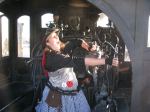
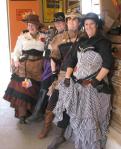
Having just returned from the amazing Wild Wild West Con 2, the Steampunk Convention at Old Tucson Studios, I have to put up more Steampunk pictures.  I had a great panel with myself, friends Patti Hulstrand and Chris Wilke.  Kudos to Diana, Jason, and Noe on throwing a great convention that was tons of fun.  Built up some wife points when I purchased Becky the whole set of original Con versions of Lady Mechanika – yes Joe Benitez was there!  They were all signed and packaged, but he was nice enough to further personalize each “to Becky.”  There was also a booth selling amazingly well made corsets for just $60.  My wife went to get one, feeling a bit guilty after I had already spoiled her, but unfortunately they did not have her size in the color she wanted.

I met so many amazing new people there is not really time to list them all.  Thanks again to those who invited me out as a guest to speak on a panel about Steampunk and writing!  Thanks also to Davina and Kathleen, who were there at the panel, and purchased The Travelers’ Club and the Ghost Ship!  I hope you enjoy it immensely!

Now, to the aircrew.  The ones in the desert are most likely from WWWC2.  I will be sprinkling them over time.  You are now ready to pick the crew and staff for your sixth airship in your burdgeoning fleet.  Do you want a merchant vessel, an explorer, a pirate ship, a military vessel, a ship for world domination, or other purposes?  Choose your crew wisely.  You cannot pick more than eight.

Leave a comment

Filed under Humor and Observations, Uncategorized

Travel the Ancient Roman Empire!

Below is a story from I09 about ORBIS.  ORBIS is an amazing site that actually allows you to explore the ancient Roman Empire by map, and see how long various modes of travel would take, what form they would take, and how many denarii would be needed.  Very cool.  First the link, then the story:

http://orbis.stanford.edu/#

This interactive travel map of the Roman Empire is like Oregon Trail meets Civilization

Ever wondered how long it would take to travel from Rome to Constantinople at the peak of the Roman Empire? Or from Luna to Larissa? Or Parma to Thessalonica? This map of the Roman World created at Stanford University is awesomely realistic — all the ancient transportation lines on it actually existed 2,000 years ago.

Tell us, would you like to travel to Rome by road, river or open sea? Would you stick to the coasts or set a course through the mainland? During which month would you journey? Would you opt for the fastest route (bearing in mind that the shortest course does not always translate to the quickest passage) or the cheapest? Speaking of expenses, how much would this journey cost you, anyway? (Please give your answer in denarii.)

Confused? Overwhelmed? Fear not — ORBIS is here to help you plan your trip. ORBIS is Stanford University’s geospatial network model of the Roman World. It’s fully interactive (as we alluded to above, you can adjust time of travel, mode of travel, starting points and destinations, and so on); highly customizable (select from fourteen different modes of transportation — and that’s just road travel); and positively bursting with information. It’s a little like Oregon Trailmeets Civilization, only without the dysentery and with infinitely more historical and comparative data. Yes, it is awesome, and — if you’re into this sort of thing — enormously time consuming.

Via Stanford:


For the first time, ORBIS allows us to express Roman communication costs in terms of both time and expense. By simulating movement along the principal routes of the Roman road network, the main navigable rivers, and hundreds of sea routes in the Mediterranean, Black Sea and coastal Atlantic [featured above is a depiction of navigable sea routes in July, with coastal routes in blue and overseas routes in green], this interactive model reconstructs the duration and financial cost of travel in antiquity.

Taking account of seasonal variation and accommodating a wide range of modes and means of transport, ORBIS reveals the true shape of the Roman world and provides a unique resource for our understanding of premodern history. [Featured below: a contour map of travel time to Rome in July.]


You can learn a little more about using ORBIS in this introductory video, but we highly recommend heading over to the ORBIS website, where you’ll learn more about this geospatial model’s applications and its historically rich digital architecture. This is really, really impressive stuff.

[ORBIS]

Top image via Shutterstock

Leave a comment

Filed under Humor and Observations, Uncategorized