Acclaimed Author Robert Scanlan to Speak at VSEBT Annual Conference

Acclaimed Author Robert Scanlan to Speak at VSEBT Annual Conference.

Leave a comment

Filed under Humor and Observations

Rough Spots…

We all have rough spots in our lives.  For me, I am in one.  I don’t usually whine or talk about myself if I can help it.  So forgive this exception…

First, it is 113 degrees in Phoenix, which is freaking hot, and our last electricity bill was $650 and will be higher for the next two or three months…

untitled (12)

Second, our three dogs have all been sick.  Our 18 year old dog was walking like a letter C.  We had to get her cortisone injections and x-rays.  Her liver is also failing.  Now she has a mystery splotch growing on her spine.  So she goes back tomorrow.  Meanwhile, her furry brothers got the flu or a cold.  Shaking, cold then hot, listless, have to be held…

untitled (3)

Third, my wife took my car without telling me.  Hers apparently has an air conditioner on the fritz and she had scheduled it for the shop.  I don’t like her driving my car because it is a six speed high compression sports car and she drives an automatic.  I worry she will have issues shifting and hit something.  Instead, a tire blew out.  So, my car was in the shop for a few days to get my custom tires imported from Japan and installed for just under $1,000.  Meanwhile, her car is in and out of the shop, fixed twice for around $400 and still not having the A/C work, goes back on Friday…

imagesCAZWJ3X0

Fourth, my ongoing osteo-necrosis has been cropping up again with severe pain in the neck and back…  Physical therapy three times per day for two hours each for six weeks has it down a bit, but this week it decided to be ugly again and get back to the 7 out of 10 scale at times…

untitled

Fifth, pain reduces my work day (I know I am supposed to be retired…).  However, as an author, writer for magazines, and consultant, this is a busy time of year for me.  The consulting especially is pretty heavy right now.  That leaves me working in pain and feeling zero creativity.

untitled (2)

Sixth, my main computer is still having memory issues.  Somehow it keeps putting temp files to my solid state boot up drive which only has 40 gig memory, instead of my hard drive which has 2 Terrabytes of unused space…  Meaning I work more off my laptop, which can’t handle graphics without restarting every 30 minutes and drops my typing speed from 100 wpm down to about 25 wpm.

Finally, unexpected expenses like cars, dogs, extreme early summer weather, medical, etc., have taken their toll on my retirement reserves.

That is my complaining for now.  Perhaps I should look at my cute dog picture posts…  How was your week?


1 Comment

Filed under Humor and Observations

Redshirts – Safer Than You Might Think

Although more Redshirts died in the many Star Trek TV shows and films, oddly enough, it is more dangerous to be a gold shirt on a percentage basis.  For non-Trekkers, the original color scheme was – Gold for Command Crew and Navigation, Red for Engineering and Security, and Blue for Medical and Science.


According to Math, the Worst Color Shirt to Wear on Star Trek Is Actually Yellow

To Boldly Go

It’s a well known maxim that nobody wants to be a redshirt on Star Trek: The Original Series. The proud members of Operations, Engineering, and Security are the space-expendables, the first line of defense, the… well the ones who always get sent down with the away party full of more important characters and get murdered by the space monster of the week. Like, all the time. But what if, instead of considering this from the viewer’s perspective, you considered it from the perspective of a crewman choosing a line of work? What if you’re just a redshirt, and not “this episode’s redshirt?”

Matthew Barsalou took this perspective and applied math to it, and lets just say that Kirk, Chekov, and Sulu might not be to happy about it.

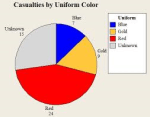
Barsalou’s findings were greatly informed by a bit of information missing from most Star Trek drinking games: the exact crew breakdown by color of the Enterprise NC 1701. While redshirt deaths make up the largest percentage of crewperson deaths in the Original Series (42%), redshirted crewmen also make up the majority of the crew of the Enterprise.

In fact, by percentage of total population of crewmen wearing their respective colors, the blue science and medical officers have it safest, only losing 5.1% of their population. Redshirts have it the next best, with an even 10%, and it’s the yellow shirts of command and helm crew who top out at losing 13.4% of their population over the course of the series. Barsalou can break it down even further: only a portion of red shirted crewmen are actually security personell, the specific population of crewmembers who suffered the worst casualties at 20%. But Barsalou takes it a step further:

Using what is known about Enterprise crew and casualty figures, suppose an Enterprise crew member has been killed. Discarding the 15 unknown casualties, redshirts consist of 60.0% of all fatalities where the uniform color is known; blue and gold uniforms are the remaining 40.0% of casualties. Redshirts are only 52.0% of the entire crew, but 60.0% of casualties, so what is the probability that the latest casualty was wearing a redshirt? The Enterprise often visits Starbases and takes on new crew members, so we assume sampling with replacement.

Then he does a bunch of math. His conclusions? If you hear about a crewperson dying on the Enterprise, there is a 64.5% chance that they were wearing a red shirt. But there is also a 61.9% chance that they were a member of the security department. All those other redshirts? They’ve only got an 8.6% casualty rate, which puts them ahead of every yellow shirted crewperson on the ship. So mommas, don’t let your kids grow up to be security personnel. But if they want to work in operations or engineering, you can probably relax.


Leave a comment

Filed under Humor and Observations

Photorealistic Pencil Drawings

Pencil art to amaze you…You can click on the first then arrow through them all to see full-sized, as with all my galleries I post.  I just don’t know how people can be so talented…

1 Comment

Filed under Humor and Observations, Uncategorized

Cute Dogs for Your Monday Blues

Cute dogs to cheer up the beginning of your work week…

1 Comment

Filed under Animals, Humor and Observations

10 Most Beautiful Villages in Europe

Bibury-England

From the Alps to the Mediterranean, these frozen-in-time European villages will make you appreciate the beauty of taking it slow. Reaching some of these European beauties requires extra effort, yet the rewards are dazzling. Your eyes will thank you.

Hallstatt, Austria

The storybook town of Hallstatt in central Austria enjoys a gorgeous setting on the bank of the Hallstätter See, between the pristine lake and a lush mountain that rises dramatically from the water’s edge. A history of salt mining dating back thousands of years has translated into enduring prosperity for the town, which is most evident in the beautiful square ringed with ivy-covered buildings.

Hallstatt-AustriaImage Source

Manarola, Italy

Manarola is a small town, a frazione of the comune (municipality) of Riomaggiore, in the province of La Spezia, Liguria, northern Italy. It is the second smallest of the famous Cinque Terre towns frequented by tourists.

tellaro-italyImage Source

Bibury, England

The hilly Cotswold region is a designated “Area of Outstanding Natural Beauty” in southwestern England, and one of its loveliest villages is Bibury, where verdant meadows abut ancient stone cottages with steep pitched roofs. The River Coln, which bisects the village, teems with trout, but the most scenic area is Arlington Row, a lane of sepia-hued cottages built in the 17th century to house weavers from the nearby Arlington Mill.

Bibury-EnglandImage Source

Colmar, France

French and German influences commingle in this well-preserved Alsatian village, where local bakeries sell both croissants and kugelhopf, and restaurants specialize in foie gras and sauerkraut (or choucroute). A range of architectural styles, from German Gothic to French Neo-Baroque, can be spotted in the old town, which was spared destruction during World War II—thanks in part to the historical beauty of its cobblestoned lanes, quiet canals, and half-timbered houses.

Colmar-franceImage Source

Reine, Norway

North of the Arctic Circle, Reine is a pretty fishing village in the Lofoten archipelago, an area of starkly beautiful Nordic wilderness, where sapphire bays punctuate fjords and mountains. Many of the bright red fishermen’s cabins (called rorbuer) have been converted into comfortable cottages for visitors that offer direct access to the Norwegian Sea. Settle in for a front-row view of the night sky and its mesmerizing entertainment, from summer’s midnight sun to winter’s northern lights.

Reine-NorwayImage Source

Pučiśća, Croatia

The buses and cruises that stop along Croatia’s sunny Dalmatian coast unleash tourists eager to experience the charms of Dubrovnik and the ancient island village of Hvar. Fewer visitors find their way to Pučiśća on the island of Brač. The reward is a seaside village with outsize appeal: white-stone villas with terracotta roofs, narrow cobblestoned alleys, and a stone-paved square. Bask in its relative solitude and the many prime spots for swimming in the turquoise Adriatic Sea.

Fotoreportaza sa otoka Braca 200713Image Source

Telč, Czech Republic

Residents of Telč, a small town in south Moravia, were once quite competitive about the beauty of their homes, as is evident today on the elongated main square, where one building is lovelier than the next. The Baroque- and Renaissance-style façades, featuring high gables painted in pale pastels, now support small shops and cafés. A grand Renaissance-era château and large fish-filled ponds surround the square.

Telč-Czech RepublicImage Source

Cong, Ireland

Encircled by streams, the picturesque village of Cong straddles the border between County Mayo and Galway—a region of lakes and vibrantly green meadows dotted with grazing sheep. Cong counts numerous stone bridges, the ruins of a medieval abbey, the occasional thatched-roof cottage, and Ashford Castle, a grand Victorian estate that has been converted into a romantic luxury hotel.

Cong-IrelandImage Source

Gruyères, Switzerland

Gruyères is famous for its namesake cheese, whose mild, nutty flavor melts so well in fondue. But few are familiar with the town itself, a medieval hamlet in the upper valley of the Saane River in western Switzerland. A wide, stone-paved street leads up to the magnificent 13th-century Gruyères Castle, with its imposing fortifications and expansive views of the surrounding Alpine foothills.

Gruyères-switzerlandImage Source

Bled, Slovenia

This small Alpine town in northwestern Slovenia rings the shore of Lake Bled, whose glacial blue waters surround a tiny island and its small Baroque church. After a two-hour stroll around the lake, hike to the medieval hilltop castle for panoramic views or recharge with a slice of the local specialty: kremšnita, a sugar-topped pastry filled with cream and custard that has been served for decades at the Hotel Park.

bled-sloveniaImage Source

2 Comments

Filed under Humor and Observations

Federal double standard on endangered species laws?

The government fined marine biologist Nancy Black $12,000 and sentenced her to three years probation for feeding a whale in Monterey Bay.

Just last month, US Fish and Wildlife cited 26-year- old tree trimmer Ernesto Pulido for violating the 1918 Migratory Bird Treaty Act for disturbing a nest of herons. Pulido was hired by the U.S. Postal Service to rid their parking lot in Oakland, Calif. of the birds and the droppings they left behind.

“It’s a violation of federal law,” said conservationist Lisa Owens Viani. “Nesting birds (herons) are protected under federal law.”

Viani arrived at the scene May 3 to find several adult herons circling the trees and five baby herons hiding under a postal truck. She took them to a wildlife rehabilitation center for blood work, fluids and feeding.

Pulido, who grew up in rural Mexico, visited the birds and voluntarily paid for their rehabilitation costs. Nevertheless, wildlife officials threatened to prosecute and fine him. On Thursday they relented, dropping the charges.

Avid New York City birdwatcher Lincoln Karim’s experience was even worse. Karim knows the law: To touch a protected bird– even a dead one– you need a permit. But Karim found a dead red-tailed hawk in Central Park on a Sunday. He called animal control to pick up the carcass. When no one responded, he put the bird in a plastic bag, took it home and kept it in the refrigerator so it would not get eaten by predators.

“If I left it on that lawn, it was going to be picked up and taken up by a raccoon or a dog or something,” he said.

Suspecting the bird had been poisoned, Karim turned it in Monday morning for an autopsy.

“When I handed it over, they arrested me,” he said. “It’s not nice getting handcuffed — especially when you know deep inside you’re not a criminal.”

Karim was charged with illegal possession of a raptor. Though his charges were eventually dismissed, marine biologist  Black wasn’t so lucky. The U.S. Attorney’s Office, on behalf of the Marine Mammal Protection Act, gave Black three years probation and fined her $12,000 for feeding a whale in Monterey Bay.

All three violated federal wildlife laws. Yet contrast their treatment to that of the wind industry.

Under a new Obama administration policy, wind farm operators are getting 30-year permits to kill protected species.

The new renewable energy policy gives wind farm operators 30-year permits – up from the current 5 years – to kill a specific number of protected species without threat of prosecution.

“What they are doing is ignoring the law,” said Bob Johns of the American Bird Conservancy. “The oil and gas industry for example, they have to abide by these laws. They’re not killing bald and golden eagles.  And if they are, they’re going to be prosecuted for it.”

The wind industry’s lethal impact on birds and bats is well documented. An estimated 1.4 million are killed each year by wind farms.

Why? One reason is that their blades move deceptively fast, up to 180 miles an hour. Second, raptors especially like to follow the currents in windy areas looking for field mice and rabbits below. Wind farms typically locate in the same areas and while many operators say they are doing their best to minimize bird fatalities, critics say the administration is practicing a double standard – prosecuting small cases while giving green energy a free pass.

“Now they’ve got the 30-year eagle permit get-out-of-jail-free card,” said Johns. “Nobody else is getting that. Nobody else is allowed to go out and kill eagles like this and get away with it. In California alone, wind farms out there are estimated to have killed over 3,000 golden eagles. And there hasn’t been a single prosecution out there for that.”

The wind industry says it needs the permits to obtain financing and avoid prosecution. They claim some fatalities are inevitable, but hope to mitigate the damage through location and design. In addition, if the world ever hopes to get off fossil fuels, they say wind is an important, clean alternative.

Bird supporters accept their logic, but worry about the sustainability of certain threatened and endangered species.

“President Obama’s climate plan would initiate an open-ended avian holocaust the likes we have never seen before,” wrote James Taylor, managing editor of Environment and Climate News.

He worries that a 25-fold increase in wind power, as called for by wind advocates, will decimate bird populations. Currently, the wind accounts for roughly 3 percent of the nation’s energy output from 500 wind farms operating 35,000 turbines. President Obama wants to move that to 20 percent  by 2030.

Raptors and bats, which have declined dramatically in some areas, have drawn the most attention. However, the Bureau of Land Management recently approved a draft environmental assessment for a 1,100-acre wind facility in close proximity to the condor range in southern California.

Although BLM hopes to reduce speed limits in the area to reduce road kill and monitor grazing to reduce livestock carcasses, others worry.

Rescued from the brink of extinction, there are only 450 California condors left in the world, many in the Tehachapi mountains where the Tylerhorse wind project is to be located. Condors are large birds and slow to maneuver.

“We’re not talking about pigeons or starlings here,” said Johns. “We have the California condor and the bald eagle. Both of those birds, we’ve spent tens and tens — maybe hundreds of millions of dollars to bring back.  And now we’re putting wind turbines right in habitats that they frequent.  We think it will be just a matter of time (before one dies).”

2 Comments

Filed under Animals, Humor and Observations

Government…sigh…

California couple faces fine for brown lawn after complying with water-saving rules

  • Droughtcouple.jpg

    July 17: Michael Korte and his wife Laura Whitney, pose outside their home lawn in Glendora, Calif. The Southern California couple who scaled back watering due to drought received a letter from the city of Glendora warning that they could face fines if they don’t get their brown lawn green again.AP

  • Californiadrought.jpg

    July 17: Michael Korte walks on his home brown lawn in Glendora, Calif.AP

  • Californiadrought2.jpg

    July 17: Laura Whitney points to a letter from the city of Glendora at her home in Glendora, Calif. She and her husband are told if they don’t revive the lawn they could be hit with up to $500 in fines and possible criminal action.AP

Laura Whitney and her husband, Michael Korte, don’t know whether they’re being good citizens during a drought or scofflaws.

On the same day the state approved mandatory outdoor watering restrictions with the threat of $500 fines, the Southern California couple received a letter from their city threatening a $500 penalty for not watering their brown lawn.

It’s brown because of their conservation, which, besides a twice-a-week lawn watering regimen, includes shorter showers and larger loads of laundry.

They’re encouraged by the state’s new drought-busting, public service slogan: Brown is the new green.

The city of Glendora sees it differently.

“Despite the water conservation efforts, we wish to remind you that limited watering is still required to keep landscaping looking healthy and green,” says the letter, which gives Korte and Whitney 60 days to restore their lawn.

They’re among residents caught in the middle of conflicting government messages as the need for conservation clashes with the need to preserve attractive neighborhoods.

“My friends in Los Angeles got these letters warning they could be fined if they water, and I got a letter warning that I could be fined for not watering,” Whitney said. “I felt like I was in an alternate universe.”

Despite the drought, Californians have increased their water use by 1 percent in May compared with previous years, according to a state survey of water providers. To combat perceived complacency, the state water board voted this week to require water agencies to adopt emergency drought plans and authorized fines of up to $500 a day for water wasters.

The board’s chairwoman, Felicia Marcus, said “a brown lawn should be a badge of honor because it shows you care about your community.” But several homeowners are reporting that a dried-up lawn instead attracts the wrath of their community.

Homeowners associations can’t punish residents for scaling back on landscaping under an executive order signed by Gov. Jerry Brown in April and a bill awaiting his signature. While both measures are silent on fines imposed by local governments, the governor’s office condemned moves that punish drought-conscious Californians.

“These efforts to conserve should not be undermined by the short-sighted actions of a few local jurisdictions, who chose to ignore the statewide crisis we face, the farmers and farmworkers losing their livelihoods, the communities facing drinking water shortages and the state’s shrinking reservoirs,” said Amy Norris, a spokeswoman for the California Environmental Protection Agency, in a written statement.

Local officials say conserving water and maintaining healthy landscaping are not mutually exclusive goals. They caution that even in times of water shortages, residents shouldn’t have free rein to drive down property values, and they can use drought-resistant landscaping or turf removal programs to meet local standards.

“During a drought or non-drought, residents have the right to maintain their landscaping the way they want to, so long as it’s aesthetically pleasing and it’s not blighted,” said Al Baker, president of the California Association of Code Enforcement Officers.

Anaheim resident Sandra Tran, 47, said she started installing drought-resistant landscaping after receiving violation notices from Orange County Public Works. She spent more than $600 on the changes as the agency mandated she water and maintain her yard in “a healthy green condition.”

Yet as Tran drives home from work, she sees signs flashing on the freeway urging her to conserve water.

“It’s almost crazy because one agency is telling you one thing and another is forcing you to do the opposite,” she said.

Democratic Assemblywoman Cheryl Brown introduced a bill that would have prohibited local governments from imposing fines, but she dropped AB1636 after cities in her district promised not to penalize homeowners for brown lawns during a drought emergency.

Brown was shocked when she heard the practice continued elsewhere in the state, and said she would consider reviving her bill in 2015.

“It seems to me those cities aren’t using common sense,” Brown said. “It’s too bad you need a law.”

Leave a comment

Filed under Humor and Observations

Cosplay Pictures for Your Saturday

Cosplay pictures for your enjoyment!

Leave a comment

Filed under Humor and Observations

1857: The Victoria Inflated Skirt

Leave a comment

Filed under Humor and Observations