Tag Archives: Dr. Who

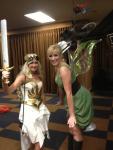
Cosplay Pictures for Your Saturday

Cosplay pictures for your weekend enjoyment!

Leave a comment

Filed under Humor and Observations

Day 2 at Phoenix Comic Con…

Friday at Phoenix Comic Con was a blast, lots of fun, but my stamina meter is dropping… I need one of those big health bottles or stamina boosts you get in video games.  Shout outs to all the old friends, new friends and those awesome folks who buy my books!

Leave a comment

Filed under Humor and Observations

Cosplay Pictures for Your Saturday

Fun cosplay pictures for your Saturday.  (I get these pictures primarily off my own Facebook account and from pictures I take at events at which I am a vendor or guest.  However, if you see yourself or work here, please email me at eiverness@cox.net and either 1) give me your photo, model, make-up, fanpage, etc so I can post it with the pictures; or 2) ask me to take it down and I will.  I do not profit from this site and my only goal is to share cosplay I think is well done and cool.  Enjoy!


Leave a comment

Filed under Humor and Observations

More Crossovers

Crossovers, or mash-ups, are where you take one or more things, usually pop culture items, and mix them together, hopefully with comic or thought provoking results.  For more of these, type “crossover” into the search box on my home page.  Enjoy!

3 Comments

Filed under Humor and Observations

Illustrations of Disney Princesses Meeting the Doctor in the TARDIS

Crossover paintings of Disney Princesses with the TARDIS from Dr. Who by Kimber Streams, images via Karen Hallion via DeviantART Tumblr.  Enjoy!


Illustrations of Disney Princesses Meeting the Doctor in the TARDIS

By  on June 12, 2013

Disney Doctor Who

Disney princesses are visited by the Doctor in the TARDIS in these lovely illustrations by artist Karen Hallion. More Disney and Doctor Who illustrations can be found at Hallion’s DeviantART gallery, and prints are available for purchase from Hallion’s Etsy shop.

Disney Doctor Who

Disney Doctor Who

Disney Doctor Who

Disney Doctor Who

Big Bad Wolf by Karen Hallion and Matthew Parsons

Disney Doctor Who

Disney Doctor Who

images via Karen Hallion

via DeviantART Tumblr

4 Comments

Filed under Humor and Observations

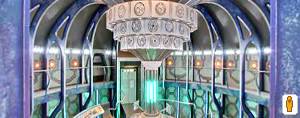
TARDIS located on Google Maps

This sited in London:

https://maps.google.com/maps?hl=en&ll=51.492159%2C-0.19092&spn=0.005291%2C0.013937&sll=51.492140%2C-0.193028&layer=c&cid=12502927659667388442&panoid=c9UMhWP_MWm9U0L48xEjYw&cbp=13%2C291.8%2C%2C0%2C18.86&gl=US&t=m&cbll=51.492132%2C-0.192862&z=17

tardis

2 Comments

Filed under Humor and Observations

More Crossovers

Crossovers or mash-ups are mixing two or more concepts, shows, movies, etc. together for humor or to make you think.  For other crossover posts, type “crossover” into the search block of my home page.  Enjoy!

1 Comment

Filed under Humor and Observations

Real Picture of the Tardis from 1939.

In 1939, Dr. Who arrives in London to save the world.  The BBC, unwitting of the significance of the public call box, use it to film a public service advertisement on vehicle safety and what to do if you are in a driving accident.  Meanwhile, the Doctor and his Companion wait inside impatiently, hoping alien forces do not win before the film crew leaves them alone.

At least, that is the way I see it…


tardis

A photograph of the making of a programme by the BBC about driving errors, taken by Saidman in 1939 for the Daily Herald.

2 Comments

Filed under Humor and Observations

Oldest Water On Earth Found

I remember an episode of Dr. Who where they found really old water at the core of a planet.  As I recall, that did not go that well…

Oldest Water on Earth Found Deep Underground

The finding suggests ancient life might be found within Earth and on Mars 

BY LIVE SCIENCE


A scientists takes a sample of water from a mine deep underground in Ontario, Canada. The water turned out to be 2.6 billion years old, the oldest known water on Earth. (B. Sherwood Lollar et al.)

A pocket of water some 2.6 billion years old – the most ancient pocket of water known by far, older even than the dawn of multicellular life – has now been discovered in a mine 2 miles below the Earth’s surface.

The finding, announced in the May 16 issue of the journal Nature, raises the tantalizing possibility that ancient life might be found deep underground not only within Earth, but insimilar oases that may exist on Mars, the scientists who studied the water said.

Geoscientist Barbara Sherwood Lollar at the University of Toronto and her colleagues have investigated deep mines across the world since the 1980s. Water can flow into fractures in rocks and become isolated deep in the crust for many years, serving as a time capsule of what their environments were like at the time they were sealed off.

In gold mines in South Africa 1.7 miles (2.8 kilometers) deep, the scientists previouslydiscovered microbes could survive in pockets of water isolated for tens of millions of years. These reservoirs were many times saltier than seawater, “and had chemistry in many ways similar to hydrothermal vents on the bottom of the ocean, full of dissolved hydrogen and other chemicals capable of supporting life,” Sherwood Lollar said. [Strangest Places Where Life Is Found on Earth]

To see what other ancient pockets of water might exist, Sherwood Lollar and her colleagues investigated copper and zinc mines near the city of Timmins in Ontario, Canada. “As the prices of copper, zinc and gold have gone up, mines now go deeper, which has helped our search for long-isolated reservoirs of water hidden underground,” Sherwood Lollar said.

‘Mind-blowing’ find

“Sometimes we went down in cages – they’re not called elevators underground – that dropped us to the levels we wanted to go,” Sherwood Lollar told OurAmazingPlanet. “Other times, we went down ramp mines, which have curling spiral roadways, so we could actually drive all the way down.”

The scientists analyzed water they found 2 miles deep. They focused on noble gases such as helium, neon, argon and xenon. Past studies analyzing bubbles of air trapped within ancient rocks found that these rare gases could occur in distinct ratios linked with certain eras of Earth’s history. As such, by analyzing the ratios of noble gases seen in this water, the researchers could deduce the age of the water.

The scientists discovered the fluids were trapped in the rocks between 1.5 billion and 2.64 billion years ago.

“It was absolutely mind-blowing,” Sherwood Lollar said. “These weren’t tens of millions of years old like we might have expected, or even hundreds of millions of years old. They were billions of years old.”

The site was formed by geological activity similar to that seen in hydrothermal vents. “We walked along what used to be ocean floor 2.7 billion years ago,” Sherwood Lollar said. “You could still see some of the same pillow lava structures now seen on the bottom of the ocean.”

Signs of life?

This ancient water poured out of the boreholes the team drilled in the mine at the rate of nearly a half-gallon per minute. It remains uncertain precisely how large this reservoir of water is.

“This is an extremely important question and one that we want to pursue in our future work,” Sherwood Lollar said. “We also want to see if there are habitable reservoirs of similar age around the world.”

Sherwood Lollar emphasized they have not yet found any signs of life in the water from Timmins. “We’re working on that right now,” she said. “It’d be fascinating to us if we did, since it’d push back the frontiers of how long life could survive in isolation.”

And the implications of such a finding would extend beyond the extremes of life on Earth.

“Finding life in this energy-rich water is especially exciting if one thinks of Mars, where there might be water of similar age and mineralogy under the surface,” Sherwood Lollar said.

If any life once arose on Mars billions of years ago as it did on Earth, “then it is likely in the subsurface,” Sherwood Lollar said. “If we find the water in Timmins can support life, maybe the same might hold true for Mars as well.”


2 Comments

Filed under Humor and Observations

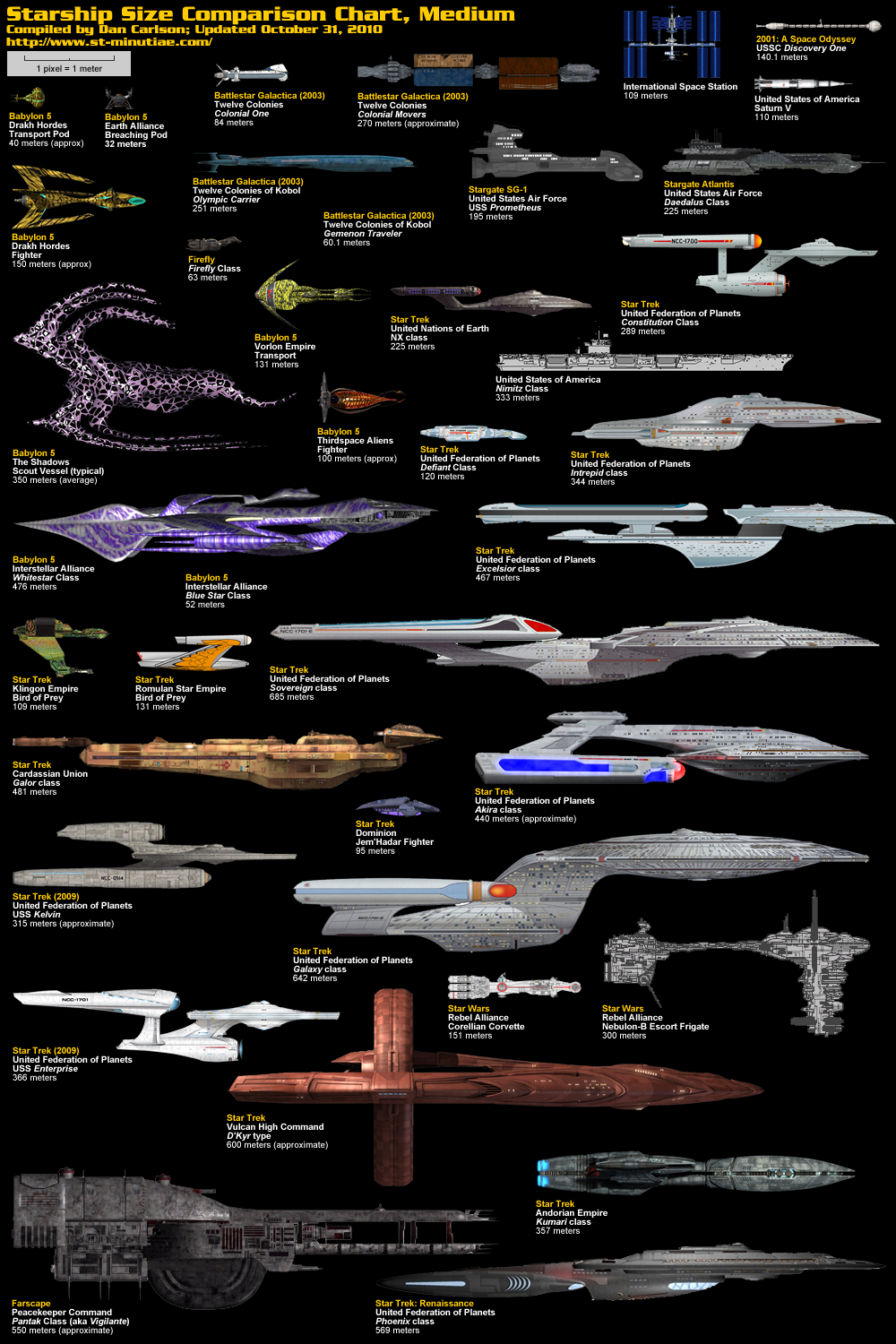
Who Has The Fastest Space Vehicle?

Star Trek, Star Wars, Firefly, Dr. Who… Who has the fastest space travel?  Who indeed…

Science-Fiction-Spaceship-Comparison-Infographic-2

If you click this link, they let you race the various ships across space to find out.

http://www.slate.com/articles/arts/map_of_the_week/2013/05/star_trek_enterprise_vs_star_wars_millennium_falcon_which_ship_is_fastest.html

From Slate.com:

Star Trek is all about interstellar travel. It’s right there in the title. “Warp 6!” or “Warp 9!” captains bark, sometimes following with a pedantic “point four” and punctuating with a “do it!” or “punch it!” or “engage!”  The numbers give the impression of a well-defined system of speed, but that’s misleading, and in this regard Star Trek is a good example of a recurring theme in popular science fiction: the obfuscation of distance and speed. When characters need to get from Point A to Point B with a speed that seems to defy existing rules, science fiction invents wormholes or slipstreams or other anomalies or allows captains to “risk” the ship by pushing it to a speed at which “she can’t take much more of this!” Or, worse, writers simply ignore the rules and leave it to fans, struggling to make sci-fi as real as possible, to explain away the inconsistencies for themselves in so many forums and wiki discussion pages.

It’s a little odd that a genre about science, the field of precision, can be so imprecise. The truth is that spaceships almost always fly at the speed of the plot. But, for those who refuse to accept that, this is a definitive guide to ship speeds, based on highly scientific computer simulations and highly unscientific speculation.

Enterprise: Nerds at Memory Alpha, the Star Trek wiki, have already arrived at a sprawling explanation that employs multiple warp scales associated with different eras of Star Trek’s fictitious history. The short version: As determined by a writers’ guide for the original series, theEnterprise of the original series, going at maximum, slightly unsafe warp, can reach Alpha Centauri in about three days. Although this conflicts with the apparently short trip the ship takes from Earth to Vulcan in Star Trek (2009), we’ll defer to the original series on this one. Later ships are faster, but even Voyager, one of the fastest Federation ships in the Star Trek universe, expected to take several decades to cross the galaxy and return home.

Millennium Falcon:  When Luke and Obi Wan first meet Han Solo in Mos Eisely, the first thing the smuggler does is brag about his ship. “You’ve never heard of the Millennium Falcon?” Han asks. That’s when A New Hope makes its infamous technical blunder. “It’s the ship that made the Kessel Run in less than 12 parsecs,” Han says. A parsec is, of course, a unit of distance, not time. Unfortunately, even the elaborate explanationof later material offers no more clues about the Millennium Falcon’s actual speed than the original flub. “She’ll make point five past light speed,” Han will later brag, but what does that mean? It certainly doesn’t mean 1.5 times the speed of light speed, because it would still take the ship several years to move between stars.

The Skywalker gang travels from Tatooine to where Alderaan is supposed to be in a matter of hours at the most, and the two planets, if this star chart is to be believed, are half a galaxy apart—though that wouldn’t jibe with a Star Wars role-playing book that suggests it would take several months to cross the galaxy. Crossover comics notwithstanding, the characters never make voyages to other galaxies, though this is apparently due to a disturbance at the edge of the galaxy. And a question I posed to the Star Wars subreddit yielded mixed answers.

Here’s my conclusion: In the films, the characters travel among Tatooine, Alderaan, Yavin, Hoth, Dagobah, Bespin, Naboo, Coruscant, Mustafar, and Geonosis, and never does it seem as if months or even weeks have passed. Every time a Star Wars character travels, it appears no more than the Star Wars equivalent of a short road trip, so we’ll conclude, assuming Han can get the hyperspace engine working, that the Millennium Falcon could reach the galactic center in mere minutes.

TARDIS: “All of time and space; everywhere and anywhere; every star that ever was,” the Eleventh Doctor says in a trailer for Series 5. In the 797 episodes of all the series, the TARDIS is seen at times instantly rematerializing in new galaxies or universes or times, usually accompanied with its signature noise. At others, it hurtles through space or chases down cars. We’re going to stick with its fastest mode of travel and assume it can travel to any place and any time, virtually instantaneously.

Planet Express Ship: The Planet Express Ship’s dark matter drive, which pulls the universe around it at 200 percent fuel efficiency, allows it to routinely make trips to other galaxies, such as the Galaxy of Terror, as well as, on one “morning off,” the edge of the universe. Its regular intergalactic flights make it easily one of the speediest ships in science fiction.

Heart of Gold: The Heart of Gold runs on the infinite improbability drive, which, according to The Hitchhiker’s Guide to the Galaxy, is “a wonderful new method of crossing vast interstellar distances in a mere nothingth of a second.” The only caveat: “you’re never sure where you’ll end up or even what species you’ll be when you get there.”


Jupiter 2: The ship of the lost Robinson family was to reach Alpha Centauri in 5.5 years, according to the aired pilot.

Serenity: Travel in the Verse is strictly interplanetary. A production manual suggested Malcolm Reynolds’ Firefly-class ship takes 16 days to travel one astronomical unit, or the distance between the Earth and the sun, although whether this is canonical is debatable. Material tied to theSerenity Role Playing Game suggests the planets of the Verse are arrayed among four very close stars that span, if this “Complete and Official Map of the Verse” is to be believed, a couple of hundred AU. Even with Wash at the helm, Kaylee in the engine room, and Malcolm spouting Chinese curses the whole way, Serenity would need a few decades to travel to another star system.

Battlestar GalacticaGalactica travels through space skipping from one location to another in instant jumps of a few light-years. The maximum range of each jump is obscure, but seems to be about 16 “Colonial light-years,” which I’m going to equate to light-years over the objections of possibly hundreds of nerds. The duration of the cool-down period is similarly elusive, but it’s “brief,” so let’s say five minutes. That’s about 4,600 light-years in a day, which means, excluding any structural damage to the ship, Galactica can travel to center of the galaxy in about six days doing one jump after another, with Cylons on their heels the whole way.

Voyager 1: The real-world space probe, launched in 1977, is traveling away from the sun at 38,600 miles per hour. That’s about 0.00005 light-years per year. If the probe were heading in the direction of Alpha Centauri, it would take several thousand years to arrive.


4 Comments

Filed under Humor and Observations