Tag Archives: Star Trek

Who Has The Fastest Space Vehicle?

Star Trek, Star Wars, Firefly, Dr. Who… Who has the fastest space travel?  Who indeed…
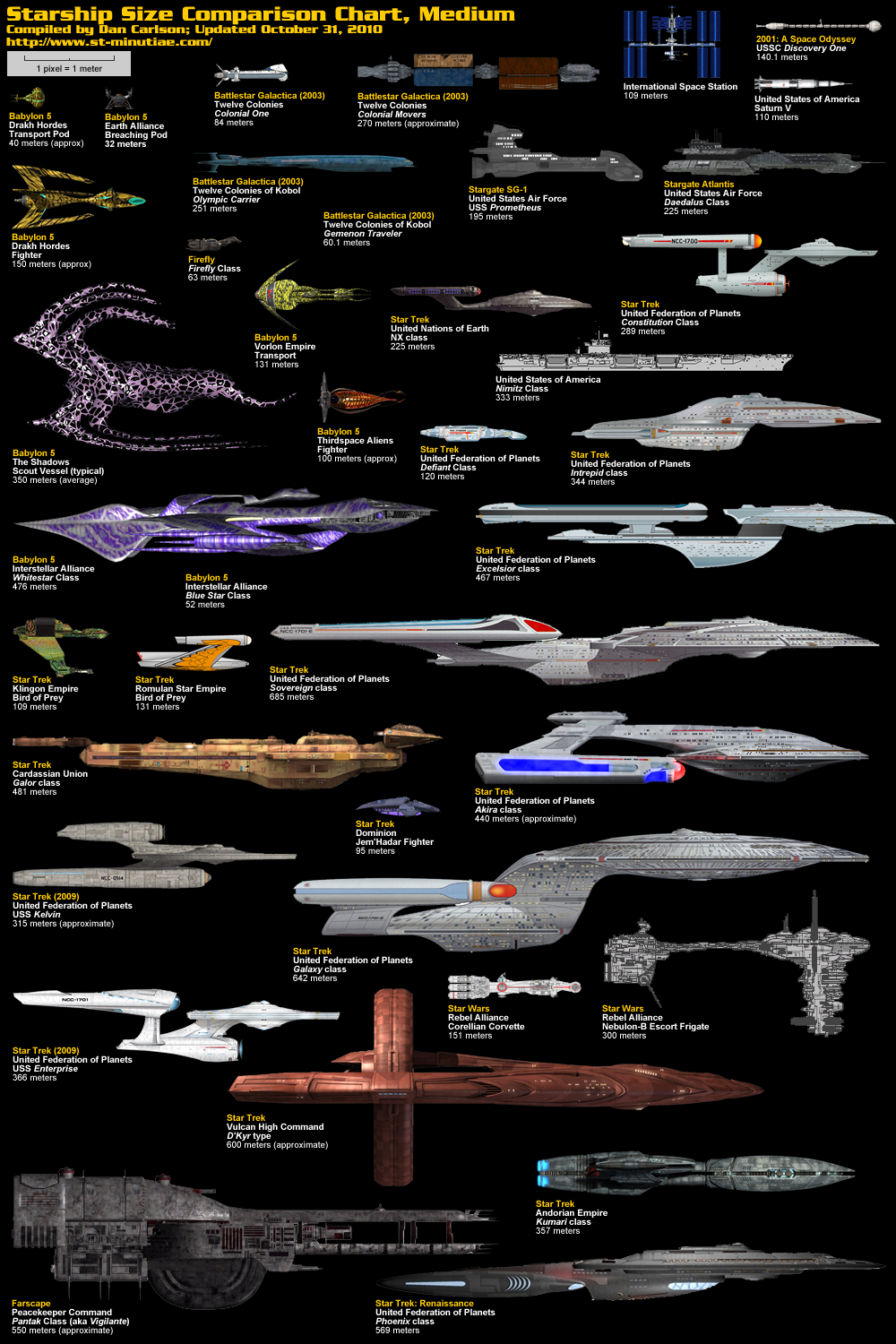
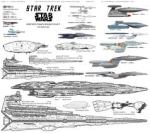
Science-Fiction-Spaceship-Comparison-Infographic-2

If you click this link, they let you race the various ships across space to find out.

http://www.slate.com/articles/arts/map_of_the_week/2013/05/star_trek_enterprise_vs_star_wars_millennium_falcon_which_ship_is_fastest.html

From Slate.com:

Star Trek is all about interstellar travel. It’s right there in the title. “Warp 6!” or “Warp 9!” captains bark, sometimes following with a pedantic “point four” and punctuating with a “do it!” or “punch it!” or “engage!”  The numbers give the impression of a well-defined system of speed, but that’s misleading, and in this regard Star Trek is a good example of a recurring theme in popular science fiction: the obfuscation of distance and speed. When characters need to get from Point A to Point B with a speed that seems to defy existing rules, science fiction invents wormholes or slipstreams or other anomalies or allows captains to “risk” the ship by pushing it to a speed at which “she can’t take much more of this!” Or, worse, writers simply ignore the rules and leave it to fans, struggling to make sci-fi as real as possible, to explain away the inconsistencies for themselves in so many forums and wiki discussion pages.

It’s a little odd that a genre about science, the field of precision, can be so imprecise. The truth is that spaceships almost always fly at the speed of the plot. But, for those who refuse to accept that, this is a definitive guide to ship speeds, based on highly scientific computer simulations and highly unscientific speculation.

Enterprise: Nerds at Memory Alpha, the Star Trek wiki, have already arrived at a sprawling explanation that employs multiple warp scales associated with different eras of Star Trek’s fictitious history. The short version: As determined by a writers’ guide for the original series, theEnterprise of the original series, going at maximum, slightly unsafe warp, can reach Alpha Centauri in about three days. Although this conflicts with the apparently short trip the ship takes from Earth to Vulcan in Star Trek (2009), we’ll defer to the original series on this one. Later ships are faster, but even Voyager, one of the fastest Federation ships in the Star Trek universe, expected to take several decades to cross the galaxy and return home.

Millennium Falcon:  When Luke and Obi Wan first meet Han Solo in Mos Eisely, the first thing the smuggler does is brag about his ship. “You’ve never heard of the Millennium Falcon?” Han asks. That’s when A New Hope makes its infamous technical blunder. “It’s the ship that made the Kessel Run in less than 12 parsecs,” Han says. A parsec is, of course, a unit of distance, not time. Unfortunately, even the elaborate explanationof later material offers no more clues about the Millennium Falcon’s actual speed than the original flub. “She’ll make point five past light speed,” Han will later brag, but what does that mean? It certainly doesn’t mean 1.5 times the speed of light speed, because it would still take the ship several years to move between stars.

The Skywalker gang travels from Tatooine to where Alderaan is supposed to be in a matter of hours at the most, and the two planets, if this star chart is to be believed, are half a galaxy apart—though that wouldn’t jibe with a Star Wars role-playing book that suggests it would take several months to cross the galaxy. Crossover comics notwithstanding, the characters never make voyages to other galaxies, though this is apparently due to a disturbance at the edge of the galaxy. And a question I posed to the Star Wars subreddit yielded mixed answers.

Here’s my conclusion: In the films, the characters travel among Tatooine, Alderaan, Yavin, Hoth, Dagobah, Bespin, Naboo, Coruscant, Mustafar, and Geonosis, and never does it seem as if months or even weeks have passed. Every time a Star Wars character travels, it appears no more than the Star Wars equivalent of a short road trip, so we’ll conclude, assuming Han can get the hyperspace engine working, that the Millennium Falcon could reach the galactic center in mere minutes.

TARDIS: “All of time and space; everywhere and anywhere; every star that ever was,” the Eleventh Doctor says in a trailer for Series 5. In the 797 episodes of all the series, the TARDIS is seen at times instantly rematerializing in new galaxies or universes or times, usually accompanied with its signature noise. At others, it hurtles through space or chases down cars. We’re going to stick with its fastest mode of travel and assume it can travel to any place and any time, virtually instantaneously.

Planet Express Ship: The Planet Express Ship’s dark matter drive, which pulls the universe around it at 200 percent fuel efficiency, allows it to routinely make trips to other galaxies, such as the Galaxy of Terror, as well as, on one “morning off,” the edge of the universe. Its regular intergalactic flights make it easily one of the speediest ships in science fiction.

Heart of Gold: The Heart of Gold runs on the infinite improbability drive, which, according to The Hitchhiker’s Guide to the Galaxy, is “a wonderful new method of crossing vast interstellar distances in a mere nothingth of a second.” The only caveat: “you’re never sure where you’ll end up or even what species you’ll be when you get there.”

Jupiter 2: The ship of the lost Robinson family was to reach Alpha Centauri in 5.5 years, according to the aired pilot.

Serenity: Travel in the Verse is strictly interplanetary. A production manual suggested Malcolm Reynolds’ Firefly-class ship takes 16 days to travel one astronomical unit, or the distance between the Earth and the sun, although whether this is canonical is debatable. Material tied to theSerenity Role Playing Game suggests the planets of the Verse are arrayed among four very close stars that span, if this “Complete and Official Map of the Verse” is to be believed, a couple of hundred AU. Even with Wash at the helm, Kaylee in the engine room, and Malcolm spouting Chinese curses the whole way, Serenity would need a few decades to travel to another star system.

Battlestar GalacticaGalactica travels through space skipping from one location to another in instant jumps of a few light-years. The maximum range of each jump is obscure, but seems to be about 16 “Colonial light-years,” which I’m going to equate to light-years over the objections of possibly hundreds of nerds. The duration of the cool-down period is similarly elusive, but it’s “brief,” so let’s say five minutes. That’s about 4,600 light-years in a day, which means, excluding any structural damage to the ship, Galactica can travel to center of the galaxy in about six days doing one jump after another, with Cylons on their heels the whole way.

Voyager 1: The real-world space probe, launched in 1977, is traveling away from the sun at 38,600 miles per hour. That’s about 0.00005 light-years per year. If the probe were heading in the direction of Alpha Centauri, it would take several thousand years to arrive.


4 Comments

Filed under Humor and Observations

Faster than light drives a reality?

Warp speed, Scotty: Faster than light drives a reality?

By Jillian Scharr

Published May 14, 2013

TechNewsDaily

  • The 100 Year Spaceship

    NASA appears to be debating a way to permanently colonize another planet, boldly going where no one has ever gone — and where no one could come back, some fear. (Paramount)

In the “Star Trek” TV shows and films, the U.S.S. Enterprise’s warp engine allows the ship to move faster than light, an ability that is, as Spock would say, “highly illogical.”

However, there’s a loophole in Einstein’s general theory of relativity that could allow a ship to traverse vast distances in less time than it would take light. The trick? It’s not the starship that’s moving — it’s the space around it.

In fact, scientists at NASA are right now working on the first practical field test toward proving the possibility of warp drives and faster-than-light travel. Maybe the warp drive on “Star Trek” is possible after all. [See also: Warp Drive: Can It Be Done? (Video)]

‘Nature can do it. So the salient question is, can we?’

– Physicist Harold ‘Sonny’ White, with NASA’s Johnson Space Center 

According to Einstein’s theory, an object with mass cannot go as fast or faster than the speed of light. The original “Star Trek” series ignored this “universal speed limit” in favor of a ship that could zip around the galaxy in a matter of days instead of decades. They tried to explain the ship’s faster-than-light capabilities by powering the warp engine with a “matter-antimatter” engine. Antimatter was a popular field of study in the 1960s, when creator Gene Roddenberry was first writing the series. When matter and antimatter collide, their mass is converted to kinetic energy in keeping with Einstein’s mass-energy equivalence formula, E=mc2.

In other words, matter-antimatter collision is a potentially powerful source of energy and fuel, but even that wouldn’t be enough to propel a starship to faster-than-light speeds.

Nevertheless, it’s thanks to “Star Trek” that the word “warp” is now practically synonymous with faster-than-light travel.

Is warp drive possible?
Decades after the original “Star Trek” show had gone off the air, pioneering physicist and avowed Trek fan Miguel Alcubierre argued that maybe a warp drive is possible after all. It just wouldn’t work quite the way “Star Trek” thought it did.

Things with mass can’t move faster than the speed of light. But what if, instead of the ship moving through space, the space was moving around the ship?

Space doesn’t have mass. And we know that it’s flexible: space has been expanding at a measurable rate ever since the Big Bang. We know this from observing the light of distant stars — over time, the wavelength of the stars’ light as it reaches Earth is lengthened in a process called “redshifting.” According to the Doppler effect, this means that the source of the wavelength is moving further away from the observer — i.e. Earth.

So we know from observing redshifted light that the fabric of space is movable. [See also: What to Wear on a 100-Year Starship Voyage]

Alcubierre used this knowledge to exploit a loophole in the “universal speed limit.” In his theory, the ship never goes faster than the speed of light — instead, space in front of the ship is contracted while space behind it is expanded, allowing the ship to travel distances in less time than light would take. The ship itself remains in what Alcubierre termed a “warp bubble” and, within that bubble, never goes faster than the speed of light.

Since Alcubierre published his paper “The Warp Drive: Hyper-fast travel within general relativity” in 1994, many physicists and science fiction writers have played with his theory —including “Star Trek” itself. [See also: Top 10 Star Trek Technologies]

Alcubierre’s warp drive theory was retroactively incorporated into the “Star Trek” mythos by the 1990s TV series “Star Trek: The Next Generation.”

In a way, then, “Star Trek” created its own little grandfather paradox: Though ultimately its theory of faster-than-light travel was heavily flawed, the series established a vocabulary of light-speed travel that Alcubierre eventually formalized in his own warp drive theories.

The Alcubierre warp drive is still theoretical for now. “The truth is that the best ideas sound crazy at first. And then there comes a time when we can’t imagine a world without them.” That’s a statement from the 100 Year Starship organization, a think tank devoted to making Earth what “Star Trek” would call a “warp-capable civilization” within a century.

The first step toward a functional warp drive is to prove that a “warp bubble” is even possible, and that it can be artificially created.

That’s exactly what physicist Harold “Sonny” White and a team of researchers at NASA’s Johnson Space Center in Texas are doing right now.

NASA’s warp drive project
According to Alcubierre’s theory, one could create a warp bubble by applying negative energy, or energy created in a vacuum. This process relies on the Casimir effect, which states that a vacuum is not actually a void; instead, a vacuum is actually full of fluctuating electromagnetic waves. Distorting these waves creates negative energy, which possibly distorts space-time, creating a warp bubble.

To see if space-time distortion has occurred in a lab experiment, the researchers shine two highly targeted lasers: one through the site of the vacuum and one through regular space. The researchers will then compare the two beams, and if the wavelength of the one going through the vacuum is lengthened, i.e. redshifted, in any way, they’ll know that it passed through a warp bubble. [See also: How Video Games Help Fuel Space Exploration]

White and his team have been at work for a few months now, but they have yet to get a satisfactory reading. The problem is that the field of negative energy is so small, the laser so precise, that even the smallest seismic motion of the earth can throw off the results.

When we talked to White, he was in the process of moving the test equipment to a building on the Johnson Space Center campus that was originally built for the Apollo space program. “The lab is seismically isolated, so the whole floor can be floated,” White told TechNewsDaily. “But the system hadn’t been [activated] for a while so part of the process was, we had the system inspected and tested.”

White is now working on recalibrating the laser for the new location. He wouldn’t speculate on when his team could expect conclusive data, nor how long until fully actuated warp travel might be possible, but he remains convinced that it’s only a matter of time.

“The bottom line is, nature can do it,” said White. “So the salient question is, ‘can we?'”

Read more: http://www.foxnews.com/tech/2013/05/14/warp-speed-scotty-star-trek-ftl-drive-may-actually-work/?intcmp=features#ixzz2TJpE9oFk

1 Comment

Filed under Humor and Observations

More Crossovers/Mash-ups

Crossovers or mash-ups put one or more things together, hopefully in a funny or thought provoking way.  This is a recurring post here.  For earlier posts like this, type “crossover” into the search block on the home page.  Enjoy!

Leave a comment

Filed under Humor and Observations

More Crossovers

Crossovers, or mash-ups, put two or more disparate ideas, shows or elements together, hopefully with comic effect.  For earlier posts like this, type “Crossover” into the search box on my home page.  Enjoy!

Leave a comment

Filed under Humor and Observations

Things You Would Like to Have

An occasional post of strange or unusual things you would kind of like to have, but don’t really need.  Enjoy!

1 Comment

Filed under Humor and Observations

Star Trek’s Tractor Beam Created

Star Trek ‘tractor beam’ created by scientists

Published January 27, 2013

SkyNews

  • Tractor Beam

    In “Stak Trek,” Federation starships relied upon tractor beams to hold and tow other vessels. Scientists may not be there yet, but they have managed to tow a small particle using light beams.

A team of scientists has created a real-life miniature “tractor beam” – as featured in the Star Trek series – in a development which may lead to more efficient medical testing.The microscopic beam – created by scientists from Scotland and the Czech Republic – allows a source of light to attract objects.

Light manipulation techniques have existed since the 1970s, but researchers say the experiment is the first instance of a beam being used to draw objects towards light.

Researchers from the University of St Andrews and the Institute of Scientific Instruments (ISI) in the Czech Republic say development of the beam may be an aid to medical testing, such as in the examination of blood samples.

A tractor beam was used to pull in spaceships and other large objects in the popular US science fiction show.

Normally, when matter and light interact, a solid object is pushed by the light and carried away in a stream of photons.

However, in recent years, researchers have realised that there is a space of parameters when this force reverses.

The scientists have now demonstrated the first experimental realisation of the concept.

Professor Pavel Zemanek of the ISI said: “The whole team have spent a number of years investigating various configurations of particles delivery by light.

“I am proud our results were recognised in this very competitive environment and I am looking forward to new experiments and applications. It is a very exciting time.”

Dr Oto Brzobohaty, also of the ISI, said: “These methods are opening new opportunities for fundamental phonics as well as applications for life-sciences.”

Read more: http://www.foxnews.com/science/2013/01/26/star-trek-tractor-beam-created-by-scientists/#ixzz2O3mTPFXo

2 Comments

Filed under Humor and Observations

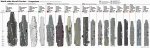
Comparing Size…

Does size matter?  Want to compare length and girth?  Check out this gallery to see how various things size up… 🙂


3 Comments

Filed under Animals, Humor and Observations, Uncategorized

‘Star Trek’ Marriage Proposal

reposted:

‘Star Trek’ Proposal Photo Captures Everyone Off Guard, Including Cast (PHOTOS)

Posted: 11/07/2012 2:32 pm EST Updated: 11/08/2012 2:06 am EST

star trek wedding proposal photo
An unexpected marriage proposal in front of the cast of “Star Trek: The Next Generation” made for a memory that is truly out of this world.

A “Trek” fan popped the question during a cast photo op Sunday at Austin Wizard World Con, according to actor Wil Wheaton, who played Wesley Crusher on the popular ’90s sci-fi show — and was seated to the immediate left of the bride-to-be during the proposal (she said “yes”).

The photo rose to the top of Reddit’s front page on Nov. 7. Wheaton, an avid user of the social news site, wrote in the comments:

About 30 minutes or so into this particular session, these two people came in. The girl went to stand between Patrick [Stewart] and [Jonathan] Frakes, and the guy directed her to stand in the front, instead. All of us tried to figure out what was going on… and the guy said, ‘I really love ‘Star Trek,’ but I love (her name) even more.’ He got down on one knee, and proposed to her.

Cast member Marina Sirtis had apparently met the couple earlier in the day and given them a hard time for not yet being married. According to Wheaton, Sirtis was a little embarrassed by the proposal.

“I guess when the cast of ‘Star Trek’ tells you to engage, you make it so,” observed one Reddit user, co-opting catch phrases from the show.

An awkward shot of the “Star Trek” proposal from a slightly different angle also circulated on the Internet, but Wheaton remarked that the unflattering photo did not do the moment justice.

“Once we knew what was happening, it was awesome. I’m incredibly happy for these people, and I love that I got to be part of what is hopefully a moment they’ll celebrate and remember for the rest of their lives,” Wheaton wrote.

Leave a comment

Filed under Humor and Observations

Death By Transporter

In the latest issue of ConNotations, in my regular science column, discusses death by transporter.  A must read for you trekkers or science geeks who THINK you know how it works…  You can find it on Page 9 of the link below.  I also have a book review on page 18.  Enjoy!

http://content.yudu.com/Library/A1yz7u/ConNotationsOctoberN/resources/index.htm?referrerUrl=http%3A%2F%2Fwww.casfs.org%2FConNotations%2FVol22Iss05.php


1 Comment

Filed under Humor and Observations, Writing

Funny Crossovers

A crossover is when one story, character, book, movie, or concept is mixed with another.  Sometimes comic books will do crossovers, sometimes TV shows on the same network do the same to boost ratings or do a tie in with another show.  Other times, people do it just to be funny.  Examples:

Star Wars meets Star Trek. Spock much more impressive that Luke.

Again, Spock more impressive than Luke.

Yoda tries to crossover from Spock, “Logical, it is not.”

Indiana Jones meets Star Wars. Who would not pay to see Chewy pull the arms off some Nazis?

Anime Angels

Mordor, the Unhappiest Place on Earth. You simply cannot just walk in.

HP Lovecraft’s Cthulhu meets the Presidential Election. Why Choose the Lessor of Two Evils When you can choose The Greatest Evil?

Blade, kills Vampires better than Abe Lincoln.

But Abe Lincoln still fun to watch.

Cheers!

2 Comments

Filed under Humor and Observations