It may have been Charles Fort, in one of his more memorable passages, who described the strange discovery best:
London Times, July 20, 1836:
That, early in July, 1836, some boys were searching for rabbits’ burrows in the rocky formation, near Edinburgh, known as Arthur’s Seat. In the side of a cliff, they came upon some thin sheets of slate, which they pulled out.
Little cave.
Seventeen tiny coffins.
Three or four inches long.
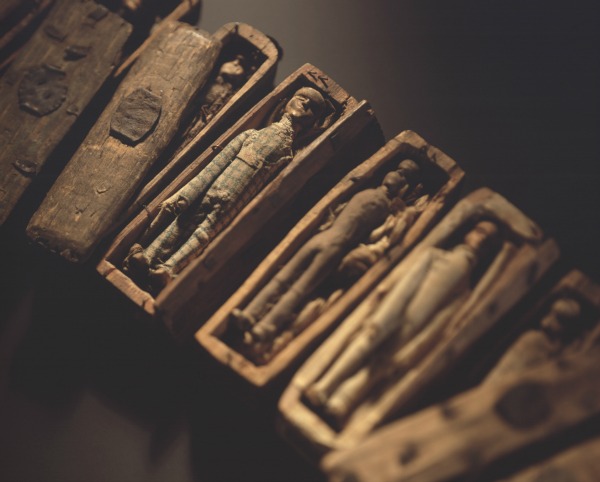
In the coffins were miniature wooden figures. They were dressed differently in both style and material. There were two tiers of eight coffins each, and a third one begun, with one coffin.
The extraordinary datum, which has especially made mystery here:
That the coffins had been deposited singly, in the little cave, and at intervals of many years. In the first tier, the coffins were quite decayed, and the wrappings had moldered away. In the second tier, the effects of age had not advanced so far. And the top coffin was quite recent looking.

Fort’s short account is accurate, so far as it goes—and for more than a century not much more was known about the origin or purpose of the strange miniature coffins. Fewer than half of them survived; the Scotsman, in the first known published account, explained that “a number were destroyed by the boys pelting them at each other as unmeaning and contemptible trifles.” Those that were brought down from the hillside eventually found their way into the collection of Robert Frazier, a South Andrews Street jeweler, who put them on display in his private museum. When, after Frazier’s retirement in 1845, the collection was auctioned off, this lot, described in the sale catalogue as “the celebrated Lilliputian coffins found on Arthur’s Seat, 1836,” sold for just over £4. The coffins thus passed into unknown private hands, and remained there until 1901, when a set of eight, together with their contents, were donated to the National Museum of Scotland by their then-owner, Christina Couper of Dumfriesshire.
Circumstantial evidence strongly suggests that these coffins were the same group as the one Frazier obtained in 1836, but few more details are available. The first newspaper reports appeared some three weeks after the initial discovery, and none named any of the boys. One much later account, which is unreferenced and which appeared in the Edinburgh Evening News as late as 1956—but which is so detailed that it may have been based on some otherwise unknown contemporary source—adds that the find was made on June 25, 1836, and notes that the niche, which was “about a foot in height and about 18 inches wide,” was opened up with trowels: tools it seems reasonable to suppose a group of boys out rabbiting might have had about their persons.

Another intriguing detail in the same account states that the surviving coffins were retrieved the “next day” by the boys’ schoolmaster, one Mr. Ferguson, who was a member of a local archaeological society. The coffins were still unopened at this point, the reporter Robert Chapman added, but “Mr. Ferguson took them home in a bag and that evening he settled down in his kitchen and began to prise the lids up with a knife…. Mr. Ferguson took them to the next meeting of his society and his colleagues were equally amazed.” Where Chapman got this information remains unknown, but a search of the contemporary street directories shows that two schoolmasters named Ferguson were working in Edinburgh in 1836–George Ferguson as a classics master at Edinburgh Academy, and Findlay Ferguson as a teacher of English and math at Easter Duddingston.
The Chapman account at least explains how the surviving coffins found their way from the boy discoverers into the hands of the city’s learned gentlemen. In these murky circumstances, it is unsurprising that the precise spot where the find was made is only vaguely known. The Scotsman reported that the boys who unearthed the coffins had been “searching for rabbit burrows on the north-east range of Arthur’s seat” when one spotted “a small opening in the rocks, the peculiar appearance of which attracted their attention.” Another account, which appears to have circulated orally in Edinburgh at this time, and which was put in writing by a correspondent to Notes & Queries under the headline, “A Fairy’s Burial Place,” puts it a good deal more dramatically:
While I was a resident at Edinburgh, either in the year 1836 or 1837, I forget which, a curious discovery took place, which formed the subject of a nine days’ wonder, and a few newspaper paragraphs. Some children were at play at the foot of Salisbury Craigs, when one of them, more venturesome than the others, attempted to ascend the escarpment of the cliff. His foot slipped, and to save himself from a dangerous fall, he caught at a projecting piece of rock, which appeared to be attached to the other portions of the cliff. It gave way, however, beneath the pressure of his hand, and although it broke his fall, both he and it came to the bottom of the craig. Nothing daunted, the hardy boy got up, shook himself, and began the attempt a second time. When he reached the point from whence the treacherous rock had projected, he found that it had merely masked the entrance to a large hole, which had been dug into the face of the cliff.
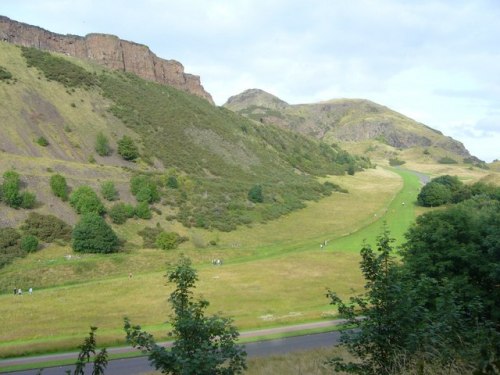
The mouth of this little cave was closed by three thin pieces of slate-stone, rudely cut at the upper ends into a conical form, and so placed as to protect the interior from the effects of the weather.The Scotsman‘s account is, I think, to be preferred here—Notes & Queries adds various other details which are known to be untrue, such as the statement that the coffins had “little handles, and all the other embellishments which the undertakers consider necessary to respectability” —but it is actually broadly in line with N&Q‘s with regard to location. Conversely, another Edinburgh paper, the Caledonian Mercury, describes the spot as lying “at the back of Arthur’s Seat”–that is, on the south side of the hill. Given the relative accessibility of the northern face, and the length of time that appears to have separated the burials from their discovery, it is perhaps marginally more likely that the exact site of the find was neither Salisbury Crags nor the north range of Arthur’s Seat, but a spot to the south, in a relatively remote location on the far side of the Seat from Edinburgh itself. This ties in rather intriguingly with the notion that Findlay Ferguson of Easter Duddingston may have been the schoolmaster associated with the find, since Duddingston lies directly beneath the southern face of Arthur’s Seat. Whatever the facts, it seems clear from the contemporary sources that the coffins were found not in a substantial “cave” on the hillside, as is sometimes supposed, but in a small gap in the rocks. The Scotsman, again, has the clearest description:
According to one later account, in a record in the so-called “Continuation Catalogue” of the Society of Antiquaries of Scotland, at least one of these slates was “rudely shaped like the headstone of a grave.” As for what the boys found when the slates had been removed, it was “an aperture about twelve inches square in which were lodged seventeen Lilliputian coffins, forming two tiers of eight each, and one on a third, just begun!” Each of the coffins, the Scotsman added,
contained a miniature figure of the human form cut out in wood, the faces in particular being pretty well executed. They were dressed from head to foot in cotton clothes, and decently laid out with a mimic representation of all the funereal trappings which usually form the last habiliments of the dead. The coffins are about three or four inches in length, regularly shaped, and cut out from a single piece of wood, with the exception of the lids, which are nailed down with wire sprigs or common brass pins. The lid and sides of each are profusely studded with ornaments, formed with small pieces of tin, and inserted in the wood with great care and regularity.
So much for the circumstances of the discovery. The greater mystery, as the Scotsman was swift to point out, was what exactly the coffins were, who had placed them in their hiding place, and when. Several potential explanations were advanced, the most popular being that the burials were part of some spellwork, or that they represented mimic burials, perhaps for sailors lost at sea. Most of these solutions, however, assumed that the newspapers of the day were correct to state that the burials had been made over a considerable period of time. According to the Edinburgh Evening Post, for instance,
in the under row the shrouds were considerably decayed and the wood rotten, while the last bore evident marks of being a very recent deposit.
This assumption is, however, hard to prove. The discovery was made not by some trained archaeologist, who made a painstaking examination before moving a single piece of wood, but by a group of boys who appear to have thoroughly mixed up the coffins by hurling them at each other, and who never gave any first-person account of their find. The best that can be said is that several of the surviving coffins display considerably more decay than the others—the most obvious sign being the rotten state (or complete absence) of the figurines’ grave clothes—but whether the decay was the product of time or simply weathering is not now possible to say. It may be that the decayed coffins were simply those that occupied the lower tier in the burial nook, and so were most exposed to water damage. If that’s the case, there is no need to assume that the burials stretched over many years.

This matters, because the only comprehensive study yet made of the “fairy coffins” strongly indicates that all postdate 1800, and that the odds favor a deposit or deposits made after about 1830—within about five years, in other words, of the discovery of the cache. The work in question was carried out by Allen Simpson, a former president of the Royal Scottish Society of Arts and currently a member of the faculty of History and Classics at Edinburgh University, and Samuel Menefee, senior associate of the Center for National Security Law at the University of Virginia, and it was published, regrettably obscurely, in the journal of the city’s local history society: The Book of the Old Edinburgh Club.
Simpson and Menefee began their work by describing the eight surviving artifacts (which can still be seen today, on display in the National Museum of Scotland). Two, they note, were originally painted pink or red; the interior of one is lined with paper, made with rag fiber and datable to the period after 1780. As for the details of the construction:
Each coffin contains an ‘occupant’ and has been hollowed from a solid piece of wood. Each also has a lid which has been held in place by pins of various sizes, driven down through the sides and ends of the coffin base. In many instances the pin shafts are still in place, though some are bent over; when the lids were prised off the coffins most of the hand-wound pin heads became detached…. Although the type of wood has not previously been commented on, it has now been identified as Scots pine. Coffin dimensions vary…those now accessible for study are 3.7 to 4.1 inches long, 0.7 to 1.2 inches wide, and 0.8 to 1.0 inches deep with their lids in place….
Judging by the longitudinal scoring on the base of the recess, a sharp knife—probably a hooked knife—has been used. The fact that the surfaces at the ends of the recess are so cleanly cut indicates that the knife has been very sharp; but the user has apparently not been a woodworker by trade because he has not had access to an edged tool such as a chisel to cut out the base of the recess, and has had difficulty in controlling the depth of the cuts (which have even penetrated the base of coffin No.5).
There are two types of external shape. Five of the coffins (Nos 1, 2, 4, 6 and 8) have been carved with square-cut corners and edges, although most have slightly bowed sides so that the coffin has a taper at each end. However, the remaining three (Nos 3, 5 and 7) have a pronounced rounding of the edges and ends of the coffin; this suggests a different manual approach…and may indicate that the coffins could have been carved by two different individuals.
As to who did the carving, Simpson and Menefee point out that “the most striking visual feature of the coffins is the use of applied pieces of tinned iron as decoration.” Analysis of this metal suggests that it is very similar to the sort of tin used in contemporary shoe buckles, and this in turn opens the possibility that the coffins were the work of shoemakers or leatherworkers, who would have had the manual skills to make the coffins but would have lacked the specialist carpentry tools needed to make a neater job of it.
The figurines found within the coffins were also studied. Each of the eight is neatly carved from close-grained white wood, and they share almost identical proportions, varying in height by no more than 5 millimeters—about a fifth of an inch. Some have arms, but several dolls have had them removed, apparently to allow the figure to fit neatly into its coffin. This suggests that the figures were not carved specifically for the purpose of burial, but have been adapted from an existing set; Simpson and Menefee—noting their “rigidly erect bearing,” indications that they originally wore hats, and their carefully carved lower bodies “formed to indicate tight knee breeches and hose, below which the feet are blackened to indicate ankle boots”—believe they are the remnants of a group of toy soldiers, and note that each is made to stand upright with the addition of a slight weight on its front, which might have been supplied by the addition of a model musket. (There would have been no need to ensure carvings intended simply as corpses would stand upright.) The features are very similar, and “it seems unlikely that the figures were ever intended to represent particular individuals.” Moreover, “the open eyes of the figures suggest that they were not carved to represent corpses.”
Based on their appearance, the authors tentatively date the group to the 1790s; no dendrochronological analysis or carbon dating, however, has been done on the collection. Several of the surviving figurines are still clad in well-preserved “grave clothes.” As Simpson and Menefee point out, “single-piece suits, made from fragments of cloth, have been moulded round the figures and sewn in place. With some figures there is evidence of adhesive under the cloth. The style of dress does not relate to period grave clothes, and if it is intended to be representational at all then it is more in keeping with everyday wear…. The fact that the arms of figure No.8 were already missing when the figure was clothed suggests that the fabric was merely intended to cover the figures decently and not to represent garments.” All the fabrics are cheap, made of plain woven cotton, though one of the figures is clad in checks and three “seem to have commercially inked patterns applied to the cloth.”
The evidence of the figurines makes dating the burials much easier. According to Naomi Tarrant, curator of European textiles at the National Museum of Scotland, the good condition of the surviving vestments suggests they were buried in the 1830s. More revealingly, one of the figures has been sewn into its grave clothes with a three-ply thread. Cotton thread replaced linen in Scotland from about 1800; “almost certainly,” Simpson and Menefee assert, “such thread would have been manufactured in the thread mills of Paisley, where tradition has it that cotton thread was not made before 1812.” Three-ply thread, according to Philip Sykas of Manchester Art Galleries–the leading expert on that topic – came into use in about 1830. Sykas believes that the mixture of one-, two- and three-ply threads found on the Arthur’s Seat figures “indicates a date in the 1830s.”
Now, none of this proves all the burials took place at so late a date as 1830; it is possible that the decayed surviving figurines represent interments that took place earlier than this, and also that the figurines sewn with one- or two-ply thread predate 1830. Nonetheless, it does seem possible to suggest that all the burials took place, at the outside, between about 1800 and 1830, and it is entirely likely that Simpson and Menefee are correct to state that all took place during the 1830s. This in turn suggests it is possible that all 17 figurines were interred at the same time, and the fact that the coffins seem to have been carved by at most two people and that the figurines apparently originally formed part of a single set implies that the burial(s) were carried out by the same person, or small group of people “over a comparatively short period.”
If this is true, write Simpson and Menefee, “the significant feature of the burial is that there were seventeen coffins,” and “it is arguable…”
that the problem with the various theories is their concentration on motivation, rather than on the event or events that caused the interments. The former will always be open to argument, but if the burials were event-driven—by, say the loss of a ship with seventeen fatalities during the period in question—the speculation would at least be built on demonstrable fact. Stated another way, what we seek is an Edinburgh-related event or events, involving seventeen deaths, which occurred close to 1830 and certainly before 1836. One obvious answer springs to mind—the West Port Murders by William Burke and William Hare in 1827 and 1828.
Simpson’s and Menefee’s solution to the mystery is certainly dramatic— so much so it seems that nobody has actually asked whether the pair searched for news of any Scottish shipwreck from the early 1830s, as they suggest it might be wise to do. (It would appear that they did not.) The West Port murders, after all, were and remain notorious: They were committed in Edinburgh by two Irish laborers, Burke and Hare, to profit by supplying corpses to Edinburgh’s medical school, where they were in great demand for dissection. The pair’s victims, mostly indigents who, they supposed, would not be missed, numbered 17, of whom one expired of natural causes while the rest were murdered. The killers’ trial, in which Hare turned King’s evidence and Burke was convicted and later hanged, was one of the sensations of the age. Crucially, in the authors’ view, the fact that all of the 17 victims were dissected, and consequently had no decent burial, may have inspired a “mimic burial” on Arthur’s Seat:
Considering beliefs such as the alleged mimic burial given to Scottish sailors lost at sea, it would not be unreasonable for some person or person, in the absence of the seventeen dissected bodies, to wish to propitiate these dead, the majority of whom were murdered in atrocious circumstances, by a form of burial to set their spirits at rest. While it is always possible that other disasters could have resulted in an identical casualty list, the West Port murders would appear to be a logical motivating force.
Since Simpson and Menefee first reported their findings in 1994, their thesis has been elaborated. The Edinburgh Evening News reported in 2005 that George Dalgliesh, principal curator of Scottish history at the National Museum of Scotland, believes “the most credible theory is that were made by someone who knew Burke and Hare,” and so had a strong motive to make amends for their crimes. Attempts to suggest that Burke himself may have manufactured and buried the pieces in an agony of contrition seem to fail on the problem that the murderers were arrested almost immediately after committing their 17th killing, leaving little or no time for any burial to be made; a DNA sample for Burke has been obtained from the murderer’s skeleton, which is preserved at Edinburgh University, but no traces of DNA could be recovered from the buried figurines.
There is, moreover, one potentially fatal objection to the theory that the Arthur’s Seat coffins are connected to the West Port murders: no fewer than 12 of Burke and Hare’s victims were female, yet the clothed bodies found in the coffins were uniformly dressed in male attire.
Without knowing more about burial customs in early 19th-century Scotland it is hard to know how worrying this objection is, but certainly it would appear no more difficult to clothe a figurine in a miniature dress than it would be to stitch on trousers. In the absence of firm evidence of any connection to the activities of Burke and Hare, I would suggest the first step in any future investigation should be to examine Scottish newspapers published between, say, 1820 and 1836, for evidence of any other disasters involving the deaths of 17 people—ideally, none of them women. Two titles, the Scotsman and the Caledonian Mercury, have now been digitized, and could be searched by a determined researcher. We await further developments.

Sources
Caledonian Mercury, August 5, 1836; Charles Fort. Complete Books. New York: Dover, 1975; Edinburgh Evening News, October 16, 1956 and December 2, 2005; Edinburgh Evening Post, August 20, 1836; Samuel Pyeatt Menefee and Allen Simpson, ‘The West Port murders and the miniature coffins from Arthur’s Seat,’ The Book of the Old Edinburgh Club, new series vol.3 (1994); Notes & Queries, 3S. III, April 4, 1863; Proceedings of the Society of Antiquaries of Scotland 36 (1901-02); The Scotsman, July 16, 1836.
Read more: http://www.smithsonianmag.com/history/edinburghs-mysterious-miniature-coffins-22371426/#tBd6Tz05MGmHkoPP.99
Give the gift of Smithsonian magazine for only $12! http://bit.ly/1cGUiGv
Follow us: @SmithsonianMag on Twitter



































































































































 Michael Bradley - Time Traveler


